
Why You Need a Sediment Pre-Filter: Protecting Your Home’s Water System
Would you spend thousands on a high-end water softener or a sleek tankless heater only to let microscopic sand and grit tear it apart from the inside? In South Jersey, our water often comes from the Kirkwood-Cohansey aquifer. This means your pipes regularly contend with fine quartz sand and silt that act like sandpaper on your plumbing. If you’ve noticed cloudy water or clogged faucet aerators, your home is already sending a warning signal. You shouldn’t have to settle for “dirty” water or frequent, expensive repairs.
It’s natural to want the best for your home. We understand that you value performance and longevity. That’s exactly why you need a sediment pre-filter as your first line of defense. Think of it as a professional bodyguard. It catches debris before it ever touches your expensive appliances. In this guide, we’ll show you how this simple, technology-driven solution ensures crystal clear water at every tap. You can finally extend the life of your equipment and enjoy the peace of mind that comes with a modern, protected home.
Key Takeaways
- Understand how a mechanical pre-filter acts as a vital barrier against physical debris before it can ever enter your home’s main water lines.
- Learn how to protect your investment by preventing abrasive sand from “sandblasting” the delicate internal seals of your faucets and high-end appliances.
- Identify the specific signs of sediment issues unique to South Jersey well water, from visible grit in your fixtures to cloudy, turbulent water.
- Discover why you need a sediment pre-filter with a customized micron rating to achieve the perfect balance of water clarity and consistent pressure.
- See why professional installation is the key to preventing leaks and ensuring your filtration system works seamlessly with your existing pressure tank.
What is a Sediment Pre-Filter and How Does it Work?
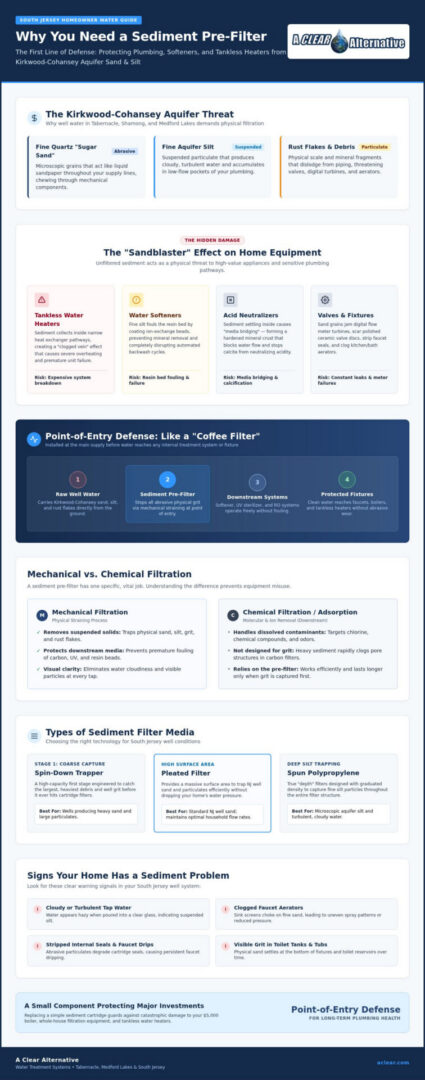
Think of your home’s plumbing as a precision-engineered system that deserves the best protection. In Tabernacle and Medford Lakes, our well water often carries fine “sugar sand,” silt, and rust flakes from the Kirkwood-Cohansey aquifer. A sediment pre-filter is a mechanical barrier designed to capture these physical particulates before they ever reach your faucets or appliances. It acts as the ultimate security guard for your water lines, ensuring that debris stays outside where it belongs.
The “pre” in the name is the key to understanding why you need a sediment pre-filter. By installing it at the point of entry, you ensure that every drop of water is scrubbed of abrasive debris before it enters your water softener, UV sterilizer, or reverse osmosis system. Visualizing the process is simple; it’s exactly like a coffee filter for your entire home. It keeps the “grounds” out so the rest of your system can perform at its peak without getting clogged by sand or organic scale. This stage relies on physical water filtration processes to ensure your water is visually clear. It removes the grit that you can see and feel, protecting the delicate internal components of your plumbing from premature wear.
The Difference Between Sediment and Chemical Filtration
Mechanical filtration is the physical removal of suspended solids from a liquid. You should distinguish this from chemical filtration. While a sediment pre-filter is excellent at stopping silt and rust, it doesn’t remove odors, chlorine, or dissolved minerals. That’s a different job for a different tool. Sediment filters rely on mechanical straining, while chemical filters use adsorption. By handling the heavy lifting of particle removal first, the pre-filter allows your downstream carbon or iron filters to last much longer and work more efficiently.
Types of Sediment Filter Media
Not all filters are created equal. You need the right technology for South Jersey’s unique conditions. Pleated filters are often the best choice for NJ well sand because they provide a massive surface area to trap particles without killing your water pressure. Spun polypropylene filters, on the other hand, are “depth” filters that excel at catching fine silt throughout their entire structure. If your well produces heavy grit, a spin-down sediment trapper can act as a high-capacity first stage to catch the largest debris before it even hits your cartridge filter. Choosing the right media ensures your water stays crystal clear without constant maintenance or unexpected drops in flow.
Protecting Your Investment: The Bodyguard for Your Appliances
Imagine a tiny, high-speed sandblaster working inside your faucets every time you wash your hands. That’s essentially what happens when fine grit from Tabernacle wells enters your plumbing. These abrasive particles strip away internal seals and cause annoying drips. Over time, this creates a “clogged vein” effect. It’s particularly dangerous for modern tankless water heaters. These units have narrow pathways that trap sediment, leading to overheating and premature failure. Sediment isn’t just an aesthetic issue. It’s a physical threat.
This is the core reason why you need a sediment pre-filter. It’s a simple financial decision. You might spend a small amount on a replacement cartridge, but that investment protects a $5,000 boiler or a sophisticated whole house water filtration system. Beyond the big appliances, the pre-filter guards the “brains” of your home water system. Modern control valves and digital meters rely on clear water to move freely. Even a few grains of sand can jam a digital turbine or scar a ceramic disc, leading to a service call you didn’t need. For a deeper look at how these components fit together, the CDC guide to home water treatment systems provides a great breakdown of point-of-entry protection.
Shielding Your Water Softener and Acid Neutralizer
Your water softener is a workhorse, but it’s vulnerable. Silt and fine sediment can foul the resin bed. This coats the beads and prevents them from effectively removing hardness minerals. It also messes with the backwash cycle. If sediment settles in an acid neutralizer, it can cause media bridging. This creates a hard crust that prevents the system from treating your water correctly. Keeping the water clear from the start ensures these systems run at peak efficiency for decades. If you want to keep your home running smoothly, it’s worth investing in expert water solutions that prioritize long-term performance.
Preserving Reverse Osmosis Membranes
Reverse Osmosis (RO) systems provide the ultimate in drinking water quality. However, the RO membrane is incredibly delicate. It’s the most expensive part of the unit to replace. Without a solid pre-filter, microscopic debris will “foul” the membrane. This forces the system to work harder and produces less water. By stopping the grit early, you extend the time between professional maintenance. You’ll enjoy better water pressure and lower costs over the life of the system.
Common Signs You Have a Sediment Problem in South Jersey
Sometimes the evidence of a water problem is undeniable. You might notice a layer of fine sand at the bottom of a glass or gritty particles settling in your toilet tank. These are classic red flags that your well is pulling more than just water. In other cases, the water looks “milky” or cloudy right after you fill a pitcher. This is turbidity. It’s caused by millions of microscopic suspended solids that haven’t settled yet. Beyond the visuals, sediment often hides in your fixtures. If your showerhead feels like it’s losing power or your kitchen faucet aerator is constantly clogged, grit is the likely culprit. Even your laundry isn’t safe. Iron-laden silt can leave stubborn red or brown spots on white porcelain and expensive linens. Following EPA home drinking water filtration guidance helps you understand how to manage these aesthetic and physical issues effectively.
You deserve water that looks as good as it tastes. When you see cloudy water, it’s more than just a visual nuisance; it’s a signal that your home’s defenses are down. This is a primary reason why you need a sediment pre-filter to act as a barrier. It’s about maintaining that premium feel in your daily life, from crystal-clear ice cubes to a shower that delivers full pressure every time.
The South Jersey Well Water Factor
Living in Tabernacle, Shamong, or Medford Lakes means your water comes from the Kirkwood-Cohansey aquifer system. This geological formation is famous for its “sugar sand” and fine silica. It’s a beautiful part of our local landscape, but it’s incredibly tough on plumbing. Heavy rains or nearby construction can shift the water table, pulling more silt into your system. This is a common discovery during professional well water testing. If you don’t stop it at the source, that sand can eventually reach your well pump, causing it to work harder and fail sooner.
Subtle Indicators Homeowners Miss
Not every sign is as obvious as a glass of sandy water. Have you noticed your dishwasher or washing machine making strange grinding noises lately? Grit often gets trapped in intake valves, forcing these expensive machines to struggle. You might also see erratic performance from your water softener. If the regeneration cycle seems off or the water doesn’t feel as soft as it used to, sediment might be clogging the internal injectors. Even invisible sediment can cause “pitting” in copper pipes over time as the particles act like tiny abrasives against the metal. This long-term damage is exactly why you need a sediment pre-filter to keep your home’s infrastructure healthy and efficient.
How to Choose the Right Micron Rating for Your Home
Selecting the right filter isn’t just a technical chore; it’s about customizing your home’s performance. A micron is a unit of measurement equal to one-millionth of a meter. To put that in perspective, a human hair is roughly 70 microns wide, while the smallest particle the naked eye can see is about 40 microns. Understanding these sizes is central to why you need a sediment pre-filter that matches your specific water profile. If you choose a rating that is too coarse, silt will still cloud your water. If you go too fine without the right setup, your water pressure will drop to a trickle. It’s all about finding the “Goldilocks” zone where you get crystal clear water and a powerful shower at the same time.
You should also look at how manufacturers label their products. You’ll encounter “Nominal” and “Absolute” ratings. A nominal rating means the filter catches a major percentage of particles at that size, usually around 85%. An absolute rating is a precision standard, meaning it traps 99.9% of those particles. For most homes in Tabernacle and Shamong, a high-quality nominal filter provides an excellent balance of cost and performance. It removes the visible grit and protects your plumbing without the higher price tag of absolute-rated laboratory equipment.
Micron Size Comparison Guide
Visualizing what these numbers mean helps you make a confident decision for your family. Here is how common sizes handle the debris found in South Jersey wells:
- 50 Microns: This is the “Rough-in” stage. It’s designed to stop large grains of sand and visible grit that you can feel between your fingers.
- 20 Microns: This is the sweet spot for many local homes. It captures fine sand and most visible silt, significantly improving water clarity.
- 5 Microns: This is the standard for protecting delicate equipment. It traps invisible particulates and is the required pre-treatment for most Reverse Osmosis systems.
When to Upgrade Your Pre-Filter System
If you find yourself changing your filter every two weeks or noticing a sudden loss of pressure, your current system might be undersized for your sediment load. A “Step-Down” filtration approach is a modern, professional solution. By installing a 20-micron filter to catch the heavy debris followed by a 5-micron filter for the fine silt, you extend the life of both cartridges. This dual-stage setup offers maximum protection with much less maintenance. If you’re tired of DIY guesswork, consulting with water treatment companies near me can help you design a system tailored to your well’s specific output. Ready to upgrade your home’s water quality? Reach out to A Clear Alternative to find the perfect filtration fit for your lifestyle.
Professional Installation vs. DIY: Ensuring Long-Term Success
Installing a filtration stage might seem like a simple weekend project, but your home’s plumbing is a high-pressure environment where precision matters. A single loose fitting can lead to significant water damage. Beyond the risk of leaks, the specific placement of your unit dictates how well your entire well system functions. Should it sit before or after your pressure tank? Placing it before the tank protects the tank itself from sand, but a clogged filter there can cause your well pump to “short cycle,” leading to a burnt-out motor. Professional installers understand these nuances, which is exactly why you need a sediment pre-filter installed by experts who know the local South Jersey geology.
A Clear Alternative has spent over 30 years perfecting these setups in Tabernacle and Medford Lakes homes. We don’t just “hook up a filter”; we integrate a bodyguard into your life. This means ensuring the plumbing connections are robust enough to handle the 40 to 60 PSI typical of residential systems. It also means looking at the big picture. We ensure your pre-filter works in harmony with your water softener or acid neutralizer, creating a seamless flow of crystal clear water that feels as good as it looks.
The Importance of Proper Sizing and Placement
Flow restriction is a common DIY pitfall. If you use the wrong pipe size or a filter housing that’s too small, your morning shower will suffer. Expert sizing ensures you have the volume you need for multiple bathrooms and appliances. Accessibility is another factor homeowners often overlook. You shouldn’t have to crawl into a dark, damp space every three months to change a cartridge. We prioritize clean, well-lit placements and always include bypass valves. These valves are essential; they allow you to swap filters in seconds without ever turning off the main water supply to your house.
Why a Professional Service Plan Wins
The best filtration technology in the world is useless if the cartridge is saturated and forgotten. Life gets busy, and filter changes often slip through the cracks. This is why you need a sediment pre-filter backed by a professional maintenance plan. Scheduled service ensures your water stays pure without you ever having to check a calendar. During these visits, our technicians provide expert eyes on your entire system. We can identify a failing well pump or a drifting softener cycle before it turns into a midnight emergency. If you’re ready to experience the freedom of professional water care, Contact A Clear Alternative today to safeguard your home’s water system with a solution that’s as reliable as it is effective.
Elevate Your Home’s Water Quality Today
Your home is your sanctuary. The water flowing through it should reflect that same standard of quality and clarity. We have explored how a simple addition can prevent abrasive sand from damaging your faucets and how the right micron rating ensures your appliances perform at their peak. This guide clearly highlights why you need a sediment pre-filter to act as the ultimate bodyguard for your plumbing and high-end treatment systems. By stopping silt and grit at the point of entry, you are choosing long-term reliability and a premium water experience for your family.
At A Clear Alternative, we bring over 35 years of South Jersey expertise to every project. As a family-owned and operated business since 1991, we understand the unique challenges of local aquifers in Tabernacle and beyond. We provide the modern, professional care your home deserves, including 24/7 emergency support for your total peace of mind. Protect your home with a professional sediment filtration plan from A Clear Alternative. You can finally stop worrying about “dirty” water and start enjoying the crystal-clear results you deserve. Let’s work together to make your water perfect.
Frequently Asked Questions
How often should I change my sediment pre-filter?
Most homeowners in Tabernacle and Shamong should change their cartridges every 3 to 6 months. However, your specific schedule depends on the sediment load in your well. If you notice a sudden drop in water pressure or see visible grit in your toilet tanks, it’s time for a swap. Regular changes prevent debris from bypassing the filter and reaching your expensive water softener or acid neutralizer.
Will a sediment filter improve the taste of my water?
Sediment filters focus on physical particulates like sand and silt rather than chemical contaminants. While removing “gritty” water improves the mouthfeel and clarity, it won’t eliminate metallic tastes or sulfur odors. If you’re looking to improve flavor, we recommend pairing your pre-filter with carbon filtration systems or a reverse osmosis system to address dissolved minerals and chemicals that affect taste.
Can a sediment filter remove bacteria or viruses?
No, a standard sediment filter cannot remove biological pathogens. Bacteria and viruses are microscopic and pass easily through mechanical filter media. To ensure your water is safe from pathogens, you need specialized solutions like Ultraviolet (UV) Sterilizers. We always suggest starting with professional water testing to determine if your Medford Lakes home requires disinfection in addition to physical sediment removal.
Does a sediment filter reduce water pressure in the house?
A clean, properly sized filter won’t noticeably impact your pressure. This is precisely why you need a sediment pre-filter that matches your home’s specific flow requirements. If you experience a significant pressure drop, it’s usually a sign that the filter is saturated with debris. Replacing the cartridge typically restores full flow immediately and ensures your “bodyguard” continues to protect your plumbing.
What happens if I forget to change my pre-filter for a long time?
Neglecting your filter can lead to a complete loss of water pressure and potential pump damage. A clogged cartridge forces your well pump to work harder, which can lead to early failure. This risk is why you need a sediment pre-filter maintenance plan. In extreme cases, the pressure can cause the cartridge to collapse, sending all the trapped sand directly into your home’s delicate appliances.
Is a sediment pre-filter necessary if I have city water?
Even city water can benefit from a pre-filter. Municipal pipes are often decades old and can shed rust, scale, or sediment during water main repairs. A sediment filter acts as a final security gate, catching these particulates before they can clog your faucet aerators or foul your refrigerator’s internal filters. It’s a low-cost way to ensure your home’s water remains crystal clear regardless of the source.
Can I wash and reuse my sediment filter cartridges?
It depends on the media type. Pleated polyester filters can sometimes be rinsed and reused a few times, but spun polypropylene filters are strictly single-use. Even with washable filters, fine silt eventually becomes permanently embedded in the fibers. For the best protection and water clarity, we generally recommend replacing the cartridge with a fresh one to ensure no debris bypasses the system into your plumbing.
Which is better: a pleated or a spun-poly sediment filter?
Neither is universally better; they simply handle different tasks. Pleated filters offer a larger surface area and higher flow rates, which is ideal for the coarse sand often found in South Jersey wells. Spun-poly filters excel at trapping fine, variable silt throughout their depth. Your choice should be based on your specific water test results. We can help you determine which technology provides the best results for your lifestyle.