
Well Water Testing in Tabernacle, Shamong, and Medford Lakes: Essential Guide for Homeowners
What if clear, good-tasting well water still has a quality issue you can’t see? Appearance and flavor don’t reveal every contaminant, so well water testing is a practical way to replace guesswork with information you can use.
It’s understandable to wonder which tests to request, especially when a lab report lists unfamiliar results. The right panel depends on your well, your location, and why you’re testing. In New Jersey, routine household monitoring and testing connected to a property sale may serve different purposes, so one test isn’t automatically right for every situation.
This guide covers a sensible testing baseline, when local conditions or household changes may call for additional tests, and how to read results without jumping to conclusions. You’ll also learn how laboratory analysis can help identify a water-quality concern and guide a measured next step. With clear information, you can make a plan based on your results, not assumptions.
Key Takeaways
- Build a testing plan around routine indicators and any specific concern or local recommendation.
- For well water testing, follow the laboratory’s sample-collection instructions exactly so the results are useful.
- Read each result alongside its unit, laboratory reference, and relevant health benchmark before deciding what it means.
- A detected contaminant needs context; a result alone doesn’t always show the level of risk or the right response.
- Match any treatment plan to measured water conditions, using professional analysis to guide the next step.
Why Well Water Testing Matters for Private Well Owners
Your water can look clear and taste normal while containing contaminants that aren’t detectable by sight, smell, or taste. Well water testing analyzes a sample for selected indicators and contaminants. It provides measurable results to help you understand what’s in the water and whether further evaluation may be needed.
That matters for homeowners in Tabernacle, Shamong, and Medford Lakes because each private well draws from its own source. Conditions can vary between nearby properties, so one household’s results can’t confirm the quality of another household’s water. A lab test tells you about the sample collected from your well, not every well in the area. For a broader overview of water quality testing procedures, see the general methods used to analyze water.
What makes private well testing different from public water testing?
Public water systems are subject to federal drinking-water oversight and monitoring requirements. Private wells are not regulated by the EPA under the Safe Drinking Water Act in the same way, so homeowners are responsible for monitoring their own water quality. Regular testing helps you track changes and decide whether to investigate further.
Public systems are monitored under drinking-water regulations; private well owners must arrange testing for their own water. Individual wells don’t all face the same risks. Local geology, well construction, and nearby activities can influence which additional tests may be appropriate.
How often should you test a private well?
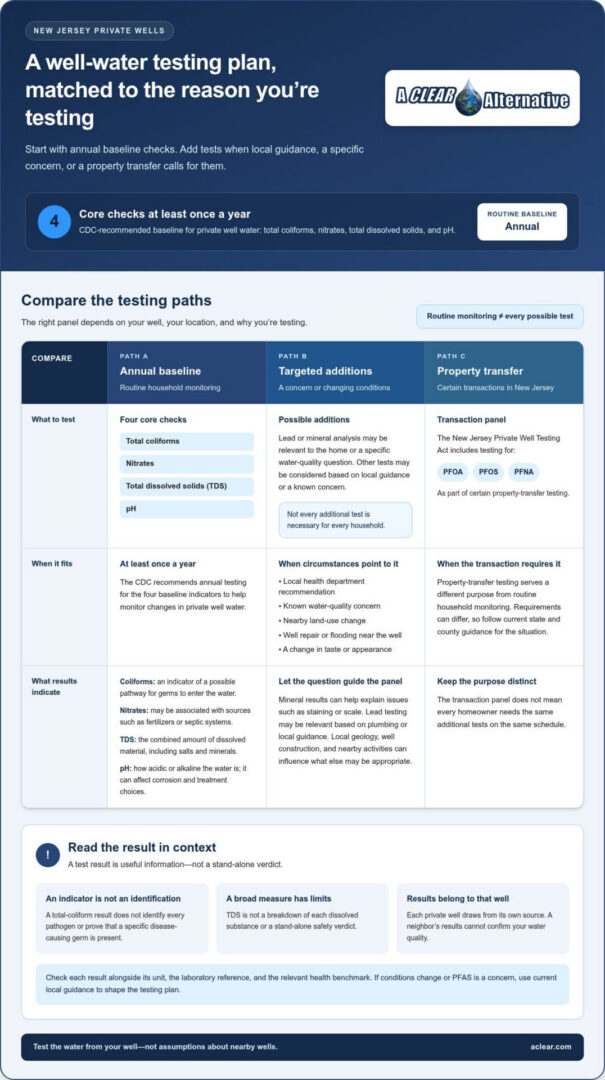
The CDC recommends testing private well water at least once a year for total coliforms, nitrates, total dissolved solids, and pH. Total coliforms are bacteria that can indicate a possible pathway for germs to enter the water. Nitrates can come from sources such as fertilizers or septic systems. Total dissolved solids measure dissolved substances in the water, while pH indicates how acidic or alkaline it is.
Annual testing is a useful baseline, but it doesn’t mean every well needs only the same tests on the same schedule. A change in water conditions, such as a new taste or appearance, flooding near the well, or work on the well system, may be a reason to seek guidance about additional testing. Local health recommendations can also help shape your plan. Follow current guidance for your area and choose tests based on your well’s circumstances. Clear water or a neighbor’s results can’t tell you what’s happening in your well.
What Should You Test for in New Jersey Well Water?
A useful test plan starts with routine indicators, then adds tests based on a specific concern or current local guidance. No single panel answers every question for every home. The CDC well water testing guidelines identify total coliforms, nitrates, total dissolved solids, and pH as core checks for private wells. These results provide a starting point, not a complete inventory of every possible contaminant.
What do the common baseline tests tell you?
Total coliforms are a group of bacteria used as an indicator of possible contamination. A result doesn’t identify every pathogen or prove that a specific disease-causing germ is present. Nitrates are a separate measure, relevant because sources such as fertilizer or septic systems can affect groundwater. pH shows how acidic or alkaline the water is, which can affect corrosion and treatment choices. Total dissolved solids (TDS) measure the combined amount of dissolved material, such as salts and minerals. TDS is a broad indicator, not a breakdown of each substance or a stand-alone safety verdict.
When might additional well-water tests be appropriate?
Consider expanding well water testing when a local health department recommends it, you have a known concern, or conditions around the well change. Nearby land-use changes, a well repair, or flooding, for example, may prompt a discussion about whether additional analysis is warranted. Choose tests based on your situation, not simply on a neighbor’s test panel.
Lead and mineral analysis are possible additions when relevant to the home or a specific water-quality question. A mineral result can help explain issues such as staining or scale, while a lead test may be appropriate based on plumbing or local guidance. Neither should be assumed necessary for every household.
New Jersey’s Private Well Testing Act includes testing for PFOA, PFOS, and PFNA as part of certain property-transfer testing. That transaction panel is distinct from routine household monitoring; it doesn’t mean every homeowner needs the same additional tests on the same schedule. Follow current state and county guidance for your circumstances, especially if PFAS or another emerging contaminant is a concern. Comprehensive laboratory testing can help turn those questions into a clearer assessment. Learn about professional water testing and how results can inform your next decision.
How to Arrange Well Water Testing and Collect a Useful Sample
A reliable result starts before the sample reaches a lab. First, write down why you’re testing: routine monitoring, a change in water quality, a concern near the well, or a property transaction. Then choose tests that fit that purpose. The CDC guidelines for well water testing offer a helpful overview of testing private wells. For a sale or rental situation, review current New Jersey requirements, which may differ from routine household testing.
Where can you get private well water tested in New Jersey?
Your county health department can be a starting point for local testing information and recommendations. Qualified laboratories also perform water analysis. Requirements may depend on the reason for testing. For example, New Jersey’s Private Well Testing Act applies to certain property transactions, and its procedures can differ from a household checkup. Review current state or county resources for applicable laboratory requirements and testing pathways before arranging a transaction-related test.
Once you’ve identified the concern and appropriate test panel, follow the laboratory’s instructions for submitting the sample and any accompanying information. After you receive the report, review it in light of your original reason for testing. This sequence keeps the process focused: identify the concern, select tests, collect and submit the sample, then review the findings.
How do you prepare and collect a well-water sample?
Use the laboratory’s instructions and the containers it specifies. Don’t rely on generic online collection steps or substitute a household bottle. Collection and handling directions can vary by test, and following them helps prevent a sample from being unsuitable or less useful for analysis.
Pay close attention to the lab’s directions for where and how to collect the water, how to handle the container, and how to deliver or return the sample. If an instruction is unclear, resolve that before collecting rather than guessing. A correct sample is essential: even a well-chosen test can’t answer your question if the sample wasn’t collected or handled as directed.
Keep a simple record of the sample date, well details, and reason for testing. Note relevant context, such as recent work on the well or a change in water conditions. When results arrive, those details can help you compare reports over time and discuss findings with a water-quality professional. Comprehensive laboratory testing provides a clearer basis for that review and for any treatment decisions.
How to Read Well Water Test Results and Decide What to Do
A lab report can feel technical at first, but a few details make it easier to interpret. Start with the analyte, the measured result, and its unit. Then check the detection limit, any laboratory notes, and the reference value or health benchmark cited for comparison. A detected substance doesn’t automatically mean the water presents a health risk; the amount, applicable standard, and reason for testing all matter.
What should you look for on a water test report?
Find the name of each substance or indicator tested, then match it to the reported value and unit. Look for notes explaining whether a result was below the lab’s detection limit, flagged for review, or affected by a sample issue. Benchmarks vary by contaminant and purpose, so use current guidance from an appropriate public-health authority rather than treating every laboratory reference range as a safety standard.
Units and comparison standards matter because the same number can mean different things when it’s measured in different units or compared with a different benchmark.
| Result type | What it can indicate | Sensible next step |
|---|---|---|
| Bacteria indicator | May signal a possible contamination pathway; it doesn’t identify every pathogen. | Follow current public-health guidance and seek advice on appropriate follow-up. |
| Nitrate or another chemical | Shows the measured amount of that specific substance in the sample. | Compare the value and unit with the current benchmark for that substance. |
| Mineral or general water-quality indicator | May help explain properties such as scaling, staining, or changes in water quality. | Use the result to decide whether targeted analysis or treatment assessment is relevant. |
What should you do if a result is outside a guideline?
Pause before choosing a treatment system. Check the report’s notes and compare the result with current guidance from the New Jersey Department of Health or your local health authority. If the finding may indicate a health concern, follow their advice about water use and next steps. Depending on the result, a follow-up sample may help clarify the finding, while a targeted treatment assessment can determine whether treatment is appropriate and what it should address.
Water that looks, tastes, or smells unusual can be a reason to investigate, but those signs alone can’t diagnose a contaminant or determine the right treatment. Use laboratory results as the basis for decisions. Keep the report and sample details together for review. Explore professional water testing and results guidance to better understand your findings and possible next steps.
Turn Well Water Testing Results Into a Clear Next Step
A test report is most useful when it leads to a decision based on what the lab actually measured. Don’t choose a system just because water has an unusual taste, leaves stains, or seems hard. Those clues can point to a concern, but they don’t confirm its cause. Match any treatment assessment to the result, the relevant guidance, and how your household uses water.
When should test results lead to a treatment assessment?
Health-related findings and aesthetic or operational concerns call for different kinds of attention. If a result suggests a possible health concern, follow current public-health guidance first. A qualified professional can then help assess whether follow-up testing or treatment is appropriate. Issues such as mineral content, acidity, iron, or sulfur may affect taste, staining, scale, or plumbing, but they need to be identified through testing rather than guessed from symptoms alone.
The right approach depends on the specific result and where the water needs treatment. Depending on the findings, options might include an acid neutralizer, water softener, iron and sulfur filtration, carbon filtration, ultraviolet sterilization, or reverse osmosis. These systems address different water conditions, so a recommendation should account for both the measured issue and household water use. For a broader overview of whole-house water filtration systems, consider how a system’s role depends on the concern it is designed to address.
How can professional testing make the next step clearer?
Comprehensive laboratory analysis replaces assumptions with measured findings. It can help clarify whether an unusual taste or staining corresponds to a specific water-quality issue, whether more targeted analysis is needed, and whether a treatment assessment makes sense. A Clear Alternative provides comprehensive water testing and treatment services to help homeowners make decisions grounded in their results.
Keep your report and any notes about changes in water quality or recent well work together. That context can make a results review more useful and help shape a plan suited to your home, rather than a one-size-fits-all fix. Explore professional well-water testing with A Clear Alternative.
Make Your Next Water-Quality Decision With Confidence
Clear-looking water can’t tell you everything a laboratory analysis can. A thoughtful well water testing plan starts with routine indicators, adds tests when your well or local guidance calls for them, and follows the lab’s instructions so the sample is useful. Once you have a report, review each result alongside its units and the appropriate health guidance before deciding whether follow-up or treatment makes sense.
Treatment should fit measured water conditions, not a guess based on taste, odor, or staining. Professional analysis can replace uncertainty with information you can use to plan a sensible next step. A Clear Alternative is family-owned and operated and has served customers since 1991, providing professional laboratory water analysis for residential and commercial clients.
Ready to move from questions to clearer information? Explore professional well-water testing with A Clear Alternative and take a practical first step toward understanding your water. With the right results in hand, you can make informed choices for your household with greater confidence.
Frequently Asked Questions
How often should you test your well water?
The CDC recommends testing private well water at least once a year for total coliforms, nitrates, total dissolved solids, and pH. Additional tests may be sensible after a change near your well, well repairs, flooding, or a change in water quality. Homeowners in Tabernacle, Shamong, and Medford Lakes should also follow current local health guidance, since testing needs can vary with well conditions and specific concerns.
What should you test for in private well water?
A useful baseline includes total coliforms, nitrates, total dissolved solids, and pH. These tests check for bacterial indicators, a particular chemical concern, the overall amount of dissolved material, and how acidic or alkaline water is. Other tests, such as lead or mineral analysis, may be appropriate depending on your plumbing, local guidance, or a known concern. Choose a panel for your situation rather than assuming every well needs identical testing.
Can well water be unsafe if it looks and tastes normal?
Yes. Clear appearance and normal taste or smell can’t establish that well water is safe to drink. Some contaminants don’t cause noticeable changes, so sensory checks can’t replace laboratory analysis. Regular well water testing gives you measured results for the indicators and contaminants included in the panel. If you’re concerned about a change, arrange testing instead of relying on appearance or flavor to decide whether the water is suitable.
Where can I get my well water tested in New Jersey?
You can start with your county health department for local testing guidance or arrange professional laboratory analysis. A Clear Alternative provides water testing for residential and commercial clients in communities including Tabernacle, Shamong, and Medford Lakes. If testing is for a property sale or another specific purpose, review current New Jersey and county requirements, since applicable procedures may differ from routine household monitoring.
What should I do if my well-water test shows bacteria or nitrates?
Review the result and its units, then follow current public-health guidance. If bacteria or nitrate findings raise a health concern, contact your local health department for advice about appropriate precautions and next steps. A follow-up test may be recommended to clarify a result. Don’t choose a treatment system based on a result alone; first understand what was measured and what guidance applies to your household.
How do I collect a well-water sample for testing?
Follow the laboratory’s instructions and use its specified sample container. Collection and handling requirements can vary by test, so don’t substitute generic directions or another bottle. Follow the lab’s guidance for collecting, storing, and delivering the sample; incorrect handling can affect how useful it is for analysis. Record the sample date, well details, and reason for testing so you can refer to them when reviewing your report.
Does well-water testing tell me which treatment system I need?
Testing can identify measured water conditions and help guide a treatment assessment, but a report doesn’t automatically select a system. The right response depends on the specific finding, applicable guidance, and how your household uses water. For example, treatment options differ for mineral, acidity, iron, sulfur, or bacterial concerns. A professional review can help determine whether treatment is appropriate and match any recommendation to the results rather than a symptom alone.