
Water Analysis Report: How to Read Your Results and Choose Next Steps
What if a number on your water analysis report is less alarming than it looks, or more important than it first appears? A result on its own doesn’t tell the whole story. You also need to know where the sample came from, what the test covered, and which comparison values apply.
If terms like mg/L, ppm, or MCL feel unfamiliar, you’re not alone. A public water utility report isn’t the same as a private well analysis: one summarizes results for a community system, while the other describes a sample from a particular property. Neither automatically tells you what’s happening at every tap in your home.
This guide explains how to check a report’s source and testing scope, interpret common result fields and units, and distinguish a utility’s Consumer Confidence Report from a private well test. These steps can help you choose a sensible next step without jumping to conclusions. For homeowners in Tabernacle, Shamong, Medford Lakes, and across South Jersey, A Clear Alternative offers free water analysis that identifies items including chlorine, iron, hardness, and bacteria.
Key Takeaways
- Start by checking which water source and sample the report describes, and which parameters were tested.
- Read each result alongside its unit and relevant context. A number alone may not tell the full story.
- Use a utility report and a property-specific analysis for different purposes, especially if your home has a private well.
- Verify the sample details and review the complete water analysis report before acting on one highlighted result.
- Homeowners in Tabernacle, Shamong, Medford Lakes, and across South Jersey can use A Clear Alternative’s free water analysis to learn about items including chlorine, iron, hardness, and bacteria.
What Is a Water Analysis Report, and Which Report Do You Have?
First, identify what the document describes: water from your tap, water from your well, or a public utility system. A water analysis report presents results for a particular sample and the parameters tested. It may list substances measured, their concentrations, and related notes. Its scope depends on where and when the sample was collected, which tests were run, and who prepared the report.
Water quality includes physical, chemical, and biological characteristics, as outlined in this overview of Water quality standards. That broad definition doesn’t mean every report checks every characteristic. A report speaks only to the sample and tests it covers. Treat it as a defined snapshot, not a complete answer to every question about a water supply.
Identify the report source and water supply
Before interpreting a result, find the details that identify what was tested. They may appear near the top of the report, in a sample summary, or in the accompanying paperwork:
- Source and location: Is the water identified as a private well, a public water system, or a sample from a specific tap or treatment device?
- Sample information: Check the collection date and any property, sampling point, or sample identification details.
- Reporting organization: Note whether the document comes from a utility, laboratory, or another testing organization.
- Testing scope: Look for the parameters tested and any notes about the sample or test method.
Next, confirm how your home receives water. A public utility supplies water through a shared system; a private well draws from a source specific to the property. Your water bill or property records may help identify the source. A public system report may describe water before it reaches your home, but it may not capture changes inside a particular building’s plumbing.
Distinguish a utility report from a household analysis
A community water system’s Consumer Confidence Report (CCR) summarizes water quality information for its customers. It typically describes the system’s source, reported contaminant levels, and whether health-based standards were exceeded. The U.S. Environmental Protection Agency requires community water systems to provide these reports annually. A CCR helps explain the broader supply, but it isn’t a test of your specific kitchen tap or household plumbing.
Private well owners don’t receive a utility CCR for their well. Because a well serves an individual property, a household-specific sample is more relevant to that source than a neighboring utility’s report. For well owners in Tabernacle, Shamong, and Medford Lakes, A Clear Alternative offers free water analysis to identify items including chlorine, iron, hardness, and bacteria. The right document is the one that matches your water source and the question you’re trying to answer.
How to Read the Main Parts of a Water Analysis Report
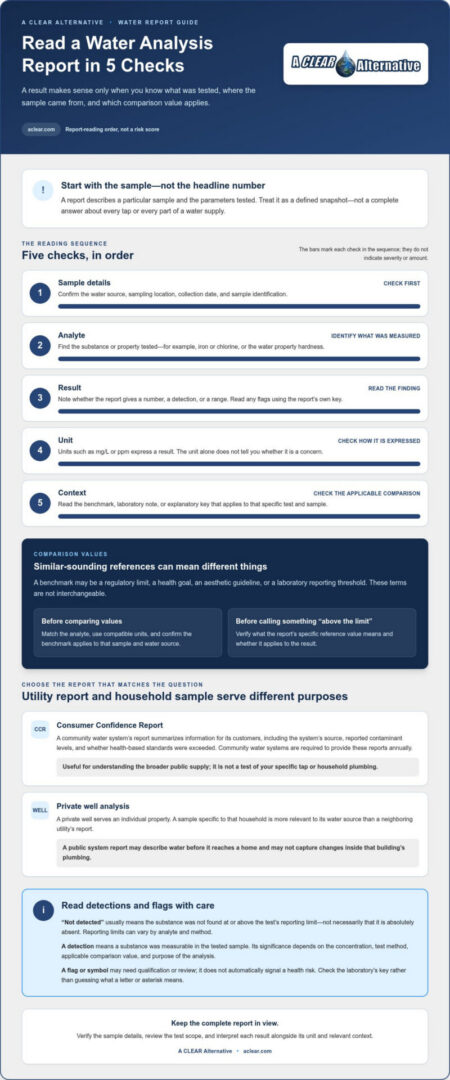
Once you’ve identified the sample, read each result as a set of connected details, not as a number in isolation. A water analysis report may include results for chlorine, iron, hardness, and bacteria, but its format and level of detail depend on the test. Review it in this order:
- Sample details: Confirm the location, collection date, and water source shown on the report.
- Analyte: Identify the substance or water property measured.
- Result: Note the reported finding, including whether it’s a number, a detection, or a range.
- Unit: Check how the result is expressed before comparing it with another value.
- Context: Read any benchmark, laboratory note, or explanatory key that applies to that specific test.
Follow each row across carefully. A result that looks high or low can’t be interpreted responsibly until you know what was measured, how it was measured, and what reference value, if any, applies.
Understand analytes, units, and comparison values
An analyte is the substance or property a test measures. Iron and chlorine are substances; hardness describes a water property. Units such as milligrams per liter (mg/L) or parts per million (ppm) express a result, but the unit alone doesn’t show whether the result is a concern. Compare values only when they refer to the same analyte and use compatible units and context.
Check the report’s legend or notes for definitions of reference terms. A benchmark might be a regulatory limit, a health goal, an aesthetic guideline, or a laboratory reporting threshold. These terms aren’t interchangeable. Before describing a result as “above the limit” or “within range,” verify what the report’s specific benchmark means and whether it applies to that sample and water source.
Read detected, not detected, and flagged results carefully
“Not detected” doesn’t necessarily mean absolute absence. It usually means the substance wasn’t found at or above the test’s reporting limit. That limit can vary by analyte and method. A flag such as “J,” “H,” or an asterisk may also have a lab-specific meaning, so use the report’s own key rather than guessing from a symbol.
A detection is a laboratory finding that a substance was measurable in the tested sample; its significance depends on the concentration, test method, applicable comparison value, and purpose of the analysis. A flag may indicate that a result needs qualification or review, not that it automatically signals a health risk. Keep the complete report, including notes and definitions, so one marked result doesn’t overshadow the details that explain it.
If the terminology still feels unclear, A Clear Alternative’s free water analysis can help homeowners in Tabernacle, Shamong, Medford Lakes, and across South Jersey learn about items such as chlorine, iron, hardness, and bacteria.
Public Water Report vs. Private Well Analysis: What Each Can Tell You
These reports answer different questions. A utility report describes a shared public water system; a private well analysis describes a sample collected from a specific property. Neither should be treated as a complete account of every possible contaminant or every change that could affect water at your tap.
| Feature | Consumer Confidence Report | Private well analysis |
|---|---|---|
| Who prepares it | The public water system or utility | A laboratory or testing organization using the submitted sample |
| Whose water it describes | The public system serving its customers | The specific sample collected from a private well |
| Its purpose | To share system-level water quality information with customers | To report results for the sample and tests listed |
What a Consumer Confidence Report represents
A Consumer Confidence Report (CCR) gives customers information about their community public water system, such as its water source and reported test results. The EPA says community water systems must provide a CCR each year by July 1. The report helps explain the broader supply, but it may not show what happens after water enters one building’s plumbing or describe a particular tap sample.
If you rent, identify which utility serves the address and where its CCR is available. Make sure the service area matches your address. A report for another utility, even one nearby, doesn’t describe your system.
What a private well analysis represents
A private well report is tied to the collected sample and the test panel listed on the document. It tells you what those tests found in that sample, not whether every possible contaminant was tested or what the water will be like in the future. Review the listed parameters and sample details before drawing conclusions.
A report can look reassuring and still have limits: a clean result only speaks to the substances and properties included in that test. It isn’t proof that untested contaminants are absent. For a clearer local picture, well owners in Tabernacle, Shamong, and Medford Lakes can use household-specific testing. This well water testing guide also offers background on testing in those communities.
Use the two documents as complements, not substitutes. A CCR helps you understand the public system; a private well analysis helps you understand the tested well sample. If your home uses utility water, system results still may not reflect conditions inside your plumbing. If it uses a well, a neighbor’s results won’t automatically apply to your property. In either case, the report’s source, sample, and test list define what it can tell you.
What to Do After Reading a Water Analysis Report
A result can raise questions without telling you exactly what to do. Before changing your water treatment or drawing conclusions about health, work through the report in order. The goal is to understand what the test says, what it leaves unanswered, and whether a suitable follow-up is needed.
- Confirm the sample details. Check the sample location, water source, collection date, and any notes about how the sample was collected. If the report refers to a different tap, property, or date than you expected, it may not answer your current question.
- Identify the specific result. Find the analyte, reported value or finding, unit, and any lab flags. Record these details rather than relying on a highlighted number or summary note.
- Check the context. Read the report’s definitions and identify the comparison value being used, if any. Determine whether it’s a regulatory standard, guidance value, lab reporting limit, or another reference.
- Choose a proportionate follow-up. If the test scope or meaning remains unclear, get help interpreting the complete report before selecting a treatment category or drawing health conclusions.
Make a short list of report-specific questions
Write down the result that caught your attention, along with its unit, sample date, and the report’s explanation. Then consider: Is this a measured concentration, a comparison with a benchmark, or a lab flag? Was the relevant substance included in the test panel? Does the comparison value apply to this water source and sample? These details keep the discussion focused and prevent one isolated number from driving a decision.
Keep the full report, including notes, definitions, and pages that weren’t highlighted. A summary may omit information that changes how a finding should be understood. If you’re in Tabernacle, Shamong, or Medford Lakes, this South Jersey water testing guide offers related local context. For questions about health effects, don’t use a single test result as a diagnosis; discuss concerns with an appropriate health professional.
Match any follow-up to the result and water source
Treatment choices should address a water characteristic that testing has identified, not a guess based on taste, appearance, or one unexplained value. The right next step may be to clarify the test scope, get a more relevant analysis, or explore treatment suited to the result. Public-system information and private-well results also call for different follow-up because they describe different sources.
If the report points to a concern that filtration may address, the whole house water filtration guide can help you understand that treatment category. If the result or report scope is still unclear, A Clear Alternative offers free water analysis in South Jersey, including Tabernacle, Shamong, and Medford Lakes. The analysis identifies items such as chlorine, iron, hardness, and bacteria. Request a free water analysis to take a practical next step based on your household water.
Get Help Understanding Your Water Analysis Report in South Jersey
A water analysis report can leave you with a practical question: what should you look into next? If you’re in Tabernacle, Shamong, Medford Lakes, or elsewhere in South Jersey, A Clear Alternative offers free water analysis for household water. It identifies items including chlorine, iron, hardness, and bacteria, giving you useful information as you consider whether further testing or treatment may be appropriate.
When a free water analysis can help
A household analysis can clarify water characteristics that may be relevant to your home. It can be a useful next step if you rely on a private well, have questions about your water, or want a clearer starting point before considering treatment. Results relate to the analysis performed, so they aren’t a diagnosis or a guarantee about every possible contaminant. Your water source and the specific question you’re trying to answer matter.
If you already have a report, keep the complete document handy. Note the sample location and date, the result that prompted your question, and any units or explanations printed beside it. That context helps make a conversation about your household water more focused. Avoid choosing treatment based on one unfamiliar number alone; first understand what it measures and whether it relates to the concern you’re trying to address.
Request local help from A Clear Alternative
A Clear Alternative is family-owned and NJ-licensed, serving customers since 1991. In Tabernacle, Shamong, and Medford Lakes, as elsewhere, water sources can vary from one property to another. Your neighbor’s results may not describe your home, so household-focused analysis offers a more relevant place to start.
You don’t need to make a treatment decision before you understand the information in front of you. Use the free water analysis to learn about selected household water characteristics, then consider the next step in light of your water source and results. If you have questions about a report, keep it nearby so the details that concern you are easy to refer to.
Ready for a clearer picture of your household water? Request your free water analysis.
Turn Your Results Into a Clear Next Step
Your water analysis report doesn’t have to be the final word. Use it as a starting point for a more informed conversation about the water you use every day. Keep the complete report with your household records, along with any questions it raises. If you get another analysis later, those records can help you compare results and spot what may deserve a closer look.
Give yourself time to understand the findings before making a decision. A clear explanation can help you move from uncertainty to a practical plan, without treating one number as the whole story. You don’t need to figure out every technical detail alone.
A Clear Alternative is a family-owned, NJ-licensed business serving customers since 1991, with 9,000+ customers served and a 4.6-star Google rating from 98+ reviews. Its free water analysis offers a helpful way to learn about your household water. Request your free water analysis and take the next step with confidence.
Frequently Asked Questions
Is a water analysis report the same as a Consumer Confidence Report?
No. A Consumer Confidence Report (CCR) comes from a community water system and describes information about that system, while a water analysis report may present results from a sample collected for a particular property or purpose. When comparing documents, check who issued each one and which water source it covers. For a home on a private well, a utility CCR won’t provide test results for that well.
Can a water analysis report show every possible contaminant?
No. A report covers only the parameters included in its testing scope, and different tests may look for different substances. For example, a report listing mineral results doesn’t automatically tell you whether bacteria or other contaminants were tested. Review the full parameter list to see what the report covers and what it leaves unanswered for your water source.
What does “ND” mean on a water analysis report?
“ND” generally means “not detected” under the test’s conditions. It doesn’t necessarily mean the substance is completely absent: the amount, if any, may be below the method’s reporting or detection limit. Check the report’s notes for that limit and the lab’s definition of ND. When comparing two reports, also check whether they used comparable methods and limits before interpreting different results.
How often should I get my private well water tested?
There isn’t one schedule that fits every well and situation. Follow applicable local public-health guidance and consider testing when circumstances change, such as after well work, flooding, or a noticeable change in the water. In New Jersey, separate Private Well Testing Act requirements apply to certain property sales and rentals. If you live in Tabernacle, Shamong, or Medford Lakes, consider your well and the reason for testing when deciding on follow-up.
Can water analysis results change over time?
Yes. A test describes the sample collected at a particular time, and water conditions can change. Seasonal conditions, changes around the well, plumbing work, or treatment equipment may affect what a later sample shows. Keep dated reports together so you can compare the same parameters and sample locations over time. A difference between reports is a reason to review the details, not proof of a specific cause by itself.
How much does a water analysis cost from A Clear Alternative?
A Clear Alternative offers free water analysis. It identifies items including chlorine, iron, hardness, and bacteria, giving homeowners a practical starting point for understanding household water. Interpret the results in light of the items included in the analysis and the question you’re trying to answer. If you’re in Tabernacle, Shamong, or Medford Lakes, keep any existing results handy so you can describe what you want to understand about your water.
Can I use a water analysis report for a home sale or rental requirement?
Not necessarily. New Jersey’s Private Well Testing Act sets specific testing requirements for covered property sales and rentals, so a general household analysis may not meet the required test panel or process. For a sale, the test must be arranged through a New Jersey-certified laboratory; rental properties with wells must be tested every five years under the Act. Review the current requirements for the property and transaction before relying on an existing report.