
Pennsauken Water Quality: What Residents Should Know in 2026
Is Pennsauken tap water safe to drink? The Merchantville Pennsauken Water Commission’s report covering 2025 says its water met or exceeded state and federal drinking water standards. That’s reassuring, but the broader picture of pennsauken water quality may not answer every question about the water at your own faucet.
It’s reasonable to pay attention when water tastes, smells, or looks different. A change doesn’t automatically mean there’s a health risk, and a utility report can’t identify every issue that may arise inside a particular home. Knowing what the report covers, and where its limits are, helps you respond without jumping to conclusions or buying equipment you may not need.
This guide explains where to find the latest official report, how to read its results, and when household-specific testing may be useful. You’ll also learn how to investigate concerns such as hardness or unusual odors. A Clear Alternative offers free water analysis to help connect household findings with practical treatment options when they’re relevant.
Key Takeaways
- For current pennsauken water quality information, start with the MPWC’s official page and select the newest report for its stated reporting year.
- A utility report covers sampled public water during a defined period; it may not explain what’s happening at a specific household faucet.
- Taste, odor, or color changes are clues to investigate, not proof of a particular contaminant. Record what changed and when.
- If you have a concern, identify your provider, review its report, and document what you notice. Contact the utility about an immediate public-system concern.
- Free household water analysis can help assess factors such as chlorine, iron, hardness, and bacteria, so treatment decisions can follow findings rather than assumptions.
Pennsauken Water Quality: What a Local Water Report Can Tell You
Water quality isn’t a single label. It refers to measurable characteristics and test results, such as the levels of substances detected in a sample. A report puts those results in context by identifying the water system, what was measured, and the period covered. That’s more useful than describing water as simply “good” or “bad.”
For Pennsauken, the Merchantville Pennsauken Water Commission (MPWC) report describes sampled water from the public system for its stated reporting period. Before applying it to your home, confirm that MPWC is your provider and that your address falls within the service area covered. Nearby addresses can have different providers, so location alone may not identify the right report.
A public water report describes sampled water from the system; it doesn’t diagnose the water at every household faucet. Keep that distinction in mind as you review pennsauken water quality information. Official results are useful, but they aren’t a substitute for investigating a concern specific to your home.
What does a Consumer Confidence Report cover?
A Consumer Confidence Report (CCR), also called an annual water quality report, summarizes a public water system’s monitoring and reported results for a defined period. Check the reporting year and the system named in the document before interpreting its tables. A newer webpage or publication date doesn’t necessarily mean every result reflects that calendar year. The CCR summarizes the system’s reported sampling, not a test of every tap, pipe, or fixture in your home.
Does one water-quality report describe every Pennsauken home?
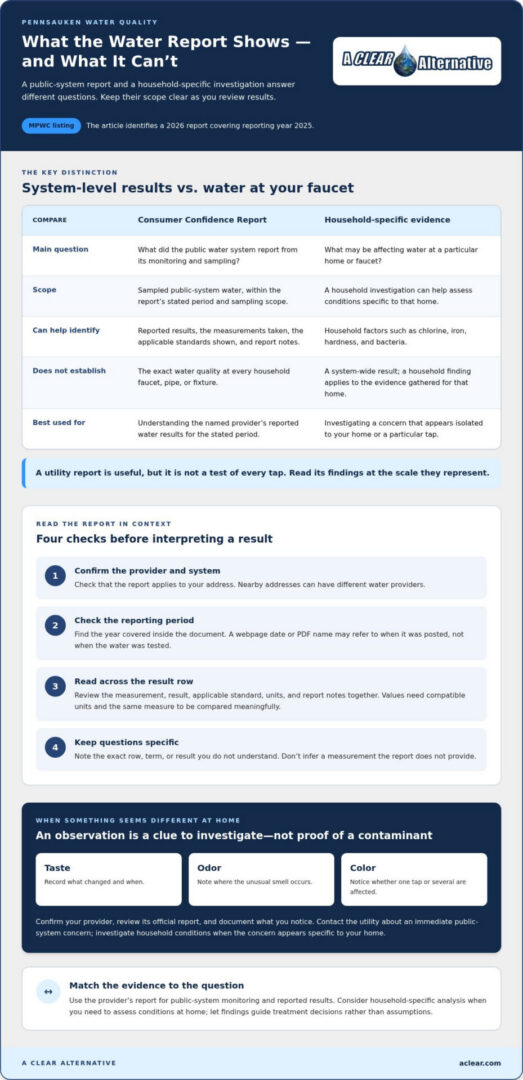
No. A system-level report and a household sample answer different questions. The report presents results within its sampling scope and reporting period. It can’t show whether a home’s plumbing, fixtures, or other conditions affect water at a particular faucet. That doesn’t make the report unhelpful; it means you need to read its findings at the scale they represent.
Separate official findings from what you notice at home. A report documents measured results; your observation might be that water tastes different, smells unusual, or looks discolored. Those observations deserve attention, but they don’t identify a specific substance on their own. Note where and when the change occurs, and whether it affects one tap or several. That information can help you decide whether to follow up with the utility or investigate conditions inside the home.
Geography can provide helpful background, but it isn’t a test result. The Pennsauken Creek Wikipedia page offers context about the creek and surrounding area. Don’t use it to infer what’s in MPWC-treated water or what’s coming from your faucet. For drinking-water decisions, rely on the named provider’s report and household-specific evidence when a concern is isolated to your home.
How to Find and Read Pennsauken’s Latest Water Quality Report
Search results may show several reports, and their titles can make the newest applicable one easy to miss. Use this sequence: confirm which water provider serves your address, open that provider’s official water-quality page, then select the newest report for your service area.
The distinction between publication year and reporting year matters. A report may be published after the water was sampled and results were recorded. Before drawing conclusions about pennsauken water quality, check the reporting year printed inside the document, not just the webpage title or PDF filename.
Which report year should Pennsauken residents check?
Start with the newest report on the official MPWC page, then confirm that the document names the applicable system and reporting period. For example, MPWC’s current listing identifies a 2026 report for reporting year 2025. Report pages can change, so return to the utility’s official page when you need current information and confirm whether a newer applicable document has been posted.
Which details matter when reading water-quality results?
Choose a result and read across its row. Note the contaminant or measurement, the reported result, the applicable standard shown in the report, and any notes or explanations. Pay attention to units: numbers can’t be compared meaningfully unless they use compatible units and refer to the same measure. If a term or table is unclear, use the report’s definitions and notes instead of guessing what a value means.
For a clear review, work through these checks in order:
- Confirm the provider and system name. Make sure the report applies to your address, not a nearby municipality or a different water system.
- Check the reporting period. Find the year covered inside the document. The webpage date may refer to when the report was posted, not when the water was tested.
- Read the result in context. Look at the listed standard and report notes alongside the value. A number without its units, comparison point, or explanation can be misleading.
- Keep questions specific. Write down the exact row, term, or result you don’t understand. Don’t infer an unreported measurement or treat a system-wide result as a test of your home’s faucet.
Need a household-level perspective? The South Jersey water testing guide explains how home testing complements public-system reports. If you’re concerned about your tap, a free household water analysis can help identify what to investigate next without assuming every home needs treatment.
Why Pennsauken Tap Water Can Seem Different at Home
A utility report provides a useful view of the public water system, but it can’t explain every change at an individual faucet. Water may also be affected by conditions between the service connection and the tap, including household plumbing or fixtures. That’s a reason to investigate what you’ve noticed, not proof that the public supply or your home has a problem.
A change in taste, smell, or appearance is an observation, not a diagnosis; it can’t identify the cause by itself. Different causes can produce similar sensory changes, and a particular taste or color doesn’t confirm a specific contaminant. Record what you notice, then decide whether a utility follow-up or household testing makes sense.
Public-system reports and federal drinking-water protections provide important context. The EPA Safe Drinking Water Act explains the federal framework for public drinking water. System-wide monitoring doesn’t tell you what may be happening at one faucet or establish the cause of a household change. Pennsauken water quality information is most useful when you understand what it measures and what it can’t resolve for your home.
What can cause a change in taste, smell, or appearance?
Similar changes can have different explanations. A metallic taste, unfamiliar odor, or cloudy appearance can’t reliably point to one cause without more context or testing. Don’t assume an observation identifies a contaminant or attribute it to a Pennsauken-specific source without current test evidence. Track when it began, which taps are affected, whether it happens with hot or cold water, and whether it persists.
These details help distinguish an observation at one tap from a broader concern. For example, if a change occurs at one faucet but not others, record that difference. It may help guide the next question, but it still isn’t a diagnosis.
When does a household question need separate testing?
A public report summarizes monitoring for the system and period it covers. A household sample addresses a different question: what’s present in water collected from a particular home or tap. Consider household testing when you need evidence about your own water or want to investigate a persistent, specific concern. Being clear about the question can help you avoid choosing treatment based on a guess.
- Record the change, when it occurs, and which taps are affected.
- Review the utility report for system-level information, without treating it as a household test.
- Use testing to investigate the specific concern before choosing treatment.
That order matters. A whole-house water filtration guide can explain treatment approaches, but first identify what you’re trying to address. Testing can help connect a household concern to an appropriate next step instead of assuming every home needs filtration.
What to Do About a Pennsauken Water Quality Concern
A concern is easier to investigate when you turn a general worry into a specific question. First identify who supplies your water, then check that provider’s current report. Next, record what you’ve noticed and decide whether your question concerns the public system or your household’s water. This process helps you avoid assumptions and choose a response that fits the issue.
- Identify your water provider. Confirm the system serving your address before relying on a report or directing a system-wide question to a utility.
- Review the current report. Check the document’s reporting period and the results relevant to your question.
- Record the concern. Note what changed, when it started, which taps are affected, and whether it continues.
- Choose the right next step. Contact the utility about an immediate public-system concern. For a question specific to your home, consider household water analysis.
This sequence separates public-system questions from household ones. If an issue affects the broader supply, use the appropriate utility channel, such as MPWC’s official customer service or contact channel if MPWC serves your address. If the concern is isolated to your home, a system-wide report may not explain what’s happening at your tap.
How can residents investigate a household water concern?
Describe what you’ve noticed rather than trying to name its cause. For example, note whether an unusual taste occurs at one faucet or throughout the home, and whether it appears consistently or only at certain times. A Clear Alternative offers free water analysis for household concerns, including factors such as chlorine, iron, hardness, and bacteria. The findings can help clarify what to investigate.
Bring your observations into the conversation: when the change began, where you notice it, and whether it persists. The local water treatment company guide offers related context on water-treatment resources in the region.
Should you buy a filter before identifying the concern?
Not necessarily. Treatment methods address different water-quality concerns, so buying equipment before understanding the issue can lead to a poor fit. Findings can help determine whether filtration, softening, or another treatment category is relevant. The right choice depends on the concern and available evidence, not on a one-size-fits-all assumption.
Start with the question you want answered, then use relevant findings to guide a treatment decision. A water softener, for example, serves a different purpose from a filtration system, so neither should be chosen simply because water tastes or looks unusual. For a household-specific concern, request free water analysis to help identify a sensible next step.
Household Water Analysis and Treatment Support Near Pennsauken
MPWC’s report and a household water analysis serve different purposes. The utility report provides official information about sampled public water during its reporting period. A household analysis can help investigate factors in water at your home. Use each resource for the question it can answer: household analysis does not replace MPWC’s report or establish what the public system’s results mean.
A Clear Alternative offers free water analysis for household concerns. It’s a practical way to move from an observation or question to information about your own water, then consider whether treatment is relevant. Start with findings, not a product assumption.
What can A Clear Alternative’s free water analysis help identify?
The free analysis can help identify chlorine, iron, hardness, bacteria, and other listed factors. Results can inform a discussion about your household’s concern and possible next steps. The analysis is a household resource, separate from MPWC’s public-system reporting. It helps ground the conversation in what was identified, rather than promising a particular outcome.
Treatment options depend on the issue. A Clear Alternative offers water softeners, reverse osmosis systems, ultraviolet (UV) sterilizers, acid neutralizers, and iron and sulfur removal systems. These options address different household water concerns, so they aren’t interchangeable or automatically necessary. For example, a finding related to hardness calls for a different treatment discussion than one related to iron or sulfur. Connect the relevant result to an appropriate option rather than installing equipment based on taste, odor, or appearance alone.
What local experience supports household water service?
A Clear Alternative is family-owned and NJ-licensed, serving households since 1991. The company has served 9,000+ customers and has a 4.6-star Google rating with 98+ reviews. Its New Jersey service area includes eight counties, including Camden County. A Clear Alternative also serves homeowners in Tabernacle, Shamong, and Medford Lakes, bringing local water-treatment support to communities across the region. MPWC remains the source for official public-system results.
If you’re unsure what a household finding means, you don’t need to jump straight to a system purchase. Review the concern and analysis together, then consider treatment when it fits the evidence. For residents seeking a clearer picture of household water alongside the official pennsauken water quality report, A Clear Alternative’s free water analysis is a practical starting point.
Take the Next Step With Confidence
Understanding pennsauken water quality is less about reacting to every change and more about asking the right question. If your concern is about the public supply, use the utility’s official channels. If it’s specific to your home, focus on household evidence before deciding whether treatment makes sense.
You don’t have to solve it all at once. Start with what you’ve noticed, gather information that speaks to your situation, and choose a next step based on what you learn. That keeps the process practical and helps you avoid investing in a solution that may not fit your needs.
A Clear Alternative is family-owned and NJ-licensed, with a 4.6-star Google rating and 98+ reviews. Every customer can receive a free water analysis. Start with a free household water analysis and take a more informed step toward understanding your water.
Frequently Asked Questions
Is Pennsauken water safe to drink?
Check the current Consumer Confidence Report (CCR) from the provider serving your address before drawing a conclusion. MPWC’s page lists a 2026 report for reporting year 2025, but that may not apply to every property in Pennsauken. Read the document’s system name and reporting period, then consider whether your question concerns the public supply or water at your own tap. A system report can’t confirm conditions in every household.
Where does Pennsauken tap water come from?
Use the current report from your water provider to find source information for the system serving your address. Look for sections describing water sources, then check that the named system matches your provider. Don’t assume a general description applies to every property based on its Pennsauken address alone. If you’re asking about a private water source or a specific faucet, the applicable report or a household sample may be different.
How often is Pennsauken drinking water tested?
Check the monitoring and testing information in the current report for the water system serving your address. The document’s dates and notes show which results relate to which period; older report pages may describe earlier monitoring. If a table doesn’t make the schedule clear, use the utility’s current information channels to ask about that specific monitoring detail. A household sample is a separate way to investigate water from your own tap.
Do I need a water filter in Pennsauken?
Not every household needs the same treatment, and a filter shouldn’t be chosen based on taste or odor alone. First identify what you want to address, then use relevant report information or household test findings to guide the decision. Different treatment categories serve different purposes. For example, a concern about hardness isn’t automatically the same as a concern about chlorine. Testing can help clarify whether a treatment option is relevant to your home.
Is bottled water safer than Pennsauken tap water?
There isn’t a blanket answer that bottled water is safer for every person or concern. The useful comparison depends on what you’re trying to address and the information available about the water you drink. Review the applicable utility report for public-system details, and consider household-specific analysis if your concern is limited to a tap in your home. If you have a personal health concern, discuss your drinking-water choices with a healthcare professional.
Why is my Pennsauken tap water discolored?
Discoloration alone can’t identify its cause. Note the color, when you first noticed it, whether it appears at one faucet or several, and whether it returns after clearing. If multiple taps are affected or the change appears beyond your home, check current utility notices and contact the provider serving your address. If it’s isolated to one fixture, household-specific investigation may help distinguish a home-level question from a system concern.