
How to Test for Iron in Well Water: A 2026 Homeowner’s Guide
What if those stubborn orange streaks in your bathtub are more than just an eyesore, but a warning sign that your plumbing is slowly suffocating? It is frustrating to pull a fresh load of white laundry out of the wash only to find it ruined by rust-colored spots. You have likely spent hours scrubbing porcelain fixtures, only for the metallic taste in your morning coffee to remind you that the problem is still there. Knowing how to test for iron in well water is the only way to stop the cycle of damage and reclaim the high-quality lifestyle you have worked hard to build.
We believe your home should be a sanctuary of comfort and beauty. You deserve to feel confident in every drop of water you drink and use. In this 2026 guide, we will walk you through the precise steps to identify which type of iron is invading your pipes. We will help you interpret your results according to modern standards and show you how to choose a filtration solution that fits your lifestyle perfectly. It is time to stop guessing and start enjoying the clear, crisp water your family deserves. Let’s turn that orange tint into a thing of the past and restore the brilliance to your home.
Key Takeaways
- Spot the early warning signs of iron damage before it stains your home’s aesthetic or shortens the life of your appliances.
- Discover how to test for iron in well water using professional laboratory analysis to get the precision that DIY strips simply cannot provide.
- Learn to distinguish between ferrous, ferric, and bacterial iron to ensure your filtration strategy addresses the root of the problem.
- Master the proper sampling technique to ensure your water test reflects the true chemistry of your aquifer.
- Find the perfect match between your iron levels and modern filtration systems to restore clear, great-tasting water to your daily life.
Recognizing the Signs: Does Your Well Water Have an Iron Problem?
You notice it first in the morning. A faint orange ring around the drain or a strange, metallic tang in your coffee. These aren’t just cosmetic annoyances; they are symptoms of a deeper issue within your well. While Water quality standards often classify iron as a secondary contaminant, its impact on your home’s aesthetic and your daily comfort is undeniable. Before you dive into the specifics of how to test for iron in well water, you need to recognize how iron manifests in your plumbing and affects your lifestyle.
The Visual Red Flags in Your Home
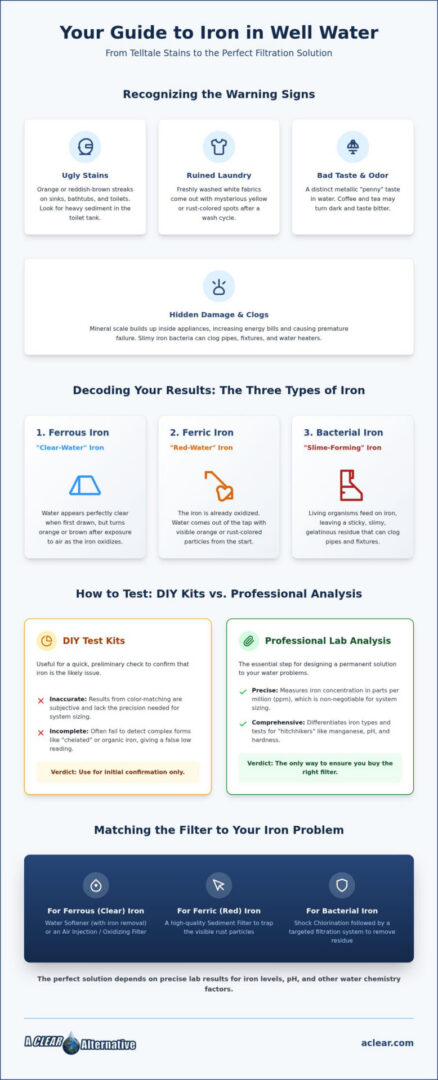
Orange streaks on white porcelain are the most obvious sign of trouble. Check your laundry first. If your white towels or bedsheets come out with mysterious yellow spots after a wash cycle, iron is likely the culprit. You should also take a moment to inspect your toilet tanks. A thick layer of reddish-brown or orange sediment at the bottom is a clear indicator of heavy mineral buildup. In some cases, you might even see a “slimy” orange residue. This is often iron-reducing bacteria, a living organism that feeds on the iron in your water. It leaves behind a sticky, gelatinous mess that can quickly clog your pipes and fixtures.
Iron doesn’t just sit on the surface where you can see it. It builds up inside your water heater, dishwasher, and washing machine. This mineral scale forces your appliances to work harder, which spikes your energy bills and leads to premature failure. You might notice “clear-water iron,” where the water looks crystal clear at the tap but turns orange after sitting in a glass or tub. In contrast, “red-water iron” appears as visible rust particles the moment you turn on the faucet. Both types contribute to that distinct “penny” taste that makes drinking water unpleasant.
Taste and Odor Indicators
Your morning ritual is often the first casualty of poor water quality. Iron reacts with the tannins in coffee and tea, turning them an unappetizing dark color and adding a harsh, metallic bitterness. It’s important to distinguish these signs from other contaminants. Don’t confuse the metallic scent of iron with the “rotten egg” smell of sulfur. While iron can have a faint, earthy odor, it often travels alongside other issues. High iron levels can actually mask low pH or acidity, which causes its own set of problems like pinhole leaks in your copper pipes. Learning how to test for iron in well water is the first step toward unmasking these hidden threats and restoring your home’s water to its peak condition.
Testing Methods: DIY Kits vs. Professional Lab Analysis
Deciding how to test for iron in well water is the first real step toward fixing your home’s water chemistry. You’ve seen the stains, and now you need data to act. While the market offers everything from $10 test strips to $400 laboratory panels, the right choice depends on whether you want a quick snapshot or a permanent solution. Choosing the wrong path here often leads to buying expensive equipment that doesn’t actually solve the problem.
When to Use a DIY Iron Test Kit
Home test kits are excellent for a preliminary check. If you’re standing in a hardware store and want to confirm that the orange tint in your sink is indeed iron, these kits provide immediate feedback. Most rely on reagent drops or test strips that you match against a color chart. However, these visual comparisons are subjective and often struggle with accuracy. It is vital to remember that DIY kits often fail to detect “chelated” or organic iron, which is iron bound to tannins or organic matter. If your kit shows a low reading but your fixtures are still staining, the kit is simply missing the full picture.
The Benefits of Professional Water Analysis
A professional lab doesn’t just tell you iron is present; it measures the concentration in parts per million (ppm). This precision is non-negotiable when sizing a filtration system. According to this Minnesota Department of Health guide, understanding the specific form of iron is just as important as the amount. Labs use advanced technology to differentiate between dissolved and oxidized iron, giving you a roadmap for treatment. For many, professional well water testing is a critical first step for any NJ homeowner because it also measures pH levels and water hardness.
Iron rarely travels alone. It often brings along “hitchhikers” like manganese, which leaves black stains, or sulfur, which creates that unpleasant odor. A professional analysis catches these secondary contaminants that a basic strip will miss. Investing in a comprehensive test might seem like an extra expense, but it prevents you from buying the wrong big-box filter that isn’t designed for your specific water profile. You can schedule a professional analysis to ensure your filtration investment actually works the first time and protects your home’s aesthetic for years to come.
Decoding Your Results: Ferrous, Ferric, and Bacterial Iron
Once you have the data from knowing how to test for iron in well water, the real work begins. Your lab report will likely show a concentration in parts per million (ppm). While any level above 0.3 ppm triggers the need for specialized filtration to prevent staining, the “ppm” is only half the story. To choose a system that actually works, you must identify which form of iron is invading your home. Each type requires a different technological approach to ensure your water remains crystal clear and your fixtures stay pristine.
Ferrous vs. Ferric: Why the State of Iron Matters
Ferrous iron, often called “clear-water iron,” is a master of disguise. It is completely dissolved in the water, meaning it looks perfectly clear when you first fill a glass. However, the moment it hits the air in your shower or toilet bowl, a chemical reaction called oxidation occurs. This turns the invisible iron into solid, orange particles. A standard water softener can often handle low levels of ferrous iron through ion exchange, but it will quickly become “fouled” and lose efficiency if the levels are too high or if the iron has already begun to oxidize.
Ferric iron, or “red-water iron,” is iron that has already oxidized before it reaches your faucet. You will see actual rust particles floating in the water the second you turn on the tap. Oxidized iron is the primary cause of physical plumbing clogs. In areas like South Jersey, we frequently see a tricky combination of low pH and high iron. Acidic water keeps iron in its ferrous state longer, which can lead to aggressive staining even if your initial DIY test seemed fine. According to the Minnesota Department of Health iron testing guidelines, identifying these chemical states is essential for sizing the correct oxidation or filtration equipment.
Identifying Iron Bacteria and Organic Iron
Iron bacteria is a different beast entirely. These organisms feed on the iron in your well, creating a thick, gelatinous sludge that can be orange, red, or even brown. You will usually find this “bio-film” inside your toilet tank or clogging your water-using appliances. Organic iron, on the other hand, occurs when iron binds with tannins or organic matter. This can make iron testing results misleading, as the iron is “shielded” and may not react to standard chemical tests. Treating these issues requires more than just a filter; you often need a specialized system to neutralize the bacteria or break the organic bond before the iron can be removed. Understanding these nuances ensures you invest in a solution that provides the freedom and water quality your modern lifestyle demands.
Step-by-Step: How to Properly Collect a Well Water Sample
Getting an accurate result depends entirely on your technique. If you collect water that has been sitting in your pipes for hours, you are testing your plumbing, not your well. To truly master how to test for iron in well water, you must follow a protocol that captures the chemical reality of your aquifer. Precision here ensures you don’t waste money on a filtration system that is either too small or completely unnecessary for your specific needs.
Preparing the Faucet and Well
Start by selecting the right location. You want a faucet that bypasses any existing softeners or filters to see the raw water quality. Remove the aerator or screen from the faucet tip first. These small parts often trap sediment or biofilm that can skew your results. Once the faucet is clear, run the cold water for 5 to 10 minutes. This allows the well pump to cycle, bringing fresh water directly from the ground into your sample bottle. It’s a simple step that makes a massive difference in data reliability.
You also need to decide if you are testing “pre-treatment” or “post-treatment.” If you are trying to diagnose a new staining problem, always go for a pre-treatment sample. This reveals the true iron ppm and helps a professional determine the best technology for your home. Testing post-treatment is only necessary if you want to verify that an existing system is still performing at its peak. Understanding this distinction prevents confusion when you receive your final lab report.
Handling and Shipping the Sample
Hygiene is your top priority once the water is running clear. Open the sterile sample bottle provided by the lab, but be careful not to touch the inside of the cap or the rim of the bottle with your fingers. Fill the container to the very brim. This is a crucial step for iron testing; excluding air prevents the iron from oxidizing inside the bottle before it reaches the lab. If the iron changes state during transport, your data won’t be accurate, and you might receive a false reading for dissolved iron levels.
Label your sample immediately with the date, time, and specific location where you collected it. Labs have a strict “hold time,” often requiring the sample to arrive within 24 to 48 hours for the most reliable results. Keep the bottle in a cooler with an ice pack during transport. This temperature control preserves the chemical integrity of the water, ensuring the lab sees exactly what is coming out of your well. If you want to skip the guesswork and ensure your results are legally and technically sound, you can order a professional collection kit to ensure every step meets laboratory standards.
Beyond the Test: Choosing the Right Iron Filtration System
Your lab results are finally in. You have a number on a page, but that number is just the beginning of your journey toward crystal-clear water. Knowing how to test for iron in well water gives you the data, but choosing the right technology turns that data into a lifestyle upgrade. The goal isn’t just to remove a mineral; it’s to protect your home’s aesthetic, preserve your plumbing, and restore your confidence in every glass of water you pour.
Matching Technology to Your Iron Type
If your results show low-level ferrous iron, typically under 2.0 ppm, a high-efficiency water softener might be all you need. These systems use ion exchange to pull dissolved iron out of the water before it can oxidize and cause stains. However, if your test reveals high levels of ferric iron or visible rust particles, you need a dedicated backwashing iron filter. These heavy-duty systems are designed specifically to trap solid particles that would quickly overwhelm a standard softener.
In many South Jersey homes, iron doesn’t work alone. If your water is acidic, you will likely need acid neutralizers to raise the pH level first. When water is too acidic, iron becomes more corrosive and much harder to filter out. For heavy iron loads, modern air-injection oxidation (AIO) systems have become the gold standard. They use a pocket of air to naturally oxidize the iron without the need for harsh chemicals, making them a clean, efficient choice for the modern homeowner.
Working with a Local Water Professional
The geology of Tabernacle and Medford Lakes is unique. We see a specific blend of low pH and high iron that “big-box” filters simply aren’t built to handle. This is where iron and sulfur filtration systems designed for local conditions make the difference. A family-owned business that has served the Tri-State area since 1991 understands these nuances. They don’t just sell you a tank; they provide a solution tailored to your specific aquifer.
Reliability is everything. With 24/7 emergency support, you never have to worry about “red water” returning to ruin your weekend or your laundry. Investing in professional expertise ensures your system is sized correctly the first time, saving you from expensive repairs and trial-and-error plumbing. Ready for a definitive answer? Schedule your professional water test with A Clear Alternative today.
Reclaim Your Home’s Brilliance and Clarity
You don’t have to live with stained fixtures or metallic-tasting water any longer. By understanding how to test for iron in well water and identifying whether you’re dealing with ferrous, ferric, or bacterial iron, you’ve already taken the most important step toward a cleaner home. Remember that precise sampling and professional lab analysis are the only ways to ensure you invest in a filtration system that actually works for your specific well chemistry. A temporary fix might save a few dollars today, but a permanent solution protects your appliances and your lifestyle for years to come.
Since 1991, we’ve helped families across the Tri-State area restore their water quality as expert iron and sulfur filtration installers. Whether you need an immediate diagnostic test or a complete system upgrade, our 24/7 emergency well support ensures you’re never left alone with a plumbing crisis. It’s time to stop the staining and start enjoying the premium, clear water your family deserves. Get a Professional Water Analysis from A Clear Alternative today and take the first step toward a worry-free home.
Frequently Asked Questions
Is iron in well water dangerous to my health?
Iron is classified as a secondary contaminant, meaning it is primarily an aesthetic issue rather than a health risk. While it won’t typically make you sick, high concentrations in Tabernacle wells can ruin your laundry and give food a bitter, metallic taste. If you notice a slimy texture, it might be iron bacteria, which requires professional treatment to ensure your home’s water system remains clean and efficient.
Can I use bleach to test for iron in my water?
Bleach acts as an oxidant and can be used as a simple visual test. If you add a small amount of bleach to a glass of clear water and it turns orange or cloudy, you likely have ferrous iron. However, this method won’t tell you the concentration or if other minerals are present. To truly know how to test for iron in well water accurately, you need a professional laboratory analysis.
How often should I test my well water for iron?
You should test your well water at least once a year. Homeowners in Medford Lakes often see changes in water chemistry after heavy seasonal rains or local construction projects. Regular monitoring allows you to catch rising mineral levels before they stain your porcelain or clog your dishwasher. If you suddenly notice a change in taste or color, don’t wait for your annual checkup to schedule a professional analysis.
Will a standard refrigerator filter remove iron?
Standard refrigerator filters are designed to improve taste by removing chlorine, but they are not equipped to handle dissolved minerals like iron. These small carbon blocks will quickly clog or simply let the iron pass through to your ice maker. To protect your appliances and enjoy truly clear water, you need a specialized iron and sulfur filtration system designed for the heavy mineral loads found in Shamong aquifers.
Why is my well water clear at first but turns orange later?
This phenomenon is caused by ferrous iron, also known as “clear-water iron.” It remains dissolved in the water while underground where oxygen is limited. Once the water leaves your faucet and hits the air, it begins to oxidize and turn into solid, rust-colored particles. This chemical reaction is why your water looks perfect in the glass but leaves stubborn orange rings in your bathtub or toilet bowl just a few hours later.
What is the “acceptable” level of iron in drinking water?
The EPA has set a secondary maximum contaminant level of 0.3 parts per million (ppm) for iron. This isn’t a safety limit but a guideline to prevent aesthetic issues like staining and metallic odors. In South Jersey, many wells naturally exceed this level. Even concentrations as low as 0.1 ppm can cause noticeable yellowing in white laundry, making a professional filtration system essential for maintaining a bright, modern home.
Can iron in water cause skin or hair problems?
High iron levels can definitely impact your beauty routine. The mineral often leaves a residue on your skin that feels dry or itchy, and it can cause blonde or light-colored hair to take on a brassy, orange tint. Over time, these minerals build up in your hair’s cuticle, making it feel brittle and difficult to style. Installing a proper filtration system is an investment in your self-care and overall confidence.
Does boiling well water remove the iron content?
Boiling your water will not remove iron. In fact, because boiling causes some of the water to evaporate, it actually concentrates the mineral content that remains. The only way to effectively reduce iron levels is through physical filtration or chemical oxidation. If you are concerned about the quality of your drinking water, a reverse osmosis system or a dedicated iron filter is the modern solution for a crisp, clean taste.