
How to Fix Hard Water Stains: 2026 Homeowner’s Guide
What if the white, crusty film on your designer matte black fixtures isn’t a sign that you’re bad at cleaning, but a sign that your water is working against you? It’s a common sight in South Jersey homes from Tabernacle to Medford Lakes. You spend your Saturday morning scrubbing until your arms ache, only to see those embarrassing spots reappear on your toilets and sinks by Tuesday. Learning how to fix hard water stains starts with admitting that endless elbow grease isn’t the answer. Research shows that hard water costs the average affected household about $800 every year in energy waste and ruined appliances.
We understand the frustration of watching expensive chrome finishes lose their luster to mineral buildup. This 2026 guide is designed to give you back your time and your confidence in your home’s aesthetic. You’ll learn the most effective DIY methods for immediate removal and the professional filtration technology that stops mineral damage at the source. We’ll walk through everything from simple home remedies to advanced systems like water softeners and acid neutralizers, ensuring your home stays as beautiful as the day you moved in.
Key Takeaways
- Learn why simple household staples like distilled white vinegar and baking soda remain the gold standard for dissolving stubborn mineral buildup.
- Discover specialized techniques for protecting modern matte black and chrome fixtures from the etching and damage caused by improper cleaning.
- Master the step-by-step process of how to fix hard water stains on high-visibility surfaces like glass shower doors and porcelain sinks.
- Understand the science of ion-exchange and how professional water softeners provide a permanent, maintenance-free solution for your home.
- Find out why comprehensive water testing is the essential first step for South Jersey homeowners to identify the specific mineral profile of their water.
What Are Hard Water Stains and Why Do They Keep Returning?
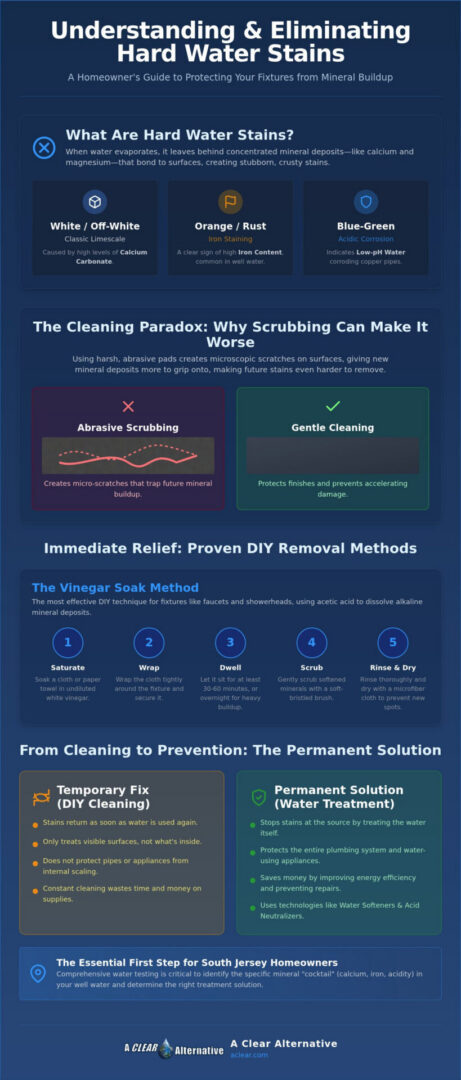
Hard water stains are more than just an eyesore; they’re a chemical footprint left behind by your home’s water supply. When water evaporates from your shower door or kitchen faucet, it doesn’t just disappear into thin air. It leaves behind concentrated mineral deposits that bond to the surface. Understanding the science behind these deposits is the first step in learning how to fix hard water stains for good. Limescale is the chalky, off-white crust that forms on faucets and showerheads due to high mineral concentration.
The primary culprits are calcium carbonate and magnesium. These minerals are naturally occurring in the earth and dissolve into the groundwater that eventually reaches your home. While they aren’t harmful to your health, they’re incredibly stubborn once they crystallize on your fixtures. You can identify exactly what’s in your water by the color of the residue it leaves behind:
- White or Off-White: This is classic calcium buildup, often called limescale.
- Orange or Rust: A clear sign of high iron content, which is common in private wells.
- Blue-Green: This indicates acidic, low-pH water that’s actually corroding your copper pipes.
The South Jersey Mineral Profile
In South Jersey, our water has a very specific personality. Homeowners in Tabernacle, Shamong, and Medford Lakes often deal with a “cocktail” of water issues. It’s rarely just simple hardness. Because many of these properties rely on private wells, we see a heavy overlap of calcium scale and iron staining. This combination creates a sticky, rust-colored film that’s much harder to remove than standard white scale. Additionally, the Pine Barrens region is known for naturally acidic water, which leads to those frustrating blue green stains in sinks and tubs.
Why Scrubbing Isn’t a Permanent Solution
If you feel like you’re stuck in a “revolving door” of cleaning, you’re right. As long as your water chemistry remains untreated, the stains will begin to reform the very next time you turn on the tap. It’s a losing battle because the visible spots are only the tip of the iceberg. The same mineral buildup is happening invisibly inside your pipes, dishwasher, and water heater.
There’s also the “Cleaning Paradox” to consider. Many homeowners try to fix hard water stains by using abrasive pads or harsh brushes. This creates thousands of microscopic scratches on your glass and chrome. These tiny grooves actually give minerals a better place to “grab” onto, making the next round of stains even harder to scrub away. Your home deserves a solution that protects its aesthetic value rather than slowly wearing it down.
How to Remove Hard Water Stains: 5 Proven DIY Methods
Once you see those crusty deposits, you need a strategy that goes beyond standard soap. Learning how to fix hard water stains requires a basic understanding of pH levels. Since mineral scale is alkaline, you need an acid to break those chemical bonds. Distilled white vinegar is the undisputed champion of DIY solutions. Its high acetic acid content dissolves calcium carbonate without damaging most standard finishes. It’s affordable, safe, and likely already in your pantry.
For lighter maintenance or a better scent, lemon juice offers a natural citric acid alternative. It’s perfect for small spots on chrome faucets. However, for severe cases, some homeowners reach for commercial removers containing phosphoric or sulfamic acid. Be careful here. These chemicals are powerful but can emit harsh fumes and irritate your skin. Always wear gloves and ensure the room is well ventilated before applying professional-grade cleaners. If you’re tired of researching how to fix hard water stains every weekend, these steps provide immediate relief.
Step-by-Step: The Vinegar Soak Method
This technique is the most effective way to address fixtures where scrubbing alone fails. It allows the acid to stay in contact with the minerals long enough to actually dissolve them.
- Saturate a cloth or paper towel with undiluted white vinegar until it is dripping.
- Wrap the cloth tightly around the affected faucet or showerhead and secure it with a rubber band.
- Allow it to dwell for at least 30 to 60 minutes. For heavy crust, leave it overnight.
- Remove the cloth and scrub the softened minerals gently with a soft-bristled toothbrush.
- Rinse the fixture thoroughly with clean water and dry it with a microfiber cloth to prevent new spots.
Removing Stains with Baking Soda and Hydrogen Peroxide
Vertical surfaces like shower walls and the deep corners of tubs need a solution that sticks. Mixing a thick paste of baking soda and a small amount of hydrogen peroxide creates a dual-action cleaner. The baking soda provides a mild, non-damaging abrasion, while the peroxide helps lift organic soap scum that often traps minerals. This combination is particularly effective for porcelain and fiberglass surfaces that can’t handle heavy scrubbing.
Apply the paste generously to stubborn spots and let it sit for 20 minutes. You’ll notice it start to work on the grime. Wipe it away with a damp sponge using circular motions to reveal the original shine. While these methods work for surface cleaning, they don’t address the underlying mineral levels in your supply. Before you stock up on more cleaning supplies, consider a comprehensive water test to see exactly what you’re fighting.
Surface-Specific Cleaning: Protecting Your Fixtures
Cleaning is not one-size-fits-all. When you’re looking at how to fix hard water stains, the material of your fixture determines the safety of your method. A common mistake is treating glass shower doors the same way you treat a porcelain toilet. On glass, mineral buildup can lead to “etching.” This is a permanent chemical change where the minerals actually eat into the glass surface. If you see a cloudy haze that won’t go away even after a vinegar soak, your glass might be etched beyond repair. You must act before the damage becomes structural.
Toilets and tubs often develop a stubborn “water line” ring that seems impossible to budge. While some online forums suggest using a pumice stone, be extremely cautious. Pumice is a volcanic rock that is harder than many modern porcelain glazes. One wrong move can leave permanent grey scratches that trap even more grime later. Stick to liquid-based dissolution methods to keep your bathroom looking premium. Kitchen appliances like coffee makers and dishwashers also suffer. For dishwashers, a cup of vinegar in a bowl on the top rack during a hot cycle can clear the spray arms and restore efficiency.
Restoring Glass Shower Doors
Prevention is the most powerful tool for glass. Using a squeegee after every shower takes thirty seconds but saves hours of scrubbing. It removes the water before the minerals have a chance to bond to the surface. For daily maintenance, a 50/50 mix of vinegar and water in a spray bottle works wonders. You can also apply a water-repellent coating to help water beads slide off before they dry. This simple layer of protection keeps your glass crystal clear and prevents the “cloudy” look that ruins a modern bathroom aesthetic.
Safe Cleaning for Sensitive Finishes
Modern aesthetics often feature natural stone or matte black finishes, which require a gentle touch. Never use vinegar or lemon juice on marble, granite, or limestone. The acid will etch the stone, leaving dull spots that require professional polishing to fix. For matte black fixtures, avoid any abrasive pads or harsh chemicals that can strip the delicate protective coating. Use only a soft microfiber cloth and a pH-neutral soap to preserve the finish. Ultimately, installing a whole house water filtration system is the only way to protect these high-end investments from the inside out. It’s the difference between fighting a daily battle and enjoying a maintenance-free home.
The Permanent Fix: Moving from Cleaning to Prevention
Scrubbing your fixtures is a reactive habit. To truly master how to fix hard water stains, you must move from temporary cleaning to systemic prevention. The gold standard for this is a water softener using ion-exchange technology. Unlike a basic sediment filter that only catches large particles, a softener works at a molecular level. It swaps out hard calcium and magnesium ions for soft sodium ions before the water ever touches your plumbing. This transformation ensures that the water coming out of your tap can’t leave a crust behind because the minerals are physically gone.
The return on investment for water treatment is immediate and measurable. Research shows that in areas with very hard water, heavy scale accumulation can reduce the lifespan of a water heater by 30% to 50%. By removing these minerals, you also use significantly less soap and detergent, as soft water allows cleaners to lather naturally. You’ll stop buying expensive chemical removers and spend your weekends enjoying your home instead of polishing it. The first step in this journey is professional well water testing to determine your specific mineral count.
Water Softeners vs. Iron Filters
In South Jersey, a standard water softener isn’t always the complete answer. If you’re seeing orange or rust-colored stains in Shamong or Tabernacle, you likely have high iron levels that a basic softener can’t handle alone. Dedicated iron and sulfur filtration systems are necessary to stop these metallic stains at the source. Similarly, if your fixtures show blue-green corrosion, you need acid neutralizers to balance your water’s pH and protect your copper pipes. We specialize in these local water profiles to provide a solution that actually works for your specific neighborhood.
Reverse Osmosis for Spot-Free Drinking Water
For the ultimate aesthetic and culinary experience, Reverse Osmosis (RO) systems are the final piece of the puzzle. While a softener treats the whole house, an RO system under your kitchen sink removes 99% of dissolved solids. This results in crystal-clear ice cubes and spot-free glassware that looks like it belongs in a showroom. To keep these systems running at peak efficiency, we offer a convenient water softener salt delivery service so you never have to lift a heavy bag again. If you’re ready to stop the cycle of scrubbing, schedule a custom water analysis with our team today.
Why South Jersey Homeowners Trust A Clear Alternative
Since 1991, A Clear Alternative has been a cornerstone of the South Jersey community. We’re a family-owned and operated business that believes your home’s water quality is the foundation of your quality of life. We don’t just sell equipment; we provide a modern, aesthetic-focused service that restores your confidence in your home. We treat your water like our own because we live and work in the same neighborhoods you do. From Tabernacle to Medford Lakes, we’ve spent over three decades perfecting the art of water chemistry.
Our approach is comprehensive and personalized. We understand that a “one size fits all” system from a big-box store won’t solve the unique challenges of your specific well. We combine laboratory-grade testing with 24/7 emergency support to ensure your home remains a sanctuary of clean, soft water. When you’re trying to figure out how to fix hard water stains for good, you need a partner who looks beyond the surface spots and addresses the root of the problem.
Our Local Expertise in the Tri-State Area
The water in our region is influenced by the Kirkwood-Cohansey aquifer. This source provides unique mineral profiles that national brands often misunderstand. Our technicians are local experts who know exactly why Shamong wells might show high iron while Medford homes struggle with low pH. This deep-rooted knowledge is why we’re the top choice for homeowners searching for water treatment companies near me. We’ve been committed to the communities of NJ, PA, NY, and DE since our founding, and that dedication shows in every system we install.
Start with a Professional Water Analysis
Many homeowners start their journey with a cheap DIY test kit. While these can provide a basic baseline, they often miss critical nuances and dangerous contaminants like lead or specific bacteria. A professional A Clear Alternative consultation is different. We provide a clear, logical explanation of your water’s profile without the heavy technical jargon. We focus on how your water affects your home’s aesthetic, your skin, and the longevity of your appliances. We’ll show you exactly how to fix hard water stains by showing you what’s actually in your pipes. Don’t leave your home’s health to chance. Schedule your professional water test today and take the first step toward a maintenance-free, spot-free lifestyle.
Restore the Luster of Your South Jersey Home
You don’t have to accept stubborn mineral buildup as a permanent part of your bathroom or kitchen. While DIY methods like vinegar soaks offer a temporary fix for existing spots, the only true way to master how to fix hard water stains is to address the chemistry of the water itself. Protecting your investment in modern fixtures and high-end appliances requires moving beyond the scrub brush and toward a systemic solution that stops scale before it forms.
Since 1991, our family-owned team has helped homeowners across NJ, PA, NY, and DE reclaim their time and their home’s aesthetic. With 24/7 emergency support and over three decades of local expertise, we understand the unique challenges of our regional aquifers. It’s time to stop fighting a losing battle against limescale and start enjoying the freedom of soft, crystal-clear water.
Get a Professional Water Test from A Clear Alternative and discover the custom filtration path that’s right for your family. You deserve a home that stays beautiful with ease.
Frequently Asked Questions
Is hard water bad for you or just your home?
Hard water is primarily an economic and aesthetic problem for your home rather than a direct health risk. The EPA does not set legal limits for hardness minerals like calcium and magnesium because they aren’t considered hazardous to ingest. However, these minerals can strip moisture from your skin and hair, leading to irritation or dullness. For your home, the impact is severe, often reducing appliance lifespan and increasing energy costs by 20% or more.
Can I use vinegar on my granite countertops to remove hard water spots?
You should never use vinegar, lemon juice, or any acidic cleaner on granite or marble countertops. The acid will chemically react with the natural stone, causing permanent dull spots known as etching. To protect your stone surfaces while learning how to fix hard water stains, use only pH-neutral cleaners specifically formulated for granite. If you have deep mineral buildup on stone, professional polishing may be required to restore the original luster and seal.
How do I know if I have hard water or acidic water?
You can usually tell the difference by observing the color of the residue left behind on your fixtures. Hard water typically leaves white, chalky, or off-white “scale” deposits. Acidic water, which has a low pH, often leaves telltale blue-green stains on sinks and tubs as it corrodes your copper plumbing. Because South Jersey water often contains a mix of both, a professional laboratory analysis is the only way to get an accurate reading.
Why are my “hard water” stains orange instead of white?
Orange or reddish-brown stains indicate a high concentration of iron in your water supply rather than just standard calcium hardness. This is extremely common for homeowners in Tabernacle and Shamong who rely on private wells tapping into local aquifers. While a standard water softener can handle minor amounts of iron, heavy orange staining usually requires a dedicated iron and sulfur filtration system to stop the discoloration at the source effectively.
Are hard water stains permanent if left untreated?
Hard water stains can become permanent if the minerals are allowed to “etch” into porous surfaces like glass or unsealed stone. Over time, the chemical bond between the minerals and the surface becomes so strong that it physically alters the material. On glass shower doors, this presents as a cloudy haze that no amount of scrubbing can remove. Acting early is the best way to prevent structural damage while learning how to fix hard water stains.
How much does a water softener cost to install in NJ?
The investment for a water softener installation in New Jersey depends on your home’s specific mineral profile and plumbing requirements. Factors such as the required flow rate, the presence of iron, and the complexity of your existing system all influence the final cost. We recommend starting with a professional water analysis to ensure you’re getting a system tailored to your needs. This prevents you from overpaying for a generic, “one size fits all” solution.
Will a water softener help with my low water pressure?
A water softener won’t directly increase your incoming water pressure, but it prevents the mineral buildup that often causes pressure to drop over time. Scale accumulates inside your pipes and showerheads, narrowing the path for water and effectively “choking” your flow. By removing these minerals, you stop the restriction from worsening. If you already have low pressure, you may need to clear existing scale from your aerators after installing your new treatment system.
How often should I have my well water tested in South Jersey?
You should have your well water tested at least once a year to ensure your filtration systems are performing correctly. In South Jersey, environmental factors and changes in the local water table can shift your water chemistry over time. Annual testing helps you catch issues like rising iron levels or pH imbalances before they cause visible damage to your home. It’s a simple, proactive step that ensures your water remains a source of comfort.