
How to Choose the Right Size Water Softener: The 2026 Homeowner’s Guide
Buying a water softener that’s too small for your home is like trying to cool a whole house with a single desk fan. It works too hard, wears out fast, and leaves you with the same scale buildup that ruins your appliances. Learning how to choose the right size water softener is the only way to protect your plumbing and stop wasting money on excess salt. If you’re tired of seeing white spots on your glasses or worrying about your water heater’s lifespan, you aren’t alone. Most homeowners feel overwhelmed by technical jargon like grains per gallon and regeneration cycles.
This guide simplifies the process for 2026. We’ll show you how to master the sizing math and why local South Jersey chemistry, especially high iron levels in areas like Tabernacle or Medford Lakes, requires a specific calculation. You’ll learn how to factor in every family member and every ppm of iron to ensure your system runs efficiently for 15 years or more. A Clear Alternative is here to help you stop guessing and start enjoying the soft, clean water your home deserves. It is about more than just a machine; it’s about the quality of life and confidence that comes with a perfectly balanced home.
Key Takeaways
- Learn why grain capacity is the secret to a system that lasts 15+ years without wasting salt or water.
- Discover how to choose the right size water softener by calculating your daily usage and local hardness levels with precision.
- Master the “Compensated Hardness” formula to account for the high iron levels found in South Jersey well water.
- Stop relying on tank size and start focusing on resin volume to avoid frequent, costly regeneration cycles.
- Understand why a professional laboratory-grade water test is the essential first step for any custom-sized solution.
Understanding Grain Capacity: Why Size Matters for Your Home
Many homeowners assume that picking a water softener is like buying a television; they think bigger is always better. In reality, finding the right size is about balance. Grain capacity is the total mineral-trapping potential of the resin tank. If you want to know how to choose the right size water softener, you must first understand that size refers to the system’s ability to remove hardness before it needs to clean itself through regeneration.
Think of your softener as a filter for dissolved rock. What is water softening? At its core, it is a chemical exchange where calcium and magnesium ions are swapped for sodium. When the resin beads are full of minerals, the system flushes them out with salt water. If your system is undersized, it will regenerate too frequently. This leads to high salt usage and premature resin wear. Conversely, an oversized system allows water to sit stagnant in the tank. This can lead to bacteria growth and a wasted initial investment. Professional sizing ensures your system hits the efficiency sweet spot, using just enough salt and water to keep your home protected.
Common Softener Sizes (32k, 48k, 64k Grains)
You will often see units labeled as 32,000, 48,000, or 64,000 grains. For a typical family of four in South Jersey, a 32,000 grain unit sounds sufficient on paper. However, the rated capacity is rarely the operational capacity you should plan for. To maximize salt efficiency, we often program systems to use less salt per cycle, which means they might only utilize 20,000 grains of that 32,000 grain total. This prevents the resin from becoming exhausted and ensures you always have soft water. Choosing a 48k or 64k unit might be necessary if your water has high mineral content or if your household usage is above average.
The Impact of Regeneration Frequency
The goal of proper sizing is to have your system regenerate once every 6 to 9 days. This frequency keeps the resin bed clean without wasting resources. If your system cleans itself every two days, you are throwing money down the drain. If it goes two weeks without a cycle, the resin beads can become packed with iron or sediment. A perfectly sized system reduces your long term maintenance costs and makes your water softener salt delivery service much more predictable. At A Clear Alternative, we look at your specific water usage patterns to find this rhythm, ensuring your home stays efficient year after year.
The Step-by-Step Sizing Calculation for Modern Households
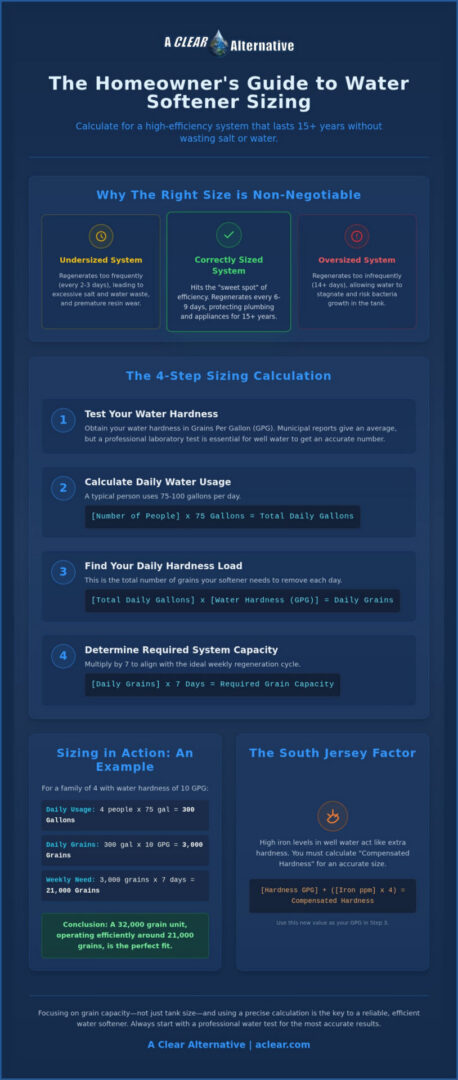
Sizing a system shouldn’t be a guessing game. It’s a precise calculation that ensures your home stays scale-free without wasting resources. If you’re wondering how to choose the right size water softener, follow these four steps to find your number. Knowing the exact requirements for your household prevents you from buying a unit that can’t keep up with your daily demands.
- Step 1: Determine your water hardness in Grains Per Gallon (GPG) through a professional test.
- Step 2: Calculate your daily water usage. A typical modern household uses 75 to 100 gallons per person each day.
- Step 3: Multiply your daily usage by your hardness level to find your Daily Hardness Grains.
- Step 4: Multiply that total by the number of days you want between regenerations.
Most experts suggest calculating your regeneration cycle based on a seven-day window. This timeframe keeps the resin bed fresh and prevents minerals from packing down too tightly. For example, a family of four using 300 gallons total per day with 10 GPG hardness needs to remove 3,000 grains daily. Over seven days, that is a 21,000-grain requirement. This math is the foundation of a reliable home water system.
Determining Your Water Hardness Level
Your starting point is always the hardness of your water. Municipal water reports provide a general average, but local well water is much more variable. Homeowners in Tabernacle and Shamong often face significantly higher hardness levels than those on city lines. A single neighbor’s reading might not match yours. This is why professional well water testing is the only way to get the math right. Without an accurate GPG number, the rest of your calculation is just a guess.
Accounting for Peak Flow Rates
Capacity isn’t just about grains; it’s also about flow. Modern homes have high-demand fixtures like rainfall showerheads and large soaking tubs. If your softener can’t keep up with your peak flow rate, you’ll experience a frustrating drop in water pressure. The size of your plumbing lines, typically 3/4-inch or 1-inch, dictates the type of control valve your system needs.
You need to distinguish between Service Flow Rate, which is the steady supply for normal use, and Peak Flow Rate, which is the maximum demand when two showers and a dishwasher run at once. A system that’s too small for your pipes acts as a bottleneck. We ensure your system handles your home’s maximum demand without a hiccup. If you want a system that fits your lifestyle perfectly, contact us for a custom sizing analysis today.
The South Jersey Factor: Adjusting for Iron and Low pH
South Jersey water isn’t just “hard.” It’s complex. If you live in Tabernacle, Shamong, or Medford Lakes, your well water likely contains high levels of “Clear Water Iron,” also known as ferrous iron. This invisible mineral creates a massive challenge for standard calculations. When you’re learning how to choose the right size water softener, ignoring iron is the fastest way to ruin a new system. Iron particles physically coat the resin beads inside your tank, “fouling” the bed and preventing it from grabbing calcium ions.
To fix this, we use the “Compensated Hardness” formula. For every 1 part per million (ppm) of iron detected in your water, you must add 3 to 4 grains of hardness to your total sizing number. This adjustment ensures your system has enough capacity to handle the extra mineral load. It also allows the system to trigger more aggressive backwashing to flush those sticky iron particles out before they can permanently damage the resin. Local expertise is the only way to avoid these common South Jersey pitfalls.
Compensating for Iron in Your Sizing Math
Let’s look at a real-world example. Imagine your professional test shows 10 grains of hardness. This sounds manageable for a standard unit. However, if that same test shows 2 ppm of iron, your “sizing hardness” jumps to 16 or 18 grains. If you bought a unit based only on the 10-grain figure, you would see orange staining on your laundry and fixtures within weeks. The softener would simply be overwhelmed by the uncounted iron.
In many homes across the region, we recommend specialized Iron and Sulfur Filtration Systems as a pre-treatment. This removes the bulk of the iron before it ever reaches your softener, significantly extending the life of your resin. Generic big-box guides often overlook this, leading homeowners to buy systems that fail long before their time. We focus on the total mineral profile to ensure your water stays crystal clear.
Low pH and Your Water Softener
The Pine Barrens region is famous for acidic water with a low pH. In Medford Lakes, it’s common to see pH levels well below 7.0. This acidity is “hungry.” It leaches copper from your pipes and eats away at the internal seals and valves of your water softener. If you don’t address this acidity, even the most expensive softener won’t last more than a few years. It becomes a cycle of constant repairs and frustration.
Sizing a system for an acidic home requires a “Whole House” strategy. We often pair softeners with an acid neutralizer to stabilize the water first. This protects your plumbing and your new softener investment. For the ultimate peace of mind, a whole house water filtration system ensures every drop of water is balanced, soft, and safe. Understanding how to choose the right size water softener in South Jersey means looking at the total chemistry, not just a single number on a chart.
Avoiding Common Sizing Mistakes: Why Professional Calibration Wins
When learning how to choose the right size water softener, many homeowners fall into the “bigger is better” trap. They assume a massive tank provides more protection. In reality, an oversized system can be just as problematic as an undersized one. One of the most common issues with oversized units is “channeling.” This occurs when water carves a single path through a large, underused resin bed. Instead of flowing through all the resin, the water takes the path of least resistance, effectively bypassing the softening process and “leaking” hard water into your home. It’s a frustrating technical failure that stems purely from poor sizing.
Another frequent error is buying based on physical tank dimensions rather than resin volume. The actual power of a softener is measured in cubic feet of resin, not the height of the cylinder. A tall tank with a small amount of resin won’t give you the performance you expect. You must also account for “Reserve Capacity.” This is the amount of soft water the system keeps in the tank to ensure you don’t run out on the day the system is scheduled to regenerate. Without this buffer, you’ll find yourself with hard water during your morning shower just because the system is waiting for its 2:00 AM cleaning cycle.
DIY Retail Units vs. Professional Grade Systems
Big-box retail stores usually sell “cabinet style” units where the salt and resin are in one plastic housing. These are built for price, not longevity. Professional grade systems use a two-tank design, separating the brine tank from the resin tank. This setup allows for much larger resin volumes and uses high-performance control valves like Clack or Fleck. These valves offer superior flow rates and are designed for easy maintenance. While a retail unit might offer a 1-800 number for help, a local, family-owned company like A Clear Alternative provides 24/7 emergency support. We ensure your system is a modern, reliable addition to your home, not a disposable appliance.
The Myth of the ‘Grain Capacity’ Label
Don’t take the number on the box at face value. A unit labeled as 32,000-grain capacity is rarely programmed to hit that limit. To maximize salt efficiency, we often calibrate these systems to regenerate at 24,000 grains. Salt efficiency decreases as you push a unit to its maximum grain limit. By leaving a little room at the top, the system uses significantly less salt per pound of hardness removed. This professional calibration saves you money and reduces the environmental impact of your system. If you want a system that is perfectly tuned for your home’s unique needs, schedule your professional calibration with A Clear Alternative today.
Finding Your Clear Alternative: Custom Solutions in South Jersey
Since 1991, A Clear Alternative has been the local authority on South Jersey water. We don’t rely on generic charts or retail guesswork. Instead, we use over three decades of specific data from Tabernacle, Shamong, and Medford Lakes to build systems that actually work. Learning how to choose the right size water softener is easier when you have a partner who understands the unique synergy between a softener and an acid neutralizer. In our region, you rarely need just one. We design custom solutions that address both hardness and low pH simultaneously, ensuring your system doesn’t just soften water but protects your entire plumbing infrastructure.
A custom-sized system is an investment that pays for itself. By perfectly matching the resin volume to your family’s needs, you’ll see a massive improvement in appliance longevity. Your water heater, dishwasher, and washing machine won’t have to fight against scale buildup every single day. You’ll also notice a dramatic drop in the amount of soap and detergent required for a deep clean. This isn’t just about technical specs; it’s about the quality of your daily life and the confidence that your home is running at peak efficiency.
Professional Water Analysis: The First Step
Our process begins with a comprehensive, laboratory-grade water analysis. We test for more than just calcium. Our technicians look at iron levels, pH balance, sulfur, and total dissolved solids. This data is the “DNA” of your home’s water supply. We then translate these complex lab results into a precise, custom system recommendation. If you’ve been searching for water treatment companies near me, you’ll find that our data-driven approach removes the risk of buying an ill-fitting retail unit.
The A Clear Alternative Difference
We are a family-owned and operated business, and that heritage defines how we treat our customers. Professional installation is a non-negotiable part of our service. We ensure every bypass valve is correctly positioned and every drain line is set up for maximum efficiency. Our commitment extends across the Tri-State area, serving homeowners in NJ, PA, NY, and DE with the same level of expert care. We don’t just install a tank and leave. We provide ongoing support through reliable salt delivery and annual maintenance checks to keep your water perfect for 15 years or more. Contact us for a professional water analysis and sizing consultation to start your journey toward a better home environment today.
Secure Your Home’s Future with the Perfect Fit
Finding the right water softener is more than a technical task; it’s a commitment to your home’s longevity and your family’s comfort. You now know that mastering how to choose the right size water softener requires looking beyond the basic labels. It’s about balancing your household’s peak flow rates with the specific “compensated hardness” found in South Jersey well water. By accounting for iron levels and pH balance, you ensure your system runs efficiently without wasting salt or wearing out your appliances early.
A Clear Alternative has been serving South Jersey since 1991. As a family-owned and operated business, we prioritize your peace of mind with 24/7 emergency support and custom solutions that big-box retailers simply can’t match. We’re ready to help you stop guessing and start enjoying the benefits of perfectly soft water. Get Your Water Tested and Sized by Our South Jersey Experts today. You deserve the confidence that comes with a system designed specifically for your life, your home, and your unique water profile.
Frequently Asked Questions
How do I know if I need a 32,000 or 48,000 grain water softener?
You determine the capacity by multiplying your household’s daily water usage by your hardness level. A 32,000 grain unit might suffice for a small family with moderate hardness. However, if you have high iron or a larger household in Tabernacle, a 48,000 grain system is often better. This larger capacity allows the system to regenerate less frequently, which saves salt and extends the life of the resin beads.
Does the number of bathrooms in my house affect the softener size I need?
While the number of people drives the capacity, the number of bathrooms determines the required flow rate. If your Medford Lakes home has three or more bathrooms, you need a control valve and tank size that can handle a high peak flow. This ensures that you don’t experience a drop in water pressure when someone starts a load of laundry while you’re taking a shower.
What happens if I choose a water softener that is too small for my family?
An undersized system will struggle to keep up with your demand, leading to several issues. It’ll regenerate too often, which wastes significant amounts of salt and water. You’ll also likely experience hard water “breakthrough” where minerals enter your pipes before the next cleaning cycle. This puts your appliances at risk and is a common mistake when learning how to choose the right size water softener without professional help.
How much iron can a standard water softener remove before I need a separate filter?
Standard softeners can typically handle up to 3 parts per million (ppm) of clear water iron. If your Shamong well test shows levels higher than this, the iron’ll likely “foul” the resin bed and cause orange staining. In these cases, we recommend installing one of our specialized Iron and Sulfur Filtration Systems. This pre-treatment protects your softener and ensures your water remains crystal clear and stain free.
Can I use well water test results from five years ago to size a new system?
You shouldn’t ever rely on old data because groundwater chemistry is constantly shifting. In the Pine Barrens, factors like seasonal rainfall and local construction can alter your pH and mineral levels over time. Using a five-year-old test to size a new system often leads to incorrect calibration. A Clear Alternative provides comprehensive lab testing to ensure your 2026 sizing is based on your water’s current reality.
Is it better to have a single-tank or dual-tank water softener system?
Is it better to have a single-tank or dual-tank water softener system?
It depends on your household’s needs and lifestyle. A single-tank system is cost-effective but goes offline during its 2:00 AM regeneration cycle. If you’ve a large family or run appliances at night, a dual-tank system is superior. These twin-alternating units provide soft water 24/7 because one tank is always in service while the other cleans itself. This setup offers maximum convenience and efficiency for busy modern homes. Professional solutions from CastleGuard often include these advanced dual-tank configurations for uninterrupted whole-home water protection.
The efficiency sweet spot for most systems is to regenerate once every 6 to 9 days. This frequency prevents the resin bed from becoming too packed with minerals while avoiding the waste of daily cleaning cycles. If your system regenerates every two days, it’s likely undersized for your needs. Conversely, waiting longer than ten days can allow bacteria to grow in the resin tank, which impacts your water quality.
Will a larger water softener use more salt than a smaller one?
A larger system doesn’t automatically mean higher salt costs. In fact, a properly sized larger unit often uses less salt over time because it regenerates less frequently than a smaller, struggling system. The key is professional calibration. We program your system to hit the maximum salt efficiency for your specific usage patterns. This ensures you get the best performance without seeing a spike in your monthly maintenance or salt delivery expenses.