
Best Under Sink Filter for Lead Removal: A 2026 Buying Guide
The best under sink filter for lead removal isn’t necessarily the one with the most stages. It’s the model with independently verified lead-reduction performance that fits your water and household. With conflicting product claims, it’s understandable to wonder which certification matters and whether lead is coming from your water source or the pipes and fixtures in your home.
This guide makes the choice clearer. You’ll learn how reverse osmosis and carbon-block filters differ, what to look for in a model-specific NSF/ANSI 53 or 58 lead-reduction claim, and how to compare installation and filter replacement needs. The EPA’s health goal for lead in drinking water is zero, so don’t rely on a general performance label or your utility’s results to tell you what’s coming from your tap.
We’ll also explain when a lead-specific tap-water test can help you understand your risk. A Clear Alternative’s free water analysis can help identify broader treatment needs, while choosing a lead filter still depends on evidence for the exact model and your home’s water.
Key Takeaways
- Choose the best under sink filter for lead removal by matching verified performance for the exact model to your water and household needs.
- Compare carbon filtration and reverse osmosis as different approaches, then check what each model’s lead-reduction evidence actually covers.
- Look beyond the filter type: installation requirements and replacement needs can shape how practical a system is for your home.
- Use a lead-specific laboratory test to assess lead at the tap. A general water analysis is a separate step and shouldn’t be treated as a lead test.
- Follow a clear decision path: identify your water source, test appropriately, verify model claims, and plan for ongoing upkeep.
Why the Best Under-Sink Filter for Lead Removal Starts With Your Water
An under-sink lead filter is a point-of-use treatment system installed beneath a sink and connected to a drinking-water tap. It treats water at that location, rather than addressing every tap throughout the home. That makes the exact model and the water reaching your chosen tap central to the decision.
In Medford Lakes, as elsewhere, don’t assume the water’s condition based only on its source. Lead can enter water as it moves through service lines, household pipes, solder, or fixtures. Two homes served by the same water system may have different plumbing and different results at the tap. A filter’s lead-reduction claim also applies to a particular model, not automatically to every system made by that brand.
Can you tell whether water contains lead by its taste or appearance?
No reliable visual or sensory check can tell you whether lead is present. Water may look clear and have no unusual taste or smell while still containing lead. Don’t wait for a change in appearance or for someone to feel unwell before investigating. Testing water at the tap is the practical way to find out what’s in the water you drink. For general background on exposure and health effects, see Lead poisoning.
Lead exposure can harm health, and children are especially vulnerable. The EPA’s health goal for lead in drinking water is zero; a regulatory action level is not a declaration that water below it is risk-free. If you’re concerned about a particular tap, arrange a lead-specific test through a qualified laboratory or local public-health resource. A utility report or general water information may not reflect conditions inside your home.
Testing helps define the problem before you compare equipment. A result from the kitchen tap, for example, gives you more relevant information for choosing treatment there than an assumption based on a neighborhood or water source alone. It also gives you a reference point for evaluating the system’s stated performance and deciding whether follow-up testing is appropriate.
What does a lead-reduction claim actually tell you?
A manufacturer’s statement is not the same as independent verification. Look for certification or test documentation that identifies the exact model and specifically covers lead reduction, rather than a broad claim about contaminant reduction. Standards such as NSF/ANSI 53 or NSF/ANSI 58 may be relevant, depending on the filtration technology, but the model and contaminant scope still matter.
Model-specific lead-reduction evidence shows that an independent test or certification applies to that exact filter model’s ability to reduce lead under stated test conditions. Those conditions and the tested performance scope matter. A claim doesn’t establish identical results for every household, water condition, or filter after its service life. “Reduces lead” also doesn’t mean “removes all lead.” Treat the wording as a defined performance claim, not a guarantee of complete removal.
That’s why the best under sink filter for lead removal is not simply the system with the longest list of claimed benefits. Start with tap-water testing, then match the result to evidence for the exact model you’re considering. This sequence keeps the decision grounded in your household’s water, rather than assumptions about source water or generalized product promises.
How Under-Sink Filters Reduce Lead and What Certification Means
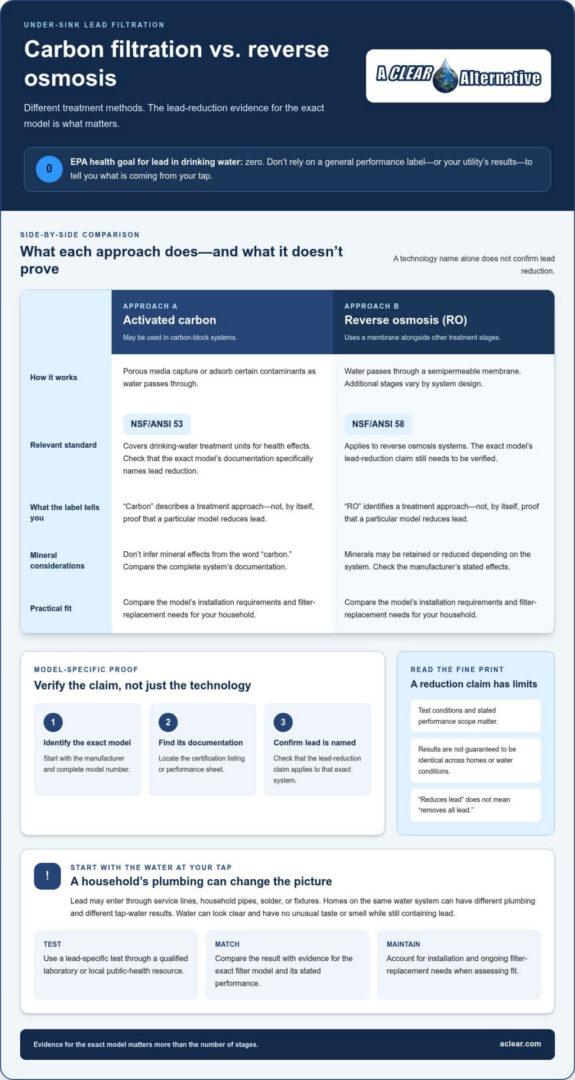
Under-sink systems use different technologies, and the label alone doesn’t tell you how well a particular model reduces lead. Activated carbon filters use porous media to capture or adsorb certain contaminants as water passes through. Reverse osmosis (RO) systems push water through a semipermeable membrane, alongside other treatment stages that vary by design. These are distinct approaches, not interchangeable promises.
For either technology, rely on evidence for the exact system. NSF/ANSI 53 covers drinking-water treatment units for health effects, while NSF/ANSI 58 applies to reverse osmosis systems. A reference to either standard isn’t proof that every product in a brand’s range is certified for lead. Certification is contaminant-specific: evidence for chlorine, for example, doesn’t establish lead reduction. The EPA’s Lead in Drinking Water Information explains how lead can enter drinking water and why reducing exposure matters.
How do carbon filters and reverse osmosis differ for lead reduction?
Carbon media and RO membranes work differently, and neither technology label by itself confirms lead reduction. A carbon-based system may use one or more filtration stages; an RO system may combine a membrane with additional filters. The specific design also affects whether minerals are retained or reduced. Check the model’s documentation for its lead claim and details on what else the system is designed to reduce.
This distinction helps with a common trade-off: shoppers may want to reduce lead while retaining minerals. Don’t assume the answer from “carbon” or “RO” alone. Find the manufacturer’s documentation for the complete system, including its treatment stages and stated performance. If mineral content matters to you, compare the system’s documented effects rather than inferring them from the filtration method.
How can you verify a filter’s lead-reduction certification?
Start with the manufacturer and complete model number, then locate its certification listing or performance sheet. Confirm that lead is named as a reduction claim and that the listing applies to the system you’re considering. A product tested under a standard isn’t automatically certified by an independent organization, so look for clear certification details and the certifier’s listing.
Certification scope is specific to the listed model and contaminant: verify that the exact system is independently certified for lead reduction, not merely that it references an NSF/ANSI standard. Also read the stated test conditions and replacement guidance. Certification supports a defined performance claim; it doesn’t promise complete lead removal or identical results in every home. Don’t transfer a certification from one model to another, even if the products look similar or share a product family.
The best under sink filter for lead removal is the one whose exact-model evidence fits your needs, not simply the technology with the most familiar name. A Clear Alternative’s free water analysis can help you understand broader water-treatment needs. It’s a separate step from verifying lead-specific certification or arranging a lead-specific test.
Compare Under-Sink Lead Filters Using These Buying Criteria
A useful comparison starts with evidence, not a brand ranking. For every candidate, record the full model number and check whether lead reduction is explicitly covered for that exact system. Then compare how it fits beneath your sink, which water it treats, and what upkeep the manufacturer specifies. If a detail isn’t documented, mark it as unknown rather than assuming models in the same product line share the same performance.
Which specifications matter most when comparing lead filters?
Start with the lead-reduction evidence. Check that the documentation names lead, identifies the precise model, and describes the scope of the claim. A general reference to NSF/ANSI 53 or NSF/ANSI 58 isn’t enough on its own. Next, review the product documents for installation requirements, which tap or water line is treated, replacement components, and maintenance instructions.
Plan for upkeep before choosing. Filters and other replaceable components need attention according to the manufacturer’s guidance. An overdue replacement can make it harder to rely on the stated performance. Confirm that the specified replacements are available through the manufacturer’s documented channels, and note any maintenance steps you’ll need to keep up with. Don’t compare systems using guessed replacement intervals or costs.
Should you choose reverse osmosis or a carbon-based under-sink system?
Neither technology is always the better choice. Compare verified lead evidence first, then weigh the documented setup and maintenance against your household’s water needs. Mineral retention is a separate preference, not proof of lead reduction. System design determines which minerals and other substances are retained or reduced, so rely on product documentation rather than assumptions about filtration type.
The best under sink filter for lead removal is the model that pairs relevant lead-specific evidence with practical installation and maintenance requirements for your home. Keep the source documents beside your comparison so you can distinguish verified specifications from general marketing claims.
Choose and Maintain a Lead Filter Based on Testing and Household Needs
A sound filter decision follows a few clear steps. Your water source guides what to investigate, testing helps define the concern, and model-specific documentation shows whether a system’s lead claim fits. Then plan for upkeep so the filter remains part of your household routine, not a one-time purchase you forget to maintain.
- Identify your water source. Find out whether your home uses a private well or a public water supply. Municipal water reports describe the utility’s system, while conditions at an individual tap can also be affected by home plumbing. Private-well owners should consult current local or state guidance about which water tests are appropriate. A well water testing guide can help you understand the broader testing process.
- Test for the concern you’re addressing. Don’t use appearance, taste, or a general water analysis as a substitute for a lead-specific laboratory test. If lead is your concern, arrange testing that specifically measures lead in water from the relevant tap. For municipal supplies, review your utility’s information and local guidance, but remember that system-wide results may not describe conditions at your own faucet.
- Match results to model evidence. Once you have relevant results, compare them with documentation for the exact filter model. Confirm that lead reduction is explicitly included in the model’s independent certification or test scope. A general statement about filtration, or a certification covering a different contaminant, doesn’t answer the lead question. The whole-house filtration guide can also help you consider whether your household has broader treatment needs beyond one drinking-water tap.
- Plan for continued care. Read the manufacturer’s instructions for replacement and maintenance before choosing. Note the required replacement components, the manufacturer’s stated schedule, and any care steps. Follow those instructions rather than assuming one filter’s upkeep applies to another model.
What should you do before buying an under-sink filter?
Keep your test results and the filter’s model-specific documentation together. This makes it easier to see whether the system’s stated lead-reduction scope addresses your concern and whether its setup suits the intended tap. A general water analysis and a lead-specific laboratory test serve different purposes. A Clear Alternative’s free water analysis can help you understand broader treatment needs, but it should not be treated as a test for lead.
What maintenance should buyers plan for?
Make replacement instructions easy to find, and add the manufacturer’s stated maintenance steps to your household plan. Don’t assume a filter is still performing as claimed if required parts haven’t been replaced according to its instructions. The best under sink filter for lead removal is a fit for your water needs and your ability to maintain it over time.
For a useful first step in understanding broader water-treatment needs, schedule a free water analysis. It can inform the wider treatment decision, while lead-specific testing and model evidence remain separate parts of choosing a lead-reduction system.
Get Help Choosing a Lead-Reduction Approach in South Jersey
Choosing a lead-reduction approach comes down to three practical checks: verify lead-reduction evidence for the exact model, match the system to your household’s water needs, and understand how to maintain it. Local context can guide the wider treatment conversation, but it can’t replace lead-specific testing or model-specific performance documentation. Homes in the same area may have different water conditions and plumbing.
How can A Clear Alternative help with water treatment decisions?
The company provides water treatment, reverse osmosis systems, and free water analysis. Operating since 1991, it has served 9,000+ customers.
A free water analysis can be a helpful starting point for understanding broader water-treatment needs and considering which approach may suit your home. It is separate from a lead-specific laboratory test, so don’t treat it as confirmation that your tap water does or doesn’t contain lead. If lead is your concern, use testing that specifically measures lead, then compare the result with evidence for the exact filter model under consideration.
This keeps the decision focused. A Clear Alternative installs water-treatment systems, including reverse osmosis systems, as part of addressing broader water needs. The lead-reduction claim still needs to be supported by documentation for the specific model. A general technology label alone doesn’t prove lead performance.
What is a practical next step for South Jersey homeowners?
Bring together what you know about your water source, any relevant test results, and the filter model’s documentation. Use those details to clarify whether your priority is treatment at one drinking-water tap or a wider water-treatment concern. Keep maintenance requirements in view, too. A system is a better long-term fit when its documented care and replacement needs are realistic for your household.
If installation is the right next step, most A Clear Alternative installations are completed within 24 hours. That timing is general and isn’t a promise for a particular system or project. The best under sink filter for lead removal still depends on verified model evidence and your home’s needs, not on installation timing alone.
Ready to discuss your water concerns and broader treatment needs? Request your free water analysis. It’s a useful starting point for a tailored conversation, while lead-specific testing remains the way to assess lead at your tap.
Take the Next Step Toward a Better-Fit Water System
Your next move doesn’t have to be choosing a filter from a crowded product list. Start with a clear picture of your household’s water concerns, then use that context to make a confident, practical decision. The best under sink filter for lead removal is one supported by evidence for its exact model and suited to your home’s needs and maintenance routine.
A broader water-treatment conversation can help you identify what else may matter to your household. A free water analysis can support that conversation, but it isn’t a substitute for a lead-specific test or model-specific certification evidence. Keep those steps distinct, and you’ll be better prepared to choose a system without relying on broad promises.
Request your free water analysis and take a thoughtful first step toward a water-treatment approach that fits your home. With the right information in hand, you can move forward with greater clarity and confidence.
Frequently Asked Questions
Can boiling water remove lead?
No. Boiling water doesn’t remove lead, and evaporation may leave lead more concentrated in the remaining water. Don’t boil water as a lead-treatment method or use it to prepare infant formula if you suspect contamination. Choose another water source while you arrange lead-specific testing and follow local public-health guidance. Boiling may address some microbes, but it doesn’t make lead-contaminated water safe.
Can an under-sink filter remove lead while keeping minerals in the water?
It depends on the exact system, so check both its lead-reduction evidence and documentation about mineral content. Some designs may reduce certain minerals along with other substances; others may retain more. Don’t assume a carbon-based filter keeps minerals or that every reverse osmosis system removes them in the same way. If mineral content matters to you, treat it as a separate product specification to compare after confirming lead performance.
How often should you replace an under-sink lead filter?
Follow the replacement schedule for your exact model. The interval can vary by system design and the manufacturer’s stated conditions, so a generic schedule may not fit your filter. Keep the manual or product sheet near the sink, record the installation date, and note the specified replacement components. If your household uses more water than usual or the instructions give usage-based limits, track those details too.
Is a water-filter pitcher as effective as an under-sink filter for lead?
Not automatically. A pitcher and an under-sink system should be compared by the lead-reduction evidence for each exact model, not by format alone. Look for lead named in the product’s independent certification or test documentation, then check the stated conditions and replacement requirements. A pitcher may suit a household that prefers a portable option, but convenience doesn’t establish lead performance. Don’t assume one category outperforms the other without model-specific evidence.
Can lead get into drinking water from household plumbing?
Yes. Lead can enter water as it passes through plumbing components, including service lines, solder, or fixtures. For example, a sample from one tap may not reflect another tap if their plumbing differs. If you’re investigating a concern, collect samples according to the laboratory’s instructions and identify the tap tested. A clear appearance or an unchanged taste doesn’t rule out lead.
Does a lead filter work for private well water?
A filter with model-specific lead-reduction evidence may be considered for well water, but first test the water and review the manufacturer’s conditions for that system. Well-water characteristics can differ from one property to another and may affect which treatment approach is suitable. If you’re in Tabernacle, Shamong, or Medford Lakes, use local or state guidance to determine appropriate well testing and keep results for treatment planning.
How can I tell whether an under-sink filter is certified to reduce lead?
Check the exact manufacturer and model number in the certifier’s product listing or the manufacturer’s documentation. Confirm that lead is specifically named, not just a different contaminant or a general reference to NSF/ANSI 53 or 58. The best under sink filter for lead removal is supported by evidence that applies to that model and its stated lead-reduction scope. A standard reference alone doesn’t prove every model in a product range is certified for lead.