
Acid Neutralizer vs. Water Softener: Which One Does Your Well Water Need?
Imagine finding a blue-green stain in your white bathtub or discovering a pinhole leak in a copper pipe that could eventually lead to a $15,000 repiping bill. These aren’t just random house headaches; they’re urgent signals from your well. When you’re staring at a confusing water test, the acid neutralizer vs water softener debate can feel like a high-stakes guessing game. One treats the aggressive chemistry that eats your plumbing, while the other handles the minerals that leave your skin dry and your laundry stiff.
It’s exhausting to deal with itchy skin or the constant worry that your pipes are thinning from the inside out. You want a home that runs effortlessly and water that enhances your lifestyle. We’ve helped South Jersey families master their water chemistry since 1991, and we know that clarity starts with the right information. This guide will give you a clear understanding of your specific water problems and a roadmap for installation that saves you money long-term. We’ll break down exactly how these systems work together to deliver the safe, pH-balanced water your family deserves.
Key Takeaways
- Identify whether your well water needs pH correction to stop pipe leaks or mineral removal to eliminate scale and skin irritation.
- Gain clarity on the acid neutralizer vs water softener debate by understanding how each technology interacts with your plumbing and appliances.
- Master the “Neutralizer First” installation rule to ensure your water treatment sequence maximizes the lifespan of your systems.
- Learn how to interpret South Jersey water trends and why professional testing is the only way to avoid costly equipment mistakes.
- Compare maintenance requirements, such as media replenishment and salt levels, to choose a solution that offers total peace of mind.
The Core Difference: pH Correction vs. Mineral Removal
Your well water is a complex cocktail of chemistry and physics. While they might look like identical twin tanks sitting in your basement, the internal technology of an acid neutralizer vs water softener serves two completely different masters. One is a chemist that balances your water’s pH; the other is a filter that extracts physical rock from your pipes. Understanding which one you need starts with looking at your fixtures.
South Jersey homeowners face a unique challenge. The Pine Barrens region is famous for its “cedar water,” which is naturally rich in organic acids and carbon dioxide. This makes our local well water exceptionally aggressive toward copper plumbing. At the same time, many wells in areas like Tabernacle and Medford also pull from mineral-heavy aquifers. This means your home might be fighting a two-front war against both corrosion and scale buildup simultaneously.
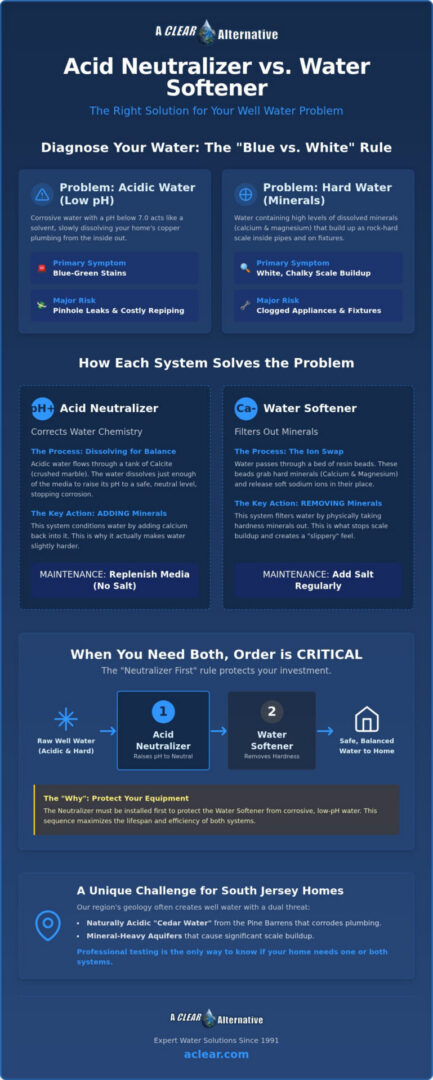
You can often diagnose your primary issue with the “Blue vs. White” rule. If you see blue-green stains on your porcelain or around your drains, your water is eating your copper pipes. If you see white, crusty, chalky buildup on your showerhead or spotted glassware, you have a mineral problem. Acid neutralizers stop the blue; water softeners stop the white.
Understanding Acidic Water (Low pH)
The pH scale runs from 0 to 14, with 7.0 being perfectly neutral. In our region, it’s common to find well water testing between 5.5 and 6.5. Anything below 7.0 is technically acidic. This acidity acts like a slow-motion solvent, dissolving the metal in your pipes and water heater. Beyond the structural damage, acidic water often leaves a sharp, metallic taste in your mouth and can even give blonde hair a subtle greenish tint from the dissolved copper.
Understanding Hard Water (Minerals)
Hardness isn’t about acidity; it’s about dissolved solids. When rain filters through limestone or gypsum, it picks up calcium and magnesium. We measure this “hardness” in Grains Per Gallon (GPG). Anything over 7 GPG is considered hard and will eventually choke your appliances with scale. To fix this, you need to understand How Water Softeners Work. These systems use a process called ion exchange to swap those “hard” minerals for “soft” sodium ions, protecting your skin, laundry, and dishwasher from the abrasive effects of rock-heavy water.
Mechanical Deep Dive: How Each System Works
To the untrained eye, the equipment in your utility room looks like a pair of silent sentinels. However, the internal mechanics of an acid neutralizer vs water softener operate on entirely different scientific principles. While one system relies on the slow, natural dissolution of minerals to balance chemistry, the other uses high-tech resin beads to physically swap out unwanted elements. Knowing these mechanics helps you understand why your maintenance routine looks different for each. One is a matter of chemistry; the other is a matter of physics.
The Neutralization Process: Dissolving for Balance
An acid neutralizer acts as a sacrificial system. Inside the tank is a bed of Calcite, which is essentially high-purity crushed marble. As your acidic well water flows through this bed, it naturally dissolves the Calcite. This process is beautifully self-correcting. The water only absorbs as much calcium as it needs to reach a neutral pH. If your water is particularly aggressive, we might blend in Magnesium Oxide to give the process a boost. Because the media is literally sacrificed to save your pipes, you don’t need salt, but you’ll need to replenish the media periodically to maintain the balance.
The Softening Process: The Ion Swap
A water softener is a masterpiece of chemical engineering. It uses a process called ion exchange. Inside the tank are millions of tiny, negatively charged resin beads. These beads act like magnets, grabbing onto hard, positively charged calcium and magnesium ions. In exchange, they release a tiny, harmless amount of sodium. This swap is the gold standard for Understanding Water Hardness and protecting your home’s aesthetic surfaces from scale. Eventually, these beads get full and need to be cleaned. This is where the regeneration cycle happens, using a salt brine to flush the minerals away. To keep this cycle running smoothly, many South Jersey residents rely on a water softener salt delivery service to ensure they never run out of supplies.
The fundamental difference is that neutralizers condition the water by adding something to it, whereas softeners filter the water by taking something out. Because the neutralizer adds calcium to raise the pH, it actually makes the water slightly harder as a byproduct. This is why many homeowners find that a standalone neutralizer isn’t enough to achieve that premium, silky water feel. If you’re ready to upgrade your home’s experience, a professional system check can pinpoint exactly how these mechanics should work for your specific well.
Acid Neutralizer vs. Water Softener: Side-by-Side Comparison
Choosing between an acid neutralizer vs water softener isn’t just about the initial setup; it’s about the long-term rhythm of your home maintenance. These systems have different lifespans and care requirements that dictate your future chores. For instance, high-quality softener resin can last 10 to 15 years before it loses its ability to swap ions effectively. In contrast, the Calcite media in a neutralizer is a consumable material. It physically disappears as it works, meaning the tank’s effectiveness drops as the media level lowers over time.
Maintenance and Operating Requirements
Neutralizers typically require a professional “top-off” once a year. During this visit, a technician adds fresh Calcite or Magnesium Oxide to replace what has dissolved into your water. In contrast, water softeners need a monthly glance at the brine tank to ensure there is enough salt for the regeneration cycle. Modern 2026 systems feature high-efficiency control valves and smart sensors that minimize waste, but they still rely on a steady power source to track your usage. To ensure your equipment is actually doing its job, scheduling professional well water testing is the only way to verify performance before a small chemistry imbalance becomes a major repair.
Protecting Your Home Investment
The real value of these systems lies in what you don’t see happening behind your walls. When treating corrosive water, an acid neutralizer serves as a bodyguard for your copper pipes, preventing the pinhole leaks that lead to mold and water damage. Softeners take the lead on appliance protection. By removing minerals, they prevent the heating elements in your water heater from burning out prematurely and keep your dishwasher running at peak efficiency. While both systems save money over the long term, they protect different parts of the home.
Environmental footprints also differ between the two. Softeners discharge a salt brine during their backwash cycle, which requires proper drainage planning to protect your septic system or local soil. Neutralizers also backwash to fluff the media and remove trapped sediment, but the discharge is mineral-heavy rather than salty. Balancing these needs ensures your home remains a sanctuary of clean, safe water without unnecessary stress or unexpected plumbing emergencies.
The ‘Both’ Scenario: Order of Installation Matters
In South Jersey, the conversation isn’t usually about choosing an acid neutralizer vs water softener. It’s about how to make them work together. Because our local aquifers often deliver water that is both acidic and mineral-heavy, a single tank rarely provides the total transformation your home deserves. However, simply hooking up both systems isn’t enough. The sequence in which your water travels through these tanks determines whether your equipment lasts for a decade or fails in a few years.
The “Neutralizer First” rule is the golden standard for a reason. Aggressive, low-pH water is a bully. If it enters your water softener first, it will begin to degrade the delicate resin beads inside the tank. Over time, this acidity turns the high-tech resin into a mushy, ineffective mess, forcing an expensive replacement. By neutralizing the acidity at the start of the line, you create a safe environment for the rest of your filtration equipment to do its job.
There is also a mathematical reason for this order. As we discussed earlier, an acid neutralizer works by dissolving Calcite into your water. This process intentionally increases your water’s hardness to balance the pH. If you were to soften the water first and then neutralize it, you would simply be adding hardness back into your “soft” water. By placing the neutralizer first, the softener can catch both the original minerals and the “hardness bump” created during the neutralization process.
The Step-by-Step Treatment Train
To achieve that premium, crystal-clear water feel, we recommend a logical progression of treatment. This “treatment train” ensures each component performs its specific role without being overwhelmed by unnecessary debris or harsh chemistry.
- Step 1: Sediment Filtration. A simple pre-filter catches sand and grit before they can clog your main systems.
- Step 2: Acid Neutralizer. This tank stabilizes your pH, protecting your copper pipes and the downstream equipment.
- Step 3: Water Softener. The final touch that removes calcium, magnesium, and the added Calcite for silky, scale-free water.
When a Single System Isn’t Enough
Every well is a unique fingerprint. Sometimes you aren’t just dealing with pH and hardness; you might also have iron that stains your laundry or sulfur that creates a “rotten egg” smell. While “all-in-one” units claim to handle everything, they often struggle with the complex chemistry found in Tabernacle and Shamong. A multi-tank solution is significantly more reliable because it allows us to fine-tune the media for each specific problem. If you’re tired of guessing which system will actually work, it’s time to talk to water treatment companies near me to design a custom configuration for your home.
Choosing the Right System for Your South Jersey Home
Selecting an acid neutralizer vs water softener shouldn’t be a shot in the dark. Your well is a unique gateway to the Kirkwood-Cohansey aquifer system, and its chemistry can change from one acre to the next. In 2026, we’re seeing more variability than ever in local wells. A professional lab test is the only way to avoid the frustration of installing a system that doesn’t solve your actual problem. Guessing leads to wasted money; data leads to clear, safe water.
Understanding the nuances of an acid neutralizer vs water softener is the first step toward a home that feels as modern and efficient as it looks. Before you commit to a system, ask your water professional these specific questions:
- Does my water test show both acidity and hardness?
- Is this system sized for my home’s peak flow rate?
- How will the New Jersey Private Well Testing Act (PWTA) 2026 requirements for PFOA and PFOS affect my filtration needs?
- What is the long-term maintenance schedule for this specific media?
The Local Water Quality Landscape
The Pine Barrens region provides some of the most unique water in the country. While it’s naturally filtered by our sandy soil, it remains highly susceptible to low pH levels. In Tabernacle and Medford Lakes, we often find pH levels dipping into the 5.0 range, while Shamong wells might show higher mineral hardness. This geographic lottery means your neighbor’s solution might not work for you. We strongly encourage every homeowner to get a South Jersey-specific water analysis to understand the exact balance of acidity and minerals in their supply.
Next Steps for Clean Water
We believe water treatment should feel like an upgrade to your lifestyle, not a technical burden. Since 1991, our family-owned team has focused on solving the specific chemistry issues that South Jersey families face every day. We don’t just sell tanks; we provide the diagnostic authority needed to protect your home’s infrastructure and your family’s health. When you choose a local partner, you gain access to 24/7 emergency support and a team that understands the local regulatory changes affecting our area as of September 2026.
Our installation process is designed to be seamless and discreet. We handle the heavy lifting, ensuring your treatment train is configured in the correct order to maximize the life of your resin and Calcite. You’ll notice the difference immediately in the clarity of your glassware and the softness of your skin. Contact A Clear Alternative today for your professional water analysis!
Transform Your Home with Professional Water Clarity
Your journey to perfect water starts with a simple realization: you don’t have to settle for blue stains or dry skin. By understanding the critical differences in the acid neutralizer vs water softener debate, you’ve already taken the first step toward protecting your home’s plumbing and your family’s comfort. Whether you’re stopping aggressive acidity or stripping away scale-building minerals, the right configuration ensures your appliances run efficiently for years to come.
Since 1991, our family-owned team has specialized in solving the unique chemistry challenges of South Jersey wells. We’re proud to serve neighbors across NJ, PA, NY, and DE with 24/7 emergency support and a commitment to modern, effective solutions. Don’t let confusing water tests hold you back from the quality of life you deserve. We’re here to turn your technical water concerns into a seamless, high-end experience that enhances your daily routine.
Schedule Your Professional Water Analysis with A Clear Alternative and take control of your well water today. You’ll love the way your home feels when your water is finally in perfect balance.
Frequently Asked Questions
Can I use a water softener instead of an acid neutralizer?
No, you cannot swap one for the other because they solve fundamentally different problems. A water softener is designed to remove calcium and magnesium minerals that cause scale. It has no chemical mechanism to raise the pH level of acidic water. In the acid neutralizer vs water softener debate, it’s important to remember that using a softener on acidic water is like using a filter when you actually need a chemical balancer.
What happens if I have acidic water but only install a water softener?
Installing only a water softener when you have acidic water leads to equipment failure. The aggressive, low-pH water typical of South Jersey wells will chemically degrade the resin beads inside your softener tank. Over time, these beads turn into a gelatinous mush; they lose their ability to soften your water. You’ll end up replacing the expensive resin much sooner than expected while your copper pipes continue to corrode. To prevent such costly infrastructure damage, many homeowners look to the high standards set by industry leaders like Flow Heating, Cooling & Plumbing Services when evaluating their own home maintenance needs.
Yes, an acid neutralizer slightly increases water hardness as a natural byproduct of the treatment process. These systems work by dissolving Calcite, which is essentially high-purity crushed marble, into your water to raise the pH. This adds calcium to your supply. While this effectively stops pipe corrosion, it can leave you with the white crust symptoms of hard water. This is why we often recommend a softener as the next step.
How do I know if my water is acidic or hard?
You can look for visual cues, but a professional lab test is the only definitive method. Acidic water usually leaves blue-green stains on white porcelain fixtures or around drains. Hard water is characterized by white, chalky buildup on showerheads and spotted dishes. In areas like Medford Lakes and Tabernacle, many homeowners find they have both issues. Our comprehensive water testing provides a clear chemistry profile to remove the guesswork.
Which system is more expensive to maintain over time?
Maintenance costs are generally comparable, but the frequency of care differs. Water softeners require a monthly investment in salt pellets to keep the regeneration cycle functioning. Acid neutralizers require an annual service visit to replenish the sacrificial Calcite media that has dissolved. While the neutralizer has a higher one-time annual cost, the softener requires more frequent attention. A local salt delivery service can help manage the softener’s ongoing needs effortlessly.
Do I need a sediment filter if I have a neutralizer and a softener?
Yes, we strongly recommend a sediment filter as the first line of defense for your home. Well water in Shamong and surrounding areas often contains fine sand or grit that can clog the delicate control valves on your treatment tanks. By installing a sediment filter first, you protect your larger investment from physical debris. This ensures that the chemical and mineral treatment tanks can operate at peak efficiency without mechanical interference.
Will an acid neutralizer affect the taste of my drinking water?
An acid neutralizer usually improves the taste of your water by removing the sharp, metallic tang associated with low pH. When water is acidic, it leaches copper and lead from your plumbing; you can often taste these metals in every glass. By balancing the pH, the water becomes more neutral and refreshing. For the highest quality drinking water, many families pair these systems with a reverse osmosis unit for a crisp taste.
Can these systems be installed in a crawlspace or basement?
Yes, both systems are commonly installed in basements or crawlspaces, provided there is enough vertical clearance and access to a drain. Each tank stands about five feet tall, so height is a primary consideration. You also need a way to discharge the backwash water. Since 1991, we’ve designed custom installations for a variety of South Jersey home layouts. We ensure your equipment remains accessible for maintenance while staying discreetly out of sight.