
Acid Neutralizer System Problems: Troubleshooting Your Well Water Treatment
That faint blue-green ring around your drain isn’t just a cleaning chore; it’s a silent signal that your plumbing is under attack. When your water’s pH drops, it doesn’t just taste metallic. It actively corrodes your copper pipes, leading to expensive pinhole leaks and ruined fixtures. It’s exhausting to deal with acid neutralizer system problems when you just want to enjoy a refreshing shower or a clean glass of water. You’ve likely noticed your water pressure dipping or seen those stubborn stains returning even though your tank looks full.
We understand that a functional home is the foundation of your well-being. You deserve a system that works invisibly in the background to protect your family and your investment. In this guide, we’ll help you identify why your neutralizer is failing and how to restore crystal-clear, pH-balanced water to every tap. We’ll look at common issues like media bridging and valve malfunctions so you can decide whether you need a quick repair or a more efficient, modern replacement. Let’s get your water quality back to its premium state and ensure your home’s infrastructure remains secure for years to come.
Key Takeaways
- Identify why blue-green stains and low water pressure have returned to your home, signaling specific acid neutralizer system problems that need attention.
- Learn how “media bridging” can turn your filtration tank into a solid block of stone, preventing your system from neutralizing acidity even when it’s full.
- Understand the “hardness trade-off” and how balancing your water’s pH naturally changes how it feels on your skin and hair.
- Master simple DIY troubleshooting steps like the “Flashlight Test” to verify your media levels without needing special tools.
- Discover why South Jersey’s unique water chemistry often requires a custom blend of Calcite and Corosex for the best results.
Common Acid Neutralizer System Problems: Why Blue Stains Return
You might notice them first on the guest bathroom’s white porcelain or the master shower floor. Those stubborn blue-green streaks are more than just an aesthetic eyesore; they’re a red flag. When you experience acid neutralizer system problems, your home’s entire plumbing network is at risk. Beyond the staining, you might notice a metallic, tinny taste in your morning coffee or white, crusty flecks clogging your faucet aerators. These symptoms suggest your water treatment process has hit a snag, allowing aggressive, low-pH water to roam free through your pipes. It’s a frustrating shift from the crystal-clear quality you expect, but these signs are simply your system’s way of asking for a tune-up.
Identifying the “Blue Stain” Failure
South Jersey residents, particularly in the Pine Barrens, face a unique challenge. The sandy, organic-rich soil creates humic acids that can drive well water pH levels below 5.5. This acidic water acts like a solvent, slowly dissolving the copper from your pipes. If you see blue stains, your neutralizer might be bypassing the treatment cycle or the media inside might be fully depleted. It’s a sign that the “shield” protecting your plumbing has vanished. This corrosion doesn’t just ruin the look of your sinks. It leads to pinhole leaks that can cause thousands of dollars in water damage behind your walls. If your neutralizer is failing to lift the pH to the recommended 6.5 to 8.5 range, your copper lines are essentially being eaten from the inside out.
Low Water Pressure and Clogged Media
Does it feel like your shower has lost its vigor? A sudden drop in water pressure often points to the “clogged filter” effect within your tank. Over time, the neutralizing media breaks down into tiny particles called “fines.” If your system’s backwash cycle isn’t frequent or powerful enough to flush these out, they settle at the bottom, creating a dense, heavy barrier. Additionally, if your well has high iron levels, that iron can coat the media, essentially gluing the grains together. This blockage forces your pump to work harder while delivering less water to your taps. Seeing white flecks in your showerhead? That’s often undissolved media or mineral buildup escaping the tank because of internal component wear. Addressing these acid neutralizer system problems early prevents the $8,000 to $15,000 bill associated with a full house repipe.
The Science of Failure: Media Depletion and Bridging
A full tank doesn’t always mean a functional system. One of the most frustrating acid neutralizer system problems is “media bridging.” This happens when the calcite inside your tank hardens into a solid, limestone like block. Instead of flowing through the media to be neutralized, your water simply carves a small channel around the edges or through the center. While the tank looks full from the outside, the water barely touches the corrective minerals. This lack of contact means your water remains acidic, even if you just added a fresh bag of media last month. Bridging often occurs when the system isn’t backwashing frequently enough to keep the grains loose and moving.
Many homeowners fall into the “set and forget” trap, believing the system handles itself. In reality, your well water is a living resource that changes with the seasons. In South Jersey, heavy spring rains or summer droughts significantly shift the water table. These fluctuations alter the contact time required to balance your pH. For those managing Private Drinking Water Wells, staying ahead of these environmental shifts is the difference between protected pipes and a plumbing disaster. If you’re unsure about your current media levels or performance, a comprehensive water test can provide the clarity you need to keep your home safe.
Calcite vs. Corosex: Which One Failed You?
Most systems rely on Calcite, a natural calcium carbonate that slowly dissolves to raise pH. It’s self limiting, meaning it won’t raise your pH above a neutral 7.0. However, if your water is extremely acidic, Calcite alone might not be enough. This is where Corosex, a highly reactive magnesium oxide, comes in. Corosex works much faster and is often blended with Calcite to handle low pH or high flow rates. The risk? If the mix is incorrect, you might “over correct” the water. This leads to a high pH that feels slippery on the skin and can actually cause mineral scaling in your water heater. Using too much Corosex without proper backwashing is also a leading cause of the media solidification mentioned earlier.
Mechanical Failures in the Control Valve
Sometimes the issue isn’t the chemistry; it’s the computer. The control valve is the brain of your treatment system, and it relies on a precise backwash timer. If your neighborhood experiences a power outage, your system might reset to the wrong time of day. This could cause it to backwash while you’re trying to run the dishwasher or take a shower, leading to a sudden drop in pressure and a face full of sediment. Over time, internal seals and spacers also wear down. If these mechanical parts fail, the system might “sleep” on the job, failing to agitate the media and allowing those acid neutralizer system problems to take root.
The Hardness Trade-Off: When Neutralizers Create New Problems
Solving one issue shouldn’t create another, yet water chemistry is a delicate balance. When you install a system to fix acid neutralizer system problems, you’re essentially adding minerals back into your water. Most neutralizers use calcium carbonate (calcite) which dissolves into the water flow to raise the pH. While this stops the corrosion of your copper pipes, it also increases the mineral content of your water. You might notice that your water, which used to feel “soft” and lathered easily, now feels “hard” or leaves white spots on your glassware and shower doors. It’s a common side effect of the neutralization process that many homeowners aren’t prepared for.
This shift is explained by the Langelier Saturation Index (LSI). Professionals use this formula to determine if your water is likely to dissolve your plumbing or leave behind mineral deposits. Ideally, you want your water to be “saturated” just enough to be neutral. If the LSI is too low, the water is corrosive. If it’s too high, you’ll see scale buildup in your dishwasher and water heater. According to the Penn State Extension on corrosive water, balancing these factors is essential to preventing both leaks and clogs. Understanding this index helps you see why “neutral” water is a specific target rather than just a general goal.
Do You Need a Water Softener Partner?
For many homeowners in Tabernacle and Shamong, a neutralizer is only half the solution. If your raw well water already has a baseline level of hardness, the added calcium from the neutralizer can push your water into the “very hard” category. This is why water softeners are frequently installed right after the neutralizer. This two-step approach ensures your pH is safe for your pipes while keeping the water gentle on your skin, hair, and appliances. It’s about creating an ecosystem where every component works in harmony to deliver a premium experience. You’ll enjoy the protection of a neutralizer without the frustration of dry skin or stiff laundry.
Managing Scale Without Losing pH Balance
You don’t always need a second tank to manage minor scale issues. Sometimes, adjusting the ratio of media inside your tank can provide the right balance. By fine-tuning the amount of magnesium oxide versus calcium carbonate, we can target a specific pH without over-saturating the water with minerals. The key is regular well water testing. Because ground conditions shift, a system that was perfectly balanced two years ago might need a slight adjustment today. Monitoring these mineral shifts allows you to maintain crystal-clear water without the frustration of white scale buildup. It’s a proactive way to keep your acid neutralizer system problems from turning into a broader plumbing headache.
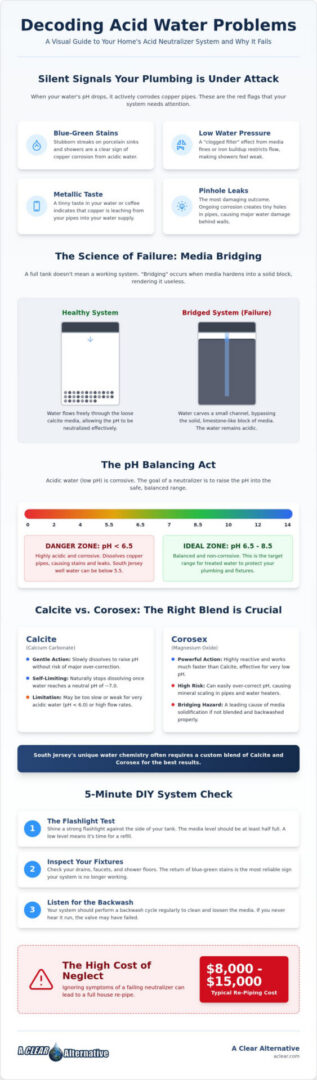
DIY Troubleshooting: 5 Steps to Check Your System
You don’t need a degree in chemistry to keep your water treatment running smoothly. Most acid neutralizer system problems can be spotted with a few simple observations. Taking a proactive approach ensures your home remains a sanctuary of clean, safe water. If you’ve noticed a change in your water quality, follow these five steps to diagnose the issue before it escalates into a costly repair.
- The Flashlight Test: Shine a bright light against the side of your translucent tank. You should see a distinct shadow indicating the media level. If the tank is less than half full, it’s time for a refill.
- Backwash Frequency: Check your control valve settings. For most South Jersey wells, the system should backwash every two to three days to prevent media bridging.
- Differential pH Testing: Test the water at your well head (before the system) and compare it to your kitchen tap. If both readings are identical and low, your system isn’t neutralizing.
- Bypass Inspection: Locate the bypass valve on the back of the control head. Ensure the levers are in the “service” position; they’re often bumped into “bypass” during cleaning or storage.
- Acoustic Check: Set your system to manual backwash and listen. You should hear the motor engage and the distinct sound of water rushing through the drain line. Silence indicates a mechanical failure.
If these steps don’t reveal a clear solution, your system might have internal damage that requires a specialized eye. Don’t let a minor glitch turn into a plumbing disaster. Reach out for a professional system diagnostic to restore your peace of mind and water quality.
How to Refill Your Media Tank Safely
Safety is your first priority when maintaining your system. Before you even touch the tank cap, you must depressurize the unit. Turn off the water supply and open a nearby faucet until the flow stops completely. When adding calcite, use a large funnel and a “dome” or “plug” to cover the center distributor tube. This prevents media from entering your home’s plumbing. Never fill the tank to the very top; leave about 10 to 12 inches of “freeboard” at the top to allow the media to expand and lift during the backwash cycle.
Testing Your Own pH: A Quick Guide
A digital pH meter or a liquid drop kit is far more accurate than paper test strips. Aim for a neutral reading of 7.0, which indicates your water is no longer “hungry” for the copper in your pipes. While DIY kits are great for routine checks, they don’t always detect complex mineral shifts. If your pH remains stubbornly low despite a full tank of media, a professional lab analysis is the only way to uncover hidden chemical imbalances. Understanding your water’s true profile is the first step toward a permanent fix.
Professional Solutions for South Jersey Well Water
The water chemistry in Tabernacle and Shamong isn’t just a technical detail; it’s a local reality. Living in the Pine Barrens means dealing with some of the most acidic groundwater in the Tri-State area. While generic, big-box solutions often fail to address these specific challenges, a professional approach treats your water as a unique profile. When you face persistent acid neutralizer system problems, the solution isn’t always another bag of calcite. It often requires a custom media blend designed for your well’s specific flow rate and mineral makeup. Since 1991, we’ve focused on these local nuances to ensure your home’s water isn’t just safe, but premium.
Modern technology has changed how we treat water. If your current setup is bulky or inefficient, transitioning to a high-efficiency Vortech tank can be a game-changer. These tanks use a specialized bottom plate that creates a whirlpool effect during backwash. This design cleans the media more thoroughly and reduces water waste by up to 30 percent compared to traditional tanks. It’s a sleek, modern upgrade that fits perfectly into a lifestyle focused on quality and sustainability. Plus, with 24/7 emergency support, you never have to worry about a sudden pressure loss or a system leak disrupting your day.
Beyond the Tank: Comprehensive Water Care
Achieving perfect water quality often involves more than a single filter. Many South Jersey homeowners find that integrating acid neutralizer systems with Reverse Osmosis (RO) or UV Sterilizers creates the ultimate protection. While the neutralizer saves your pipes, an RO system delivers bottled-quality water to your kitchen tap. As a family-owned provider for over three decades, we understand that your needs are personal. We don’t just sell equipment; we design a complete water experience that fits your home’s aesthetic and functional requirements. Scheduling a professional system audit is the simplest way to see where your current setup can be improved.
Ensuring Long-Term Performance
Your water treatment system is an investment in your home’s infrastructure. While DIY checks are helpful, professional media re-bedding every few years is what truly saves you money over time. We use specialized equipment to remove old, solidified media and replace it with fresh, high-performance minerals. This process prevents the common acid neutralizer system problems that lead to pipe corrosion and low pressure. Annual maintenance check-ups ensure your control valve is calibrated and your water remains perfectly balanced. It’s a small step that provides massive peace of mind. Schedule your system inspection with A Clear Alternative today!
Restore the Clarity and Safety of Your Home’s Water
Your home deserves water that’s as refreshing and clear as it looks. Dealing with acid neutralizer system problems doesn’t have to be a source of constant stress. Whether you’re battling stubborn blue stains on your porcelain or a frustrating drop in water pressure, identifying the root cause is the first step toward a permanent solution. Remember that “media bridging” can hide even in a full tank, and South Jersey’s unique aquifer requires a specialized touch to balance pH without creating excessive mineral scale. You have the tools to troubleshoot, but you don’t have to manage your water chemistry alone.
Since 1991, our family-owned and operated team has helped homeowners across Tabernacle and Medford Lakes reclaim their water quality. We provide the modern technology and local expertise needed to keep your plumbing safe and your fixtures pristine. If you’re tired of troubleshooting on your own, we offer 24/7 emergency water support to handle leaks or pressure loss the moment they happen. Get Expert Help With Your Acid Neutralizer Today and let us restore the crystal-clear, pH-balanced water your family relies on. It’s time to enjoy the peace of mind that comes with a perfectly functioning home.
Frequently Asked Questions
Why is my acid neutralizer making my water pressure low?
Your water pressure drops when the neutralizing media breaks down into tiny particles called fines, which settle and create a dense barrier. This “clogged filter” effect often indicates your system isn’t backwashing with enough power to lift and clean the bed. High iron levels can also glue the media together, further restricting flow. Regular maintenance prevents these acid neutralizer system problems from turning into a total household pressure loss.
How often do I need to add calcite to my acid neutralizer?
Most homeowners need to replenish their calcite media every 18 to 36 months, though this depends on your water’s acidity and usage. If your well’s pH is extremely low, you’ll consume the minerals faster. We recommend checking the level every six months using the “Flashlight Test” to avoid a sudden return of blue stains. Keeping the tank at least half full ensures enough contact time to neutralize the water effectively.
Can an acid neutralizer cause my water to be hard?
Yes, acid neutralizers naturally increase water hardness because they work by dissolving calcium carbonate into your water flow. While this process raises the pH to protect your pipes, it also adds minerals that can leave white scale on glass and appliances. If your raw well water is already hard, the neutralizer might push it into a range where a water softener becomes a necessary partner for maintaining your home’s comfort.
My water is still blue even with a neutralizer, what is wrong?
Blue-green staining suggests that acidic water is still corroding your copper pipes despite the treatment system. This often happens if the media has depleted below the minimum level or if “bridging” has occurred, allowing water to bypass the minerals. Check your bypass valve to ensure it wasn’t accidentally engaged during cleaning. If the tank is full and the valve is open, your water chemistry might require a more reactive magnesium oxide blend.
How do I know if my backwash valve is working correctly?
You can verify the valve’s operation by initiating a manual backwash cycle and listening for the motor’s hum. You should hear water rushing through the drain line and see the media bed lifting if you have a translucent tank. If the timer has reset due to a power outage, the system might be backwashing at the wrong time or not at all. Silence or a dry drain line during the cycle indicates a mechanical failure.
Is an upflow or downflow acid neutralizer better for preventing clogs?
Downflow systems are generally superior for preventing clogs because they include a motorized backwash cycle that flushes out sediment and prevents media bridging. While upflow systems are simpler and don’t require electricity, they often struggle with South Jersey’s high iron levels, which can cause the media to solidify into a block. A backwashing downflow system keeps the minerals loose and active, ensuring consistent performance even in challenging local well conditions.
What is the average lifespan of an acid neutralizer system?
A high quality acid neutralizer system typically lasts between 10 and 15 years with proper maintenance. While the fiberglass tank is incredibly durable, the mechanical components in the control valve may require seal or spacer replacements every five to seven years. Staying on top of media refills and annual checkups is the best way to extend your system’s life and avoid the common acid neutralizer system problems that lead to premature failure.
Can I use a neutralizer if I have high iron in my well water?
You can use a neutralizer with high iron, but it requires a strategic approach to prevent media fouling. Iron can coat the calcite grains, preventing them from dissolving and neutralizing the acid. In these scenarios, we often recommend a more frequent backwash schedule or installing an iron and sulfur filtration system before the neutralizer. This ensures your media stays clean and your water remains both pH balanced and stain free for your family.