
Cost of Iron Filter for Well Water: 2026 Price & Value Guide
You might think the biggest expense of a failing well system is the hardware, but it’s actually the ruined white linens and the orange-stained porcelain you’re scrubbing every weekend. It’s exhausting to see your home’s aesthetic compromised by metallic water, especially when you’re trying to figure out the real cost of iron filter for well water amidst conflicting quotes. You deserve a home where the water is as clear and refreshing as your lifestyle demands, without the constant fear of hardware failure.
We agree that deciphering water treatment shouldn’t feel like a technical chore. This 2026 guide provides a transparent look at the total investment required for professional filtration in the Tri-State area, from initial hardware to long-term maintenance. You’ll discover which modern technologies offer the best ROI and how professional testing ensures you aren’t overpaying for a system that can’t handle your specific regional iron levels. We’re here to help you build a clear budget and gain the knowledge to reclaim your home’s water quality with total confidence.
Key Takeaways
- Identify whether you’re dealing with “clear water” or “red water” iron, as this distinction significantly impacts your hardware requirements.
- Compare the total cost of iron filter for well water across different technologies, including chemical-free Air Injection systems that offer lower long-term maintenance.
- Avoid the pitfalls of generic internet purchases by prioritizing professional-grade control valves and local installation expertise.
- Secure your home’s aesthetic and plumbing health by scheduling comprehensive water testing before committing to any filtration hardware.
- Plan for the future by understanding how media replacement and annual operating costs affect your total return on investment over the next decade.
Understanding Well Water Iron & Why Filtration Costs Vary
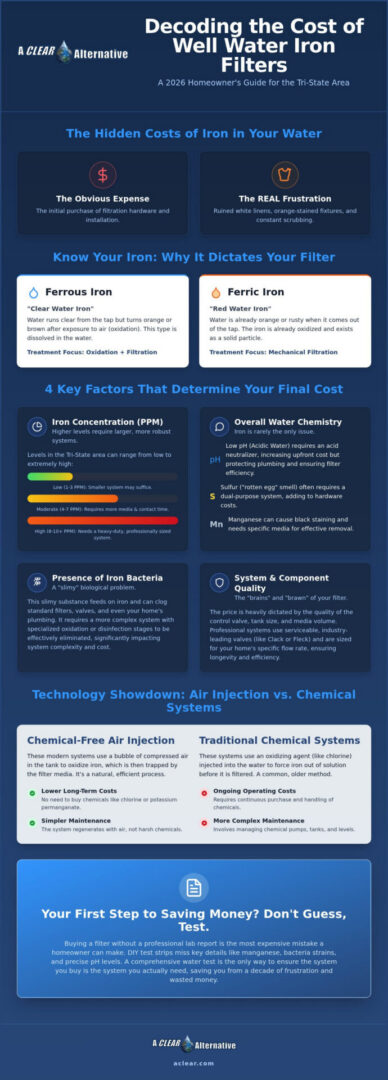
The geology of the Tri-State area presents a unique challenge for homeowners. In places like Tabernacle and Shamong, the water isn’t just “hard”; it’s often heavy with iron levels that vary wildly from one property to the next. This regional chemistry is why the cost of iron filter for well water isn’t a single flat rate. Your investment depends largely on whether you have ferrous or ferric iron. Ferrous iron is the “clear water” variety that turns orange only after it hits the air. Ferric iron is already oxidized, meaning you see the rust the moment you turn on the tap.
Ferric iron often requires more intensive water filtration methods to physically trap the particles. If you also have iron bacteria, a slimy substance that feeds on the minerals, the complexity of your system increases. These bacteria can clog standard valves and media beds, requiring specialized oxidation systems to keep your water flowing. The concentration, measured in parts per million (ppm), also dictates equipment size. A system designed for 2 ppm won’t stand a chance against the 10 ppm levels we often see in local aquifers.
The Chemistry of Cost: Iron, pH, and Sulfur
Iron removal is a chemical dance that requires the right environment. If your water has a low pH, it’s acidic. Most iron filters struggle to oxidize minerals in acidic conditions. This is why many local homeowners find the best value by pairing their system with an acid neutralizer. This combination protects your pipes and ensures the iron filter operates at peak efficiency. If you’re also dealing with the “rotten egg” smell of sulfur, you’ll likely need a dual-purpose system. While this adds to the initial hardware price, it saves you from the frustration of treating only half the problem.
Why a Water Test is Your First “Saving” Step
Buying a filtration system without a lab report is a gamble you don’t need to take. Professional well water testing is the only way to safeguard your investment. DIY test strips might give you a rough idea, but they often miss the presence of manganese or specific bacteria strains that dictate which technology will actually work. A detailed lab report ensures the cost of iron filter for well water translates into a decade of performance rather than a year of frustration. It’s about buying the right solution once, so you can stop worrying about your laundry and start enjoying your home.
Breaking Down the Upfront Purchase Price of Iron Filters
When you begin researching the cost of iron filter for well water, you’ll quickly notice a wide spectrum of options. It’s tempting to treat hardware like a simple appliance purchase, but these systems are the engine of your home’s water quality. The initial price is usually dictated by the “brain” of the system: the control valve. Professional-grade systems almost exclusively use industry-leading valves like Clack or Fleck. These components are designed for heavy-duty cycles and, more importantly, they are serviceable. Budget units often use proprietary or low-cost valves that are impossible to repair, turning your entire system into a “throwaway” item if one small part fails.
Tank size and media volume also play a massive role in your initial investment. A larger tank allows for more contact time between the water and the filtration media, which is essential for high concentrations of Iron in Well Water. If a system is undersized for your household’s flow rate, it will backwash too frequently, wasting water and wearing out the media prematurely. Investing in a properly scaled system ensures you aren’t just buying hardware; you’re buying a decade of reliable performance.
Component Quality and Its Impact on Price
The materials used in construction determine how well the system handles the high pressure of a well pump. While most modern tanks use poly-glass, professional systems often feature reinforced builds and digital smart-valves. These smart-valves track your actual water usage rather than relying on a simple manual timer. This precision prevents unnecessary regeneration cycles, saving you money on electricity and water over time. Additionally, high-quality systems include internal bypass features, allowing you to access water even during maintenance without bypassing the entire home’s filtration.
E-commerce vs. Full-Service Provider Pricing
It’s easy to find a low price tag on a generic e-commerce site, but these “deals” often come with hidden risks. When you buy hardware online, you’re responsible for the shipping logistics, the technical setup, and the warranty claims. If a part arrives broken or fails in six months, you’re the one spending hours on hold with a national call center. Local providers offer a total package value that includes expert sizing, professional calibration, and long-term support. They understand the specific mineral challenges of your neighborhood, ensuring the hardware you buy actually solves your problem. If you want to stop guessing and start seeing results, a professional water quality consultation is the most reliable way to protect your investment.
Choosing the Right Technology: Air Injection vs. Chemical Systems
Selecting the right technology is the single biggest factor in the long-term cost of iron filter for well water. You aren’t just buying a tank; you’re choosing a chemical or physical process that has to work perfectly with your home’s unique chemistry. Modern homeowners typically choose between maintenance-heavy traditional methods and innovative, chemical-free solutions. The goal is to find a balance between the initial price and the amount of time you’ll spend managing the system in the years to come.
The ROI of Maintenance-Free Air Injection
Air Injection Oxidizing (AIO) systems have become the gold standard for South Jersey wells. These systems create a pocket of compressed air at the top of the tank. As water passes through, the iron is instantly oxidized and trapped by the media bed. It’s a clean, elegant process that doesn’t require you to buy, lug, or pour heavy chemicals every month. While the upfront investment for AIO hardware is often higher than basic filters, the return on investment is clear. You save on recurring supply costs and avoid the hassle of handling chlorine or potassium permanganate. However, these systems do have flow rate limitations, meaning they’re best suited for residential use rather than high-flow commercial applications.
Chemical Injection: When to Pay More for Precision
Sometimes, air alone isn’t enough to tackle the job. If your water test reveals iron bacteria or exceptionally high manganese, you might need the precision of a chemical injection system. These setups use a specialized pump to feed chlorine or hydrogen peroxide into your water line before it reaches the filter. According to researchers at Rutgers, managing iron in water effectively in these scenarios requires this extra step to disinfect the bacteria that would otherwise clog a standard filter. National “big box” brands often avoid these systems because they require expert calibration and regular service. For local homeowners, paying a bit more for a professional peroxide system can be the difference between clear water and a system that fails within six months.
For moderate iron levels, cost-effective alternatives like Birm or Catalytic Carbon media can work well without complex hardware. On the high end of the market, some homeowners opt for Ozone or UV integration. These premium additions provide an extra layer of sterilization and oxidation, offering the ultimate peace of mind for those who value the highest possible water purity. No matter which path you choose, the cost of iron filter for well water should always be measured by its ability to provide clean, stain-free water without becoming a second job.
Estimating Installation and Long-Term Operating Costs
Hardware is only half the story. If you’re browsing online, the price you see doesn’t account for the labor and materials needed to actually get water flowing through your taps. The total cost of iron filter for well water must include the specialized skills of a professional who understands regional plumbing codes. In the Tri-State area, professional installation typically ranges between $150 and $500 for the labor alone, depending on the complexity of your existing setup. This process often requires more than just a few pipe fittings; it may involve adjusting your pressure tank, running new drain lines for backwash, and ensuring a dedicated electrical outlet is available for the control valve.
The “Disaster Cost” of a DIY mistake far outweighs any initial savings. An incorrectly installed drain line can lead to basement flooding or septic system failure. If the system isn’t calibrated to your specific well pump’s flow rate, the media bed won’t lift properly during backwash. This causes the iron to “bake” into the filter, ruining hundreds of dollars of media in just a few months. Professional installation ensures your system is primed for longevity from day one.
Professional Installation Factors
In New Jersey and Pennsylvania, local building codes often require specific backflow prevention and permitting for new water treatment installs. A licensed installer doesn’t just swap pipes; they ensure your home remains compliant and your insurance coverage stays intact. If you’re integrating an iron filter with existing whole house water filtration systems, the sequence of equipment is critical. Placing an iron filter after a softener, for example, is a common mistake that can destroy both units. A professional handles these logistics so you don’t have to.
Ongoing Operating Expenses
Once your system is running, the monthly impact on your wallet is surprisingly low. Modern smart-valves are designed to be energy-efficient, drawing minimal power to track your water usage. You should, however, budget for annual operating costs which typically fall between $50 and $300. This covers the electricity and the water used during regeneration cycles. The most significant long-term expense is the media bed replacement. Most high-quality media lasts between 7 and 10 years. Replacing this media generally costs between $200 and $500 plus labor, representing a small price for another decade of pristine water quality.
Don’t leave your home’s water quality to chance or a generic instruction manual. For a system that’s sized and installed correctly the first time, contact our team for a professional installation quote and secure your peace of mind.
Investing in Quality: The A Clear Alternative Advantage
Choosing a water treatment system isn’t just a transaction. It’s a commitment to your home’s longevity and your family’s daily comfort. While you can find hardware on any generic e-commerce site, those platforms don’t understand the complex iron profiles of South Jersey. Since 1991, we’ve built our reputation on being more than just a vendor. We’re a family-owned partner that treats your water quality as if it were our own. When you evaluate the cost of iron filter for well water, you have to look beyond the initial price tag and consider the value of a system that’s custom-engineered for your specific backyard.
The Value of Local Expertise
The Kirkwood-Cohansey aquifer presents challenges that national brands simply can’t solve from a call center. Our deep roots in Tabernacle, Shamong, and Medford Lakes mean we’ve seen every variation of Pinelands water chemistry. We know how high acidity interacts with heavy iron and manganese in this region. This local insight allows us to custom-build systems that actually perform, rather than relying on a one-size-fits-all approach. You aren’t just buying a tank; you’re investing in decades of regional data and success.
We offer a level of security that a website can’t match. If you face a midnight plumbing emergency or your well runs dry, we provide 24/7 emergency support. As a licensed potable water hauler, we also handle bulk water delivery and emergency hauling. This comprehensive approach means your home’s water supply is protected by a team that understands every part of the process, from the aquifer to your kitchen tap. This local troubleshooting is a critical component of the real-world cost of iron filter for well water, preventing small issues from becoming expensive repairs.
Your Next Steps to Clean Water
Reclaiming your water quality is simpler than you think. The process starts with understanding exactly what’s in your well. We always recommend professional testing before you invest in any hardware. This ensures your system is sized correctly and targets the specific contaminants affecting your home. It’s the most effective way to manage your investment while avoiding the frustration of equipment misapplication. We help you skip the guesswork and move straight to the results.
Once we have your results, we’ll provide a transparent, no-obligation quote. You’ll see exactly how the hardware, installation, and maintenance plan work together to create a worry-free experience. There are no hidden fees or generic solutions. Just clear, refreshing water and the confidence that comes with a professionally managed system. We make the path to perfect water quality simple, logical, and entirely stress-free.
Get your well water tested by the local experts today.
Take the First Step Toward Crystal Clear Water
Investing in your home’s water quality is a decision that pays dividends in both daily comfort and long-term property value. You’ve learned that the cost of iron filter for well water is about more than just the tank; it’s about selecting the right technology for your specific chemistry and ensuring professional installation for years of reliability. By prioritizing high-quality control valves and local Tri-State expertise, you avoid the hidden “disaster costs” of generic hardware. Clean, stain-free laundry and pristine fixtures are within reach when you stop guessing and start testing.
Since 1991, our family-owned team has helped homeowners across New Jersey, Pennsylvania, and Delaware navigate these choices with total confidence. We don’t just sell equipment; we provide a lifestyle upgrade backed by 24/7 emergency support. It’s time to stop scrubbing orange stains and start enjoying the water you deserve. Request a Professional Water Analysis & Iron Filter Quote today. We’re ready to help you transform your well water into a source of pride for your home. You’ve got this, and we’re here to help.
Frequently Asked Questions
Is an iron filter more expensive than a water softener?
Generally, yes. Iron filters involve more complex oxidation technology than standard water softeners. While a softener uses ion exchange to remove hardness minerals, an iron filter must physically or chemically transform iron into a solid particle before it can be trapped. This specialized process and the robust media required usually result in a higher initial investment for iron-specific hardware. It’s the only way to effectively prevent the staining that softeners often miss.
How long does a professional iron filter system last?
A professionally installed iron filter system typically lasts between 10 and 15 years. While the heavy-duty poly-glass tanks and digital control valves are built for long-term durability, the internal media bed is a consumable part. You can expect to replace this media every 7 to 10 years to maintain peak performance. Choosing high-quality, serviceable components ensures your system remains a reliable part of your home’s infrastructure for well over a decade.
Can I install an iron filter myself to save on costs?
You can attempt a DIY install, but it often leads to higher long-term expenses. Professional installers in Tabernacle and Shamong understand local building codes and the specific backflow prevention requirements of New Jersey. If you miscalculate your well pump’s flow rate, the system won’t backwash correctly, which ruins the media bed in months. A licensed professional ensures the system is calibrated perfectly, protecting your home insurance and your hardware investment.
Do iron filters require a lot of electricity to run?
Iron filters are incredibly energy-efficient and won’t noticeably impact your monthly utility bill. The digital smart-valve draws a very small amount of power, similar to a small alarm clock, to track your water usage and manage regeneration cycles. Most of the filtration work is done through physical contact with the media or chemical oxidation. This means you get 24/7 protection for your home’s plumbing without worrying about a significant increase in electricity costs.
What is the most cost-effective iron filter for high-iron wells?
For many homeowners, an Air Injection Oxidizing (AIO) system is the most economical choice over time. While the upfront hardware price might be higher than entry-level units, you save money by eliminating the need for recurring chemical purchases. This technology uses a pocket of compressed air to oxidize minerals naturally. When calculating the total cost of iron filter for well water, AIO systems often provide the best return on investment through lower maintenance.
Will an iron filter also remove the rotten egg smell from my water?
Many iron filters are specifically designed to tackle both iron and the hydrogen sulfide gas that causes a rotten egg smell. Air Injection systems are particularly popular in Medford Lakes because they oxidize both contaminants simultaneously. If your water test shows high levels of both iron and sulfur, we can custom-build a system that addresses both issues in a single tank. This dual-purpose approach saves space and reduces the amount of hardware you need to maintain.
How often do I need to replace the media in my iron filter?
You should plan to replace the filtration media every 7 to 10 years. The exact lifespan depends on the iron concentration in your well and your household’s daily water consumption. If you notice a return of orange staining or a slight drop in water pressure, it’s often a sign that the media is becoming saturated. Scheduling professional water testing every few years is the best way to monitor your media’s health and prevent quality issues.