
Common Water Contaminants in South Jersey: A 2026 Homeowner’s Guide
What if the water you use to refresh your skin and clean your home is silently working against you? In towns like Tabernacle, Shamong, and Medford Lakes, the natural beauty of the Pinelands often masks a complex chemical reality below the surface. Identifying the common water contaminants in south jersey is the first step toward reclaiming your home’s aesthetic and your family’s health. You shouldn’t have to tolerate blue-green stains on your fixtures or a metallic taste in your morning coffee. These aren’t just quirks of living near the Kirkwood-Cohansey aquifer; they’re signs that your water quality needs a modern, professional upgrade.
It’s completely normal to feel a sense of urgency when you hear reports about PFAS “forever chemicals” or new lead regulations in 2026. You deserve to feel confident every time you turn on the tap. This guide will help you understand the specific local risks and provide a clear path to total water security through advanced testing and treatment. We’ll explore how modern solutions like reverse osmosis and acid neutralizers can seamlessly integrate into your lifestyle. By the end of this article, you’ll have the actionable steps needed to ensure your water is as pure and inviting as the home you’ve built.
Key Takeaways
- Understand why the Kirkwood-Cohansey aquifer’s unique chemistry requires a specialized approach compared to national water treatment standards.
- Identify the most common water contaminants in south jersey, including 2026 updates on PFAS regulations and lead safety.
- Learn how to eliminate aesthetic issues like blue-green staining and rotten egg smells with modern acid neutralizers and sulfur filtration.
- Discover the specific laboratory tests you need to accurately measure your water’s pH, iron levels, and bacterial safety.
- Explore how discreet, high-tech solutions like reverse osmosis and UV sterilizers can elevate your home’s water quality and your family’s peace of mind.
Understanding the South Jersey Aquifer: Why Your Water is Unique
The ground beneath Tabernacle and Shamong isn’t just sand and pine needles. It’s a complex filtration system that defines your daily life. If you’ve noticed blue-green stains on your showerhead or a metallic tang in your tea, you’re experiencing the unique chemistry of our region. South Jersey homeowners face a set of water challenges that are worlds away from the hard water issues found in North Jersey. Understanding these differences starts with the source of your water and the soil it travels through.
The Kirkwood-Cohansey Aquifer Explained
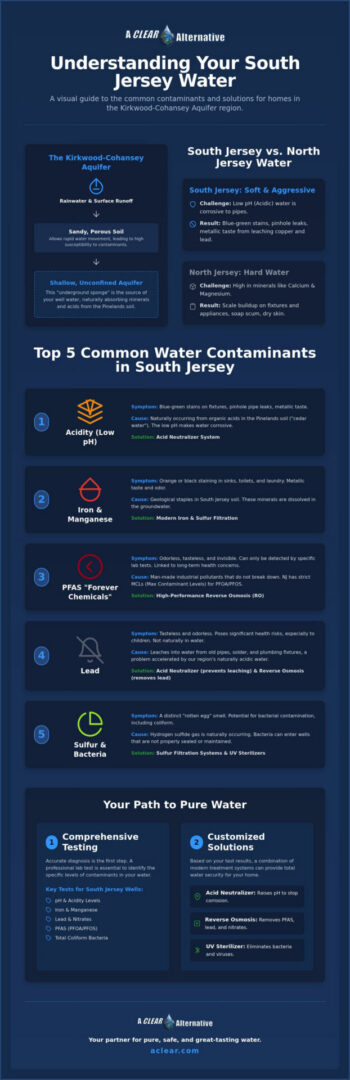
Most of our local water comes from the Kirkwood-Cohansey aquifer system. Unlike the deep, protected aquifers found in other parts of the country, ours is relatively shallow and unconfined. Think of it as a massive underground sponge sitting just below the surface. Because the soil in Medford Lakes and surrounding areas is so sandy and porous, rainwater moves through it with incredible speed. While this is excellent for keeping the water supply replenished, it also means the aquifer is highly susceptible to surface runoff. Anything on the ground can eventually find its way into your well. This permeability is a primary reason why we see specific common water contaminants in south jersey that you won’t find in areas with denser clay or bedrock.
Natural vs. Man-Made Contaminants
It’s helpful to separate what the earth naturally puts into the water from what human activity adds to it. In the Pinelands, our water is naturally acidic. This low pH is caused by organic acids in our soil, often referred to as “cedar water” by locals. This acidity is what eats away at your copper pipes, causing those frustrating blue stains and pinhole leaks. Iron and manganese are also geological staples here; they’re the culprits behind the orange streaks in your dishwasher and the metallic taste in your glass.
However, human activity introduces a different tier of risks. Man-made common water contaminants in south jersey include nitrates from agricultural fertilizers and the growing concern of “forever chemicals” known as PFAS. While iron might ruin your laundry, these industrial pollutants carry long-term health implications. Recognizing the difference between a natural mineral issue and a chemical safety risk is essential for choosing the right treatment. You aren’t just fixing a smell; you’re curating a safer, higher quality of life for your family.
South Jersey vs. North Jersey: The Great Divide
If you moved here from North Jersey, you might be surprised by how different your water feels. Up north, the water is often “hard,” meaning it’s loaded with calcium and magnesium from limestone deposits. In South Jersey, our water is “soft” but aggressive. It lacks those minerals but possesses a low pH that makes it corrosive. We don’t deal with scale buildup as much as we deal with pipe degradation and metallic leaching. It’s a hyper-local problem that requires a specialized, local solution.
Top 5 Common Water Contaminants in South Jersey
Modern living requires a modern approach to safety. While our local geology provides the foundation for our water, human and industrial activity introduces complex risks. Identifying the common water contaminants in south jersey isn’t about fear; it’s about taking control of your home’s environment. From “forever chemicals” to aging infrastructure, these five contaminants represent the most significant challenges for local families in 2026.
PFAS: The Modern Challenge for NJ Water
Per- and Polyfluoroalkyl Substances (PFAS) are often called “forever chemicals” because they simply don’t break down in the environment. As of August 25, 2026, the NJ DEP has enforced strict Maximum Contaminant Levels (MCLs) to protect residents. Current standards limit PFOA to 0.014 ppb and PFOS to 0.013 ppb. These compounds are linked to various health concerns and are notoriously difficult to remove with basic carbon pitchers. Because of their molecular structure, high-performance Reverse Osmosis Systems are the gold standard for removal. Ensuring your family isn’t consuming these chemicals starts with comprehensive well water testing to establish a baseline for your home.
Lead and Nitrates in Rural Wells
Lead rarely starts in the aquifer. Instead, it enters your water through the very pipes meant to deliver it. The naturally acidic nature of our region, documented in this USGS Kirkwood-Cohansey aquifer study, makes our water highly corrosive. In older homes across Tabernacle and Shamong, this “aggressive” water leaches lead from brass fixtures and lead-based solder. Even low levels of lead exposure are unsafe, particularly for children. It’s a hidden risk that only professional testing can uncover.
Nitrates present a different rural challenge. In our agricultural communities, nitrogen from fertilizers can seep through the sandy soil into the groundwater. For infants under six months, high nitrate levels can interfere with the blood’s ability to carry oxygen. This makes regular monitoring essential for any growing family in South Jersey’s farm belt.
Bacteria and VOCs: The Invisible Residents
Beyond chemicals and metals, biological threats like Coliform and E. coli remain common water contaminants in south jersey. A heavy rainstorm can wash surface bacteria into a shallow well in Medford Lakes overnight. Similarly, Volatile Organic Compounds (VOCs) from industrial runoff or fuel spills can migrate through the Tri-State area’s interconnected water systems. These invisible risks are why annual testing is a non-negotiable part of responsible homeownership. If you haven’t checked your levels lately, it might be time to schedule a professional water analysis to restore your peace of mind and protect your family’s health.
The “Pinelands Special”: Iron, Sulfur, and Acidity
While industrial pollutants often dominate the headlines, the daily reality for many in Tabernacle and Medford Lakes is defined by the “Pinelands Special.” These are the common water contaminants in south jersey that turn a relaxing shower into a sulfurous ordeal and leave your pristine white sinks covered in rusty streaks. Because these issues are classified as “secondary” contaminants by regulatory agencies, they are often dismissed as mere aesthetic nuisances. However, for a homeowner, they represent a significant threat to your property’s value and your daily comfort.
Acidic Water and Blue-Green Staining
If you’ve noticed vibrant blue or green stains around your drains, your water is likely trying to tell you something. In our region, the soil’s natural chemistry results in a low pH, meaning the water is “hungry” and corrosive. As this acidic water travels through your home’s copper plumbing, it literally eats away at the metal. Those colorful stains are actually dissolved copper from your own pipes. Left untreated, this process leads to pinhole leaks behind your walls and the expensive reality of a full home repipe.
Installing modern acid neutralizer systems is the most effective way to stop this destruction. These systems work by passing the water through a bed of natural minerals that balance the pH, making it “neutral” and safe for your plumbing. It’s a discreet, set-it-and-forget-it solution that protects your home’s infrastructure while ensuring your fixtures stay spotless and your hair and skin feel softer after every wash.
Dealing with Iron and Sulfur Odors
Nothing ruins the premium feel of a modern home quite like the smell of rotten eggs coming from the tap. This distinctive odor is caused by hydrogen sulfide gas, often produced by naturally occurring sulfur bacteria in the Kirkwood-Cohansey aquifer. When combined with high iron levels, you’re faced with a double challenge: water that smells unpleasant and leaves stubborn orange or brown stains on everything it touches, from your laundry to your dishwasher. This isn’t just a South Jersey quirk; it’s a sign of a chemical imbalance that affects your quality of life.
We believe your home should be a sanctuary, not a place where you have to hold your breath in the shower. High-performance iron and sulfur filtration systems can strip these common water contaminants in south jersey from your supply without the need for harsh chemicals or constant maintenance. By utilizing advanced air-induction technology, these systems oxidize and trap the minerals and gases, delivering crystal clear, odorless water to every faucet. It’s an investment in your home’s aesthetic and your family’s daily happiness, ensuring that your water finally matches the beauty of your Pinelands surroundings.
How to Test and Interpret Your South Jersey Water
Testing is the bridge between guessing and knowing. If you’ve been living with a persistent smell or staining, a lab report provides the data needed to reclaim your home’s water quality. In South Jersey, where the Kirkwood-Cohansey aquifer presents unique challenges, a standard “one-size-fits-all” test isn’t enough. You need a targeted strategy that looks for the specific common water contaminants in south jersey that actually impact your lifestyle and plumbing.
- Step 1: Schedule a professional laboratory analysis. To meet 2026 standards, your samples must be processed by a state-certified lab that can detect minute levels of PFAS and lead.
- Step 2: Identify the “Big Three” for our region. Focus on pH (acidity), iron content, and bacterial presence. These are the primary drivers of aesthetic and structural issues in Tabernacle and Shamong.
- Step 3: Compare results against NJ standards. Check your levels against the NJ DEP Maximum Contaminant Levels (MCLs). For example, PFOA should not exceed 0.014 µg/L.
- Step 4: Consult with a local expert. A lab report is just numbers until a specialist translates it into a custom treatment plan for your specific well depth and chemistry.
Why DIY Test Kits Often Fail
It’s tempting to grab a package of “strip tests” from the hardware store. While these are fine for balancing a swimming pool, they lack the precision required for drinking water safety. They often miss low concentrations of lead and are completely incapable of detecting PFAS or complex Volatile Organic Compounds. To truly understand the common water contaminants in south jersey affecting your home, you need lab-grade equipment. Investing in a professional South Jersey water test ensures that your results are legally defensible and scientifically accurate, giving you the confidence to make informed decisions about your family’s health.
When to Test Your Well
Regular monitoring is the only way to catch changes in your aquifer before they become expensive problems. We recommend annual testing for bacteria and nitrates as a baseline. However, certain events should trigger an immediate check. Heavy flooding can wash surface contaminants into shallow wells in Medford Lakes, while nearby construction can shift underground sediment. If you notice a sudden change in taste, a drop in water pressure, or if your current filtration system seems to be struggling, it’s time for a re-evaluation. Don’t wait for a red flag to appear. You can schedule a comprehensive water analysis today to ensure your home remains a sanctuary of purity and comfort.
Custom Solutions for South Jersey Water Quality
Understanding the science of your well is the first step, but taking action is where your lifestyle truly transforms. You shouldn’t have to settle for water that stains your laundry or leaves you worried about long-term health risks. Solving the issues caused by common water contaminants in south jersey requires more than a retail filter; it demands a customized strategy that respects the unique chemistry of the Kirkwood-Cohansey aquifer. Whether you’re dealing with aggressive acidity or industrial runoff, modern technology offers discreet, high-performance solutions that fit seamlessly into your home.
Modern Technology for a Healthier Home
We believe that water treatment should be felt, not necessarily seen. Modern whole house water filtration systems are designed with a focus on both aesthetics and efficiency. These systems act as a comprehensive shield, neutralizing acidity and removing iron before the water ever reaches your faucets. For those seeking the highest standard of drinking water purity, Reverse Osmosis Systems provide a point-of-use solution that effectively targets PFAS and lead, delivering bottled-water quality directly to your kitchen tap.
Safety also means being prepared for the unexpected. If you’re concerned about biological risks, Ultraviolet (UV) Sterilizers offer a chemical-free way to deactivate bacteria and viruses, ensuring your supply remains potable year-round. Beyond filtration, we understand that well ownership can come with sudden challenges. That’s why we provide emergency water hauling and bulk potable water delivery. If your system fails or your well runs dry, you have a local partner ready to restore your home’s most vital resource with 24/7 emergency support.
A Family-Owned Legacy in Tabernacle
Local expertise isn’t just a marketing slogan; it’s a commitment to the community. Since 1991, A Clear Alternative has been a family-owned fixture in Tabernacle, serving neighbors in Shamong and Medford Lakes with a deep understanding of Pinelands water. We don’t just sell equipment; we provide the same solutions we use in our own homes. National brands often rely on generic configurations that fail to address the specific common water contaminants in south jersey, like the aggressive low pH that defines our region.
Choosing a local specialist means you’re working with someone who knows the depth of the wells on your street and the specific mineral patterns of your neighborhood. We prioritize clear communication and simple, effective technology over complex jargon. Your home is your sanctuary, and you deserve water that reflects that. If you’re ready to move past the frustration of stains and odors toward a future of total water confidence, we’re here to guide you every step of the way. Contact A Clear Alternative for a consultation and discover how simple it is to elevate your home’s water quality today.
Take Control of Your Home’s Water Quality
You’ve seen how the unique geology of the Kirkwood-Cohansey aquifer impacts your daily life. Identifying common water contaminants in south jersey is the first step toward reclaiming your home’s aesthetic and your family’s health. From the aggressive low pH that stains your fixtures to the modern challenge of PFAS, the right data empowers you to make better choices. You don’t have to tolerate sulfur smells or blue streaks when high-tech, discreet filtration solutions are available to match your lifestyle.
Since 1991, A Clear Alternative has specialized in the specific chemistry of the Pine Barrens. We’re a family-owned team that understands your water is the foundation of your quality of life. Whether you need a modern acid neutralizer or a reverse osmosis system, we provide the local expertise you deserve. With 24/7 emergency service and a deep commitment to our neighbors in Tabernacle, Shamong, and Medford Lakes, your peace of mind is our priority. Get Your South Jersey Water Tested Today and start enjoying the crystal-clear water your home was meant to have. You’re just one step away from total confidence in every drop.
Frequently Asked Questions
Is South Jersey well water safe to drink without a filter?
Safety isn’t guaranteed just because the water looks clear. Our shallow aquifer is vulnerable to surface runoff and local land use. In 2026, several major New Jersey water systems reported violations for contaminants like coliform. For private well owners, you’re responsible for identifying the common water contaminants in south jersey hiding in your tap. Professional laboratory testing is the only definitive way to confirm your water is safe for your family to consume.
What causes the blue-green stains in my South Jersey sinks?
Those vibrant blue-green stains are a direct result of low pH levels in your water. The Pinelands region is famous for its naturally acidic water, which acts as a corrosive agent on your home’s copper plumbing. As the water sits in your pipes, it dissolves the metal, carrying it to your fixtures where it leaves a permanent mark. Installing an acid neutralizer stops this process, protecting your plumbing and keeping your sinks looking pristine.
How often should I test my well water in Shamong or Tabernacle?
You should test your well water at least once every year for bacteria and nitrates. This is especially vital for homes in Shamong and Tabernacle where agricultural runoff can shift groundwater chemistry. We also recommend a comprehensive panel every three to five years to check for lead, iron, and pH levels. If you experience heavy flooding or notice a sudden change in taste or odor, don’t wait for your annual check; schedule a test immediately.
Can a water softener remove PFAS from my drinking water?
No, a standard water softener is designed to remove minerals like calcium and magnesium, not chemical pollutants. To effectively remove PFAS “forever chemicals” and ensure your drinking water meets 2026 safety standards, you need a high-performance Reverse Osmosis System. These systems use a specialized membrane to strip away microscopic contaminants that softeners miss. Using the right technology for the specific threat is the only way to achieve true water purity and peace of mind.
Why does my well water smell like rotten eggs during the summer?
That distinctive rotten egg smell is caused by hydrogen sulfide gas. It often becomes more noticeable in the summer as warmer temperatures increase bacterial activity in the aquifer. This issue is one of the most common water contaminants in south jersey and can ruin your daily shower experience. Modern iron and sulfur filtration systems can eliminate these odors without harsh chemicals, restoring a fresh, premium feel to your home and your water.
What is the Kirkwood-Cohansey aquifer and why does it matter for my water?
The Kirkwood-Cohansey aquifer is a massive, shallow water source that sits directly beneath our sandy local soil. Because it’s unconfined and porous, it’s incredibly efficient at collecting rainwater, but it also absorbs surface pollutants just as quickly. This geological reality is why Tabernacle and Medford Lakes residents often deal with high iron and low pH. Understanding this source is the key to designing water treatment systems that actually work for our specific regional chemistry.
Are there state grants for NJ homeowners to fix contaminated wells?
Yes, the New Jersey Spill Fund provides financial assistance to homeowners whose private wells exceed Maximum Contaminant Levels for specific pollutants. This includes man-made chemicals like PFAS or Volatile Organic Compounds. Eligibility depends on your specific test results and current 2026 state regulations. If your well fails a state-certified lab test, you should contact the NJ DEP to explore your options for funding a professional filtration system or a new well.
Do I need a UV sterilizer if I have a private well in South Jersey?
While not always a legal requirement, a UV sterilizer is a highly recommended layer of protection for private wells. Shallow wells in our area can experience sudden bacterial spikes after heavy rainstorms or seasonal shifts. An Ultraviolet Sterilizer provides a chemical-free way to deactivate bacteria and viruses, ensuring your water remains safe even if the aquifer’s conditions change. It’s a modern, low-maintenance solution that offers an extra level of security for your family’s health.