
Water Treatment System for Coffee Quality: How to Choose
What if the water behind your coffee is why the same beans and recipe taste different from one morning to the next? It’s easy to blame the grind or brew time, but water makes up about 98% of coffee. Its mineral balance and chlorine taste can shape the cup, while some water profiles may also contribute to scale buildup in equipment. The Specialty Coffee Association recommends a total dissolved solids (TDS) range of 75-250 ppm for brewing water, with a target of 150 ppm. TDS is useful, but it doesn’t tell the whole story.
Choosing a water treatment system for coffee quality starts with your water profile, not a filter category. Carbon filtration can address chlorine and off-tastes, while softening and reverse osmosis target different water concerns. The right fit depends on your test results, brewing setup, and priorities, whether that’s a more consistent cup, equipment care, or both.
This guide explains how water affects extraction, compares common treatment options, and offers practical steps for choosing what to do next. A free water analysis from A Clear Alternative can provide a useful starting point for your home or commercial setup.
Key Takeaways
- Choose a water treatment system for coffee quality based on measured water conditions and brewing goals, not the filter label alone.
- Use water testing to identify which concerns matter most before comparing treatment methods.
- Match your approach to your setup: home brewing and higher-volume café use can have different priorities and upkeep needs.
- In South Jersey, use your own source-water results rather than assuming water conditions are the same everywhere.
- A Clear Alternative’s free water analysis can help connect your results with options such as carbon filtration, softening, reverse osmosis, or whole-house filtration.
Why a Water Treatment System Can Matter for Coffee Quality
Coffee-water treatment means filtering or adjusting water to better suit brewing. That might mean reducing a noticeable chlorine taste, managing mineral content, or addressing another issue shown by a water test. The goal isn’t to make every water source identical. It’s to understand what’s coming from your tap and decide whether a change makes sense for your coffee, your equipment, or both. The broader Water Treatment Overview describes the range of processes used to improve water for different purposes.
Two brews can taste different even when you use the same coffee and recipe if their water differs. Source water varies in dissolved minerals and other characteristics, and those differences can influence how coffee compounds dissolve during brewing. In short, water doesn’t just carry coffee into your cup; its chemistry helps shape what you taste.
Which water characteristics can influence a cup?
Hardness describes the amount of dissolved minerals, commonly calcium and magnesium. Alkalinity describes water’s ability to resist changes in acidity, while pH indicates how acidic or alkaline it is. Minerals can support extraction, but their effects depend on their concentrations and the brewing method. Chlorine can create an unwanted taste or smell for some people. No single reading explains the whole cup, and one treatment choice won’t suit every recipe or source.
For example, a chlorine-like taste points to a different concern than mineral deposits inside a kettle or espresso machine. A pour-over and an espresso machine also differ in how water moves through coffee and in the equipment’s operating requirements. Use test results to identify what’s present, then consider how it relates to your brewing method. Don’t treat a taste concern, a scale concern, and a drinking-water safety question as interchangeable. Each calls for its own assessment.
Why coffee quality and equipment care are linked
Minerals such as calcium can contribute to limescale as water is heated. Deposits may build up inside water pathways and on heating surfaces, affecting equipment operation over time. That’s why treatment decisions can involve more than taste. Reducing chlorine-related off-flavors, managing hardness, and addressing a safety concern are distinct goals, even if they all begin with the same tap.
More treatment isn’t automatically better. Removing too much mineral content can change the water in ways that don’t suit a brewing recipe or machine, while a taste-focused carbon filter won’t necessarily address hardness. Check your equipment’s water guidance alongside your test results before choosing a system. If results show several concerns, prioritize them rather than choosing a filter based on its name alone.
Start by writing down what you want to improve: flavor consistency, visible scale, or a specific water-quality concern. Then use measured results to guide your next decision. A water treatment system for coffee quality should fit both the water you have and the way you brew, without creating a new maintenance or equipment problem.
How Water Treatment Methods Affect Coffee Brewing
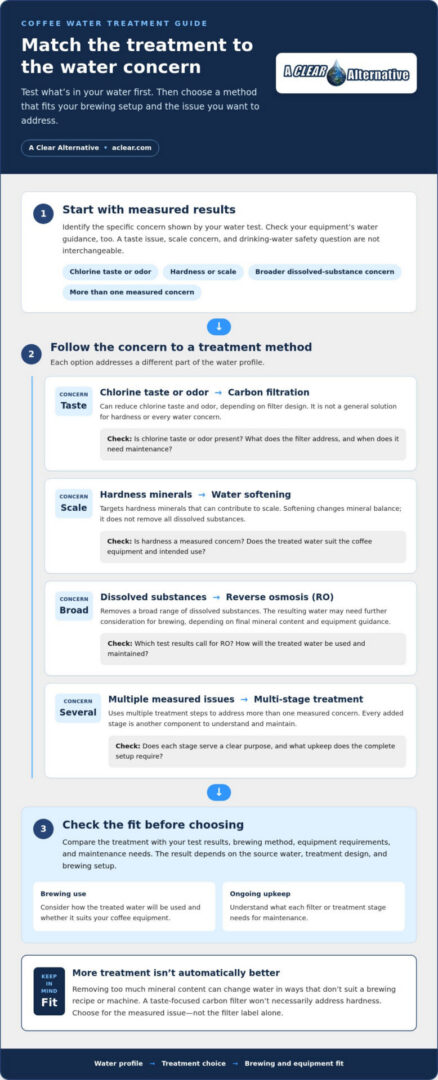
Water treatment methods solve different problems. A filter that reduces chlorine-related taste may leave hardness largely unchanged, while a softener targets hardness rather than every substance that affects flavor. Reverse osmosis removes many dissolved substances, so the treated water may need further consideration for brewing. Compare methods by the issue you want to address, the water entering the system, and how you’ll use the treated water.
Filtration targets selected substances; softening addresses hardness; reverse osmosis removes a broad range of dissolved substances. None guarantees better-tasting coffee on its own. The result depends on the source water, treatment design, and brewing setup.
| Method | Typical purpose | Key consideration | Questions to resolve |
|---|---|---|---|
| Carbon filtration | Reduce chlorine taste and odor, depending on the filter design. | It isn’t a general solution for hardness or every water concern. | Is chlorine taste or odor present? What does the filter address, and when does it need maintenance? |
| Water softening | Reduce hardness minerals that can contribute to scale. | Softening changes mineral balance; it isn’t the same as removing all dissolved substances. | Is hardness a measured concern? Does the treated water suit the coffee equipment and intended use? |
| Reverse osmosis (RO) | Remove a broad range of dissolved substances from water. | The resulting water may need further adjustment for brewing, depending on its final mineral content and equipment guidance. | Which results call for RO? How will the treated water be used and maintained? |
| Multi-stage treatment | Address more than one measured concern through multiple treatment steps. | Each added stage brings another component to understand and maintain. | Does each stage serve a clear purpose, and what upkeep does the complete setup require? |
Carbon filtration, softening, and reverse osmosis compared
Start with the problem, not the technology name. If tap water has an unwanted chlorine odor, carbon filtration may be relevant. If hardness and scale are the concern, investigate softening. If testing identifies a broader dissolved-solids issue, reverse osmosis may be worth considering. These methods aren’t interchangeable, and their suitability depends on incoming water and intended use. For any option, follow the treatment system’s guidance and the coffee equipment manufacturer’s water recommendations.
When does a multi-stage treatment setup make sense?
Multiple stages may be useful when test results reveal distinct concerns, such as an unwanted taste alongside hardness. Each stage should have a defined role, rather than being added simply because a system has more components. More stages can also mean more maintenance to track. Use your water results, brewing volume, and equipment needs to identify which stages address a specific concern.
To select a water treatment system for coffee quality, weigh the water concern against the system’s ongoing care and how you brew. A free water analysis can help clarify which results matter before you compare options. Explore a free water analysis as a practical starting point for matching treatment to your water.
How to Choose a Coffee Water Treatment System for Your Setup
A practical choice starts with evidence, then narrows to your brewing needs. Use this sequence to avoid choosing a treatment method that targets the wrong concern or adds unnecessary upkeep.
- Identify your water source. Note whether your supply is municipal, a private well, or another source. Source type can guide what to investigate, but it doesn’t tell you the complete water profile. Keep any recent water reports available as a starting point.
- Test the water you use. Review results that clarify taste or odor concerns, hardness, pH, and other measured characteristics relevant to your setup. For well water, don’t assume a neighbor’s results apply to your home. A water analysis gives you a more useful basis for choosing treatment than guesswork.
- Define your goals. Decide whether you’re trying to address an off-taste, reduce scale concerns, improve consistency, or investigate a drinking-water issue. These goals aren’t interchangeable. Also consider the coffee you brew and whether the equipment manufacturer gives specific water guidance.
- Compare methods against the results. Consider carbon filtration for certain taste or odor concerns, softening when hardness is a measured issue, and reverse osmosis when a broader reduction of dissolved substances is relevant. A water treatment system for coffee quality should address a defined need, rather than being selected by category name alone.
- Plan for upkeep. Before choosing, understand what maintenance the treatment system requires, how replacement components are accessed, and what instructions apply to your coffee equipment. Follow the system and equipment manufacturers’ guidance. Replacement timing depends on the specific system and its documentation.
Match the system to your water source and brewing volume
Your daily brewing pattern matters. A home brewer making a few cups has different water demand from a café preparing drinks throughout service. Consider how much treated water you use, whether the system can support that demand, and where it will connect to your brewing setup. For a whole-home approach, the whole-house water filtration systems guide can help you understand that broader treatment context.
For home use, convenience and a clear maintenance routine may be central. A café or other higher-volume operation may need to weigh demand during busy periods, the number and type of machines, and the effect of interruptions for service. In either case, compare system capacity with actual use rather than assuming a solution designed for one setting will fit another.
Plan for upkeep before making a purchase
Maintenance is part of the decision, not an afterthought. Check how the treatment system indicates or specifies routine care, whether replacement filters are accessible, and whether upkeep fits your schedule. Don’t rely on a generic replacement interval. Follow the documentation for the particular system, along with your equipment’s water and cleaning instructions.
Keep the decision grounded: know the source, confirm the water profile, set a clear goal, match the method and capacity, then account for ongoing care. The right fit should support your brewing routine without adding steps you can’t realistically maintain.
Why Water Testing Comes Before Choosing Treatment in South Jersey
South Jersey doesn’t have one uniform water profile. Your source, property, and water supply can differ from those nearby, so a treatment approach that fits one home may not address another’s concerns. Whether you’re in Tabernacle, Shamong, or Medford Lakes, start with your own results. They help you prioritize coffee taste, hardness, pH, and other measured factors before comparing treatment methods.
What to learn from a water analysis
A test can turn a general concern, such as inconsistent coffee or an unusual taste, into a more focused treatment discussion. Taste alone can’t identify what’s in water or establish whether a particular treatment is needed. Review the actual analysis and note which parameters it reports. Depending on the test, those may include:
- Hardness: Useful when considering mineral content and possible scale concerns.
- pH: Helps describe whether water is acidic or alkaline.
- Other measured characteristics: Review any reported results relevant to taste, odor, or your household’s water concerns.
Don’t assume every analysis includes the same measurements. Use the findings you have and identify any questions they leave open. Test first, then choose treatment based on what your water actually shows. A Clear Alternative offers free water analysis, giving you a practical starting point for a treatment conversation. Homeowners relying on a private well can also use this well water testing guide for local homeowners to understand why testing matters.
How local water concerns can shape treatment choices
Water sources and property conditions can vary across South Jersey. That’s a reason to test, not to assume every home has the same issue. If results point to hardness, that can guide a discussion about softening. If they show a taste or odor concern, another method may be more relevant. Match the next step to the finding rather than treating a neighborhood reputation as a diagnosis.
Acidic water is another example where a measured result matters. If testing identifies that concern, an acid neutralizer systems guide can help explain the treatment category. That doesn’t mean acidity is common to every local supply, or that an acid neutralizer is automatically the right choice for coffee. Consider the result alongside your brewing equipment’s water guidance and your broader household needs.
A water treatment system for coffee quality should be selected with both test results and brewing goals in view. Begin with evidence, decide which measured concerns matter, and then compare suitable options. Request your free water analysis to understand your water before choosing treatment.
A Clear Alternative’s Water Treatment Next Steps for Better Coffee
You don’t need to guess which treatment method fits your coffee routine. Start with your water findings, then connect them to what you want to improve and how you brew. A Clear Alternative offers free water analysis and can discuss treatment options based on the results and intended application. This keeps the decision practical: address a measured concern rather than adding treatment that may not serve your needs.
Turn water-test findings into a practical treatment conversation
Bring your analysis results and describe your brewing setup, how often you use it, and what you’ve noticed in the cup or on your equipment. Carbon filtration, water softening, and reverse osmosis address different water concerns, while whole-house filtration treats water at the household level. The right option depends on the findings and use case, not on a promise that one category will improve every brew.
For example, a reported taste or odor concern may lead to a discussion about carbon filtration. A hardness concern may make softening relevant, while reverse osmosis may be considered when results point to a broader dissolved-substances issue. These are starting points, not automatic prescriptions. Your coffee equipment’s water guidance also matters, and household treatment needs may differ from brewing goals.
A Clear Alternative can help connect those priorities with its water-treatment options, including carbon filtration, softening, reverse osmosis, and whole-house filtration. If the analysis points to a concern that calls for another treatment category, the findings help guide that conversation too. The aim is a clear next step based on your water, not a one-size-fits-all setup. A water treatment system for coffee quality should fit both the measured water concerns and how you plan to use the treated water.
Get started with local water analysis
For homeowners in Tabernacle, Shamong, and Medford Lakes, local water sources and property conditions can vary, so your own analysis is a more useful foundation than assumptions about nearby homes. Free water analysis gives you a practical place to begin, whether you’re focused on a home coffee routine or evaluating water for a higher-volume setup.
Have your results ready if you already have them, along with a brief description of your brewing equipment and goals. If you don’t, start with an analysis and use the findings to shape the conversation. Call 1-888-577-8088 or begin a chat to get started. You don’t need to settle on a treatment method before you understand your water.
Start with free water analysis and take the next step toward a treatment choice that fits your water and brewing needs.
Build a Better Brew One Measured Step at a Time
Your next move doesn’t need to be a major equipment change. Start by using your water findings to set a clear baseline, then adjust your brewing routine or explore treatment where it makes sense. That gives you a practical way to track whether your coffee becomes more consistent without guessing which change made a difference.
A Clear Alternative is family-owned and NJ-licensed since 1991, with 9,000+ customers served and a 4.6-star Google rating with 98+ reviews. To turn your water questions into a useful next step, begin with a free water analysis. It’s a straightforward starting point for choosing a water treatment system for coffee quality that fits your measured water concerns and brewing setup.
Take it one step at a time. With a clearer picture of your water, you can make your next coffee decision with more confidence.
Frequently Asked Questions
Can I use well water to brew coffee?
Yes, well water can be used for brewing, but its composition varies by source and property. A cup’s taste won’t reveal every water characteristic that may matter. For example, coffee that tastes fine can still come from water with a measured concern worth addressing. A water analysis can help guide your next steps. A Clear Alternative offers free water analysis, and each well should be assessed on its own results.
How often should a coffee water filter be replaced?
Follow the replacement schedule in your specific filter’s documentation. Timing can vary with the model, incoming water, and how much water passes through it, so a general interval may not apply to your setup. Record when you install and replace the filter to make upkeep easier to track. If taste or flow changes, review the instructions and assess the system rather than treating that change as a definitive replacement signal.
How can I tell if my coffee water filter is still working?
Use the system’s stated service indicators and maintenance schedule, not appearance alone. A filter can look clean without showing whether it’s still performing as intended. If the water’s taste changes or flow seems different, check the instructions and consider appropriate testing. Keep in mind that one test or symptom may not show how well the system handles every substance it’s designed to address.
Can one water treatment system serve both espresso and brewed coffee?
Possibly, but one setup may not suit both methods automatically. Compare your water results with the guidance for each machine, then consider how much water each brewing method uses during a typical day. For instance, an espresso machine’s requirements and a batch brewer’s demand may differ. A water treatment system for coffee quality should be selected for the actual equipment and volume, with maintenance planned for the complete setup.
Does water treatment remove lead from drinking water?
Only a system with verified performance for lead should be considered for that purpose. A general label such as “filtered” doesn’t establish that a particular system reduces lead. Review the documentation for the exact system and use suitable testing to understand your water. If lead is a concern, prioritize contaminant-specific information from reliable drinking-water or public-health guidance rather than relying on taste, appearance, or coffee-focused treatment advice.
Should coffee water meet the coffee machine manufacturer’s recommendations?
Yes, use the machine manufacturer’s water guidance when evaluating treatment options. Those instructions are specific to the equipment and can help you avoid applying advice meant for a different machine. Compare the recommendations with your water analysis and the treatment system’s documentation. If the instructions aren’t clear, consult the manual or support information for that exact model. Don’t assume one machine’s guidance applies to every home brewer or café setup.