
Point of Entry UV Sterilizer: A Homeowner’s Buying Guide
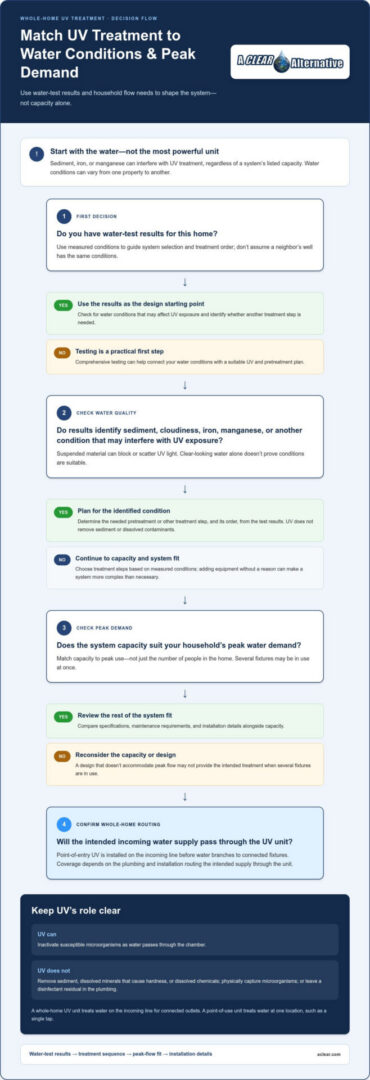
The most powerful point of entry UV sterilizer isn’t automatically the right one for your home. If your well water contains sediment, iron, or manganese, those conditions can interfere with UV treatment, regardless of the system’s listed capacity.
It makes sense to want added confidence about microorganisms in the water used throughout your home. UV treatment can inactivate susceptible microorganisms as water passes through the system, but it doesn’t remove sediment or dissolved contaminants, and it doesn’t leave a disinfectant residual in your plumbing. Start by understanding your water, then match the equipment to the results.
This guide explains how whole-home UV treatment works, what it can and can’t address, and how to compare flow capacity, pretreatment, system specifications, and maintenance. You’ll also learn which water-test results can help shape system design. For homeowners with private wells in Tabernacle, Shamong, and Medford Lakes, conditions can vary from one property to another. Comprehensive water testing is a practical first step toward matching UV treatment and pretreatment to your household’s needs.
Key Takeaways
- A point-of-entry UV sterilizer treats water as it enters the home, but it isn’t a catch-all solution for every water-quality concern.
- Match system capacity to household peak water demand, not just the number of people in your home.
- Compare pretreatment needs, maintenance requirements, and installation details alongside system specifications.
- Use water-test results to guide your choices instead of assuming your well has the same conditions as a neighbor’s.
- A Clear Alternative’s water testing and system installation can help connect your South Jersey home’s water conditions with a suitable UV treatment plan.
What a Point of Entry UV Sterilizer Treats Throughout Your Home
A point-of-entry UV sterilizer is installed on the incoming water line, before water branches off to the home’s plumbing. This makes it a whole-home treatment step: water that passes through the system can then reach connected fixtures, such as sinks, showers, and laundry taps. Its purpose is to address susceptible microorganisms in incoming water, not every possible water-quality issue.
In brief: Point-of-entry treatment happens where water enters a building and can serve connected outlets. Point-of-use treatment happens at one location, such as a single tap. The difference is where the water is treated and which outlets receive treatment.
What does whole-home UV treatment mean?
In a point-of-entry setup, water passes through a UV chamber on the incoming line before continuing into the home’s plumbing. A device installed at one kitchen faucet treats only water delivered at that tap. If you want treatment across connected fixtures, a point of entry UV sterilizer is designed for that broader role.
Coverage depends on more than the unit’s location. The system must suit the home’s plumbing and water demand, and the installation must route the intended water supply through the unit. A design that doesn’t accommodate peak flow may not provide the intended treatment when several fixtures are in use. UV also doesn’t create a disinfectant residual, so it doesn’t continue disinfecting water as it travels through the plumbing.
What UV treatment does, and does not, address
Inside the chamber, ultraviolet-C light exposes passing water to energy that can inactivate susceptible microorganisms by affecting their ability to function and reproduce. This process is called Ultraviolet Germicidal Irradiation (UVGI). UV treatment inactivates target organisms; it doesn’t strain them out of the water or remove their physical remains.
That distinction matters. A UV unit isn’t a sediment filter, water softener, or chemical-reduction system. It won’t remove particles, dissolved minerals that cause hardness, or dissolved chemicals. If water contains cloudiness or other substances that interfere with UV exposure, those conditions may need to be addressed as part of the treatment setup. Water-test results, rather than appearance alone, can help determine what’s needed.
Think of UV as one treatment barrier in a broader water-quality plan, not a complete solution by itself. Filtration can address particles, while other treatment methods are selected for specific dissolved contaminants or hardness. A whole house water filtration system guide explains how filtration can fit alongside UV. For homeowners in Medford Lakes, testing is a practical way to identify which concerns call for UV and which require a different treatment step.
How Point of Entry UV Sterilizers Work, and Why Water Quality Matters
A UV system works only when water and operating conditions allow its light to reach the microorganisms being targeted. Water flows through a chamber and passes near a source of ultraviolet-C (UV-C) light. Because treatment relies on sufficient exposure as water moves through, system design must account for factors such as flow and the condition of the incoming water. Clear-looking water alone doesn’t prove those conditions are suitable.
That makes water quality part of system design, not a detail to consider after choosing equipment. Sediment, cloudiness, or certain dissolved substances can interfere with UV transmission or allow particles to shield microorganisms. A system selected without considering these conditions may not perform as intended. Testing can inform both system selection and the order of treatment steps.
Why clarity and pretreatment matter
Suspended material can block or scatter light. A microorganism behind a particle may receive less UV exposure, even while water elsewhere in the chamber is being treated. Cloudy water can also reduce how far light travels through the water. Filtration may help address an identified issue before water reaches the UV chamber, but adding equipment without a reason can make a system more complex than necessary.
Water-test results help determine which treatment steps are needed and the right order for them. For example, testing may show that a home needs particle filtration ahead of UV, or that another water-quality concern calls for a different treatment method. The treatment sequence should follow measured conditions rather than a one-size-fits-all package. A Clear Alternative’s comprehensive water testing helps homeowners use actual results to guide those decisions.
What happens inside the UV chamber?
As water passes through the chamber, UV-C light affects susceptible microorganisms so they can no longer function or reproduce normally. This is inactivation, not chemical purification. UV doesn’t add a chemical disinfectant, and it doesn’t physically capture microorganisms or particles. A filter works differently: water passes through a barrier that traps certain material, which stays in the filter until it is serviced or replaced.
Many UV designs use a lamp inside or alongside a protective sleeve. The sleeve separates the lamp from direct contact with water while allowing light to pass through. Configurations vary, so check the specifications for the selected system. The lamp, sleeve, and chamber must function as designed, and maintenance needs depend on the system. Replacing one component or adding a filter won’t necessarily resolve every water-quality issue.
For Medford Lakes homes using well water, test results can help distinguish between a need for UV treatment and a need to address clarity or other conditions first. Explore A Clear Alternative’s water testing and treatment services to base that decision on your home’s water rather than assumptions.
Compare Point of Entry UV Systems by Fit, Capacity, and Support
A useful comparison starts with your water test and household routine, not a product ranking. A point of entry UV sterilizer must suit both the incoming water conditions and the home’s peak demand. Compare the complete setup, including any pretreatment and the practical work involved in keeping the system operating as specified.
Match system capacity to household water use
Think about the busiest moments in your home. A shower, washing machine, and kitchen tap running at the same time can create more demand than one fixture used alone. Household size provides context, but routines matter too. A smaller household with overlapping water use may have different peak demand from a larger household that spreads use throughout the day.
Compare measured or documented demand with the system’s verified design-flow specifications. Final selection should also account for the property’s plumbing, water source, and site conditions. Household size alone isn’t a sizing rule.
| Comparison factor | UV-focused setup | UV with pretreatment | What to compare |
|---|---|---|---|
| Intended use | Microbial treatment where test results support UV as the needed barrier. | Microbial treatment plus steps that address identified water-quality conditions. | Does the treatment plan match the concerns shown by the water test? |
| Design flow | UV capacity must suit the home’s peak demand. | The combined equipment must accommodate household demand. | Compare documented design flow with likely simultaneous fixture use. |
| Pretreatment | May suit water conditions that don’t call for additional treatment ahead of UV. | May include filtration or another treatment step if testing identifies a need. | Which measured conditions make each step necessary? |
| Maintenance | Review the system’s stated service tasks and replacement components. | Review UV upkeep plus service needs for each added treatment stage. | Are maintenance instructions clear, and are replacement components accessible? |
| Installation | Requires placement on the incoming line and a design suited to the plumbing. | Requires space and plumbing connections for the treatment sequence. | How will installation fit the home and allow for routine service? |
Compare pretreatment and maintenance requirements
A UV-only configuration and a treatment train serve different combinations of needs. If testing identifies particles or another condition that may affect UV operation, appropriate pretreatment may be needed before the UV stage. If results don’t indicate that concern, extra equipment may add maintenance without addressing a demonstrated need. Let the test guide the configuration.
Compare service instructions for every component, including what needs routine attention and which replacement parts the system uses. For local well-water considerations, well water testing in Tabernacle, Shamong, and Medford Lakes can help explain why results should shape the treatment plan. A clear comparison connects test findings, peak demand, pretreatment, and upkeep in one practical decision.
A Practical Checklist for Choosing and Maintaining a Whole-Home UV System
A dependable setup starts with evidence about your water and a clear picture of how your household uses it. Follow these steps to turn test results and daily needs into a system plan, then keep the manufacturer’s instructions accessible for routine care.
- Test the water. Arrange comprehensive testing that considers microbial concerns and physical conditions that may affect treatment, such as particles or cloudiness. A clear appearance, pleasant taste, or lack of odor can’t establish whether water is microbiologically safe.
- Map household demand. Note which fixtures and appliances may run at the same time, along with your usual patterns. This gives you a more useful picture of peak water use than household size alone.
- Identify treatment needs. Use the test findings to decide whether UV is appropriate on its own or whether a complementary treatment step is needed first. Tie each component to a documented concern.
- Review system specifications. Compare the manufacturer’s stated design flow and operating conditions with the home’s documented demand and water results. Select a point of entry UV sterilizer for the property’s actual requirements, not its appearance or a broad household-size estimate.
- Plan the installation. Identify where the system can be integrated into the incoming water line, with enough room for the unit and access for service. Professional installation connects the treatment sequence to the home’s plumbing and intended coverage.
- Set up a care routine. Read the operating instructions and note the manufacturer’s directions for inspection, lamp care, and protective sleeve cleaning or replacement, if applicable. Track required replacement components and service intervals as specified for the selected system.
Use test results to plan the treatment sequence
Testing helps distinguish microbial concerns from physical water conditions that may affect UV operation. Results can indicate whether filtration or another pretreatment step belongs ahead of the UV unit, or whether the treatment plan should focus elsewhere. Don’t use visible clarity, taste, or odor as a safety test. These qualities don’t reliably show whether microorganisms are present. Let measured findings guide the sequence.
Plan installation and routine care
Good placement makes the system easier to inspect and maintain. When planning installation, consider access to the unit, lamp, and any protective sleeve so manufacturer-directed care can be completed without unnecessary disruption. Follow the selected system’s instructions rather than assuming every model uses the same components or maintenance schedule. A Clear Alternative provides water testing and water-treatment system installation to connect test findings with the home’s setup.
Use A Clear Alternative’s water testing and treatment support to plan around your water results.
Get Point of Entry UV Guidance for Your South Jersey Home
Choosing a point of entry UV sterilizer means considering your water, your household’s demand, and the care you can plan for over time. Start with comprehensive water testing. Use the results to identify whether UV treatment fits your needs and whether pretreatment belongs in the design. Then compare system specifications with your household’s peak water use, choose an installation location with service access, and follow the manufacturer’s maintenance instructions.
How local water testing supports a better-fit solution
Private-well water conditions can vary between properties, even in the same community. One home may have particles or other conditions that call for pretreatment, while a nearby home may have different results. Testing replaces assumptions with information about your own water, so treatment decisions can reflect your results rather than a neighbor’s setup.
For homeowners in Medford Lakes, Tabernacle, Shamong, and nearby South Jersey communities, A Clear Alternative offers comprehensive water testing to inform treatment planning. Learn more about the local context in this South Jersey water treatment company guide. Testing helps determine which treatment steps make sense; it doesn’t mean every home needs the same equipment.
Next steps for testing, installation, and support
Approach the process one step at a time. Begin by describing your water concerns and household use. Testing provides a clearer basis for identifying treatment needs. Then review UV system specifications and any indicated pretreatment together, so the plan accounts for both water conditions and household flow. A Clear Alternative provides UV sterilizers and water-treatment system installation, connecting equipment selection with the home’s incoming water line and intended use.
Before installation, consider where the system can be positioned for practical access and review its operating and care instructions. Lamp and sleeve maintenance should follow the manufacturer’s guidance for the selected system. Planning for upkeep from the outset makes ongoing care part of the system’s routine rather than an afterthought.
A Clear Alternative is family-owned and operated, serving residential and commercial customers since 1991. For homeowners in Tabernacle, Shamong, and Medford Lakes, connect with A Clear Alternative about water testing, UV treatment, and installation.
Make Water Treatment a Confident Next Step
The right system is one you can understand, maintain, and feel confident using as your home’s needs evolve. Keep water-test results, system documentation, and maintenance notes together. That simple habit makes future decisions clearer if your household’s water use changes or you need to review the treatment setup.
Choosing a point of entry UV sterilizer isn’t about finding the most complex equipment. It’s about making an informed choice for your water and home, with a plan for ongoing care. A Clear Alternative can help you move from questions to a considered treatment plan through water testing, UV sterilizers, and system installation.
Talk with A Clear Alternative about UV treatment for your home and take the next step with greater confidence.
Frequently Asked Questions
Can a point of entry UV sterilizer work without electricity?
No. A point of entry UV sterilizer needs electricity to power its lamp and operating components, so it can’t treat water passing through during an outage. If you rely on a private well, a power loss may also stop the pump. Plan how your household will access water during outages, and follow the system’s instructions before resuming normal operation after power returns.
Does UV treatment change the taste, smell, or appearance of water?
UV treatment itself generally doesn’t change water’s taste, smell, or appearance. If water had a noticeable odor, color, or flavor before treatment, UV alone may not address the cause. Changes in these qualities can signal a separate water-quality issue, but they can’t identify it reliably. If you notice a new or persistent change, consider testing the water rather than relying on appearance or taste to assess safety.
Will a point of entry UV sterilizer remove chemicals from well water?
No. UV treatment isn’t designed to remove dissolved chemicals, metals, or minerals from well water. A laboratory water test can help identify which substances are present and whether a separate treatment method is appropriate. The method selected for a dissolved contaminant depends on the test results and the substance involved. Don’t assume that water treated with UV is also free of chemical contaminants.
What happens to UV treatment during a power outage?
The UV lamp stops operating without power, so water flowing through the unit during the outage won’t receive UV treatment. UV also doesn’t leave a disinfectant residual in water already inside household plumbing. If an outage affects your well or you suspect contamination, follow local public-health guidance about water use. Once power returns, use the system according to its instructions before relying on it for treatment again.
How often should a UV sterilizer lamp be replaced?
Follow the replacement interval specified in the manual for your exact system. Lamp life and service instructions vary, so a general schedule may not fit your unit. Note the installation or replacement date, keep the correct replacement information with the system documents, and don’t wait for a lamp to stop glowing before checking its service requirements. A lit lamp doesn’t necessarily mean it’s still within its recommended operating life.
Is a point of entry UV sterilizer suitable for every private well?
No. Suitability depends on the well’s test results, the home’s water demand, and whether the water conditions support effective UV treatment. A well with conditions that interfere with exposure may need pretreatment, while another property may have different needs. Homeowners in Tabernacle, Shamong, and Medford Lakes should base the decision on their own water test rather than assuming a nearby well has the same profile.