
Home water quality audit Tabernacle: Lead, Copper and Filtration Advice
What’s in your tap water? A home water quality audit in Tabernacle starts with testing a sample from your home. The results show which water-quality concerns were measured, including lead and copper. Use your results, not guesswork or a randomly chosen filter, to decide what to do next.
It’s reasonable to want clear answers before choosing a filtration system. Test results can seem technical, but the key is understanding what each one measures and how it relates to your household’s water. This guide explains how to read lead and copper findings, what they can tell you, and how to consider filtration based on the results.
You’ll also learn how a private well testing opportunity in South Jersey fits into the picture and when comprehensive testing can help clarify your next step. By the end, you’ll have a practical framework for understanding your results and choosing a water treatment approach suited to your home.
Key Takeaways
- Learn how to read lead and copper results, and why a test result needs context before you choose a treatment.
- See what the South Jersey private well testing opportunity covers and how to use the results to guide next steps.
- Understand the key New Jersey requirements that apply to private well water testing.
- Build a sensible retesting routine around changes to your well, plumbing, or water quality.
- Match filtration to the issue identified by testing, rather than choosing a system based on guesswork.
Lead and copper test results
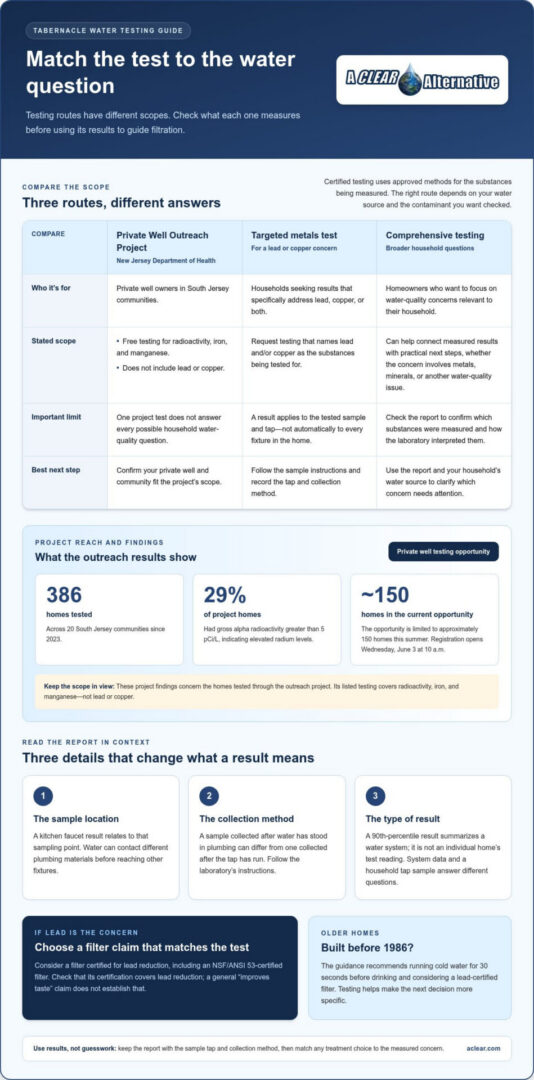
A lead result measures the lead detected in the tested water sample. A copper result measures copper in that sample. Neither automatically describes every tap in your home, because water can contact different plumbing materials before reaching each fixture. Note the sample location and collection method to understand what the result represents.
Read the result, unit, and sampling instructions together. Check whether the sample came from a kitchen tap, another fixture, or a particular collection method. A sample collected after water has stood in the plumbing can differ from one collected after the tap has run. Follow the laboratory’s instructions, and consider how each sample was collected before comparing results.
A 90th-percentile result summarizes results across a water system; it isn’t an individual home’s test reading. System-wide data and a household tap sample answer different questions. A system result cannot show whether water picked up lead or copper inside your home’s plumbing. For your own property, use a sample collected from the tap you’re investigating and keep its location with the report.
For a private well, testing gives information about the sample collected from that supply. For public water, system-level monitoring describes water at the system level, while a household sample can address water after it passes through your plumbing. A kitchen faucet result, for example, relates to that sampling point, not automatically to every bathroom tap.
Homes built before 1986 deserve particular attention to lead in household plumbing. For those homes, the guidance recommends running cold water for 30 seconds before drinking. It also recommends considering a lead-certified filter. These steps are useful precautions, but testing helps identify what is present in the sample and makes the next decision more specific.
Filter claims should match the substance measured. For lead, consider a filter certified for lead reduction, including an NSF/ANSI 53-certified filter. Check that the certification covers lead reduction; a general claim such as “improves taste” doesn’t establish that. A filter selected for lead also doesn’t answer whether copper or another measured substance needs a different treatment.
Legal thresholds are one consideration when interpreting a water test result. Some contaminants may still pose health risks below legal thresholds. Don’t treat a result below an MCL as proof that every household concern has disappeared. Consider the measured result, the laboratory’s interpretation, and the sample details together before deciding whether another test or response makes sense.
For a home water quality audit in Tabernacle, organize the information before choosing filtration. Identify whether your home uses a private well or public water, record the sample tap, and note the collection method. Compare each result with the report’s interpretation. If lead or copper appears, base your next step on that finding, not on taste, appearance, or broad filter claims.
Where can Tabernacle residents get certified water testing?
Certified water testing is laboratory analysis using methods approved for the substances being measured. For Tabernacle homeowners, the right testing route depends on whether the home uses a private well or public water and which contaminants need answers. A report about iron, for example, doesn’t establish whether lead or copper is present.
Private well owners in South Jersey can look to the New Jersey Department of Health’s Private Well Outreach Project. According to the department, the project offers free testing for radioactivity, iron, and manganese to private well owners in South Jersey communities. Its stated scope doesn’t include lead or copper, so those concerns require testing that specifically covers those metals.
The project has tested private well water from 386 homes across 20 South Jersey communities since 2023. Among homes tested through the outreach project, 29% had gross alpha radioactivity greater than 5 pCi/L, indicating elevated radium levels. Those findings show why it helps to match each test to a specific concern instead of assuming one sample covers every possible contaminant.
The current opportunity is limited to approximately 150 homes this summer. Registration opens Wednesday, June 3 at 10 a.m. If you plan to participate, note the registration time and confirm that your private well and community fit the project’s stated scope. The listed testing covers radioactivity, iron, and manganese, not every water-quality question a household may have.
For lead or copper concerns, request testing that names those metals as analytes, meaning substances the test is designed to detect. Before collecting a sample, decide whether you need results from a particular tap or for a specific plumbing concern. Follow the test’s collection instructions, because sample handling affects what the result represents.
A useful report identifies the substances tested, measured results, and the laboratory’s interpretation. Keep it with the sampling location and date. When comparing results over time, using the same tap and consistent collection instructions makes the comparison more meaningful. A result from one location should not automatically be treated as a measurement from every faucet.
Tabernacle residents looking for broader household answers can use comprehensive water testing to focus on the concerns relevant to their home. Comprehensive water testing can help connect measured results with practical next steps. Bring the test report and note whether your home uses a private well or public water. That gives the evaluation a clear starting point, whether your question involves metals, minerals, or another water-quality concern.
Paragraph 53 of the Instruction on the Worship of the Eucharistic Mystery recommends, where possible, placing the tabernacle in a chapel distinct from the church’s central area. The wording is conditional: “where possible” does not make a chapel necessary in every case, and “distinct” describes the chapel’s separation from the church’s central area. This is guidance about the placement of a church tabernacle, not about collecting a water sample or interpreting laboratory results.
Here, Tabernacle refers to the community, so a church-placement recommendation should not be mistaken for a water-testing resource for residents. It provides no information about certified laboratories, analytes, sample collection, or water-quality results. Residents seeking answers about household water need testing information that addresses the specific concern and identifies the substances analyzed. Keeping these meanings separate avoids confusing guidance about a tabernacle’s location with evidence about water quality or a report based on a household sample.
What are New Jersey’s drinking water testing requirements for private wells?
A private well is a household water source outside a public water connection. For a Tabernacle homeowner, the first step is to distinguish a legal requirement from a voluntary testing opportunity or personal water-quality check. These serve different purposes. A program’s offer to test water doesn’t, by itself, explain every rule that may apply to a property or transaction.
New Jersey’s Department of Health offers a Private Well Outreach Project for private well owners in South Jersey communities. According to the department, the project offers free testing for radioactivity, iron, and manganese this summer. This is a defined testing opportunity, not a complete answer to every question about well-water obligations or household contaminants.
Start by identifying why you need a test. A home purchase, a change in water quality, and routine monitoring are different situations. Write down your reason before selecting a test. For example, a test focused on iron and manganese won’t answer a separate question about lead or copper unless those substances are included in the analysis.
Use this practical sequence to organize your next steps:
- Identify the water source. Confirm whether the home uses a private well or public water. A private-well result describes the sample collected from that well or its plumbing.
- Name the purpose. Record whether you’re testing for a property-related requirement, a specific concern, or general household information. Keep the reason with the report.
- List the substances. Match the test panel to the concern. Radioactivity, iron, and manganese are the substances named in the New Jersey outreach project.
- Follow collection instructions. Use the supplied container and sampling method. Note the tap and collection date so the result has clear context.
- Keep the paperwork together. Save the laboratory report, sampling details, and any property documents linked to the test. These records help distinguish one test purpose from another.
A testing requirement is a rule attached to a particular circumstance; a testing recommendation is guidance for making an informed choice. Don’t assume a free outreach test satisfies a separate requirement or that one test panel covers every concern. For a home sale, identify the test requested for the transaction and compare its analytes with your other water questions.
Results have limits: a report addresses only the substances tested in the sample collected. If a concern involves lead, copper, or another substance outside the project’s listed scope, choose testing that explicitly includes it. Keep that result separate from the outreach project’s findings, even if both samples came from the same property.
For Tabernacle homeowners, a useful plan starts with the well type, reason for testing, and substances to be measured. Follow the collection method and keep the report. This distinguishes New Jersey’s testing opportunity from property-specific requirements while giving you a clear record for decisions about your household water.
Testing requirements depend on the circumstance, such as a property transaction, so identify the test required for that situation. The state’s outreach project offers free testing for radioactivity, iron, and manganese, but don’t assume that test satisfies a separate requirement.
How often should Tabernacle homeowners test their drinking water?
Testing frequency is the interval between water samples collected from a home. For a Tabernacle household, set that interval based on the water source, past results, and changes that could affect the supply. A private well and a home using public water call for different testing decisions because their water sources and plumbing differ.
For a private well, use its history to guide your schedule. A stable result from an earlier sample describes that sample, not every future season or change. Keep each report with its collection date, location, and substances tested. This record helps you see whether a new result differs from your home’s baseline.
Some events call for a fresh sample outside your routine. Consider testing after well repairs, plumbing work, flooding near the well, or a noticeable change in water’s appearance, taste, or odor. These conditions can alter what reaches the tap. A sample collected after a change can help distinguish a new water-quality issue from an earlier result.
Build a practical schedule around specific triggers:
- New home or well: Establish a starting point before relying on water for daily household use.
- Well or plumbing work: Take a new sample after work that could affect the water path.
- Changed water: Record the change and arrange a test that targets the concern, rather than repeating an unrelated panel.
- Earlier result: Use the report’s findings to decide whether the same substances need follow-up testing.
- Household change: Revisit the plan when the well, plumbing, or water use changes.
For homes on public water, distinguish system monitoring from a test at your own tap. A system report describes monitored water at the system level. A household sample can address questions about water after it travels through your plumbing. If your concern involves a specific kitchen faucet, for example, a sample from that tap may answer a different question than a system-wide report.
Choose a test panel that matches the reason for sampling. If you’re investigating lead, copper, or another specific substance, make sure the analysis measures it. Repeating a test for iron won’t track lead, for example. Keep the collection method consistent when comparing results, and note which tap supplied each sample.
A calendar reminder can help, but a useful water-testing plan also responds to changes. Keep a simple log with the sample date, tap location, test substances, and any well or plumbing work. Use the record to identify what needs follow-up, then plan your next water test around your home’s source and recent changes.
A Clear Alternative: Acid Neutralizers
A Clear Alternative offers acid neutralizers for homes where water testing identifies acidic water. An acid neutralizer treats acidity by raising the water’s pH, helping address a condition that can contribute to plumbing corrosion. It isn’t a lead or copper filter, so match treatment to the test findings rather than assuming one system solves every concern.
Consider an acid neutralizer when your results show low pH or acidity and you want treatment suited to that issue. If your report points to lead, copper, or another concern, the appropriate solution depends on the substance measured and the treatment needed. Clear results make the next step easier to choose.
Contact A Clear Alternative to discuss your water test results and treatment options.
Turn Your Water Results Into a Clear Next Step
A home water quality audit in Tabernacle is most useful when it leads to a treatment choice based on your household’s actual results. Keep your test report and note which water concerns matter most in daily use. This gives the next conversation a practical starting point, instead of leaving you to choose equipment based on broad claims or guesswork.
A Clear Alternative offers Acid Neutralizers, Water Softeners, and Reverse Osmosis Systems. The right category depends on what your testing identifies and what you want to address. If you’d like help connecting your results to possible options, contact A Clear Alternative for advice. Bring your questions and test information, and take the next step with greater clarity.
Frequently Asked Questions
What’s in your tap water?
Only a test of your home’s water can identify what’s in the sample from your tap. The answer depends on the water source and the route it takes through your plumbing. A public system’s report and a sample from your kitchen faucet describe different points. For a home water quality audit in Tabernacle, identify whether you use a private well or public water, then test for concerns relevant to your home.
What does a home water quality audit include?
A home water quality audit connects your water source, test results, and household concerns. Note whether your home uses a private well or public water, then list concerns such as taste, staining, or plumbing changes. Select testing that measures substances relevant to those concerns. Review the report’s units and sample location, then use the findings to prioritize follow-up questions or treatment options.
How can I test tap water quality at home?
You can use a home test kit for an initial screen, following its collection and timing instructions closely. Choose a kit that measures the concern you want to investigate, such as hardness or a specific contaminant. Collect water from the intended faucet without changing the instructions. For a more detailed assessment, arrange laboratory testing and keep the sample location and collection details with the results.
What are the common water contaminants in Tabernacle, New Jersey?
There isn’t enough information to identify which contaminants are most common across Tabernacle homes. The New Jersey Department of Health’s South Jersey Private Well Outreach Project tests for radioactivity, iron, and manganese. These are substances the project measures, not proof that every local well contains them. Your results depend on your property’s sample, so choose testing based on your water source and specific concerns.
How do I interpret water test results and compare them with EPA standards?
Read each result alongside its unit, the substance tested, and the report’s interpretation. Compare it with the relevant EPA standard for that contaminant, making sure the units match. Maximum contaminant levels are minimum standards, and some contaminants may still pose health risks below legal thresholds. A result below a standard doesn’t answer questions about substances the test didn’t measure or different taps in your home.
What steps should I take if my water test finds contaminants?
Identify the contaminant, its measured result, and the sample location. Keep the report and collection details together, then select any follow-up test to address the specific finding. Match filtration to the contaminant instead of relying on a general-purpose claim. For example, an acidity concern calls for a different treatment consideration than a lead finding. Let the test results, not guesswork, guide your next decision.