
Getting Rid of Metallic Taste in Water: Find the Cause First
A metallic taste is a clue, not a diagnosis. If it’s making you avoid drinking or cooking with tap water, getting rid of metallic taste in water starts with finding where the taste comes from, not choosing a filter by guesswork. Minerals in a private well, the municipal supply, or metals entering water through household plumbing can all affect its flavor.
Taste alone can’t tell you which substance is present, and it can’t reliably reveal lead. Testing matters, especially if the taste is new, persistent, or seems limited to particular taps. Until you know more, don’t assume the water is safe or unsafe based only on its flavor.
This guide explains common causes, how to investigate the issue, and how comprehensive water testing can clarify what’s going on. You’ll also learn how treatment options, including iron and sulfur filtration, acid neutralization, carbon filtration, and reverse osmosis, may help when matched to test results. The goal is a practical path from unpleasant taste to an informed solution.
Key Takeaways
- A metallic taste is a clue, not proof of a particular contaminant. Water sources, plumbing, and fixtures can all affect flavor.
- Compare taps and note differences between cold and hot water, but don’t treat those observations as a diagnosis.
- Testing can identify water-quality issues and guide the next step. Lead, in particular, can’t be reliably detected by taste, smell, or appearance.
- Getting rid of metallic taste in water starts with finding the cause so treatment can match the confirmed issue.
- Iron and sulfur filtration, acid neutralization, carbon filtration, and reverse osmosis address different water concerns. Test findings help determine which option is appropriate.
Why Does Water Taste Metallic, and What Can the Taste Tell You?
A metallic taste can make water seem rusty, bitter, sharp, or like coins. These descriptions help explain what you notice, but they don’t identify a specific substance. Minerals in the source, changes in water chemistry, and contact with pipes or fixtures can all affect the taste of water at your tap.
That distinction matters. Iron, copper, and manganese may contribute to an unusual taste, while low-pH water can be more corrosive and interact with plumbing materials. The same taste can have different causes, and some contaminants may be present without a noticeable flavor. Your senses offer a starting clue, not a water-quality result.
What does metallic-tasting water usually mean?
People use “metallic” to describe a range of sensations, from a bitter or tinny aftertaste to a rusty flavor. Some mineral-related issues can also affect appearance, such as causing visible discoloration. But appearance can’t reliably identify what’s dissolved in the water. Iron, copper, and manganese are possibilities to investigate, not answers you can confirm by tasting.
Water chemistry can add another factor. Lower pH means more acidic water, which may contribute to corrosion and allow metals from plumbing to enter the water. Still, a metallic or bitter taste can’t tell you the pH, which metal might be involved, or how much is present. Standards also distinguish health-related requirements from aesthetic guidance on qualities such as taste. The overview of drinking water quality standards explains this difference.
Why the source matters before trying a fix
Start by considering where the water could be changing. With a private well, the source water itself may contain minerals that affect its taste. With municipal water, the change could occur in the home’s plumbing or fixtures, even if water entering the property tastes different. In either case, the route from source to glass matters.
Notice whether the taste occurs at every tap or only one. If one faucet is affected while others seem normal, that pattern may point to a localized fixture or plumbing issue. It’s a useful observation, not proof. Water can vary for more than one reason, and comparing taps can’t confirm safety.
- Compare water from several faucets, using the same type of water.
- Note whether the taste is constant or appears only at certain times.
- Record visible changes, such as unusual color, without treating them as a diagnosis.
These details can help narrow the investigation, but testing is what helps identify the water-quality issue. Before getting rid of metallic taste in water with a filter or other treatment, establish whether the source is the well, household plumbing, or another part of the system. The right fix depends on that evidence.
Common Causes of Metallic Taste: Water, Pipes, and Low pH
Metallic-tasting water can have several distinct causes. Minerals in source water, corrosive water chemistry, and household plumbing materials can each affect what comes out of your tap. A rusty or bitter flavor is a reason to investigate, not enough evidence to identify the cause or choose a fix.
Iron and other dissolved metals in water
Iron in source water may create a metallic taste and, in some cases, reddish-brown staining or discoloration. Manganese can also affect water’s appearance, while copper or zinc may contribute to an unusual flavor. These are possibilities, not taste-based identifications. Clear water can still contain metals, and rusty-looking water doesn’t prove iron is the source.
Lead deserves particular care. It can enter water from plumbing, but you can’t rule it in or out by taste, smell, or appearance. The EPA Secondary Drinking Water Standards discuss aesthetic issues such as metallic taste and explain how corrosion of iron and copper can affect flavor. Testing, rather than a taste comparison, is needed to determine what’s present in your water.
Low pH, corrosion, and household plumbing
Water with a low pH is more acidic and may be corrosive. As it travels through plumbing, it can interact with pipes, solder, fittings, or fixtures and pick up metals along the way. The source water may be one factor, while the materials between the source and your faucet may be another. The EPA notes that controlling factors such as pH can help reduce metal leaching.
Look for patterns that help distinguish a whole-house issue from a localized one. Compare water from several cold-water taps. If only one faucet tastes different, its fixture or nearby plumbing may be involved. If several taps have a similar taste, the cause could be farther upstream, but that pattern isn’t proof. Also note whether the taste is strongest in water that has sat in the pipes. Record what you observe, but don’t taste-test water to assess safety.
Use these observations to guide the investigation, not to make a diagnosis. A well-water concern may start with the source itself; a plumbing-related issue can arise after water enters the home. Comprehensive testing can help distinguish between these possibilities and show whether pH or particular metals need attention. Comprehensive water testing can help move the investigation from clues to evidence.
Getting rid of metallic taste in water starts with matching the response to the actual cause. Treating the wrong part of the system may leave the taste unchanged. A test-informed approach helps focus on the water, plumbing, or chemistry that needs attention.
Is Metallic-Tasting Water Safe to Drink? What Testing Can Establish
A metallic taste alone can’t tell you whether water is safe or unsafe to drink. It may come from a mineral that mainly affects taste or appearance, or it may signal a water-quality issue that needs closer attention. Flavor can’t identify the substance, measure its level, or rule out a contaminant that has no noticeable taste.
Treat a new or persistent taste change as a reason to investigate, not as a safety verdict. Don’t rely on taste, smell, or clarity to decide whether lead is present. Lead can’t be reliably detected by any of those senses, and water that seems normal may still need testing if there’s a specific reason for concern.
What taste can, and cannot, tell you about health
Some water-quality issues are primarily aesthetic, affecting flavor, color, or odor. Others may involve contaminants with health implications. A noticeable taste doesn’t tell you which category applies, and an absence of taste doesn’t confirm that water is free of unwanted substances. Testing measures only the contaminants included in the analysis, so the test should fit the concern.
If you have an immediate safety concern, check current guidance from your water utility or local and state public-health authorities. Follow any advisory they issue about drinking, cooking, or using tap water. Don’t make a safety decision based only on whether the water tastes better after running the tap or using a household filter.
When water testing is the useful next step
Arrange testing if the taste change persists, appears suddenly without an obvious fixture-related explanation, or affects several taps. Testing is especially important for private-well households because there isn’t a municipal water system monitoring the well on the household’s behalf. If the taste occurs at just one faucet, note that pattern too. It can help guide the investigation, even though it can’t establish the cause on its own.
The right analysis depends on the water source and what you’re trying to determine. A private-well test may need to assess water chemistry and metals, while a plumbing concern may call for sampling that distinguishes source water from water after it passes through household pipes. A general-purpose home kit may not test for every relevant contaminant, so review what its results actually cover.
- Write down when the change began and which taps are affected.
- Note whether hot and cold water seem different, without treating that comparison as proof.
- Keep any utility notice or prior test results available when arranging follow-up testing.
Until results clarify the issue, use official public-health or utility guidance to decide what to do about drinking and cooking water. For private-well households, a South Jersey well water testing guide can help you prepare for the next step. Once results identify what’s present, you can consider treatment that matches the findings rather than trying to mask the taste.
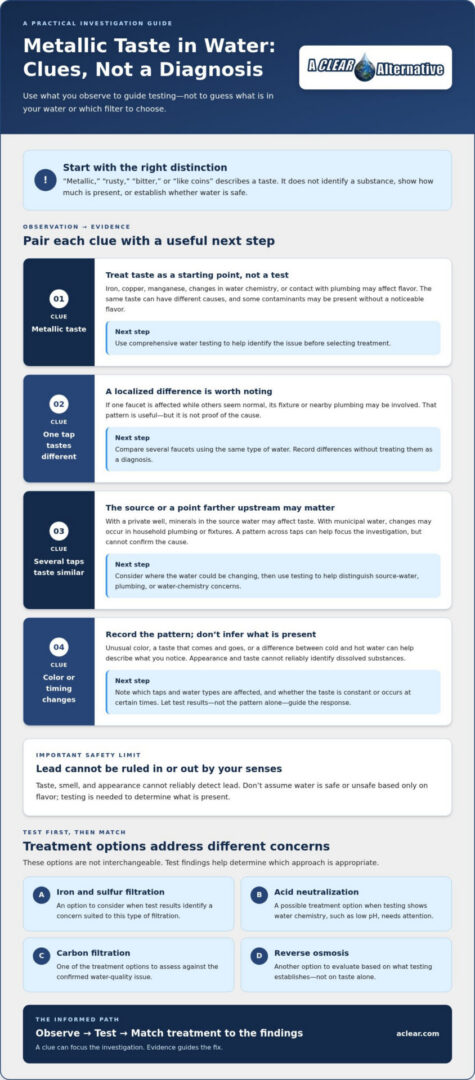
How to Track Down Metallic Taste Before Choosing a Filter
A few simple observations can help you describe the problem and decide what to investigate next. They won’t identify a contaminant or prove water is safe, but they can help distinguish a pattern limited to one fixture from a change affecting the home’s water more broadly. Follow a practical sequence: compare taps, record what you notice, review recent changes, then arrange testing.
Check whether one tap or the whole home is affected
Compare cold water from several faucets under similar conditions. Note which taps taste different and whether the taste appears after water has been unused or changes after it runs. You can also compare cold and hot water, but a difference is only a clue. Don’t use flushing, heating, or tasting as a way to decide whether water is safe.
Keep a short log. Record the date, affected fixtures, any unusual color, whether the water had been sitting, and recent plumbing work or changes to your well or water supply. A taste noticed at one faucet may point toward a localized fixture or nearby plumbing issue; a similar change at several taps may call for a broader investigation. Neither pattern confirms the source.
- One faucet: Record whether nearby fixtures seem unaffected and note any recent work on that tap.
- Several faucets: Check whether the pattern includes both nearby and distant fixtures.
- Hot versus cold: Note any difference, but don’t treat it as a definitive test.
- Change over time: Write down when the taste began and whether it is constant or intermittent.
Use test results to narrow the next step
Once you understand the pattern, arrange testing suited to your water source and concern. A comprehensive analysis can assess relevant water characteristics, such as pH, and test for specific contaminants. For example, if results show low pH, an acid neutralizer may be relevant. If a metal is detected, the next step should address that finding rather than rely on the taste description.
For a private well, include the well source in the investigation. For a plumbing-related concern, explain which taps are affected and whether the taste changes after water sits. Share your observations and previous results when arranging testing. This context can help focus the analysis, but it doesn’t replace a properly selected test.
Don’t install a filter based only on a metallic flavor or assume treatment can replace a plumbing repair if a fixture or pipe is the source. For getting rid of metallic taste in water, the useful first step is evidence that connects the symptom to the cause. If low pH is confirmed, an acid neutralizer may be one treatment category to consider; broader filtration choices depend on test findings.
Arrange comprehensive water testing to identify the issue before choosing a treatment.
Match Metallic-Taste Treatment to the Confirmed Water Issue
The right response depends on what testing finds and where the issue originates. A metallic flavor alone can’t tell you whether the water needs filtration, pH adjustment, plumbing attention, or another step. Matching treatment to evidence helps avoid installing a system that targets the wrong problem while the real cause remains.
Which treatment category may fit which test finding?
Use test results as your guide, not the taste description. Different treatment categories address different water concerns, and not every option suits every home or water source.
- Iron or sulfur identified: An iron and sulfur filtration system may be relevant when testing confirms these issues. Results help clarify whether these substances are present and need treatment.
- Low pH confirmed: An acid neutralizer is designed to address acidic water. It may help manage conditions that contribute to corrosion, but it isn’t a universal fix for every metallic taste.
- Other water concerns found: Reverse osmosis or carbon filtration may be considered when the test findings and intended application support that choice. Neither should be selected simply because water tastes metallic.
If results point to a problem with a faucet, pipe, or other plumbing material, filtration may not address the underlying source. A plumbing issue may need its own evaluation and repair—for instance, property owners dealing with pipe replacement or system diagnostics can turn to installation specialists like ooinkinstallaties.nl. Likewise, a system aimed at iron won’t necessarily resolve a taste caused by low pH or another substance. The goal is to treat the confirmed issue, then assess whether water quality has changed as intended.
Get local help identifying the cause
A Clear Alternative is a family-owned water-treatment business serving communities in the Tri-State area, including Tabernacle, Shamong, and Medford Lakes. The company has provided water treatment and purification services since 1991, including comprehensive water testing and treatment options. Testing builds a clearer picture of the water before a treatment approach is selected.
Bring your observations and any previous water-quality results into the conversation. Knowing which taps are affected, whether the water comes from a private well, and what testing has already covered can help frame the investigation. Test findings, rather than a guess based on taste, can guide consideration of iron and sulfur filtration, acid neutralization, reverse osmosis, or carbon filtration where appropriate.
That evidence-first approach is the practical path to getting rid of metallic taste in water: identify the issue, choose a treatment that fits, and avoid relying on a one-size-fits-all filter. If you’re noticing a persistent metallic taste, explore local water testing and treatment with A Clear Alternative to take the next informed step.
Move Forward With a Clearer Water Plan
You don’t have to guess your way through an unfamiliar taste or buy a filter and hope it helps. Turn what you’ve noticed into a focused plan: keep your observations handy, clarify what you want testing to answer, and use the findings to guide any changes to your water system. That way, getting rid of metallic taste in water becomes a practical decision, not a trial-and-error project.
Once you understand the cause, you can consider a response that fits your home instead of relying on a one-size-fits-all fix. A Clear Alternative provides water testing and treatment options to help you make informed choices based on the issue identified. Explore water testing and treatment with A Clear Alternative, and take the next step toward water that feels more comfortable to use every day.
Frequently Asked Questions
Can metallic-tasting water be safe to drink?
It may be, but taste alone can’t determine whether water is safe or identify what’s causing the flavor. Some causes mainly affect water’s taste or appearance; others may need prompt attention. Lead is a particular concern because you can’t reliably detect it by taste. If the change persists or you’re unsure about safety, arrange appropriate testing and follow local public-health guidance. Don’t treat a normal-looking or better-tasting sample as proof of safety.
Why does only one faucet have a metallic taste?
A taste limited to one faucet may point to that fixture, its connections, or nearby plumbing rather than the whole supply, but it doesn’t prove the source. Compare cold water from other taps, including one used regularly and one that may sit unused. Note whether the flavor changes after water has been standing or after it runs. If it continues, testing or a plumbing assessment by professionals such as Plomberie Anjou can help narrow down what’s happening.
Can boiling water remove a metallic taste?
No. Boiling isn’t a general way to remove dissolved metals or correct low pH. As water evaporates during boiling, some dissolved substances can become more concentrated. Don’t use boiling as a substitute for testing or treatment suited to the issue. If you’re concerned about the water’s safety, check guidance from your water utility or local public-health authorities while you identify the source of the taste.
Can a pitcher filter get rid of metallic taste in water?
It depends on the pitcher filter’s specific reduction claims, maintenance, and what’s causing the taste. A filter designed to reduce one substance may not address other metals, acidic water, or a problem in plumbing. Check the product’s certified claims and maintenance instructions, then compare them with water-test results. Buying a pitcher based on flavor alone may not address the cause or establish whether the water is suitable for drinking.
Why does water taste metallic after plumbing work?
Plumbing work can disturb deposits or temporarily change how water flows, which may affect its taste. Follow any flushing instructions provided for the work, then compare the affected fixture with other taps. Keep track of whether the flavor fades or continues. Don’t dismiss a persistent change as routine. If it lasts or raises a safety concern, arrange appropriate water testing before choosing a treatment.
Does a metallic taste in well water mean there is iron?
No. Iron is one possible cause, but taste can’t confirm its presence or concentration. Manganese, copper, low pH, and other factors can create similar impressions. A water test can check whether iron is present and help identify other relevant conditions. For private-well households in Tabernacle, Shamong, or Medford Lakes, testing can provide evidence to guide the next step instead of relying on flavor alone.
Should I stop using water that suddenly tastes metallic?
A sudden change doesn’t by itself prove there’s a hazard, but taste can’t rule one out either. If the flavor is strong, continues, or appears with unusual color or another concern, don’t make a safety decision based only on your senses. Check guidance from your water utility or local public-health authorities, and arrange testing to investigate the change. Follow any official instructions about drinking or cooking with the water.