
Ice Machine Water Filter Replacement for Medford Lakes Businesses
A clogged filter can restrict water flow to a commercial ice machine. Ice machine water filter replacement in Medford Lakes may help if a blocked cartridge is the cause. Filtration can also reduce particulates, while contaminants in unfiltered water may contribute to cloudy, hollow, or unpleasant-tasting ice.
When ice production slows, it’s easy to focus on the machine and overlook its water supply. The replacement cartridge must match the installed filtration system, so start by identifying the system and its requirements.
This guide explains how restricted flow can affect ice production, how to identify a compatible replacement cartridge, and how filtration relates to ice clarity and taste. It also covers when broader water treatment may be relevant, helping you make an informed decision for your Medford Lakes business.
Key Takeaways
- Commercial filtration can help protect ice equipment from particles and scale that may interfere with operation.
- When water flow drops, inspect the filter as one possible cause before assuming the ice machine itself is at fault.
- Use the existing system’s identification details to find a compatible replacement cartridge and understand where it fits.
- Cloudiness, hollow cubes, or off-tastes can point to water quality factors worth considering alongside the machine.
- For broader water concerns, water testing can help determine whether an Acid Neutralizer or another treatment option fits the issue.
Commercial ice machine water filtration
There is no single filter for every Medford Lakes ice machine. The right setup depends on the incoming water and the machine’s specifications.
Commercial filtration sits between the incoming water supply and equipment such as an ice maker. A suitable filter can help reduce particulates and address water conditions that contribute to scale buildup, corrosion, abrasion, or clogging. Choose filtration based on both the water and the machine’s requirements.
Mineral deposits can accumulate inside equipment that uses water. A filter suited to the relevant water conditions may help limit that buildup, but it doesn’t replace routine machine cleaning or maintenance. Filtration targets specific water concerns; the machine’s maintenance procedures address its components and surfaces.
Start with the equipment. Find the ice machine’s make and model, then review its water-inlet and filtration requirements. The replacement must suit the machine’s connection and intended use. Even a cartridge that fits physically may be the wrong choice if it doesn’t match the system or address the relevant water concern.
- Identify the water concern: Look for particulates, scale, or other water-quality issues affecting the site.
- Check the machine details: Use the model information and installation documentation to identify filtration requirements.
- Match the treatment: Select filtration based on the concern and equipment, not appearance alone.
- Review the result: Observe water flow and ice production after the filter is installed.
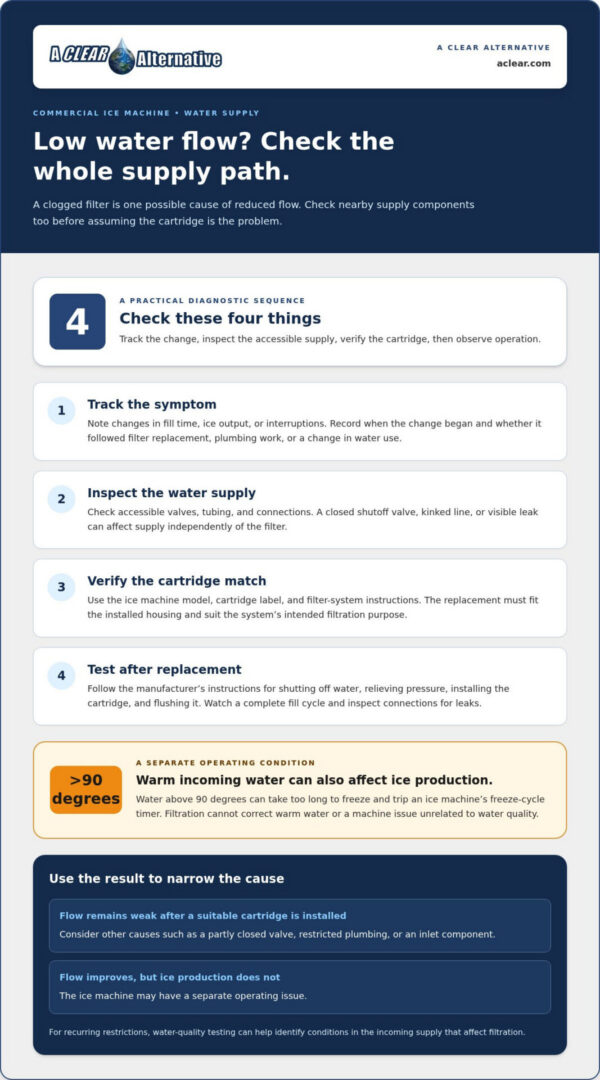
Water temperature matters too. Water above 90 degrees can take too long to freeze and trip an ice machine’s freeze-cycle timer. That is a separate operating condition from filtration, but it shows why diagnosing ice production requires looking beyond the cartridge. Filtration cannot correct warm incoming water or a machine problem unrelated to water quality.
Does Medford Lakes tap water require special filtration for ice machines? There is no single filter that suits every local business. The right choice depends on the water at your location and the machine’s requirements. Comprehensive water testing can help identify water concerns before you select treatment.
When replacing an ice machine water filter in Medford Lakes, consider the machine details alongside any water concerns. This helps you choose a cartridge suited to the installed system instead of assuming every ice maker uses the same setup.
Scale buildup can affect water-using equipment. Consider it alongside the machine’s requirements and any water concerns identified at your business when assessing filtration options.
Low water flow and a potentially plugged water filter
A clogged water filter is one possible cause of low flow to a commercial ice machine. Reduced supply can affect filling, so when production changes, inspect the full water path, not just the ice bin.
Compare the current flow with the machine’s usual operation. Note whether filling takes longer, production has slowed, or the machine has stopped making ice. Record when the change began and whether it followed filter replacement, plumbing work, or a change in water use. This can help distinguish a gradual restriction from a sudden interruption.
Inspect the filter housing and nearby water line. A cartridge that has reached its service limit or collected particulates may restrict flow. Also look for a closed shutoff valve, kinked line, or visible leak. These issues can reduce supply independently of the filter, so replacing a cartridge without checking nearby components may not solve the problem.
Use the ice machine’s model information and filter-system instructions to identify the right replacement. The cartridge must fit the installed housing and suit its intended filtration purpose. Follow the manufacturer’s instructions for shutting off water, relieving pressure, installing the cartridge, and flushing it before use. A loose connection can leak, and an incorrectly installed cartridge may leave the flow problem unresolved.
- Track the symptom: Note changes in fill time, ice output, or interruptions.
- Inspect the supply: Check accessible valves, tubing, and connections for restrictions or leaks.
- Review the cartridge: Match its identification details to the filter housing and machine documentation.
- Test operation: After replacement, watch a complete fill cycle and inspect connections for leaks.
If flow remains weak after you install a suitable cartridge, consider other causes. If flow improves but ice production doesn’t, the machine may have a separate operating issue. Distinguishing these symptoms can help avoid repeated filter changes that don’t address the actual fault.
For recurring restrictions, water-quality testing can help identify conditions in the incoming supply that affect filtration. A water softener may also be relevant where water hardness contributes to scale buildup. The key is to connect the treatment choice to the observed water condition, rather than treating every low-flow event as a plugged cartridge.
Filter cartridge replacement resources
Use the ice machine’s model details and existing filter information to identify a suitable replacement. The equipment manual, cartridge label, and filter instructions can help narrow the options.
Approved and Generic Filters
A generic cartridge is suitable only if it meets the filter system’s requirements. Compare its connection, dimensions, filtration purpose, and stated compatibility with the machine documentation. A cartridge that fits the housing may still be unsuitable for the machine or water concern. The manufacturer-approved option provides a reference for checking these details.
Before purchasing, record the cartridge label and ice machine model. Compare both with the replacement information instead of relying on a similar appearance. Keep the packaging or product details with your maintenance records to make the next replacement easier to identify.
Compatible Filter Models
No single filter model fits every ice machine in Medford Lakes. Compatibility depends on the machine, filter housing, and installed system. Check the ice maker’s model plate and the identification printed on the current cartridge, then use those details to find a listed replacement.
If the cartridge label is unreadable, consult the machine manual and look for identification on the housing. Don’t choose a model based only on its brand name or connection size. After installation, follow the cartridge instructions for flushing and check for leaks before returning the machine to normal use.
Filter indicators vary by machine. After replacement, follow the reset procedure in the equipment manual or on-screen instructions. Some controls use a button sequence, but the exact steps depend on the model.
Local Replacement Services
The right service depends on the issue. A commercial appliance technician can address ice-machine components and equipment-specific filter procedures. A plumber is a better fit when the problem involves the building’s water line, shutoff valve, or a visible plumbing leak.
When arranging service, describe the symptom clearly, such as slow filling, a leaking connection, or an indicator that stays on after cartridge replacement. Provide the ice machine’s make and model and the current filter label. These details can help distinguish a filter change from a water-supply or equipment problem.
Replacement Timing
Replace the cartridge according to its stated service interval and the ice machine or filtration system instructions. Timing also depends on water quality and usage: a busy kitchen may use the cartridge’s capacity faster than a lightly used machine. Record installation dates and follow the system’s indicator, if provided.
Don’t rely on the indicator alone if flow declines or the cartridge instructions call for replacement. A new cartridge won’t fix a closed valve or separate machine fault, so observe the next fill cycle and check for leaks. If restrictions return, water testing can help identify conditions affecting the filter.
Ice clarity and taste
Cloudy, hollow, or bad-tasting ice may point to contaminants in the water entering a commercial ice machine. Filtration can help reduce particulates, but a cube’s appearance or flavor alone doesn’t identify a specific cause. Treat a change as a clue and consider the water, filter, and machine conditions together.
Note whether the change affects every batch or occurs intermittently. Compare ice from the machine with water from a nearby tap. If both have an unwanted taste, consider the incoming water. Chlorine can impart an undesirable taste and odor to drinking water, which may carry into ice made from that supply.
Cloudiness and hollow centers also need separate consideration. Unfiltered contaminants may result in cloudy, hollow, or bad-tasting ice. A filter intended to reduce particulates may address some water concerns, but it won’t automatically resolve every cause of poor ice quality. The machine’s operation and cleanliness also affect the result.
Use a consistent troubleshooting check. Record the ice’s appearance and taste, along with any recent cartridge change. Inspect the filter label and follow its replacement and flushing instructions. If you installed a new cartridge, confirm it is seated correctly and the filter instructions were followed before assessing the next batch.
- Cloudy cubes: Note whether cloudiness appears throughout the batch or in particular cubes.
- Hollow cubes: Record whether the shape change occurs with other quality symptoms.
- Unwanted taste or odor: Compare the ice with water from a nearby tap, including any chlorine-like taste or smell.
- Recent filter change: Review the cartridge instructions and confirm the system was flushed as directed.
Keep the ice machine’s cleaning routine separate from filter replacement. A cartridge treats water passing through the filtration system; cleaning addresses the machine itself. Replacing the filter doesn’t replace the ice maker’s cleaning instructions, and cleaning the bin won’t remove contaminants entering with the water. Track both tasks so one isn’t mistaken for the other.
If a taste or clarity issue persists, record what you observe and consider comprehensive water testing. Test results can identify water-quality concerns and help guide filtration choices. For example, a chlorine-related taste points to a different concern than visible particulates. Matching treatment to the identified issue is more useful than changing cartridges without a clear reason.
For a Medford Lakes business, take a clear troubleshooting approach: compare tap water and ice, note specific symptoms, and review the cartridge instructions. These steps can help distinguish water-related changes from cleaning or equipment concerns before you decide what to do next.
What water filter models are compatible with ice machines in Medford Lakes, NJ?
No single filter model is compatible with every commercial ice machine in Medford Lakes. Compatibility depends on the ice maker, installed filter housing, and water-treatment needs.
Start with the machine’s make and model. Find the identification plate on the cabinet, then check the equipment manual for filtration requirements. Next, inspect the existing cartridge and housing for a model number or other identifying details. This information gives you a practical starting point for finding a replacement listed for your setup.
Physical fit is only one part of filter compatibility. The cartridge must also suit the housing and intended filtration task. For example, a cartridge designed to reduce particulates may not address a separate taste concern. Match its stated purpose to the water issue instead of choosing by appearance or brand alone.
- Machine identification: Record the ice maker’s make and model from its identification plate.
- Housing details: Note the current cartridge label and the filter housing’s identifying information.
- Filter purpose: Compare the stated filtration function with the water concern you’re addressing.
- Installation directions: Follow the cartridge instructions for fitting, flushing, and checking connections.
If the existing label is missing or difficult to read, use the equipment manual and housing information together. Don’t guess based on a cartridge’s shape or a familiar-looking connection. A replacement that looks similar may still have a different intended use. Record the selected cartridge details for the next service visit.
After installation, follow the filter instructions for flushing and check the connections for leaks. Observe the machine’s next fill cycle. If the filter indicator stays active, follow the reset instructions for that specific ice maker. A persistent flow problem may involve the water supply or another machine component, not just filter compatibility.
Local water conditions can also inform filtration choices. If your business has recurring concerns about taste, particulates, or scale, comprehensive water testing can help clarify which water issue needs attention. Results can guide treatment without assuming water conditions are identical at every Medford Lakes location.
For a better match between water concerns and treatment, arrange comprehensive water testing. Bring the ice machine model and current cartridge details into the decision, so equipment compatibility and water needs are considered together.
A Clear Alternative: Acid Neutralizers
If water testing identifies acidity as a concern for your business, A Clear Alternative offers acid neutralizers to treat acidic water. This addresses a broader water-quality issue; it doesn’t replace the ice machine’s cartridge.
That distinction matters: the ice maker still needs a compatible filter, while an acid neutralizer may be relevant if the incoming water needs pH treatment. Water softeners, reverse osmosis systems, and ultraviolet (UV) sterilizers address different treatment needs. The right option depends on the water concern identified.
If your business has recurring water-quality concerns alongside filter changes, comprehensive water testing can help clarify the next step. Contact A Clear Alternative to discuss your water treatment needs.
Make Your Next Water Treatment Decision With Confidence
Connect the ice machine’s requirements with the broader water conditions at your business. Keep the equipment and cartridge details handy, and note the water concerns you want to address. This gives you a clear starting point to discuss ice machine water filter replacement in Medford Lakes and any separate treatment needs.
A Clear Alternative offers acid neutralizers, water softeners, and reverse osmosis systems, each for a different water treatment need. The right direction depends on what you’re trying to resolve. Cartridge replacement and whole-water treatment serve different purposes, so identify the issue you need to address.
Ready to discuss your water treatment needs? Contact A Clear Alternative to take the next step. A more informed water plan starts with the questions specific to your business.
Frequently Asked Questions
Where can I buy replacement ice machine water filters near Medford Lakes, NJ?
Use the filter model number to find a replacement cartridge through the ice machine or filtration system manufacturer. Commercial refrigeration supply counters may also help match a cartridge if you provide the equipment model and current filter label. For a Medford Lakes business, keep the old cartridge or a clear photo of its label handy. A water treatment provider can help investigate water-quality concerns; that doesn’t necessarily mean it sells the machine’s replacement cartridge.
How do I identify the correct replacement filter for my ice machine model?
Match the ice machine’s make and model with the filter system’s identification details. Photograph the machine’s identification plate and cartridge label, including any model codes, then compare them with the equipment documentation. If the cartridge label is missing, note the housing details instead. For example, a restaurant replacing a cartridge should distinguish the ice maker model from the separate filtration-system model before selecting a part.
What are the signs an ice machine water filter needs replacement?
A filter indicator, a cartridge reaching its stated service limit, or a change in water flow can signal that replacement is due. Other clues include a new taste or odor in ice or a change in clarity between batches. Note when symptoms began and whether they affect tap water as well as ice. This comparison can help distinguish a water-supply concern from an issue limited to the machine.
What problems can a clogged or overdue ice machine filter cause?
A clogged filter can restrict water reaching the ice machine, while an overdue cartridge may no longer perform as intended. Restricted supply can disrupt filling and ice production. Water contaminants may also affect ice clarity or taste. If a compatible new cartridge doesn’t resolve the symptoms, the cause may lie elsewhere in the water supply or machine. Businesses in Tabernacle, Shamong, and Medford Lakes can use comprehensive water testing to investigate broader water-quality concerns.
Which local plumbers or appliance services replace ice machine water filters near Medford Lakes?
A commercial appliance technician can help with ice-machine components and equipment-specific filter procedures. A plumber is a better fit for issues involving the building’s water line, shutoff valve, or a visible plumbing leak.