
Is My Well Water Causing Plumbing Leaks? How to Find Out
What if a plumbing leak is more than a worn-out pipe? If you’re asking, “is my well water causing plumbing leaks,” the answer could be yes, but a leak alone can’t prove it. Low-pH, corrosive water can gradually damage copper pipes. Age, a faulty connection, or another plumbing issue could also be behind the problem.
It’s understandable to want a clear answer before a leak gets worse or you choose a treatment. Blue-green stains on fixtures or a metallic taste can be clues of corrosion, but they aren’t a diagnosis. A water test can reveal pH and other chemistry concerns, but it can’t identify the exact source of a leak or prove what caused it.
This article explains how water chemistry may affect plumbing, what other evidence to look for, and how testing can guide your next step. You’ll also learn what a water analysis can and can’t tell you, why plumbing condition matters, and how A Clear Alternative’s free water analysis can help you understand your well water before deciding whether treatment may be appropriate.
Key Takeaways
- If you’re asking “is my well water causing plumbing leaks,” treat water chemistry as one possibility, not a conclusion based on the leak alone.
- Pipe material, age, installation conditions, and water chemistry can all affect corrosion risk. Look at the pattern of leaks and where they’re occurring.
- Record when leaks appear and which fixtures or areas are affected. These details can help distinguish a recurring pattern from an isolated plumbing issue.
- Address active leaks first, then use water testing and a plumbing assessment to guide what to do next.
- A Clear Alternative offers free water analysis for homeowners in Tabernacle, Shamong, and Medford Lakes. Test findings can help determine whether treatment, such as an acid neutralizer for low-pH water, may be appropriate.
Can well water cause plumbing leaks, or is something else going on?
A leak in your Tabernacle home is a reasonable reason to ask, “is my well water causing plumbing leaks?” Water chemistry can contribute to corrosion and gradual pipe damage, particularly when water is acidic. But a drip or wet spot by itself doesn’t identify the cause. A worn connection, damaged fixture, high pressure, aging pipe, or installation issue may also be responsible.
Corrosive water is water whose chemistry can gradually react with and damage plumbing materials, potentially contributing to metal loss and leaks. That describes a possible risk, not a diagnosis of your home’s plumbing. Water damage can result from various issues, including burst pipes and leaks. Finding water damage tells you there’s a problem to address, but not whether water chemistry played a role.
What water chemistry can tell you about corrosion
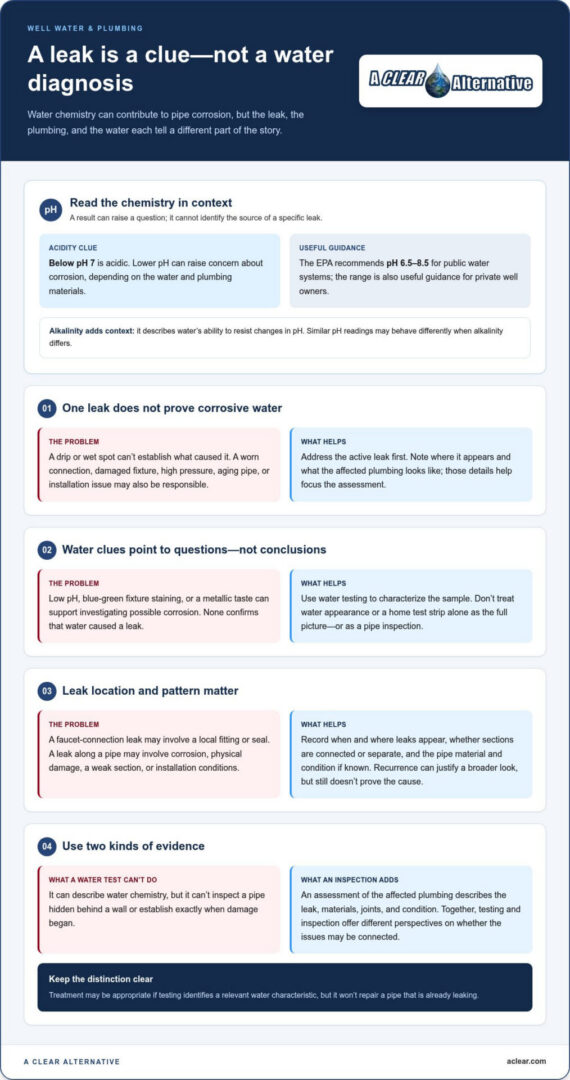
pH indicates how acidic or alkaline water is. A pH below 7 is acidic; lower pH can raise concern about corrosion, depending on the water and plumbing materials. The EPA recommends a pH range of 6.5 to 8.5 for public water systems, and this range is also useful guidance for private well owners. A low reading is a clue to investigate, not proof that water caused a particular leak.
Alkalinity adds important context. It describes water’s ability to resist changes in pH, so it helps show how stable that pH may be. Two samples with similar pH readings can behave differently if their alkalinity differs. That’s why a single number, or a home test strip alone, may not provide the full picture. Water testing can help characterize chemistry; it can’t inspect a pipe hidden behind a wall or establish exactly when damage began.
Why one leak does not identify the cause
Consider where the water appears and what the plumbing looks like. A leak at a faucet connection may point to a local fitting or seal. A leak along a pipe could involve corrosion, physical damage, a weak section, or installation conditions. Recurring leaks in different areas may justify looking beyond one fixture, but a pattern still doesn’t prove the water is corrosive.
- Water-quality clues: Low pH or blue-green staining on fixtures can support further investigation of possible corrosion. Neither confirms the cause of a leak.
- Plumbing clues: The leak’s location, pipe material and condition, joints, fixtures, and pressure can help narrow down plumbing-related possibilities.
Keep these clues separate. A water test describes the water sample; an inspection of the affected plumbing describes the leak and the materials around it. You may need both perspectives to understand whether they’re connected. Treatment may be appropriate if testing identifies a relevant water characteristic, but it won’t repair a pipe that’s already leaking. Address the active leak and assess the plumbing condition before treating chemistry as the confirmed cause.
How low-pH or corrosive well water may affect plumbing
Corrosion usually develops gradually, as water chemistry interacts with plumbing materials over time. If water is corrosive, susceptible metal components may be affected, including sections of pipe or fittings. That doesn’t mean every private well has corrosive water, or that every metal pipe in a home will react the same way. Water chemistry is only one part of the picture.
The risk can depend on pipe material and condition, the water’s characteristics, and how the plumbing was installed. A newer section connected to older pipe may not have the same history or exposure as the rest of the system. Joints, connections, and areas affected by physical stress can also develop leaks for reasons unrelated to corrosion. So if you’re wondering, “is my well water causing plumbing leaks,” consider water chemistry alongside the condition of the plumbing itself.
What low pH can mean for metal plumbing
Acidic water may interact with some metal plumbing materials and contribute to corrosion. Copper is one material that can be affected, but its presence in a home doesn’t prove a leak came from water chemistry. A low-pH result is a reason to look more closely, not a verdict on the pipes. The EPA recommends a pH range of 6.5 to 8.5 for public water systems; this range is also useful guidance for private well owners.
Risk can depend on more than pH alone. Water with low mineral content may also be corrosive, while alkalinity helps indicate how well water resists changes in pH. That broader chemistry matters when interpreting a test. There’s no reliable timeline to infer from a single leak: visible damage depends on the specific water, materials, and conditions in the home.
Clues that deserve investigation, not assumptions
Make a simple record before drawing conclusions. Note when a leak appears, where it occurs, whether the affected pipe is metal, and whether you’ve noticed changes such as staining or visible surface damage. If another leak appears in a different area, add it to the same record. A repeated pattern can help focus an investigation, but it still can’t establish the cause by itself.
- Recurring leaks: Document dates, locations, and whether the affected sections are connected or separate.
- Visible changes: Photograph staining or apparent pipe deterioration, but don’t treat color or water appearance as a pH test.
- Plumbing condition: Record the type of component involved, if known, and have the affected plumbing assessed.
Compare your observations with water-test results and a plumbing assessment. If testing identifies low pH, an acid neutralizer may be considered as water treatment, but it won’t repair a leaking pipe. A Clear Alternative provides free water analysis for local well owners, including those in Tabernacle, Shamong, and Medford Lakes. Learn about free water analysis and use the findings to make a treatment decision based on evidence, not guesswork.
Water chemistry or plumbing failure: how to compare the likely causes
If you’re asking, “is my well water causing plumbing leaks,” compare two kinds of evidence: what’s happening in the water and what’s happening at the pipe. A water analysis measures characteristics that may inform treatment. A physical inspection focuses on the leak location and plumbing components. Neither replaces the other, and neither should be treated as proof beyond what it actually shows.
Use the clues below to organize your investigation. Widespread or recurring issues may make it more useful to investigate water chemistry, but they don’t confirm corrosive water. A single leak still deserves attention, even if other fixtures seem fine.
| Clue | What it may suggest | What it can establish |
|---|---|---|
| Water test shows low pH | A water characteristic that may be relevant to corrosion and treatment | The measured result for the tested sample, not the cause of a specific leak |
| Leaks recur in separate areas | A reason to investigate broader water or plumbing factors | A pattern worth documenting, not proof that water chemistry is responsible |
| Leak occurs at one fitting or fixture | A possible local issue involving a connection, component, or installation | The location of the leak, not the water’s chemical properties |
| Visible wear near the leak | A reason to examine the affected pipe or component | Observable condition, not a remote diagnosis of why it changed |
When water-quality testing belongs in the investigation
Testing can measure water characteristics such as pH and provide information relevant to treatment decisions. If results indicate low pH, an acid neutralizer may be considered based on those findings. Testing doesn’t show whether a fitting is loose, a pipe is damaged, or installation conditions contributed to a leak. For a practical overview of what to test and why, see this well water testing guidance.
When plumbing condition needs separate attention
A physical inspection can assess where water is escaping and examine the affected pipe, joint, or fixture. Don’t rely on a photo or water result alone to diagnose damage you can’t see. If a leak is active, take appropriate steps to limit damage: if it’s safe and you know how, shut off the local water supply, keep belongings away from the water, and arrange prompt attention to the leak. Homeowners dealing with urgent water intrusion can consult professional services—such as Plomberie Laval for emergency drainage and plumbing assistance—to ensure pipes and fixtures are properly assessed.
Leak location can show where water is escaping, but it can’t reveal the water chemistry that may have contributed to the problem. Keep your observations and test results together, then use each to answer its own question: what is in the water, and what condition is the plumbing in?
What to do if well water is causing leaks
If you’re asking, “is my well water causing plumbing leaks,” follow a clear sequence instead of choosing a treatment based on suspicion. Deal with active water first, document what you see, test the well water, and use the results to guide treatment decisions. Water treatment may address a measured water-quality concern, but it isn’t a substitute for fixing an existing plumbing leak.
- Address active leakage. If water is escaping now, take appropriate steps to limit damage. If you can safely identify and shut off the supply to the affected fixture or area, do so. Don’t delay urgent action to gather evidence or wait for test results.
- Record what’s happening. Note when the leak started, whether it recurs, which fixtures or areas are affected, and any visible changes near the leak. Photos and dates can help you compare events over time.
- Test the water. A water analysis can measure characteristics relevant to treatment, including pH. A plumbing assessment looks at the leak’s location and the condition of the affected components. Together, these provide different pieces of the picture.
- Assess treatment after reviewing findings. Match any water-treatment choice to the test results rather than assuming every leak calls for the same solution.
Start with the leak and collect useful observations
Focus on useful details, not a remote diagnosis. A leak under one sink, for example, differs from recurring leaks in separate parts of the home, but neither pattern alone identifies the cause. Note whether water appears near a fixture, connection, or visible pipe, and record whether the same area becomes wet again. Keep safety and damage control ahead of documentation.
A physical assessment can examine affected plumbing; water analysis can characterize the water. One doesn’t replace the other. Together, they can help clarify whether you’re looking at a plumbing issue, a water-quality concern, or both.
Match a water-treatment option to the test finding
If results show acidic water, an acid neutralizer may be appropriate to address that water condition. It isn’t a pipe repair, and the presence of a leak alone doesn’t establish that you need one. Review this acid neutralizer system guidance when low pH is identified by testing.
A water softener serves a different purpose from pH adjustment, so don’t assume softening will correct acidity. Other filtration choices should also match the specific water-quality concern shown by testing. A measured result gives you a more grounded starting point than selecting equipment based on staining, taste, or a leak alone.
A Clear Alternative provides free water analysis to help local well owners understand their water and consider treatment based on its characteristics. Explore the free water analysis service.
How water testing and treatment can guide your next step
If you’re still asking, “is my well water causing plumbing leaks,” testing can help you move from suspicion to a more informed decision. A water analysis identifies measured characteristics that may matter for treatment. It doesn’t examine pipes or prove what caused a particular leak, so pair the results with a separate assessment of the affected plumbing.
That distinction helps prevent guesswork. A leak by itself doesn’t tell you to install a treatment system, and a test result should be interpreted in context rather than treated as a plumbing diagnosis. The practical path is straightforward: test the water, understand what the findings indicate, and consider treatment only for a water-quality concern the results support.
What a water analysis can help you understand
Analysis can provide useful information about water characteristics relevant to treatment decisions. For example, if results identify acidic water, an acid neutralizer may be considered to address that condition. Other concerns call for different treatment choices. The goal is to match a system to the measured issue, not to assume one solution will address every concern in a home.
Water analysis has limits, too. It describes the tested water, not the age, condition, or installation of a pipe. It can guide a water-treatment decision, but it can’t establish that chemistry caused one leak or determine whether a leaking component needs repair. For a broader look at how treatment choices can address different water concerns, explore this whole-house water filtration guidance.
A friendly next step for South Jersey well owners
A Clear Alternative is a family-owned, NJ-licensed water treatment and testing business serving South Jersey and parts of Pennsylvania, New York, and Delaware. The company has served customers since 1991 and offers free water analysis. For well owners in Tabernacle, Shamong, and Medford Lakes, the analysis is a practical starting point for understanding water characteristics and considering treatment based on the findings.
Bring together your water-analysis findings and your observations about the leak. If a water characteristic suggests a treatment need, the results can help guide the next decision. If the plumbing assessment points to a mechanical issue, water treatment alone won’t repair it. Keeping those questions separate makes it easier to take the right next step without expecting a water test to do more than it can.
Ready to learn more about your well water? Request a free water analysis and use the findings to make an informed treatment decision.
Take the next step with more confidence
Uncertainty can make every new drip feel like another clue, but guessing at a cause can lead you toward the wrong fix. If you’re still wondering, “is my well water causing plumbing leaks,” make your next decision from evidence, not worry. Keep your water results and plumbing notes together so you have a clear reference as you plan future home maintenance.
That record can help you spot changes over time and explain your concerns more clearly during a follow-up assessment. A water analysis won’t diagnose a pipe, but it can help clarify whether a water characteristic deserves attention. From there, you can consider treatment for the issue identified while addressing any plumbing problem separately.
A Clear Alternative is family-owned and NJ-licensed, has served 9,000+ customers, and offers free water analysis. For well owners in Tabernacle, Shamong, and Medford Lakes, a water analysis is a practical first step toward understanding the water. Get a free water analysis from A Clear Alternative.
Frequently Asked Questions
Can acidic well water cause pinhole leaks in copper pipes?
Yes, acidic well water may contribute to corrosion that can create pinhole openings in susceptible copper plumbing. But a pinhole leak alone can’t show whether chemistry caused it. The pipe’s age and condition, nearby joints, installation, and other factors also matter. Have the affected section assessed and compare that information with water-test results. Even if treatment is appropriate, it doesn’t mend an existing hole or guarantee that leaks will stop.
How can I tell if my well water is corrosive?
If you’re asking, “is my well water causing plumbing leaks,” taste, appearance, or a leak can’t confirm the water’s chemistry. An analysis can measure characteristics such as pH, while a plumbing assessment checks the affected components. For Tabernacle, Shamong, and Medford Lakes homeowners, considering both kinds of information can make the next step clearer. Base treatment choices on measured results, not on a stain or symptom alone.
Can hard water cause plumbing leaks?
Hardness and acidity are different water characteristics, and hardness alone doesn’t explain a specific leak. A water analysis can identify whether hardness is a concern, while the leak’s physical cause requires a separate assessment of the affected plumbing. A water softener addresses hardness; an acid neutralizer addresses acidic water when test findings support that need. Don’t assume one system addresses both concerns or will resolve a leaking connection.
Will an acid neutralizer stop an existing plumbing leak?
No. An acid neutralizer treats acidic water when analysis indicates that this treatment is appropriate, but it doesn’t repair a damaged pipe or fitting. The leak still needs attention as a plumbing issue. A water analysis can help guide treatment decisions, while an assessment of the affected plumbing helps determine its condition. Neither results nor treatment should be taken as a guarantee that future leaks will be prevented.
What should I do first if a pipe is actively leaking?
First, focus on limiting water damage and getting the leak assessed. If you can safely reach a shutoff and know how to use it, stop the water; avoid wet areas near electrical equipment and leave unsafe situations to qualified help. Calling on emergency specialists like SOS Plombiers can help rapidly contain sudden pipe failures. Don’t wait for a water test before responding. Testing can follow once immediate concerns are controlled, or happen alongside the plumbing response if the situation allows.
Can a water test prove that well water caused a leak?
No. A water test can identify measured characteristics, but it can’t establish by itself what caused a particular plumbing failure. Consider the results alongside the pipe material and condition, the location of the leak, and what an assessment finds. This helps separate a water-quality concern from a mechanical problem. Use test findings to guide water-treatment choices, not as a substitute for determining what’s wrong with the plumbing.
Does every well-water leak mean I need an acid neutralizer?
No. A leak may result from a plumbing issue unrelated to water pH, and not every well has acidic water. An acid neutralizer is relevant when water analysis indicates an acidity concern. Testing first helps you avoid choosing treatment based on the leak alone. Remember that water conditioning addresses a water characteristic; it won’t repair the leaking pipe, joint, or fixture itself.