
How to Test for Sulfur in Water: A Practical Homeowner Guide
A rotten-egg smell can be a clue, but it is not a test result. If you’re wondering how to test for sulfur in water, start by separating what you can observe from what a test can establish. The odor may suggest hydrogen sulfide, but it can’t confirm what is in your water or how much is present. Other causes may also produce an unpleasant smell, and sulfate, another form of sulfur, does not have the same telltale odor.
The right test depends on what you want to find out. A home kit may offer a quick screen, while laboratory analysis can provide a more detailed, documented result. Hydrogen sulfide is especially tricky to measure because it can escape from a sample, so collection and handling matter. A sample that is collected incorrectly may not give you useful answers.
This guide explains what smell and appearance can, and cannot, tell you, how to choose a testing option, and how to collect a representative sample. You’ll also learn when professional analysis makes sense and how results can guide next steps. A Clear Alternative provides comprehensive water testing for homeowners, helping turn a suspected issue into clearer information for an informed decision.
Key Takeaways
- Learn how to test for sulfur in water by matching the test to the sulfur-related compound you want to investigate.
- Use a home kit as a limited screen, and only when its listed analytes match your question.
- Follow the laboratory’s instructions for preparing, collecting, labeling, and submitting your sample.
- Check the result’s analyte, units, testing method, and notes before deciding what the findings mean.
- Discuss unclear results with a water-quality professional before choosing a treatment approach.
How to Test for Sulfur in Water: Start With the Clues, Not a Guess
If you notice a rotten-egg odor from a well-water tap, treat it as an observation, not a diagnosis. Testing means analyzing a water sample for specific sulfur-related compounds. The right analysis depends on the question you want answered: identifying the source of an odor and measuring a compound are not the same task.
Hydrogen sulfide is a gas associated with the familiar rotten-egg smell in water. Understanding Sulfur Water can help explain how sulfur compounds relate to water’s characteristics, but a description of a smell cannot identify what is in your well. A laboratory result applies only to the analytes measured in the submitted sample.
What does sulfur in water smell like?
People commonly describe the odor associated with hydrogen sulfide as similar to rotten eggs. Note where and when you notice it: at one tap or several, in cold water, hot water, or both. These details help describe the pattern, but they do not prove its cause or reveal a concentration.
Before arranging a test, keep a brief record. Write down the tap, whether the water was hot or cold, when the odor appeared, and whether it changed after the water ran briefly. If the smell comes and goes, note that too. Don’t taste water that seems questionable to check for sulfur or any other issue.
- Cold water: Note whether the odor is present when you first turn on a cold tap.
- Hot water: Record whether the smell appears only with hot water or also with cold.
- Multiple taps: Check whether the same pattern occurs at other faucets, without tasting the water.
Can smell alone confirm sulfur in well water?
No. Odor alone cannot identify the compound, establish its concentration, or confirm that sulfur is the source. Water and plumbing conditions can affect what you notice, so avoid diagnosing the cause from a single faucet or brief episode. Your notes provide context, not a substitute for analysis.
If you’re a homeowner in Tabernacle and the odor persists, changes, or raises a concern about drinking water, arrange testing that measures compounds relevant to your question. Describe the pattern when requesting water analysis. That shifts the process from guessing based on smell to reviewing evidence from a sample.
Use the clues to frame a clearer question: Is the odor limited to hot water, or does it occur throughout the home? Does it happen consistently or only sometimes? Record what you observe and share it with a water-quality professional. The test result, rather than the odor itself, can help guide informed next steps.
What a Sulfur Water Test Can, and Cannot, Tell You
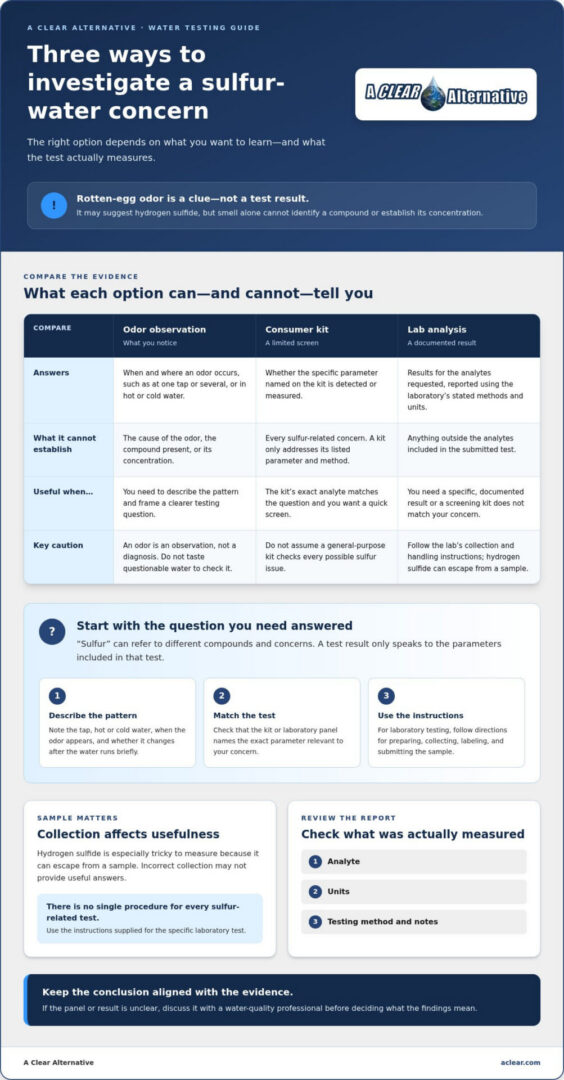
Different ways of checking water answer different questions. An odor observation records what you notice, a home kit screens for the specific parameter it was designed to measure, and laboratory analysis can provide a more detailed, documented result. These options are not interchangeable. Before choosing a test, decide what you need to learn and check that the method can provide that information.
“Sulfur” can refer to different compounds and concerns. A result only speaks to the parameters included in the test. If a report does not identify the substance you’re concerned about, it cannot settle that question, even if the water still has an unusual odor.
- Odor observation: Helps describe when and where a concern occurs, but does not identify a compound or measure its concentration.
- Consumer kit: Screens for the parameter stated on the package and in the instructions. It does not automatically assess every sulfur-related concern.
- Laboratory analysis: Can provide a documented result for the requested analytes, using the laboratory’s stated methods and reporting units.
Do home test kits detect sulfur in water?
Some kits measure a specific water parameter, while others screen for different general water-quality indicators. What a kit can tell you depends on its analyte and test method. Read the label and instructions, and look for the exact parameter being measured. A kit that tests for one substance, or a general-purpose kit, should not be assumed to confirm every possible sulfur issue.
When is laboratory water testing the better choice?
Choose laboratory analysis when you need a specific, documented result or when a screening kit does not match your concern. The requested analytes should fit the question, and the laboratory’s instructions should guide the test and sample process. For a broader look at private-well testing in the area, see this South Jersey well water testing guide.
Before submitting a test, confirm what the selected panel measures. A report naming a particular analyte is useful only if that analyte was included and measured by the stated method. Check the report’s scope rather than assuming it covers related compounds too. If the panel description or result is unclear, get help interpreting it before deciding what to do next.
For homeowners in Tabernacle, Shamong, and Medford Lakes, A Clear Alternative provides comprehensive water testing to help turn an uncertain observation into clearer information about the tested sample. A documented result is a practical starting point for evidence-based decisions about your well. Learn more about professional water testing.
How to Collect a Water Sample for Sulfur Testing
A useful result starts with a sample collected and handled according to the laboratory’s directions. There is no single procedure for every sulfur-related test. The correct container, tap preparation, storage conditions, and delivery timing can vary by test and laboratory. Treat the laboratory’s instructions as part of the test, not as optional details.
This matters especially if you’re investigating hydrogen sulfide. The gas can escape from water after collection, so delays or incorrect handling may affect the usefulness of a result. Do not guess how much water to collect or how quickly to submit it. Check the laboratory’s specific requirements before you begin.
Prepare the tap and sample container
Identify the tap the laboratory recommends for sampling. If the odor or concern occurs at a particular faucet, record its location and share it when requesting instructions. Also note whether you’re sampling hot or cold water. Do not assume a kitchen tap or any other fixture is suitable for every analysis.
Use only the container supplied or approved by the laboratory. Do not rinse, sterilize, or otherwise alter it unless the instructions specifically say to do so. An unapproved bottle, leftover container, or added preservative could affect the sample or make it unsuitable for the requested analysis.
Collect, label, and submit the sample
Follow the laboratory’s directions for preparing the tap and collecting the water. Keep your hands away from the inside of the container and its cap. Fill it as instructed, then close it securely. Avoid improvising steps such as rinsing the container or leaving it open. Follow the laboratory’s procedure for handling the sample.
Before submitting the sample, label it clearly and make sure the identifying details match any paperwork. Use this sequence to help prevent mix-ups:
- Identify: Record the tap location and whether the sample is hot or cold water.
- Prepare: Follow the laboratory’s instructions for the faucet and container.
- Collect: Use the specified procedure and avoid touching the container’s interior.
- Label: Add the collection date, time, and location as directed.
- Submit: Follow the laboratory’s storage, transport, and delivery instructions.
Check the laboratory’s guidance for any sample holding time, storage temperature, preservation, or delivery deadline. These details depend on the test, so do not rely on a schedule or handling method used for a different water analysis. If an instruction is unclear, get guidance from the laboratory before collecting. This can help prevent an avoidable delay or a sample that cannot be analyzed as intended.
For a well in Tabernacle, include a short note about the reason for testing and the tap sampled if the laboratory requests it. Keep a copy of the collection details with your results. Knowing where and when the sample was collected helps put the report in context. A result from one tap or condition does not necessarily describe every tap or condition in the home.
How to Choose Between a Home Test and Professional Sulfur Testing
The best testing route depends on what you need to learn and how specific an answer you need. A home kit can be a practical first screen if it explicitly measures the parameter related to your concern. For persistent odor, unclear readings, or a result you need documented, professional water analysis is a stronger next step. Check what the test measures rather than choosing based on the word “sulfur” alone.
Your goal: Get an initial indication
A home kit may fit if its label names the specific parameter you want to screen for and you can follow its instructions. Treat the reading as preliminary, not a complete assessment of your well water.
Your goal: Investigate an ongoing concern
Professional laboratory analysis is a better fit when the odor persists or a home result is unclear. The requested analytes should match the concern, and the laboratory can guide you on the appropriate test and sample process.
Your goal: Keep a documented result
Choose professional analysis if you need a report showing what was measured. Review its scope and method so you know which questions the result can answer and which it cannot.
Your goal: Decide on treatment
Start with results that identify the issue before considering equipment. Once you understand the findings, this whole-house water filtration guide can help you explore treatment considerations.
When might a home test be enough for an initial check?
A kit can offer an initial check when its instructions explicitly name the relevant parameter. Read the label, method, and result range before buying or using it. Directions and ranges vary, so follow the kit’s procedure closely. A reading can help you decide whether to investigate further, but it does not establish overall water quality or assess parameters the kit does not measure.
When should a homeowner request professional analysis?
Consider laboratory analysis if the odor continues, a screening result is difficult to interpret, or you want a documented finding. For private-well owners in South Jersey, testing can replace assumptions with information about the requested analytes. A water-quality professional can clarify what the report supports and which follow-up questions matter. Do not treat an odor or a single screening result as a diagnosis.
If you’re still weighing how to test for sulfur in water, begin with the question you want the result to answer. A Clear Alternative provides comprehensive water testing for homeowners in Tabernacle, Shamong, and Medford Lakes. Request professional water testing to move from a suspected issue toward evidence-based next steps.
What to Do After Testing Sulfur in Your Water
A test report is useful when you understand what it measured and how to interpret the result. Start by checking the analyte, units, test method, and any notes from the laboratory. A result provides information about the sample and parameters tested. It is not a diagnosis of every possible water concern in your home.
How should you read a sulfur water test result?
Look for the exact name of the analyte first. Then note the reported units and method, and read the laboratory’s comments. Do not assume that a detected amount automatically means a health problem, or that the result covers compounds the panel did not test. If the report is unclear, ask a qualified water-quality professional to explain its scope before drawing conclusions.
As you review the report, check:
- Analyte: What substance did the test measure?
- Units: How is the result expressed?
- Method and notes: What does the laboratory say about how the sample was analyzed and how to interpret the finding?
Keep the report with your sampling notes. The collection location and date can help you and a professional understand what the result represents, especially if you tested a particular tap or water condition. If a detail is missing or unfamiliar, get clarification rather than guessing at its meaning.
How can test results guide the next step?
Use the report to frame a conversation, not to select equipment by assumption. The appropriate follow-up depends on what was measured, what the result says, and how you use water at home. An odor concern and a documented result may prompt different questions from a test that did not include the analyte you wanted to investigate. No single result automatically points to one universal system.
Before considering treatment, review the findings with a water-quality professional. Ask what the report supports, whether additional analysis would clarify an unanswered question, and how your household’s water needs affect the options. This evidence-led approach helps avoid choosing treatment based only on smell or on a result that does not address the concern.
A Clear Alternative provides comprehensive water testing and iron and sulfur filtration systems for homeowners in Tabernacle, Shamong, and Medford Lakes. Testing comes first; any treatment discussion should fit the actual findings and the home’s needs. If you’re deciding how to test for sulfur in water or what a report means, explore professional water testing and treatment as a starting point for practical guidance.
Turn Your Water Concerns Into a Clear Next Step
Knowing how to test for sulfur in water is most valuable when it helps you make a thoughtful decision, not when it pushes you toward a quick fix. Keep your test report with your household water records, and use it as a reference if the odor or your water-use needs change. That gives future conversations a clearer starting point.
If you’re unsure what a finding means or what to consider next, a water-quality professional can help connect the information in your report to practical options for your home. A Clear Alternative is a family-owned water treatment business that provides comprehensive testing for residential and commercial clients. Homeowners in Tabernacle, Shamong, and Medford Lakes can use testing results to make better-informed decisions about their water.
Take the next step with guidance grounded in your water’s results. Explore professional water testing with A Clear Alternative and move forward with greater confidence in your home’s water.
Frequently Asked Questions
Can you test for sulfur in water with a home test kit?
Yes, if the kit specifically measures the sulfur-related parameter you’re concerned about. Check its label: a kit that tests for sulfate, for example, does not necessarily test for hydrogen sulfide. Follow the kit’s procedure and interpret the result only within its stated range. For a Tabernacle well, use a home reading as an initial screen, not as a complete picture of drinking-water quality.
Does a rotten-egg smell prove that water contains sulfur?
No. The odor can point toward hydrogen sulfide, but it cannot confirm the compound or show its concentration. If the smell occurs only at one faucet, compare it with another tap and note whether the pattern changes, but do not rely on that comparison to diagnose the cause. A test designed for the relevant concern is needed to establish what was measured in a water sample.
Can water contain sulfur without a noticeable smell?
Yes. Sulfate is a sulfur compound that generally does not create the characteristic rotten-egg odor associated with hydrogen sulfide. A lack of smell cannot rule out sulfate or other water-quality concerns. To find out whether a specific compound is present, choose an analysis that names that analyte rather than relying on your senses. Test scope matters more than whether the water smells unusual.
Is sulfur in well water harmful to drink?
It depends on the compound and the amount, so “sulfur” alone is not enough to judge safety. The EPA’s 250 mg/L sulfate guideline is a non-enforceable secondary standard based on aesthetic effects, not a health-based limit. High sulfate levels may cause temporary diarrhea and dehydration, and infants can be more sensitive. If a result raises a concern, discuss it with a water-quality professional before deciding how to use the water.
How often should you test private well water for sulfur?
Annual water testing is a sensible routine for private-well owners, with additional testing worth considering if the odor or water conditions change. The right sulfur-specific testing schedule can depend on your well and what earlier results showed. Do not assume every annual panel includes the same analytes. Homeowners in Tabernacle, Shamong, and Medford Lakes can use a water-quality professional to determine whether sulfur-related analysis fits their circumstances.
Can boiling water remove a sulfur smell?
Boiling is not a dependable way to treat a sulfur odor or establish that water is safe to drink. Heat may cause some dissolved hydrogen sulfide gas to escape, but that does not confirm the source or address other sulfur compounds. Boiling is used to reduce certain biological risks, not to correct chemical water concerns. If the odor persists, rely on appropriate testing and professional guidance rather than boiling as a fix.
Why does sulfur odor come and go in well water?
An intermittent smell can reflect changes in the water or in how it moves through household plumbing, but the pattern alone cannot identify the cause. Note whether it follows periods of low use, appears only with hot water, or affects several taps, then share those details when arranging analysis. A changing odor is a reason to investigate, not proof that the water is safe whenever the smell disappears.