
Why Your Tabernacle Well Water Smells Like Rotten Eggs: 2026 Homeowner’s Guide
Last Tuesday, a Tabernacle homeowner named Sarah realized she couldn’t ignore the issue any longer when her dinner guests politely declined a glass of tap water. That unmistakable rotten egg smell in water Tabernacle residents frequently encounter is more than a nuisance; it’s a direct hit to your home’s comfort and your personal confidence. You’re right to feel frustrated when your morning shower smells like a sulfur spring or when you’re worried that minerals are silently corroding your expensive plumbing.
It’s natural to want a home that feels as clean and modern as it looks. You deserve water that’s completely clear and refreshing, not something that causes embarrassment during a dinner party. This 2026 guide promises to uncover the specific cause of those odors and provide the professional filtration steps to fix them forever. You’ll learn how to tell if your water heater or the well itself is the culprit, and we’ll preview the high-tech, local solutions that restore your water to its premium, odor-free state.
Key Takeaways
- Identify how the unique geography of the Pine Barrens contributes to hydrogen sulfide production in your private well.
- Learn simple DIY diagnostic tests to determine if your sulfur issue originates in the well or your water heater’s anode rod.
- Discover the most effective way to eliminate the rotten egg smell in water Tabernacle homes using modern, chemical-free filtration technology.
- Compare professional-grade solutions like Air Induction Oxidation (AIO) to ensure your water is both fresh and safe for your family.
- Understand the benefit of choosing local experts who offer 24/7 emergency support tailored to the specific water chemistry of South Jersey.
Decoding the Rotten Egg Smell in Tabernacle Water
You turn on the kitchen faucet and that unmistakable, pungent odor hits you instantly. It’s frustrating and frankly embarrassing when guests are over. In our area, the rotten egg smell in water Tabernacle families deal with is almost always caused by Hydrogen sulfide (H2S). This gas isn’t usually a sign of man-made pollution. Instead, it’s a byproduct of sulfur-reducing bacteria that thrive in the unique underground environment of South Jersey. Because Tabernacle sits directly atop the Kirkwood-Cohansey aquifer, your well draws from shallow, oxygen-poor layers where these bacteria are most active.
For most homeowners, this smell is classified as a “nuisance” rather than an immediate toxicity threat. It ruins the flavor of your cooking, stains your laundry, and makes every shower feel less than refreshing. While it might not be a crisis today, it’s a clear signal that your water chemistry is out of balance. Living with it shouldn’t be your “new normal.” Modern water technology allows you to eliminate these odors completely, restoring the clean, crisp lifestyle you expect from a premium home in the Pines.
Is Sulfur Water Dangerous to Drink?
Drinking water with low levels of hydrogen sulfide isn’t typically a health risk for healthy adults. However, the situation changes if your water also contains high concentrations of sulfates. High sulfate levels can cause a significant laxative effect, leading to dehydration or digestive upset, especially in infants or visitors who aren’t used to the local mineral profile. Most residents don’t wait for a doctor’s visit to take action. The sheer intensity of the odor usually drives homeowners to seek a solution long before physical symptoms appear. It’s about more than just “safe” water; it’s about having the confidence to drink from your own tap without hesitation.
The Pine Barrens Connection
Tabernacle’s geography is a major factor in your water quality. The soil here is famously acidic, often registering a pH between 3.5 and 5.5. This acidity accelerates the breakdown of organic matter and minerals in the ground. When you combine this with the iron-rich “teawater” common in the Pine Barrens, you create the perfect breeding ground for sulfur-reducing bacteria. These organisms feed on the sulfates and organic decay trapped in the sandy layers of the aquifer.
You’ll likely notice that the rotten egg smell in water Tabernacle homes experience fluctuates with the weather. During heavy rain cycles in Shamong or seasonal shifts near Medford Lakes, the water table rises and falls. This movement flushes new organic material into the path of your well pump, causing “odor spikes.” In 2026, we are seeing these cycles become more pronounced due to changing local precipitation patterns. Understanding that your water is a living part of the local ecosystem is the first step toward choosing a treatment system that actually works for the long term.
The Science of Sulfur: Bacteria vs. Chemical Reactions
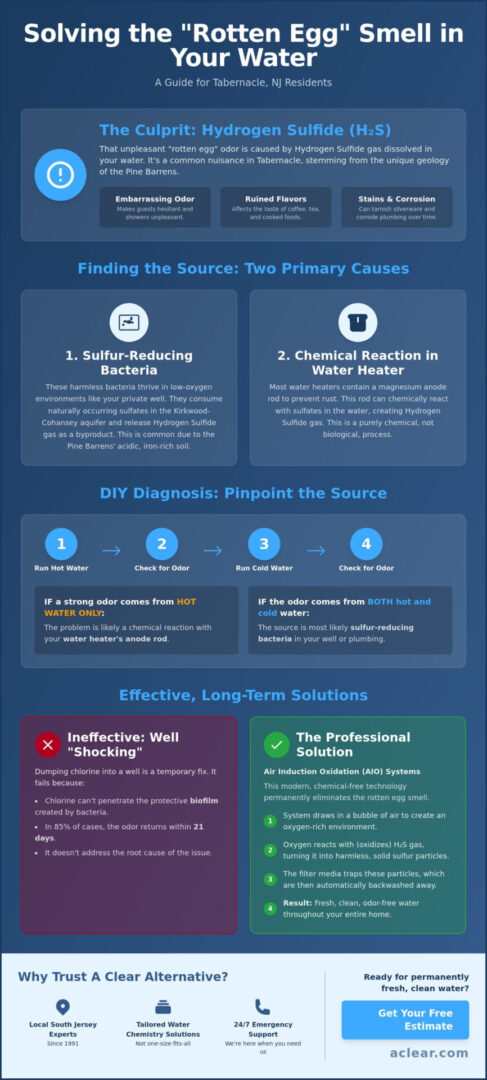
Your well isn’t just a pipe in the ground. It’s a complex ecosystem where chemistry and biology collide. In the deep, oxygen-starved aquifers of New Jersey, two main culprits create that unmistakable rotten egg smell in water Tabernacle residents deal with. The first is a biological process involving sulfur-reducing bacteria. These organisms live in low-oxygen environments, like the bottom of your well or inside your water heater. They don’t cause illness, but they thrive by consuming sulfates and exhaling hydrogen sulfide (H2S) gas as a byproduct.
The second cause is purely chemical. Most water heaters contain a magnesium anode rod designed to prevent tank corrosion. When this magnesium reacts with high sulfate levels in the water, it creates a steady stream of H2S gas. If you notice the smell is significantly stronger when running the hot tap, your water heater is the likely source. Research into Hydrogen Sulfide and Sulfur Bacteria in Well Water shows that these two factors often work together, making the odor nearly impossible to ignore.
Many homeowners try “shocking” their well with chlorine. This usually fails. While chlorine kills active bacteria, it rarely reaches the colonies protected by thick biofilms. In about 85% of cases, the odor returns within 21 days because the root cause remains unaddressed. Achieving a fresh, clean home environment requires a more sophisticated, long-term approach to modern water filtration.
Understanding Sulfur-Reducing Bacteria
These bacteria thrive in the dark, stagnant corners of your well casing. They produce a sticky, gel-like substance known as biofilm. This slime protects the colony from disinfectants and can eventually clog your well screens. If you see black flecks in your toilet tanks or feel a slippery coating inside your pipes, your bacterial problem has escalated into a slime issue. This requires more than just a quick fix; it needs a solution that breaks down the biological barrier.
Corrosion and Your Home’s Value
Sulfur gas is highly corrosive. It doesn’t just smell bad, it actively eats away at your home’s infrastructure. H2S gas causes rapid oxidation, turning expensive silver jewelry black and tarnishing copper fixtures within days. This chemical aggression extends to your appliances. Sulfur buildup can shorten the lifespan of a dishwasher by 30% due to internal component failure. Eventually, this constant corrosion leads to pinhole leaks in copper plumbing, which can cause thousands of dollars in hidden water damage behind your walls.
DIY Diagnosis: Finding the Source in Your Tabernacle Home
You don’t have to be a chemist to figure out why your tap smells like a swamp. Identifying the rotten egg smell in water Tabernacle homes often experience starts with a few simple, logical steps. By isolating different parts of your system, you can determine if you’re dealing with a simple maintenance task or a deeper well issue. It’s about regaining control of your home’s comfort and your family’s peace of mind.
Start with the “Sniff Test” at multiple locations. If the odor only lingers at the kitchen sink but not in the master bath, the issue is localized to those specific pipes. If the smell is everywhere, the source is more central. To diagnose the source with more precision, you need to compare your hot and cold lines. This simple contrast often reveals the culprit in under five minutes.
Is it Your Water Heater?
If the rotten egg smell in water Tabernacle residents report only occurs when the hot water is running, your water heater is the likely offender. Most tanks contain a magnesium anode rod. This rod protects the tank from corrosion, but it can react with sulfate-reducing bacteria to produce hydrogen sulfide gas. You can test this by flushing your heater. Drain approximately 10 gallons of water from the bottom valve to remove sediment. If the smell persists, you might need to swap your magnesium rod for an aluminum-zinc alloy version, which is less reactive in New Jersey’s unique water chemistry.
Is it the Well or the Plumbing?
To check the well itself, head to the source. Draw a glass of water directly from the pressure tank drain valve before it passes through any softeners or filters. If the water smells here, the sulfur is coming directly from the ground. You should also perform a “first draw” versus “constant flow” test. If the scent is strongest in the first 30 seconds of turning on a tap but fades away, the bacteria are likely growing in your pipes. If the smell never stops, the aquifer itself is the source.
- Check the Softener: Open your brine tank. If you see a slimy film or “salt bridging,” bacteria could be colonizing the resin bed.
- Isolate Fixtures: Test every faucet. Odors found in only one room suggest a localized bacterial colony in a specific P-trap or aerator.
- Professional Verification: While DIY tests are a great start, a laboratory-grade well water testing is the only way to get a 100% accurate digital profile of your water’s mineral and bacterial content.
Don’t settle for guesswork when it comes to your health. A professional analysis provides a clear roadmap to the right filtration solution, ensuring your Tabernacle home stays fresh and your water remains crystal clear.
Effective Solutions for Sulfur and Iron Removal
You shouldn’t have to hold your breath every time you turn on the kitchen faucet. Many Tabernacle residents realize too late that a standard water softener is not a cure-all. Softeners are designed to swap calcium and magnesium for sodium; they aren’t built to trap gas. If you try to use one for heavy sulfur, the gas eventually coats the resin beads, making the system useless within 12 to 18 months. To truly eliminate the rotten egg smell in water Tabernacle homes experience, you need targeted iron and sulfur filtration systems designed for the unique chemistry of the Kirkwood-Cohansey aquifer.
Air Induction Oxidation (AIO) Systems
AIO technology is the modern homeowner’s favorite because it’s clean, efficient, and chemical-free. The system maintains a compressed pocket of air at the top of the tank. As your well water passes through this “air bridge,” the dissolved hydrogen sulfide and iron instantly oxidize into solid particles. These solids are then trapped by a specialized media bed and washed away during a midnight backwash cycle. It’s a digital, low-maintenance approach that fits perfectly into a busy South Jersey lifestyle. You get fresh water without the hassle of hauling heavy salt bags or handling caustic chemicals every month.
Carbon Filtration and Chlorine Injection
Sometimes, the rotten egg smell in water Tabernacle wells produce is caused by high concentrations of sulfur-reducing bacteria. In these specific cases, a simple air system might not be enough to kill the biological source. Chlorine injection systems act as a disinfectant, neutralizing the bacteria on contact. We then pair this with an activated carbon filter to remove the residual chlorine taste and any remaining odor. While this setup has a slightly larger footprint in your utility room, it provides a “fail-safe” solution for the most aggressive well water issues. It’s about choosing the right tool for your specific water profile rather than a one-size-fits-all box from a big-box store.
Maintaining these systems is simpler than you might think. AIO units typically require a professional check-up once a year to ensure the air injector stays clear of debris. Chemical feed systems need a quick refill of their solution tank every 4 to 8 weeks, depending on your water usage. Modern 2026 filtration designs focus on durability, ensuring your home remains a sanctuary of clean, odorless water for a decade or more. Investing in the right technology means your morning shower feels like a spa experience, not a trip to a sulfur spring.
Ready to reclaim your home’s water quality? Contact Aclear for a custom filtration consultation and breathe easy again.
Why Tabernacle Trusts A Clear Alternative Since 1991
Choosing a water treatment partner isn’t just about buying a piece of equipment. It’s about finding a team that understands the specific chemistry of the Pine Barrens. Since 1991, A Clear Alternative has operated as a family-owned business deeply rooted in the Tabernacle community. We don’t rely on generic, one-size-fits-all solutions that national brands often push. Instead, we use over 34 years of local geological data to permanently fix the rotten egg smell in water Tabernacle homeowners deal with regularly.
Our approach integrates modern technology with practical, hands-on service. We specialize in customizing acid neutralizer systems to work in perfect tandem with high-efficiency sulfur filters. This dual-action setup ensures your water is pH-balanced, non-corrosive, and completely odorless. If your well system fails at 2:00 AM, we provide 24/7 emergency support across Tabernacle, Shamong, and Medford Lakes. We are also one of the few local specialists licensed for potable water hauling. This means we can deliver clean, safe water to your home during major well repairs, ensuring your family’s routine isn’t disrupted while we work.
Hyper-Local South Jersey Expertise
We understand the Kirkwood-Cohansey aquifer better than any national franchise. Our recommendations aren’t based on a guess; they’re backed by rigorous laboratory testing. We provide honest, transparent results that show exactly what’s flowing through your pipes. The A Clear Alternative guarantee on odor removal means we don’t stop until that rotten egg smell in water Tabernacle is gone for good. You get a system built specifically for South Jersey’s unique soil conditions, ensuring long-term reliability and total peace of mind.
Ready for Clean, Fresh Water?
It’s time to stop dreading your morning shower and start enjoying your home again. Scheduling a comprehensive water analysis is the first step toward a better lifestyle. When you book a professional consultation, our technician arrives on time to perform a detailed on-site test. We’ll explain the results in plain English and show you exactly how to achieve crystal-clear water. Don’t let poor water quality lower your home’s value or your daily comfort. Contact us today to restore your home’s water quality and enjoy the fresh, clean results you deserve.
Take Control of Your Home’s Water Quality Today
You shouldn’t have to hold your breath every time you turn on the kitchen faucet. Whether it’s hydrogen sulfide gas or sulfur-reducing bacteria, that rotten egg smell in water Tabernacle homeowners often face is a solvable problem. Since 1991, our family-owned team at A Clear Alternative has helped local residents transition from smelly, stained water to a crisp, refreshing experience. We use modern, high-efficiency filtration technology to target iron and sulfur at the source, ensuring your home feels like a clean sanctuary again.
As a licensed potable water hauler with 24/7 emergency water support, we’ve spent over 30 years solving New Jersey’s toughest well water challenges. You deserve a lifestyle free from embarrassing odors and the plumbing damage caused by high mineral content. Stop guessing about your water chemistry and start enjoying the peace of mind that comes with professional, digital diagnostics. It’s time to reclaim your home’s comfort and confidence.
Get a Professional Water Test and Eliminate Sulfur Odors Today
Frequently Asked Questions
Is the rotten egg smell in my water a health risk?
The rotten egg smell in water Tabernacle residents notice is generally not a health risk. This odor usually comes from hydrogen sulfide gas, which you can detect at levels as low as 0.5 parts per million. While it’s safe to drink in small amounts, high concentrations can corrode your pipes and stain your sinks. You should still test your well to ensure the smell isn’t masking more harmful contaminants like coliform bacteria.
Will shock chlorinating my well get rid of the sulfur smell?
Shock chlorination is a temporary fix that won’t permanently solve a deep sulfur issue. This process uses a 200 ppm chlorine solution to kill bacteria inside the well casing. It works if the smell comes from sulfur-reducing bacteria living in the well itself. However, if the gas is naturally present in the aquifer, the smell will return within 2 to 4 weeks. You’ll need a dedicated filtration system for a lasting result.
Why does my water only smell like rotten eggs when the hot water is on?
If the smell only appears when you use hot water, the problem is likely inside your water heater. Most heaters contain a magnesium anode rod that reacts with sulfates in the water to produce hydrogen sulfide gas. This reaction happens faster when the tank temperature is set at 140 degrees Fahrenheit or higher. Replacing your standard rod with an aluminum-zinc alloy version usually eliminates this specific odor immediately.
Can a water softener remove sulfur odors?
A standard water softener can’t remove the rotten egg smell in water Tabernacle homes often face. Softeners are designed to remove calcium and magnesium through ion exchange, but they don’t filter out dissolved gases. In fact, sulfur can coat the resin beads inside your softener and reduce its efficiency by up to 30 percent. You’ll need an oxidizing filter or an air injection system to properly treat gas-based odors.
How much does a sulfur filtration system cost in South Jersey?
According to 2024 data from Angi, homeowners in the Northeast typically pay between $1,500 and $4,000 for a whole-house water filtration system. The final price depends on the technology used, such as air injection or activated carbon. While local labor rates vary, these national benchmarks provide a realistic starting point for your budget. Investing in a quality system ensures your water stays fresh for 10 to 15 years.
Does the rotten egg smell mean there is bacteria in my water?
Yes, the odor is often a direct result of sulfur-reducing bacteria living in your plumbing or well. These bacteria aren’t usually harmful to humans, but they thrive in low-oxygen environments and create gas as a byproduct. About 80 percent of sulfur issues in New Jersey wells stem from these microorganisms. A professional lab test can confirm if you’re dealing with harmless sulfur bacteria or more dangerous pathogens like E. coli.
What is an anode rod and how does it affect my water’s smell?
An anode rod is a sacrificial metal rod installed in your water heater to prevent the tank from rusting. When the rod’s magnesium or aluminum material corrodes, it releases electrons that can react with sulfate-reducing bacteria. This process produces the hydrogen sulfide gas you smell at the kitchen tap. If your rod is more than 5 years old, it’s likely time for a replacement to keep your hot water smelling clean.
How long does it take to install a sulfur filtration system?
A professional installation of a sulfur filtration system typically takes between 4 and 6 hours to complete. This timeframe includes the physical setup of the tanks, connecting the bypass valves, and running a 30-minute initial regeneration cycle. Most Tabernacle homeowners can have their water quality restored in a single morning. Once the system is live, you’ll notice the difference in your water’s scent and taste immediately.