
Why Does My Laundry Smell Like Sulfur? 2026 Guide to Causes and Solutions
You spend an hour sorting, washing, and drying your favorite linens, only to pull them out and realize they smell like a swamp. It’s incredibly frustrating to wonder why does my laundry smell like sulfur after you’ve used the “extra rinse” cycle and a premium detergent. You shouldn’t have to feel embarrassed about the scent of your clothes or worry that your home’s water quality is compromised. We know that “clean” should actually smell clean, not like rotten eggs.
We understand the anxiety of wasting money on extra products that only mask the problem. You’re looking for a permanent solution that restores your confidence and ensures your water is safe for your family. This 2026 guide is designed to help you stop the guesswork and identify the root cause of the odor for good.
We’ll walk you through the three most common culprits: bacterial buildup in your machine, water heater reactions, or well water issues specific to South Jersey communities like Tabernacle and Medford Lakes. From professional testing insights to modern filtration options, you’re about to discover how to eliminate sulfur odors and get back to the fresh, effortless lifestyle you love.
Key Takeaways
- Learn how to use the Cold Water Test to pinpoint whether the odor is coming from your washing machine’s drum or your home’s water supply.
- Discover exactly why does my laundry smell like sulfur by understanding how hydrogen sulfide gas and bacteria interact with your plumbing.
- Identify why your hot water cycles often smell worse and how your water heater’s anode rod might be triggering a chemical reaction.
- Understand why professional water testing is the only way to move beyond temporary masks to a permanent filtration solution.
- See why South Jersey’s unique geology requires a specialized approach to sulfur removal for long-term freshness.
Is it the Washer or the Water? Diagnosing the Sulfur Smell
Before you commit to a deep clean or consider a new appliance, you need to play detective. The biggest mistake many homeowners make is assuming a smelly load of clothes means a dirty machine. While that is a common frustration, it is not always the root cause. To solve the mystery of why does my laundry smell like sulfur, you first need to determine if the odor is living inside your drum or flowing through your pipes.
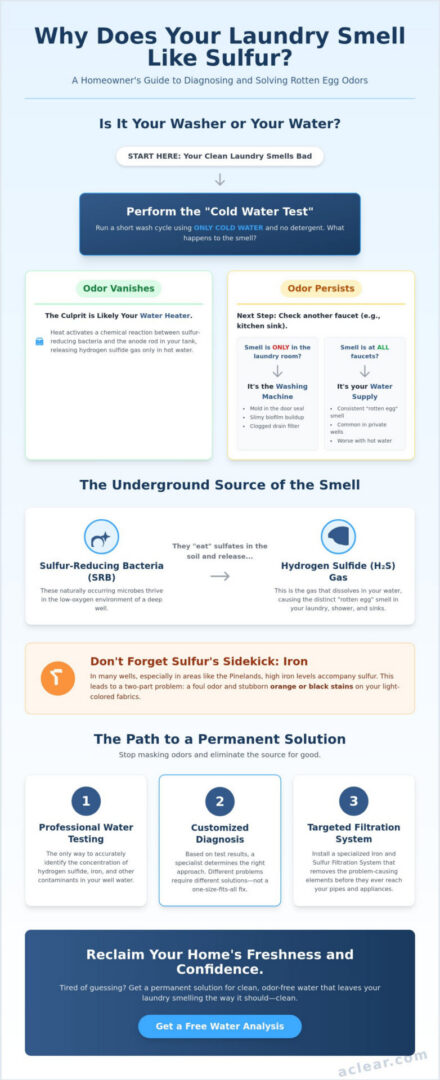
Start with a simple “Cold Water Test.” Run a quick cycle using only cold water and no detergent. If the odor vanishes during this test, your water heater is likely the culprit. If the smell persists, it is either the machine itself or your groundwater. To confirm, walk over to your kitchen sink and run the tap for a minute. If the sink also smells like rotten eggs, you are likely dealing with Sulfur water. This distinction is crucial for your peace of mind and your budget.
You should also pay attention to the specific “flavor” of the scent. Musty, earthy, or damp odors usually point to mold or mildew colonies inside the machine. However, a sharp, pungent, egg-like smell is almost always a chemical byproduct related to sulfur. Understanding this difference helps you choose a permanent fix rather than just a temporary scent mask.
Signs Your Washing Machine is the Culprit
Modern high-efficiency machines, especially front-loaders, are designed to save water, but they can easily trap moisture. Check the rubber door seal for visible mold or “biofilm,” which is a slimy grey or black buildup. If the smell is strongest when the machine is empty and you first open the door, the appliance is the likely source. Stagnant water trapped in the drain pump filter can also rot over time. This creates a localized odor that stays in the laundry room rather than affecting your entire home.
Signs Your Water Supply is the Source
If the scent is consistent across all your water-using appliances, the machine isn’t to blame. This is a frequent reality for residents in areas like Tabernacle, Shamong, or Medford Lakes who rely on private wells. In these South Jersey communities, the unique geology can lead to gas buildup in the groundwater. You might notice the smell is significantly worse during hot cycles because heat accelerates the release of hydrogen sulfide gas. If your shower and your laundry both share that unmistakable egg scent, professional well water testing is the most effective way to verify your water is safe and odor-free.
Hydrogen Sulfide and Sulfur-Reducing Bacteria in Well Water
Hydrogen sulfide isn’t just a bad smell. It’s a gas created by Mother Nature that finds its way into your home’s water supply. If you’re asking why does my laundry smell like sulfur, the answer usually lies deep underground. In the oxygen-depleted environment of a deep well, certain organisms find a perfect home. These organisms aren’t necessarily harmful to your health, but they are devastating to your home’s aesthetic appeal and your sense of comfort.
Sulfur-reducing bacteria (SRB) are the primary workers here. They don’t usually cause illness, but they are experts at turning sulfates into gas. This chemical process is what creates the unmistakable rotten egg odor in water wells. Once that gas is dissolved in your water, it doesn’t just stay in the pipes. It hitches a ride directly into your washing machine and onto your favorite fabrics.
In South Jersey, this issue often comes with a sidekick: iron. If you live near the Pinelands, you might see orange or black spots on your whites along with that pungent scent. High iron levels often accompany sulfur, making your laundry chores feel like a losing battle. A specialized Iron and Sulfur Filtration System can stop these minerals before they ever touch your clothes, restoring the premium feel of your home’s water.
How Sulfur-Reducing Bacteria (SRB) Thrive
These bacteria love deep, dark, and still environments. Because deep wells lack oxygen, SRB can multiply without competition. They feed on naturally occurring sulfates in the soil and rocks. As they digest these minerals, they release hydrogen sulfide gas as a byproduct. While these bacteria are classified as an “aesthetic” nuisance by the EPA, they can quickly turn a modern home into an uncomfortable environment. They don’t just smell; they create a slime or biofilm that can coat the inside of your plumbing over time.
The Impact on Your Laundry and Fabrics
Porous fabrics are especially vulnerable to gas absorption. Materials like cotton towels and thick linens act like sponges for gas molecules. They trap the sulfur scent during the rinse cycle when the water is agitated. When you move those clothes to the dryer, the heat actually expands the gas molecules. This is why does my laundry smell like sulfur even more intensely after the drying cycle is complete. Beyond the smell, sulfur-related minerals can interfere with how your detergent works. This often leaves your clothes feeling “grimy” or stiff, even when you’ve used plenty of fabric softener. In some cases, the chemical reaction can even lead to subtle yellow or black staining that ruins delicate whites.
If you’ve noticed that your whites only come out smelling like rotten eggs when you use the heavy-duty hot cycle, you’ve found a major clue. It is one of the most reliable ways of diagnosing the source of a hydrogen sulfide problem in your home. When the cold tap runs clean but the warm wash stinks, your water heater is almost certainly the culprit. This happens because your heater is more than just a storage tank; it is a pressurized chemical reactor where temperature and minerals collide.
The Anode Rod Chemical Reaction
Most water heaters contain a sacrificial anode rod. Its job is simple: it corrodes so your steel tank doesn’t. However, the standard magnesium rods used in many units provide a constant stream of electrons. When these electrons react with naturally occurring sulfates and sulfur-reducing bacteria in your water, they create hydrogen sulfide gas. This explains why does my laundry smell like sulfur specifically during those high-temperature washes. Switching to an aluminum or zinc alloy rod can often break this chemical chain without sacrificing your tank’s lifespan. You should never remove the rod entirely. Doing so leaves the steel tank vulnerable to rapid corrosion, which can lead to a catastrophic leak and an expensive replacement.
Sediment Buildup and Bacterial Colonies
Over time, your water heater gathers what professionals call “tank mud.” This is a layer of sediment, calcium, and minerals that settles at the bottom of the tank. This warm, protected environment is a five-star hotel for bacterial colonies. If you keep your heater on an “energy-saver” or low-heat setting, you might not be reaching the 140°F temperature required to neutralize these organisms. While a standard tank flush is a good maintenance habit, it often leaves these deep-seated colonies behind in the sludge. If your hot water smells like rotten eggs, you are dealing with a biological issue that requires more than just a simple rinse. Identifying this early saves you from the embarrassment of smelly linens and preserves the quality of your home’s most essential systems. It ensures your laundry room remains a place of freshness rather than a source of frustration, allowing you to enjoy the premium lifestyle you deserve.
Professional Solutions to Eliminate Sulfur Odors
If you’re tired of pouring money into extra-scented detergents that only mask the problem, it’s time for a permanent shift. Solving the mystery of why does my laundry smell like sulfur requires moving beyond DIY hacks and temporary fixes. The first step is always professional well water testing. This isn’t just a basic check. It is a precise analysis of your water’s chemistry that tells us exactly how much hydrogen sulfide and iron we’re fighting. This data allows for a solution tailored specifically to your home’s needs.
Modern technology offers elegant ways to strip these gases from your water before they reach your washing machine. Air injection systems are a standout choice for high-performance homes. They work by introducing a pocket of oxygen into the water line, which oxidizes the sulfur gas. This process turns the gas into a solid particle that can be easily trapped and flushed away. It’s a clean, mechanical process that doesn’t rely on constant chemical additives, keeping your home’s water as natural as possible.
To achieve that final, premium level of clarity, we often incorporate activated carbon filtration. This acts as a finishing touch, removing any residual tastes or faint odors that might linger. It’s the difference between water that is simply “treated” and water that is truly refreshing. When your water is handled correctly, you can stop asking why does my laundry smell like sulfur and start enjoying the simple luxury of truly clean linens.
Whole-House Iron and Sulfur Filtration
For a truly comprehensive result, high-performance iron and sulfur filtration systems provide the ultimate protection. These systems are designed to handle the heavy mineral loads common in South Jersey without using harsh chemicals like chlorine. The benefits go far beyond your laundry room. You’ll notice softer skin, brighter dishes, and a longer lifespan for your dishwasher and water heater. Maintenance is straightforward, typically involving a simple periodic check to ensure the system is regenerating correctly. It’s an investment in your home’s infrastructure and your daily comfort.
Shock Chlorination for Wells
Sometimes, the bacteria colonies are so established in your well casing that they need a “reset.” Shock chlorination is a deep-clean process that floods the system with a high concentration of chlorine to kill off sulfur-reducing bacteria. While effective as a temporary fix, it rarely solves the problem long-term if your local aquifer is naturally rich in sulfur. It is also a process that requires professional execution. If done incorrectly, you risk damaging delicate well components or leaving behind a chemical residue. We often recommend this as a starting point before installing a permanent filtration system. Ready to breathe easy again? Explore our Iron and Sulfur Filtration Systems to find the perfect fit for your home.
Expert Water Treatment in Tabernacle, Shamong, and Medford Lakes
The geology of South Jersey is beautiful, but it can be incredibly tough on your plumbing. If you live in Tabernacle, Shamong, or Medford Lakes, you are likely familiar with the iron-rich, acidic soil of the Pinelands. This specific environment is exactly why does my laundry smell like sulfur more often than in other regions. Since 1991, A Clear Alternative has focused on these localized challenges. We don’t believe in one-size-fits-all hardware. Instead, we analyze your home’s unique water profile to design a system that fits your lifestyle and your aesthetic standards.
Our approach combines modern technology with decades of hands-on experience in the Tri-State area. We customize acid neutralizer systems and high-performance filters to balance your water’s pH while stripping away pungent odors. This doesn’t just fix the smell; it protects your pipes and ensures your high-end appliances last for years. We also know that water emergencies don’t wait for business hours. That is why we provide 24/7 emergency support, ensuring you never have to deal with a water crisis alone. We are here to restore your confidence in your home’s most vital resource.
Why Local Knowledge Matters
Shamong and Medford Lakes often face a difficult combination of high iron and low pH. This “aggressive” water can corrode copper pipes and make sulfur smells even more intense. As a family-owned business, we understand these nuances better than any national franchise. We have spent over 30 years solving “unsolvable” laundry smells for your neighbors. We understand that a sulfur smell isn’t just a technical glitch. It is a barrier to the clean, effortless, and comfortable life you’ve worked hard to build. Our local expertise allows us to skip the guesswork and get straight to the solution.
Get Your Water Tested Today
The only way to move from frustration to a permanent fix is through accurate data. Our comprehensive laboratory testing looks for more than just the source of that rotten egg scent. We check for bacteria, lead, nitrates, and other regulated contaminants that could be hiding in your well. Scheduling a consultation is the first step toward a home that smells as fresh as it looks. You shouldn’t have to settle for masked odors or “good enough” water quality. Request a professional water analysis from A Clear Alternative today and take the first step toward reclaiming your laundry room and your peace of mind.
Reclaim Your Home’s Freshness and Confidence
You don’t have to settle for laundry that smells like a swamp. You’ve learned that the answer to why does my laundry smell like sulfur usually isn’t more detergent; it’s proper water chemistry. Whether the issue is a reacting anode rod in your heater or sulfur-reducing bacteria in your well, there is a clear path to a permanent fix. You now have the diagnostic tools to stop the guesswork and start focusing on a solution that actually works.
Since 1991, our family-owned team has specialized in high-performance Iron and Sulfur Filtration Systems. We understand the unique water challenges of Tabernacle, Shamong, and Medford Lakes better than anyone else. We’re here to provide the modern, discreet solutions you need to restore your home’s aesthetic and your own peace of mind. With 24/7 emergency support, you’re never alone when managing your water quality.
Stop the smell today; schedule your professional water test with A Clear Alternative. It’s time to enjoy the simple luxury of truly clean, scent-free clothes every single day. You deserve water that matches the quality of your lifestyle.
Frequently Asked Questions
Is sulfur-smelling water safe to wash clothes in?
Yes, it is generally safe to wash your clothes in sulfur-smelling water, but it is rarely a pleasant experience. While hydrogen sulfide isn’t usually a health risk at typical residential levels, it can leave your fabrics feeling stiff and grimy. High concentrations can also cause subtle staining or tarnish the metal components of your washing machine over time.
Can I use bleach to get the sulfur smell out of my clothes?
You should avoid using chlorine bleach to treat sulfur odors in your laundry. Chlorine can react with sulfur and iron minerals, often leading to permanent yellow or orange staining on your whites. Instead, try adding a cup of white vinegar or an oxygen-based booster to your wash cycle to help neutralize the scent without the risk of chemical discoloration.
Why does my laundry smell like rotten eggs only when I use the hot water setting?
If the odor only appears during hot cycles, your water heater is the most likely culprit. This happens when your heater’s sacrificial anode rod reacts with sulfates in the water to create gas. It’s a common reason why does my laundry smell like sulfur and usually requires a professional to inspect the tank or replace the rod with an aluminum/zinc alloy.
Will a water softener get rid of the sulfur smell?
A standard water softener will not remove sulfur odors. Softeners are designed to swap calcium and magnesium for sodium to prevent scale buildup. Hydrogen sulfide is a dissolved gas that requires specialized iron and sulfur filtration systems or air injection technology to be properly neutralized and removed from your home’s water supply.
How often should I clean my washing machine to prevent odors?
You should perform a deep clean on your washing machine at least once a month. This prevents the buildup of biofilm and stagnant water that can contribute to musty odors. Pay close attention to the rubber door seal on front-loaders and run a dedicated “tub clean” cycle with a specialized cleaner or a mix of vinegar and baking soda.
What is the best way to remove the sulfur smell from towels that already have it?
The most effective way to recover smelly towels is a two-step stripping process. Run the first cycle with one cup of white vinegar and no detergent. Follow it immediately with a second cycle using a half-cup of baking soda. This combination breaks down the trapped gas molecules and mineral buildup that standard washing often misses.
Does the sulfur smell mean there is bacteria in my well?
A rotten egg scent is a strong indicator that sulfur-reducing bacteria are present in your well. While these specific bacteria are considered an aesthetic nuisance rather than a health hazard, their presence means your well environment is ideal for bacterial growth. We always recommend comprehensive laboratory testing to ensure your water is also free from harmful pathogens.
How much does a sulfur filtration system typically cost for a home?
The investment for a professional sulfur filtration system varies based on your home’s specific water chemistry and daily usage needs. Factors like the concentration of hydrogen sulfide gas and the presence of iron will dictate which technology is most effective for you. A professional consultation is the best way to get an accurate assessment of what your specific home requires for permanent odor removal.