
Whole House Water Filter Replacement: The Complete 2026 Maintenance Guide
Is your morning shower starting to feel more like a chore than a refreshing escape? You’ve probably noticed that frustrating drop in water pressure or a faint, metallic scent that just won’t go away. It’s easy to ignore these signs at first, but they are clear signals that your filtration system is struggling. Managing a whole house water filter replacement shouldn’t feel like a complex engineering project or a messy weekend headache. You deserve water that’s as clear and pure as your home’s aesthetic, and keeping it that way is simpler than you think.
We understand that the confusion over different filter sizes and sediment types can be overwhelming. That’s why we’ve created this guide to give you total clarity and confidence. You’ll learn exactly when and how to swap your filters to restore your water pressure and protect your expensive plumbing from sediment damage. We’re diving into the 2026 maintenance standards to help you build a foolproof schedule. By the end, you’ll have the peace of mind that comes with knowing your home’s water is safe, soft, and perfectly filtered for your modern lifestyle.
Key Takeaways
- Spot the subtle signs of filter exhaustion, from fading water pressure to lingering odors, before they impact your daily comfort.
- Navigate the specific roles of sediment and carbon media to choose the exact protection your plumbing and appliances need.
- Streamline your whole house water filter replacement process with a clear, step-by-step approach that ensures a mess-free result.
- Adopt a proactive 2026 maintenance schedule that keeps your system running at peak efficiency with minimal effort.
- Discover how professional testing and support can take the guesswork out of water quality, giving you total peace of mind.
Signs Your Whole House Water Filter Needs Replacement
Recognizing when your system is struggling is the first step toward reclaiming that premium water quality you’ve grown used to. Most manufacturers suggest a whole house water filter replacement every 6 to 12 months, but your actual usage and local South Jersey water conditions might speed up that timeline. If you start seeing cloudiness in your favorite wine glasses or a fine grit at the bottom of the toilet tank, your filter has likely reached its limit. Understanding Water Filtration helps you realize that these systems are mechanical barriers that eventually fill up with the very contaminants they’re designed to stop. Don’t wait for the water to turn orange or for your appliances to start complaining.
Pressure Drops and Flow Rate Issues
Ever notice the shower feels a bit weaker than it did last month? When sediment filters become saturated with silt, sand, or rust, they restrict the volume of water entering your home. This isn’t just an inconvenience for your morning routine. Low flow rates can actually starve high-end appliances like your dishwasher or tankless water heater of the water they need to function efficiently. You can test this by timing how long it takes to fill a gallon jug at a faucet. If it’s significantly slower than when the system was new, your media is likely choked and requires immediate attention to prevent internal plumbing strain.
Taste and Odor Breakthrough
Your nose is often the best diagnostic tool you have. If the sharp, clinical scent of chlorine returns to your city-supplied water, your carbon media has lost its ability to absorb chemicals. For those on well water in areas like Tabernacle or Shamong, a metallic tang or a sudden “rotten egg” smell is a major red flag. These issues often stem from exhausted iron and sulfur filtration systems. These specialized units work hard to neutralize South Jersey’s unique mineral profile. Once the media is spent, those smells and tastes will return instantly. A proactive whole house water filter replacement ensures your home stays a sanctuary of clean, crisp water without the unpleasant surprises of mineral breakthrough.
Understanding Different Types of Whole House Filter Media
Choosing the right media is like selecting the perfect skincare routine; it has to be tailored to your specific environment. In South Jersey, our ground water often carries a heavy load of minerals and sediment that can wreak havoc on a standard setup. Sediment filters serve as the essential first line of defense, physically trapping sand, silt, and rust particles. Without them, these abrasive materials would quickly wear down your valve seals and faucet aerators. Carbon filtration works on a molecular level, using a vast surface area to adsorb chemicals, pesticides, and those sharp chlorine odors common in municipal supplies. For homeowners dealing with the “rotten egg” smell of sulfur or the orange staining of iron, specialized media like manganese dioxide becomes the hero of the system.
Adhering to EPA Filtration Guidelines provides a solid foundation for understanding how these materials interact with your home’s health. However, the effectiveness of any media is strictly tied to its saturation point. Once the carbon is full or the sediment pores are blocked, the purification process stops. This is why a regular whole house water filter replacement isn’t just a recommendation; it’s the only way to ensure your water remains as clear and safe as the day your system was installed.
Cartridge Filters vs. Backwashing Media
Understanding whether you have a cartridge-based system or a backwashing tank changes your maintenance approach entirely. Cartridge systems require you to physically swap out a filter, usually categorized by a micron rating. A 5-micron filter catches smaller particles than a 20-micron version but might clog faster. Backwashing systems, on the other hand, use a large tank of loose media that cleans itself periodically. However, the media inside eventually dissolves or loses its potency. This is especially true for acid neutralizer systems, where calcite or magnesium oxide must be replenished to prevent acidic water from eating through your copper pipes. If you’re tired of guessing which media levels are low, a comprehensive water analysis can provide the answers you need.
Advanced Purification: UV and RO Components
If your home uses advanced technology like Ultraviolet (UV) sterilizers or Reverse Osmosis (RO) systems, your maintenance checklist gets a bit more technical. UV lamps are designed to scramble the DNA of bacteria and viruses, but they have a finite lifespan. Even if the bulb still emits a blue glow, its germ-killing power fades significantly after one year of continuous use. RO systems are equally sensitive. While the sediment and carbon pre-filters protect the system, the RO membrane itself is the heart of the purification process. Neglecting your whole house water filter replacement schedule for the pre-filters can lead to premature membrane failure, which is a much more costly fix. Keeping these components in peak condition ensures your water isn’t just clear, but biologically safe for everyone in the house.
DIY Replacement vs. Professional Maintenance Services
Deciding between a DIY weekend project and professional care isn’t just about cost. It’s about the standard of living you want to maintain. While a basic whole house water filter replacement is manageable for some, the complexity of modern multi-stage systems often requires a more refined touch. If you choose the DIY route, you’ll need a specific toolkit: a heavy-duty strap wrench, plenty of towels, and a bucket to catch the inevitable spill. You must also be prepared for the physical demand of handling water-logged cartridges that can weigh significantly more than they did when they were dry. It’s a task that demands precision and a bit of muscle.
Professional maintenance offers a different level of security. It’s not just a filter swap; it’s a comprehensive system tuning. Technicians check for tiny leaks, inspect valve seals, and ensure your flow rate is optimized for your home’s specific plumbing. In the Tri-State area, our water chemistry is notoriously fickle. The CDC on Home Water Filters highlights that even the best technology fails if it isn’t maintained correctly. Professional service bridges that gap, providing a level of polish and reliability that DIY often misses.
Risks of Improper Filter Installation
A simple mistake during installation can lead to weeks of frustration. One of the most common issues is the dreaded air lock, where air becomes trapped in the lines and causes your faucets to sputter and cough. Even worse, a pinched O-ring or a slightly misaligned housing can cause slow, silent leaks that damage your flooring over time. You must always depressurize the system before attempting to open any housings to avoid a high-pressure spray. Beyond the mechanical risks, improper sanitization is a hidden danger. If the housing isn’t cleaned correctly during the whole house water filter replacement, you might accidentally introduce bacteria into your treated water line.
The Value of Professional Water Analysis
Water quality in New Jersey and Pennsylvania isn’t static. It shifts with the seasons. Professional well water testing is the only way to know if your current filtration media is actually doing its job. A pro can adjust your system settings based on current iron or acidity levels, ensuring your water stays soft and clear year-round. This proactive approach prevents the sudden “rotten egg” smells that catch homeowners off guard. Plus, having a professional team means you have 24/7 emergency support if a component ever fails. It’s about more than clean water. It’s about the confidence that your home’s infrastructure is in expert hands.
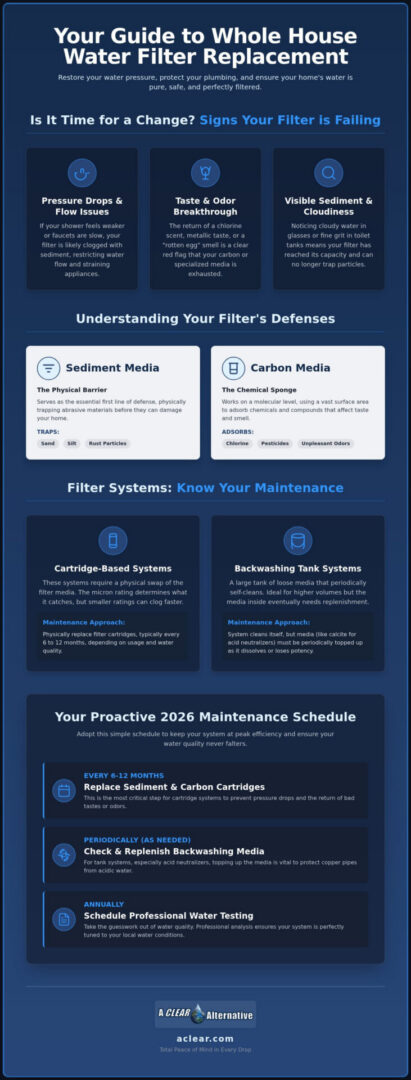
The 2026 Whole House Maintenance Schedule
Consistency is the secret to a high-performing water system. Think of your maintenance schedule as a wellness routine for your home’s infrastructure. By following a structured timeline, you prevent minor issues from escalating into expensive plumbing repairs. A proactive whole house water filter replacement strategy ensures your family never has to deal with a sudden drop in water quality or pressure. Here is the gold standard for maintaining your system in 2026:
- Monthly: Perform a quick visual inspection. Check for any moisture around fittings and take a glance at your pressure gauges. A sudden 10-15 psi drop across the filter usually means it’s time for a swap.
- Quarterly: Test your water’s hardness and pH levels. South Jersey’s water can be aggressive, and these tests tell you if your neutralizer or softener needs a setting adjustment.
- Bi-Annually: This is your primary window for a whole house water filter replacement. Swap out your sediment and carbon cartridges to maintain peak flow and chemical absorption.
- Annually: Schedule a deep dive. This includes a full system sanitization to prevent bacterial growth and a mandatory UV lamp replacement, even if the old bulb is still glowing.
Step-by-Step Cartridge Replacement Guide
Ready to handle the swap yourself? Start by shutting off the main water supply valve and opening a faucet further down the line to relieve built-up pressure. Once the system is depressurized, use your housing wrench to unscrew the filter canister. Don’t just drop the new filter in and call it a day. Take a moment to scrub the inside of the housing with a mild bleach solution to remove any slippery biofilm. Before reassembling, apply a thin layer of food-grade silicone lubricant to the O-ring. This simple step prevents leaks and makes your next filter change significantly easier. Hand-tighten the housing; over-tightening with a wrench is a common mistake that can crack the plastic or crush the seal.
Tracking Your System’s Performance
The easiest way to fail at maintenance is to rely on your memory. Keep a simple log near your system or set digital calendar alerts for each milestone. If you find yourself constantly forgetting to check your brine tank, consider setting up automated water softener salt delivery to take one more task off your plate. For systems older than five years, an annual professional ‘health check’ is a smart investment. A technician can spot worn-out internal seals or valve wear that a standard filter change won’t fix. If you aren’t sure where your system stands, book a professional system evaluation to get a clear picture of your home’s water health.
Hassle-Free Filter Replacement with A Clear Alternative
Managing your home’s water quality shouldn’t feel like a part-time job. While the technical side of a whole house water filter replacement is vital, the experience of maintaining it should be effortless and invisible. We believe that clean, crisp water is a fundamental part of a modern, high-quality lifestyle. That is why we’ve designed our service to remove every friction point. Whether you are in Tabernacle, Shamong, or Medford Lakes, our customized maintenance plans are built around your specific schedule and water needs. You don’t have to worry about tracking model numbers or remembering micron ratings. We take care of the details so you can simply enjoy the results.
Our expert technicians live and work in South Jersey, so they have first-hand experience with the aggressive iron and acidity issues that define our local water. We don’t just swap a cartridge and leave. We handle the heavy lifting, the messy cleanup, and the proper disposal of exhausted media. You’ll never have to carry heavy bags of salt or struggle with a stuck filter housing again. Plus, our 24/7 emergency support means that if your system ever encounters a hiccup, a professional is only a phone call away. It’s about providing a premium service that respects your time and your home’s aesthetic.
Why Families Trust A Clear Alternative Since 1991
Experience matters when it comes to your family’s health. As a family-owned business since 1991, we have spent decades refining our approach to water treatment in the Tri-State area. We don’t rely on guesswork. Every whole house water filter replacement we perform is backed by our commitment to providing 100% potable, safe water. Our comprehensive service includes professional laboratory testing to ensure your filtration media is perfectly calibrated for your current water chemistry. This data-driven approach allows us to catch shifting mineral levels before they affect your skin, your hair, or your expensive plumbing fixtures. We treat your home with the same discretion and care as we do our own.
Ready for Better Water? Schedule Your Service Today
Reclaiming your water quality is simpler than you think. We provide clear, flat-rate quotes for your filter replacement so there are never any surprises on your bill. Our service area spans across New Jersey, Pennsylvania, New York, and Delaware, bringing elite water treatment solutions to homeowners who value both performance and convenience. Stop settling for “good enough” water and start experiencing the clarity you deserve. Your journey to a maintenance-free lifestyle starts with a single click. Schedule your 2026 filter maintenance with A Clear Alternative today!
Elevate Your Home’s Water Quality Today
Your home deserves more than just ‘standard’ water. It deserves a system that works silently and perfectly in the background. By recognizing the early warning signs of pressure drops and staying ahead of the 2026 maintenance schedule, you ensure your family always has access to the pure, safe water they need. A proactive whole house water filter replacement isn’t just a chore; it’s a vital investment in your home’s infrastructure and your personal well-being. You’ve already taken the first step by learning the process; now it’s time to enjoy the results. If you are looking to utilize your purified water for high-performance recovery, Iceology Cold Plunge offers systems that benefit significantly from proper filtration; learn more about their wellness tubs.
At A Clear Alternative, we’ve been serving the Tri-State area since 1991. We understand the specific challenges of local water chemistry and the importance of a reliable system. As a licensed potable water hauler, we bring a level of expertise that goes beyond simple maintenance. Whether you need a routine check or 24/7 emergency water support, we are here to handle the heavy lifting and the technical details for you. Ready to restore your water’s clarity and your own peace of mind? Schedule Your Professional Filter Replacement with A Clear Alternative. Let’s make pure, refreshing water a permanent feature of your modern lifestyle.
Frequently Asked Questions
How often should I replace my whole house water filter?
Most systems require a swap every 6 to 12 months to maintain peak performance. However, the heavy mineral content often found in South Jersey water might necessitate a more frequent schedule, especially for sediment cartridges. If you notice a pressure drop or a subtle change in taste before the 6-month mark, it’s time for a whole house water filter replacement. Regular checks are the only way to ensure your media hasn’t reached its saturation point prematurely.
What happens if I don’t change my whole house water filter on time?
Neglecting your maintenance leads to restricted water flow and potential damage to your home’s infrastructure. Clogged filters force your pumps to work harder and can allow contaminants to bypass the media once it’s fully saturated. This results in sediment buildup in your water heater and dishwasher, leading to inefficient operation. Over time, exhausted carbon filters will also stop removing chemicals, allowing sharp chlorine or metallic tastes to return to your taps.
Can I change my whole house water filter myself?
Many homeowners can handle basic cartridge swaps with the right tools and a bit of patience. You’ll need a housing wrench, a bucket, and food-grade silicone for the O-rings. However, complex systems like backwashing iron filters or UV sterilizers often require professional calibration. If you’re uncomfortable with depressurizing the main water line or properly sanitizing the housings, professional service ensures a leak-free result without the typical weekend mess and heavy lifting.
Why is my water pressure low after installing a new filter?
Low pressure after a fresh install usually indicates an air lock in the lines or a misaligned cartridge. If air is trapped in the housing, it restricts flow until it’s properly purged through a downstream faucet. Another possibility is that you’ve chosen a micron rating that’s too fine for your home’s incoming sediment load. A 1-micron filter catches more particles but can restrict flow significantly compared to a standard 20-micron version used in most homes.
How do I know which size filter my system needs?
You can find the correct size by checking the model number on your filter housing or measuring the existing cartridge. Most whole house systems use standard “Big Blue” sizes, which are typically 10 or 20 inches in length and 4.5 inches in diameter. Using the wrong size causes bypass leaks, where unfiltered water flows around the cartridge instead of through it. If the labels have faded, a quick professional evaluation can identify your exact specifications.
Do I need to sanitize my filter housing during a replacement?
Sanitization is a critical step that many skip during a whole house water filter replacement. Over time, a slippery biofilm of bacteria can grow inside the warm, dark environment of the housing. Scrubbing the canister with a mild bleach solution or specialized sanitizer before inserting the new media prevents this buildup. This ensures your water stays biologically clean and your new filter starts in a pristine environment, protecting your family’s health and water clarity.
Will a whole house filter replacement fix my smelly well water?
A fresh filter will fix the issue if your system is designed to target those specific odors. If you have an iron and sulfur filtration system, the “rotten egg” smell usually returns only when the media is exhausted. Swapping the cartridge or replenishing the media should restore that clean, odorless scent immediately. If the smell persists after a replacement, you may need a more comprehensive water analysis to see if your local water chemistry has shifted significantly.
How much does a professional water filter replacement service cost?
Professional service costs vary based on the complexity of your filtration setup and the specific media your home requires. While we don’t provide specific dollar amounts, a professional visit covers far more than just the filter swap. It includes full system sanitization, leak testing, and a comprehensive health check of your valves and O-rings. Many homeowners find that the flat-rate convenience of a scheduled maintenance plan is more cost-effective than dealing with sudden system failures.