
Water Treatment for Restaurants in Tabernacle, NJ: The 2026 Pro Guide
What if the most expensive ingredient in your kitchen isn’t the locally sourced produce, but the untreated water flowing through your espresso machine? In the Tabernacle dining scene, your water quality is either a silent brand ambassador or a hidden liability that eats away at your margins. You’ve likely felt the frustration of seeing cloudy glassware emerge from the dishwasher or tasting that metallic “off” note in a premium cup of coffee caused by local iron and sulfur. It’s a common struggle in the Pinelands, where naturally acidic water can quietly corrode your equipment and compromise your culinary standards.
We’re here to help you turn that around. This 2026 guide explains how professional water treatment for restaurants Tabernacle safeguards your investment and ensures your flavors remain pure. You’ll discover how to achieve crystal clear ice and spotless plates while staying ahead of Burlington County health standards and the new 2026 Legionella testing requirements. We’ll preview the modern filtration technologies, from reverse osmosis to acid neutralizers, that extend the lifespan of your boilers and dishwashers. It’s time to make water management a seamless, high-performance part of your restaurant’s success story.
Key Takeaways
- Understand why Tabernacle’s naturally acidic Pinelands water is a hidden risk to your ingredients and how to neutralize it effectively.
- Prevent scale buildup, the primary cause of commercial appliance failure, to reduce emergency plumbing costs and protect your equipment investment.
- Explore the best options for water treatment for restaurants Tabernacle, including Reverse Osmosis for premium beverages and softeners for spotless plates.
- Prepare for Burlington County Health Department inspections by implementing documented testing and staying compliant with 2026 safety regulations.
- Discover how a tailored water system creates a seamless operational flow, ensuring your kitchen runs with total confidence and zero downtime.
Why Water Quality is the Secret Ingredient for Tabernacle Restaurants
Your kitchen’s most frequently used ingredient doesn’t arrive on a delivery truck. It flows directly through your taps. In Tabernacle, water quality defines the ceiling of your culinary success. While you might obsess over the grade of your steak or the origin of your coffee beans, the water you use to blanch pasta, steam vegetables, or freeze into ice cubes acts as the foundation for every flavor profile. Poor water quality doesn’t just taste bad. It erodes the premium experience you’ve worked hard to build. When your water isn’t right, your brand isn’t right.
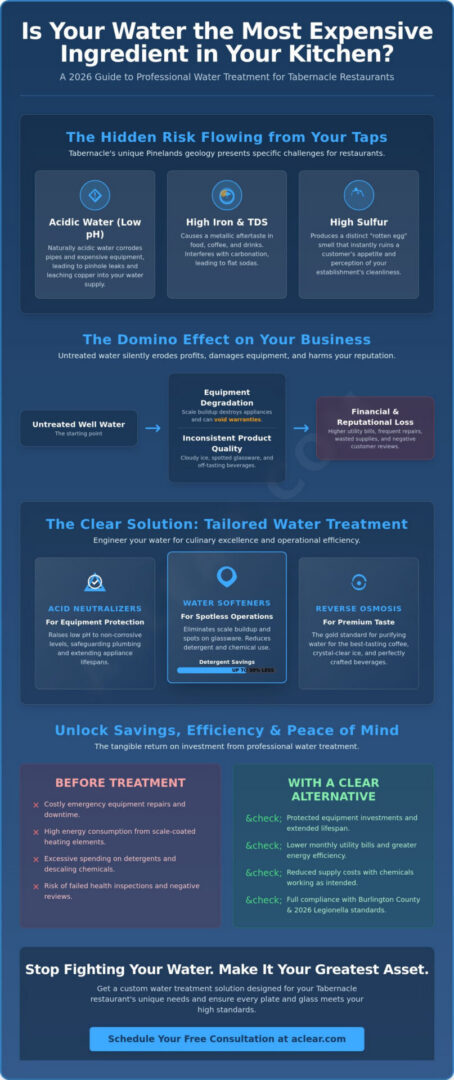
Tabernacle sits in the heart of the Pinelands, a region known for its unique and often challenging groundwater chemistry. This geography means local business owners deal with naturally acidic, low-pH water that requires a specialized approach. Implementing effective water treatment for restaurants Tabernacle is about more than just “filtering” out sediment. It’s about re-engineering your water to meet the rigorous demands of a high-volume commercial kitchen. Understanding the complexity of industrial water treatment processes is the first step toward selecting a system that protects both your flavor and your bottom line.
The Local Tabernacle Well Water Challenge
Tabernacle doesn’t rely on the massive municipal grids found in nearby cities. Most local establishments operate on independent well systems. These wells often pull water high in iron and sulfur, leading to that distinct “rotten egg” smell or metallic aftertaste that can ruin a customer’s appetite instantly. More importantly, the low-pH acidity common in Pinelands groundwater is aggressive. It’s known to leach copper from your restaurant’s plumbing, which eventually leads to pinhole leaks and a bitter, metallic tinge in your drinking water. You aren’t just fighting contaminants; you’re fighting the local geology.
Impact on Food and Beverage Consistency
Consistency is the hallmark of a great restaurant. If your signature coffee tastes different every Tuesday, your regulars will notice. High levels of Total Dissolved Solids (TDS) interfere with beverage carbonation, leading to flat fountain drinks and inconsistent espresso extraction. Beyond taste, there’s the aesthetic factor. In a modern dining environment, presentation is everything. Cloudy, soft ice or spotted glassware destroys the “premium” feel of your dining room. Crystal-clear ice and spotless plates aren’t just nice to have. They’re visual signals to your guests that your standards are uncompromising. Proper treatment ensures your water is as polished as your menu.
Protecting Your Investment: ROI of Commercial Water Treatment
Every dollar spent on your kitchen equipment is an investment in your restaurant’s future. However, Tabernacle’s hard and acidic water acts as a slow-motion tax on your profitability. Scale buildup is the silent killer of commercial dishwashers and steamers. It coats heating elements, forcing them to work harder and consume more energy just to reach temperature. By implementing professional water treatment for restaurants Tabernacle, you stop this cycle of decay before it starts. You’re not just buying a filter; you’re buying insurance for your most expensive assets.
The financial logic is simple. Clean heating elements translate directly to lower monthly utility bills. When your water is properly softened, you can also reduce detergent and chemical waste by up to 30%. Hard water minerals neutralize soaps, requiring your team to use more product just to get a lather. With conditioned water, your chemicals work exactly as intended, saving you money on every shift. Understanding the standards for safe water in foodservice helps you see that water quality isn’t just about taste. It’s a critical component of operational safety and efficiency.
Safeguarding High-End Kitchen Equipment
High-end espresso machines are particularly vulnerable. Micro-scale can clog delicate internal boilers and flow meters, leading to expensive repairs and downtime during your busiest hours. For combi-ovens and steamers, many manufacturers now list specific water quality parameters as a warranty requirement. If your water isn’t treated, a major repair might not be covered. Even your ice machines benefit. Treated water reduces the frequency of labor-intensive deep-cleaning and sanitization cycles, keeping your ice production consistent and safe.
Labor and Chemical Savings
Think about the hours your staff spends hand-polishing spotted glassware. It’s a tedious task that vanishes when you address water hardness at the source. Soft water ensures a “sheeting” action in the dishwasher, leaving plates and glasses sparkling without manual intervention. This efficiency extends to your back-of-house too. Linens and uniforms last longer when they aren’t subjected to the harsh minerals found in untreated well water. If you’re ready to stop overpaying for repairs and utilities, it’s worth exploring how a customized filtration strategy can streamline your operations and give you back your time.
Custom Solutions: RO Systems, Softeners, and Neutralizers
Customized water treatment for restaurants Tabernacle isn’t a luxury; it’s a technical necessity. Your dishwasher needs different water than your espresso machine, and your boiler has requirements that differ from your soda fountain. A multi-stage approach respects the unique chemistry of the local aquifer while meeting the specific needs of your high-end equipment. By deploying targeted technologies, you create a seamless environment where every drop of water is optimized for its specific task. It’s about precision engineering, not just basic filtration—a concept well-understood by technical leaders like Adage Components who focus on the high-quality components that drive modern industrial systems.
Reverse Osmosis for Beverages and Ice
Reverse Osmosis (RO) Systems represent the pinnacle of beverage quality. These systems remove up to 99% of total dissolved solids, giving your chefs and baristas a true “blank canvas” to work with. While Reverse Osmosis systems for homes provide excellent drinking water, commercial-grade units often include sophisticated blending valves. These valves let you reintroduce a controlled amount of mineral content. This is a game-changer for specialty coffee. Some minerals are essential for extracting the complex flavor notes of a light roast. Without this control, your coffee might taste flat or surprisingly thin.
Neutralizers and Iron Filtration
Acidity is the primary challenge for any business in the Pinelands. Low-pH water is the silent culprit behind the blue-green staining that plagues many local fixtures. Integrating acid neutralizer systems for Tabernacle establishments is a critical step to halt pipe corrosion. These systems raise the pH to a neutral level, protecting your expensive copper plumbing and preventing metallic off-tastes. When you pair this with iron and sulfur filtration, you also eliminate the embarrassing “rotten egg” odors that can linger in a dining room or restroom, ensuring your guest’s focus remains on the food.
For front-of-house efficiency, commercial water softeners handle the heavy lifting. They strip away the minerals that cause scale, ensuring your glassware stays crystal clear and your detergent costs stay low. For restaurant owners looking to optimize their sanitation further, visit Serenity Chemicals Limited. Finally, Ultraviolet (UV) Sterilizers offer a chemical-free shield against bacteria. Since Tabernacle restaurants rely heavily on well water, UV systems provide an essential layer of safety by neutralizing potential pathogens without altering the water’s natural flavor. This combination of technology ensures your water is safe, functional, and aesthetically perfect.
Compliance and Consistency: Meeting Burlington County Standards
Passing an unannounced inspection from the Burlington County Health Department shouldn’t feel like a roll of the dice. In Tabernacle, where most establishments rely on private wells, your water source is under a microscope. A “Conditionally Satisfactory” rating can damage your reputation faster than a bad review, making compliance a core part of your business strategy. Total health code adherence means proving your water is of a safe, sanitary quality as defined by N.J.A.C. 8:24. It’s about more than just being clean; it’s about being documented and ready.
The regulatory environment is shifting. By December 2026, new state requirements under Bill S2188 mandate that public water systems, including many that serve restaurants, implement proactive Legionella management plans. When you invest in professional water treatment for restaurants Tabernacle, you aren’t just buying equipment. You’re securing a partner who understands these evolving Burlington County standards. We help you maintain the rigorous standards required by the New Jersey Safe Drinking Water Act, ensuring your facility remains a safe space for every guest.
The Potable Water Audit Checklist
- Step 1: Schedule comprehensive well water testing. Under the Private Well Testing Act, you must test for bacteria, nitrates, and local Pinelands contaminants like pH and iron.
- Step 2: Verify your backflow preventers. Protecting the local water supply from cross-connections is a non-negotiable safety requirement for any commercial kitchen.
- Step 3: Maintain a digital or physical maintenance log. Inspectors want to see a clear history of UV bulb replacements and filter changes to prove your system is operational.
Emergency Bulk Water Support
Operational continuity is the heartbeat of your restaurant. If your well pump fails or a drought impacts your supply on a busy Friday night, you can’t simply wait for a repair. A Clear Alternative provides licensed potable water hauling and bulk delivery to keep your kitchen running. We bridge the gap during emergencies by filling cisterns with certified safe water, so your doors stay open even when your well doesn’t cooperate. If you’re concerned about your current compliance status, get a professional water audit to ensure your facility meets every 2026 standard.
Partnering with A Clear Alternative for 24/7 Commercial Support
You don’t just need a service provider. You need a partner who understands the specific quirks of Burlington County’s geography. A Clear Alternative has been family-owned and operated since 1991. We’ve spent over three decades navigating the unique water chemistry of the Pinelands. This deep local history allows us to design water treatment for restaurants Tabernacle that doesn’t just meet general standards. We address the exact mineral profile of your specific well, ensuring your system is as unique as your menu.
Restaurants don’t live in a 9-to-5 world. If a neutralizer fails or a pump loses pressure during a Saturday night rush, you can’t wait until Monday morning for a solution. Our 24/7 emergency support ensures your kitchen never misses a beat. We also offer proactive, scheduled maintenance programs. These are designed to handle the technical details of filter changes and system calibrations in the background. Your staff should focus on culinary excellence and guest satisfaction, not troubleshooting plumbing issues. We believe the best technology is the kind you never have to think about.
Every menu has its own requirements. A high-volume steakhouse has different water needs than a boutique bakery or a craft cocktail bar. We don’t believe in “one size fits all” solutions. We analyze your equipment list, from your high-pressure steamers to your delicate espresso boilers, to create a balanced water profile. This modern, technology-forward approach protects your investment while making your flavors pop. It’s about giving you the freedom to run your business with total confidence in your most basic utility.
The A Clear Alternative Advantage
Local expertise is our greatest asset. We understand the distinct mineral differences between Tabernacle, Shamong, and Medford Lakes water profiles. Our goal is a professional installation with minimal disruption to your kitchen’s flow. We work around your service hours to ensure your doors stay open. As one of the expert water treatment companies near Tabernacle, we prioritize technical precision and a clean, aesthetic setup that matches your professional standards.
Start Your Professional Water Analysis
A professional water analysis is the foundation of a high-ROI kitchen. We provide no-obligation consultations for new restaurant builds or existing kitchen renovations. We’ll examine your specific water chemistry and equipment specs to tailor a solution that fits your budget and your goals. Don’t leave your reputation to chance. Schedule your restaurant water analysis today and take the first step toward a more efficient, consistent, and compliant operation.
Elevate Your Culinary Standards with Professional Water Management
Your water is the silent engine of your kitchen. By now, you understand that investing in water treatment for restaurants Tabernacle is about much more than just passing an inspection. It’s a strategic move to preserve your high-end equipment, slash utility costs, and ensure every guest experiences the pure, consistent flavors they expect. Whether you’re neutralizing Pinelands acidity to save your plumbing or using Reverse Osmosis to perfect your signature espresso, the right system gives you a competitive edge.
A Clear Alternative has been family-owned and operated since 1991, meaning we’ve spent decades solving the specific challenges local restaurateurs face. As a licensed potable water hauler with 24/7 emergency commercial support, we’re ready to keep your doors open even when your well doesn’t cooperate. Don’t wait for an equipment failure or a conditional health rating to take action. Protect your kitchen with a professional water analysis from A Clear Alternative. Success in the kitchen starts at the tap. Let’s make your water work for you.
Frequently Asked Questions
Do restaurants in Tabernacle need a specific permit for water treatment?
You don’t need a specific permit just to own a filtration unit, but your installation must comply with the New Jersey Safe Drinking Water Act. Local plumbing permits are required for the physical installation of any commercial water treatment for restaurants Tabernacle. You should also ensure your maintenance logs are ready for review during your annual Burlington County Health Department inspection.
How often should a commercial reverse osmosis system be serviced?
Commercial reverse osmosis systems typically require professional service every six to twelve months. In a high-volume Tabernacle kitchen, you might need to swap pre-filters quarterly to protect the delicate RO membrane from sediment. Regular testing of Total Dissolved Solids (TDS) levels will tell you exactly when your system’s efficiency starts to dip.
Will a water softener make my restaurant’s soda taste different?
No, because softeners are generally used for utility water rather than beverage lines. We typically route water for fountain drinks through separate carbon filtration or reverse osmosis systems. This ensures your soda has the perfect “blank canvas” for syrup and carbonation, while the softener focuses on protecting your dishwasher and boiler from scale buildup.
What is the most common water problem for Tabernacle businesses on well water?
The most frequent challenge is the naturally low-pH, acidic water characteristic of the Pinelands region. This acidity aggressively corrodes copper plumbing and leads to bitter, metallic off-tastes. When you combine this with the high iron and sulfur levels common in local wells, it creates a complex chemistry that requires specialized neutralizers and filtration.
Can water treatment help extend the life of my commercial dishwasher?
Yes, professional water treatment is the most effective way to prevent premature dishwasher failure. By removing the minerals that cause scale, you keep heating elements and spray arms clear of restrictive buildup. This prevents the motor from overheating and ensures your machine operates at peak energy efficiency without the need for frequent, expensive descaling treatments.
What happens if my restaurant’s well water fails a bacteria test?
You must immediately stop using the water for food preparation or drinking and switch to a certified safe source. Remediating the well often involves shock chlorination or the installation of a UV sterilizer to neutralize pathogens. The Burlington County Health Department will require a certified clean re-test before you can resume normal operations and clear your inspection status.
Does A Clear Alternative offer emergency water delivery for restaurants?
Yes, we provide emergency water hauling and bulk potable water delivery to keep your kitchen running during well failures. We understand that a dry well or a pump failure on a busy weekend can be catastrophic for your bottom line. Our team can fill your cisterns or provide temporary storage solutions so your staff can stay focused on service.
Is hard water or acidic water a bigger threat to my kitchen equipment?
Both are dangerous, but they attack your kitchen in different ways. Acidic water is a threat to your infrastructure, as it eats away at copper pipes and leads to leaks. Hard water is a threat to your appliances, creating scale that chokes espresso machines and boilers. A comprehensive system addresses both issues to ensure your entire facility remains protected.