
Water Testing for Home Loan in Tabernacle, NJ: The 2026 Buyer’s Guide
Your dream home in the Pine Barrens shouldn’t be held hostage by a laboratory deadline. The excitement of moving to Tabernacle is real. However, the pressure of meeting strict lender requirements can quickly turn a celebration into a stressful race against the clock. Securing water testing for home loan Tabernacle requirements is often the final hurdle between you and your new front door. It’s completely normal to feel overwhelmed by the conflicting rules of FHA, VA, and New Jersey’s Private Well Testing Act.
We’re here to turn that confusion into confidence. You deserve a clear path to closing that ensures your family’s water is as pure as your new lifestyle. This 2026 guide breaks down exactly what the NJDEP and your lender need to see. You’ll discover the specific parameters for Burlington County, including mercury and radioactivity tests. You’ll also learn the timeline secrets to avoid closing delays. From understanding the latest PFAS regulations to getting a certified report in your hands, we’ve mapped out the entire process to keep your move on track and your water safe.
Key Takeaways
- Identify the specific water testing for home loan Tabernacle requirements that distinguish “safe” water from “lender-approved” standards.
- Navigate the mandatory NJ Private Well Testing Act (PWTA) parameters, including the latest 2026 PFAS and VOC regulations.
- Understand how unique Pine Barrens factors like radioactivity and acidic water can impact your closing timeline if not tested early.
- Master the “Neutral Third Party” rule to ensure your water samples are collected and processed according to strict mortgage guidelines.
- Learn how to fast-track remediation with professional filtration solutions to turn a failed test into a successful, stress-free closing.
Navigating Water Testing Requirements for Your Tabernacle Home Loan
Securing a mortgage for a property with a private well adds a layer of complexity to your home-buying journey. In the Tabernacle real estate market, water quality isn’t just a health concern; it’s a financial one. Lenders view your future home as collateral. If the water supply is compromised, the property’s value and habitability are at risk. This is why water testing for home loan Tabernacle requirements is a non-negotiable step in your closing checklist. Banks need to know the asset they are financing is viable from the very first day you turn on the tap.
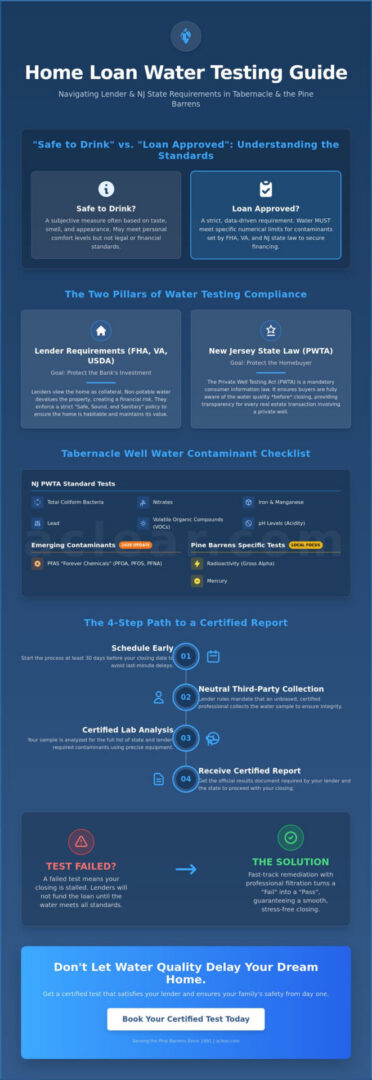
There’s a vital difference between water that’s “safe to drink” and water that’s “loan approved.” You might be perfectly comfortable with the taste of the water, but if it doesn’t hit the specific numerical targets set by federal agencies, your loan won’t fund. FHA, VA, and USDA loans each have their own benchmarks. These organizations follow a strict “Safe, Sound, and Sanitary” mantra. They look for specific levels of contaminants like lead, nitrates, and coliform bacteria that might differ from personal preference or even some general guidelines. Meeting these standards requires precision, local expertise, and a clear understanding of South Jersey’s unique geological makeup.
Why Mortgage Lenders Mandate Water Analysis
Lenders are naturally risk-averse. A home without potable water is a home that’s difficult to sell, making it a liability for the bank. By mandating a comprehensive water analysis, they ensure the property meets basic health and safety standards. In Tabernacle, where natural minerals and low pH levels are common, these tests are even more critical. A failed test doesn’t just mean a delay; it can potentially stall a closing indefinitely if not addressed. These requirements protect you as much as the lender, ensuring you don’t inherit a costly environmental problem the moment you sign the deed.
The Interplay Between Federal Loans and NJ State Law
New Jersey maintains some of the nation’s most rigorous rules through the Private Well Testing Act (PWTA). However, federal loan programs often layer additional requirements on top of this state mandate. It’s a complex intersection of regulations. While federal drinking water standards provide the fundamental baseline for safety, local conditions in the Pine Barrens require a more nuanced approach. You might pass the PWTA’s requirements but still fail a specific VA loan threshold for a different parameter.
A Clear Alternative has been bridging this regulatory gap for homeowners since 1991. We understand exactly how these requirements overlap and evolve. Whether it’s the latest 2026 PFAS standards or traditional bacterial checks, we ensure your certified report satisfies every banker and underwriter involved in your deal. Timing is essential here. You shouldn’t wait until the final week of your contract to schedule your water testing for home loan Tabernacle needs. Starting this process at least 30 days before your closing date provides the cushion you need to handle any necessary remediation without losing your moving day.
Understanding the NJ Private Well Testing Act (PWTA) Standards
In New Jersey, water quality isn’t left to chance or personal opinion. The Private Well Testing Act (PWTA) is a mandatory consumer information law that applies to every real estate transaction involving a private well in Tabernacle. It’s not just a suggestion from your realtor. It’s a legal requirement that ensures both buyers and sellers have a transparent look at what’s in the glass. While the law itself doesn’t force a seller to fix a problem, your lender certainly will. This makes water testing for home loan Tabernacle compliance the most important technical step in your journey toward homeownership.
The state requires a specific battery of tests that go far beyond basic clarity or taste. A certified lab must analyze the untreated water for a “long list” of contaminants. This includes total coliform bacteria, nitrates, iron, manganese, and pH levels. Since 2021, the state has also required testing for “forever chemicals” like PFOA, PFOS, and PFNA. As of June 2026, these protocols have become even more refined to reflect our growing understanding of groundwater health. For a deeper look at how these regulations have shaped the state’s safety landscape, you can review this Harvard case study on the PWTA, which highlights the law’s role in protecting local families.
Mandatory Analytes for Burlington County Homes
Tabernacle sits in a unique geological zone that requires extra vigilance. Because we are in Burlington County, the state mandates mercury testing, a requirement not found in every NJ county. You’ll also face mandatory testing for Gross Alpha particle activity. This is a radiological parameter common in the Pine Barrens due to natural deposits in the Cohansey aquifer. Older homes in our area also trigger mandatory lead testing. These specific requirements mean your water testing for home loan Tabernacle report must be handled by a lab that understands our local soil and water chemistry.
The PWTA Reporting Process and Your Closing Date
Once the samples are drawn, the clock starts ticking. The laboratory doesn’t just give the results to you; they’re legally required to submit the data directly to the New Jersey Department of Environmental Protection (NJDEP). This process typically takes 7 to 10 business days. Because results for certain parameters like Gross Alpha can take longer, we recommend scheduling your appointment at least three to four weeks before your closing date. If you’re feeling the pressure of a tight deadline, reaching out for comprehensive water testing early can save your deal from a last-minute paperwork crisis. Remember, while most results are valid for a year, coliform and E. coli results expire after just six months. Timing your test correctly ensures your certification is fresh when you head to the closing table.
Common Contaminants in Tabernacle & Shamong: What Could Stall Your Closing?
Tabernacle and Shamong sit in the heart of the New Jersey Pine Barrens. While this location offers stunning natural beauty, the ground beneath your future home presents unique challenges for your well. The sandy soil and the Cohansey aquifer create a specific chemical profile that lenders watch closely. When you order water testing for home loan Tabernacle services, you’re looking for more than just bacteria. You’re checking the geological fingerprints of the region. Some of these factors are invisible, while others leave a messy trail in your sinks and showers. Understanding these local quirks is the best way to ensure your closing stays on track.
Lenders often flag specific local issues that might not be as prevalent in other parts of the state. In South Jersey, we don’t just worry about what humans put into the ground. We also have to manage what nature already put there. From the acidity of the soil to naturally occurring minerals, your water quality is a direct reflection of the Pine Barrens ecosystem. Addressing these concerns early prevents a “surprise” failure on your lab report that could postpone your move-in date by weeks.
Radioactivity and Radium in South Jersey Well Water
The mention of radioactivity can feel alarming. However, in the Pine Barrens, it’s a known geological reality. Gross Alpha particle activity is a common parameter that can trigger a failed report. These naturally occurring radioactive elements, like radium, seep into the groundwater from the surrounding soil and rock. They don’t have a smell, taste, or color. You can’t see them, but a certified lab definitely can. Long-term exposure is a serious health concern, which is why the state and your lender take it so seriously. We use advanced digital diagnostics to identify these invisible threats quickly. Pinpointing the exact levels allows us to determine if specialized filtration is needed to meet safety standards and secure your loan approval.
Low pH and Iron: The “Nuisance” Contaminants That Matter
Not every contaminant is a direct health threat, but some can still kill a real estate deal. Tabernacle water is notoriously acidic. This low pH level acts like a slow-motion solvent on your home’s plumbing. If you see blue-green stains on your fixtures or notice pinhole leaks in copper pipes, you’re dealing with the effects of acidic water. Lenders worry about this because it compromises the longevity of the home’s infrastructure. They don’t want to finance a house that’s literally eating its own pipes. High iron and sulfur are also common in our local aquifer. While these are often labeled as “nuisance” contaminants, they cause significant aesthetic issues. Orange staining, metallic tastes, and that unmistakable “rotten egg” smell can make a home feel unsanitary. Fortunately, these are solvable problems. Installing modern Acid Neutralizer Systems or iron filtration can transform your water quality overnight. Taking these steps doesn’t just satisfy a checklist. It protects your investment and ensures your family enjoys premium, crystal-clear water from day one.
The Step-by-Step Process: From Sample Collection to Certified Results
You can’t just fill a clean water bottle from your kitchen sink and hand it to your banker. When it comes to water testing for home loan Tabernacle requirements, the process is just as important as the results. Lenders operate under a strict “Neutral Third Party” rule. This means the person collecting the water cannot have a financial interest in the transaction. Neither the buyer, the seller, nor the real estate agents can draw the samples. This rule prevents even the slightest hint of tampering, ensuring the laboratory receives an authentic representation of the home’s groundwater.
Scheduling your appointment with a certified technician is the first active step in clearing this hurdle. Once on-site, the technician follows a rigorous protocol to maintain the “Chain of Custody.” This is a legal paper trail that tracks the sample from the moment it leaves your tap until it’s logged into the laboratory system. It guarantees that the water tested is exactly the water that came from the well. This level of integrity is what underwriters look for when they review your closing package.
Professional Collection vs. DIY Kits
It’s tempting to grab a mail-in DIY kit from a big-box store, but homeowners in Medford Lakes and Tabernacle often find these kits rejected by local lenders. Most mortgage programs require a professional who understands proper tap flushing and sterile collection techniques. If a sample is contaminated by a dirty faucet aerator or an unwashed hand during collection, you’ll get a “false positive” for bacteria. This mistake can cost you weeks of delays and the added expense of re-testing. We ensure your samples are handled with digital precision and clinical care from start to finish, providing the professional certification your lender demands.
Reading Your Water Quality Report
When the results arrive, they can look like a wall of confusing numbers and acronyms. The most important term to know is MCL, or Maximum Contaminant Level. Think of this as the legal “speed limit” for each substance in your water. If a number is below the MCL, you’re in the clear. However, if a result comes back as “Present” for Coliform bacteria, it’s an immediate red flag for the lender. This doesn’t mean your dream home is a lost cause. It simply means you need a clear plan for remediation. Consulting with Well Water Testing experts allows you to interpret these numbers accurately and decide on the right technology to fix the issue.
Ready to secure your certified report and keep your closing on schedule? Reach out to schedule your comprehensive water testing today and move forward with total peace of mind.
Beyond the Report: Partnering with A Clear Alternative for a Smooth Closing
A failed lab result doesn’t have to be the end of your real estate transaction. Many testing companies simply hand you a page of bad news and leave you to figure out the rest. We take a different approach. By choosing a specialist for your water testing for home loan Tabernacle needs, you gain a partner who understands the finish line. We don’t just identify the contaminants; we provide the technology to eliminate them. This “Fix-It” advantage is critical when you’re working against a strict mortgage commitment date. You need solutions, not just statistics.
Our team understands that every day counts during a move. If your report shows elevated levels of iron, low pH, or bacteria, we pivot immediately to remediation. We offer 24/7 support for emergency water needs, including bulk potable water delivery if your system requires a complete overhaul. This level of dedication ensures that your family has safe water from the moment you get the keys. You aren’t just buying a filtration system. You’re investing in a seamless transition to your new life in the Pine Barrens.
Immediate Solutions for Failed Water Tests
When a lender sees a “Present” result for bacteria or high levels of minerals, they require proof of a professional fix. We specialize in fast-track remediation that satisfies even the toughest underwriters. For issues with aesthetics or plumbing protection, we install advanced Iron and Sulfur Filtration Systems. These units clear up the staining and odors that often flag a property during a home inspection. If bacteria is the culprit, our Ultraviolet (UV) Sterilizers provide an instant, chemical-free way to neutralize threats. Once the system is in place, we provide the necessary certification of installation. This paperwork is exactly what your lender needs to clear the final water contingency and fund your loan.
The Local Difference: Why Tabernacle Trusts A Clear Alternative
We’ve spent 35 years mastering the unique water landscape of the Tri-State area. Since 1991, our family-owned business has helped over 9,000 customers navigate the complexities of groundwater health. We aren’t a corporate, one-size-fits-all brand. We’re your neighbors. We understand the specific radiological concerns of the Cohansey aquifer and the acidic nature of our local soil. This local expertise allows us to design systems that actually work for Tabernacle homes. We value the aesthetic of your home and the quality of your life, offering discrete and highly effective digital solutions. Don’t let a technicality stall your dreams. Schedule your certified home loan water test today and experience the freedom of clear, safe water.
Clear Your Path to a Smooth Closing
Your move to Tabernacle represents a fresh start and a beautiful new chapter. Don’t let the technicalities of groundwater regulations slow you down. By now, you know that meeting the intersection of federal loan requirements and the NJ Private Well Testing Act is about more than just checking a box. It’s about protecting your investment and your family’s health from invisible local threats like radium or acidic water. Professional collection and a verified chain of custody aren’t just hurdles; they’re your safeguards for a successful, stress-free closing.
Choosing the right partner for water testing for home loan Tabernacle requirements ensures you have the data you need and the solutions to fix any issues instantly. As a family-owned business since 1991 and a licensed potable water hauler, we bring deep local expertise to every sample we draw. We specialize in PWTA compliance and fast-track remediation to keep your moving day on schedule. We understand the Pine Barrens water better than anyone, and we’re ready to put that knowledge to work for your new home.
Schedule Your Certified Home Loan Water Test Now
Your new home in the Pine Barrens is waiting. We’re here to help you cross the finish line with total confidence and crystal-clear water.
Frequently Asked Questions
How much does water testing for a home loan in Tabernacle cost?
The cost of your analysis depends entirely on the specific parameters required by your mortgage lender and the state of New Jersey. While the PWTA mandates a core list of contaminants, certain loan programs like FHA or VA may require additional checks. It’s best to request a customized quote to ensure you’re only paying for the specific tests your underwriter needs to see.
How long does it take to get NJ PWTA water test results back?
You should expect to receive your certified results within 7 to 10 business days. Some specific radiological tests, such as Gross Alpha, may require the full 10-day window due to laboratory processing times. We always recommend scheduling your collection at least three weeks before your closing date to provide a comfortable buffer for paperwork and review.
Can I use a DIY water test kit for my FHA or VA loan?
No, lenders will not accept results from a DIY or mail-in kit. Federal loan programs require a “Neutral Third Party” to collect the samples to prevent any conflict of interest or tampering. Professional collection also ensures sterile techniques are followed, which prevents the false positives that often happen when homeowners draw their own samples.
What happens if my well water fails the home loan test?
A failed test simply means you need to implement a treatment solution before the loan can fund. You’ll need to install the appropriate system, such as a UV sterilizer or acid neutralizer, and then perform a certified re-test. Once the new results show the water meets safety standards, we provide the installation certification your lender needs to clear the contingency.
Does the seller or the buyer pay for the water testing in NJ?
Payment for water testing for home loan Tabernacle requirements is a negotiable item in your sales contract. In many South Jersey transactions, the seller pays for the mandatory PWTA testing while the buyer covers any additional tests required by their specific lender. You should consult with your real estate agent to see how this is structured in your specific agreement.
Is radioactivity testing mandatory for all wells in Tabernacle?
Yes, testing for Gross Alpha particle activity is a mandatory requirement for all real estate transactions in Burlington County. Because Tabernacle is located within the Pine Barrens, the state requires this check to monitor for naturally occurring radioactive elements. This test is a standard part of the PWTA battery for our specific geographical area.
How long is a water test valid for a mortgage closing?
Most parameters on your PWTA report are valid for one year. However, results for Total Coliform and E. coli are only valid for six months. If your closing date gets pushed back significantly, you may need to re-test for bacteria to ensure your water testing for home loan Tabernacle documentation remains current for the bank’s underwriters.
What is the most common reason for a failed water test in South Jersey?
Low pH and Total Coliform bacteria are the most frequent reasons for a failed report in our region. The naturally acidic soil in the Pine Barrens results in water that can be corrosive to plumbing. Bacteria issues are also common but are typically resolved quickly with the installation of a professional UV sterilization system.