
Water Quality Report Shamong NJ: Your 2026 Guide to Clean Tap & Well Water
In Shamong, the safety of your drinking water isn’t determined by a municipal treatment plant, but by the unique chemistry of the soil beneath your feet. Since every home here relies on private wells, you’ve likely dealt with the frustration of blue-green sink stains or that unmistakable rotten egg smell during your morning shower. While you might be looking for a standard water quality report Shamong NJ, the truth is that your home’s safety depends on individual testing. This is especially vital following the May 2025 discovery of PFOA and PFOS levels exceeding state thresholds in local wells.
You deserve to feel certain about the water your family uses every day. We’ll help you decode the latest 2026 NJDEP regulations, including the new recommended testing for GenX and other PFAS compounds under the Private Well Testing Act. This guide explains how to protect your plumbing and your health by neutralizing acidity and filtering out heavy metals. We’ll show you how to move past confusing government PDFs and achieve the crisp, clean water that fits your modern lifestyle.
Key Takeaways
- Decode your water quality report Shamong NJ to understand exactly how local geography impacts the safety and feel of your home’s water.
- Clarify the legal requirements of the NJ Private Well Testing Act (PWTA) so you can protect your property value and family health with confidence.
- Spot the early warning signs of low pH and high iron levels before they cause permanent damage to your fixtures and appliances.
- Learn how to schedule a comprehensive analysis to identify hidden contaminants like PFAS or sulfur that affect your everyday comfort.
- Compare advanced treatment options like acid neutralizers and specialized filtration systems to achieve the crisp, clear water your lifestyle demands.
Understanding the 2026 Shamong NJ Water Quality Report
You’ve likely seen those dense, multi-page PDFs from the state or county. They’re meant to provide clarity, but they often feel like a technical manual rather than a guide for your home. In Shamong, your relationship with water is unique. Unlike most New Jersey suburbs, Shamong is a community built entirely on private wells and septic systems. This means there isn’t one single, centralized water quality report Shamong NJ homeowners can download to see their specific results. Instead, you’re the manager of your own mini-utility.
What is a Consumer Confidence Report (CCR)?
In towns with public water systems, the law requires an annual Consumer Confidence Report. This document lists every regulated contaminant found during testing. It measures things in “Parts Per Million” (PPM) or “Parts Per Billion” (PPB). To visualize this, one PPM is like a single penny in a stack of $10,000. While these reports provide a safety baseline, they often ignore unregulated contaminants. For a Shamong resident, looking at regional CCRs from neighboring towns can offer clues about local groundwater trends, but it won’t tell you what’s coming out of your kitchen faucet.
Shamong’s Unique Environmental Context
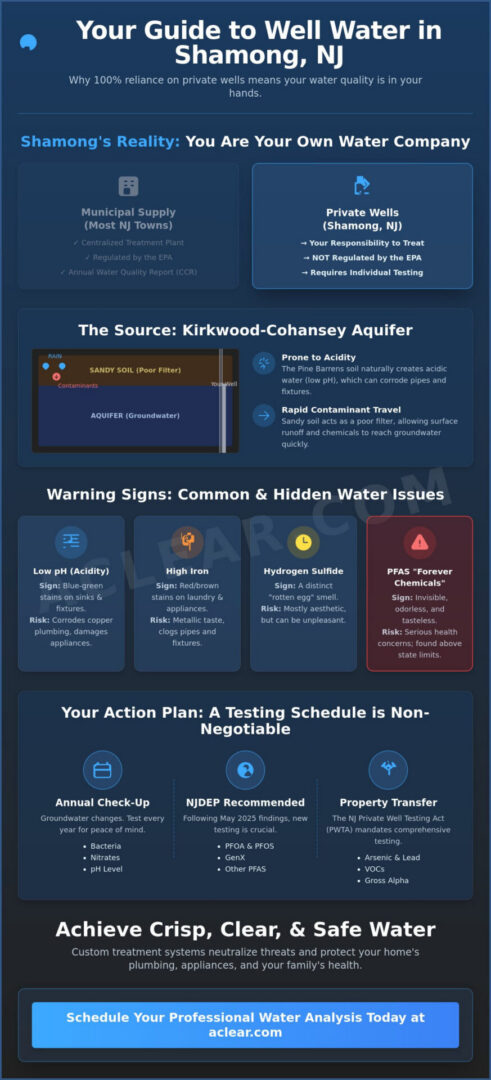
Our local water is a direct product of the Pine Barrens environment. Most of our wells tap into the Kirkwood-Cohansey aquifer, a massive, shallow reservoir sitting just beneath our feet. This aquifer is famous for its purity, but it has a catch. The soil here is incredibly sandy. Sandy soil acts as a poor filter compared to thick clay. Rainwater moves through it rapidly, picking up natural acidity and minerals along the way. It also means surface contaminants can reach the water table much faster than in other regions.
You have to distinguish between aesthetic issues and health risks. A government report might label your water “safe” because it lacks bacteria or lead, but that doesn’t account for the iron that ruins your white laundry or the acidity that eats through your copper pipes. True water quality is about more than just meeting a legal minimum. It’s about protecting your home’s infrastructure and your family’s daily comfort. Since there’s no official 2026 township-wide report, you can check the NJDEP Data Miner for regional groundwater studies, but individual testing remains your only definitive answer. Safe water shouldn’t be a guessing game. It should be a standard part of your modern home experience.
Municipal Water vs. Private Wells in Shamong
Living in Shamong offers a level of independence you won’t find in the more crowded corners of Burlington County. You aren’t just a consumer; you’re the manager of your own personal water utility. While residents in neighboring towns might rely on a centralized water quality report Shamong NJ homeowners have a different reality. You own the pump, you own the pipes, and you own the responsibility for every drop that reaches your glass. This independence is a luxury, but it requires a proactive mindset to ensure your “raw” water meets modern standards of purity and taste.
The legal landscape for well owners changed significantly with the NJ Private Well Testing Act. This law mandates comprehensive testing during real estate transactions, ensuring that new homeowners aren’t inheriting hidden contaminants. However, relying solely on a test performed years ago during a home sale is a risk. Groundwater is dynamic. Factors like local agricultural runoff, seasonal heavy rains, or even changes in the Kirkwood-Cohansey aquifer can alter your water’s chemistry overnight. Regular oversight is the only way to maintain the premium water quality your home deserves.
The Burden of Proof for Private Well Owners
Private wells are not regulated by the EPA. This means the federal safety standards governing city tap water don’t automatically apply to your backyard. You must be your own advocate. At a minimum, we recommend testing for bacteria, nitrates, and pH levels every year. In our local sandy soil, acidity is a constant threat. If your pH is off, your water becomes a slow-acting solvent, quietly damaging your high-end fixtures and appliances. Staying ahead of these shifts is essential for preserving both your health and your home’s aesthetic value.
Shamong Municipal Water Systems
While the vast majority of Shamong relies on individual wells, a few small-scale community systems serve specific developments. These systems operate under different rules, with the utility provider handling the heavy lifting of filtration and lead monitoring. However, even if you’re on a community line, the “last mile” of plumbing inside your home is still your territory. Whether you’re managing a private well or connected to a shared system, a comprehensive well water test provides the data you need to make informed decisions about your family’s lifestyle. You shouldn’t have to wonder if your water is as clean as it looks; you should have the data to prove it.
Common Contaminants in Shamong & Tabernacle Water
Your water’s journey through the sandy Pinelands soil isn’t just a geographic fact; it’s a chemical process that changes everything from your morning coffee to the lifespan of your plumbing. While a standard water quality report Shamong NJ might mention regional averages, your specific well likely tells a more complex story of minerals and acidity. In our area, the most common issues aren’t just about safety; they’re about how water interacts with your home’s aesthetic and infrastructure.
The Danger of Low pH and Copper Leaching
South Jersey water is notoriously aggressive. Because the soil lacks natural buffers like limestone, the groundwater remains highly acidic. This low pH acts as a slow-acting solvent. It doesn’t just sit in your pipes; it actively eats away at them. Blue-green stains in your sinks and tubs aren’t just an eyesore; they’re the physical evidence of your copper plumbing dissolving from the inside out. Over time, this lead to pinhole leaks that can cause thousands in water damage. Installing modern acid neutralizer systems is the most effective way to balance this chemistry and protect your home’s value.
Sulfur and Iron: Aesthetic vs. Functional Issues
If your laundry is turning orange or your dishwasher looks rusted, you’re dealing with high iron and manganese levels. These minerals are naturally abundant in the Kirkwood-Cohansey aquifer, but they’re a nightmare for modern appliances. Beyond the stains, many Shamong residents struggle with the unmistakable “rotten egg” smell of hydrogen sulfide. This odor often intensifies when the water heater is running, as the heat accelerates the release of the gas. While these minerals are primarily aesthetic concerns, they can clog high-efficiency valves and reduce the lifespan of your water-using equipment.
Modern concerns have also shifted toward “forever chemicals.” According to a May 2025 report, wells at two homes in Shamong Township tested positive for PFOA and PFOS levels exceeding the state’s permissible thresholds. New Jersey has some of the strictest standards in the nation, setting the Maximum Contaminant Level for PFOA at 14 parts per trillion and PFOS at 13 parts per trillion. Since these chemicals are tasteless and odorless, they won’t leave the obvious signs that iron or sulfur do. This makes targeted testing essential for anyone relying on a private well in the 2026 landscape. Understanding what’s in your water is the first step toward a home that feels truly clean and safe.
How to Get a Professional Water Analysis in Shamong
Obtaining a definitive water quality report Shamong NJ homeowners can trust starts with moving beyond guesswork. You wouldn’t guess the temperature of your home; you use a thermostat. Your water deserves the same digital-age precision. The path to total confidence in your tap is a simple, five-step process that transforms raw data into a personalized lifestyle upgrade. It’s about moving from “I think it’s fine” to “I know it’s perfect.”
- Step 1: Identify your primary concerns. Start with your senses. Do you notice a metallic taste, a sulfur smell, or blue-green staining on your designer fixtures?
- Step 2: Schedule a professional analysis. Don’t rely on generic data. Book a well water test to get a snapshot of your specific aquifer health.
- Step 3: Precision collection. We use sterilized, lab-grade containers to ensure your sample isn’t contaminated by outside air or handling.
- Step 4: Expert review. Once the lab results are in, sit down with a specialist to translate the PPMs and PPBs into plain English.
- Step 5: Targeted design. Use the data to build a filtration strategy that only targets what you actually need, avoiding “one-size-fits-all” solutions.
DIY Test Kits vs. Laboratory Analysis
It’s tempting to grab a “strip test” from a local hardware store, but these kits have significant limitations. They’re often inaccurate and only test for a handful of basic parameters. In New Jersey, lab-grade testing isn’t just a recommendation; it’s a legal requirement for real estate transactions under the PWTA. A professional analysis uncovers complex issues like PFOA levels or specific bacteria strains that a DIY kit will simply miss. When it’s your family’s health and your home’s infrastructure on the line, professional-grade data is the only acceptable standard.
Interpreting Your Lab Results
When you receive your water quality report Shamong NJ, you’ll see terms like “Maximum Contaminant Level” (MCL) and “Action Levels.” An MCL is a strict health standard. If your water exceeds this, it’s a priority fix. Action levels are often more about aesthetics and long-term plumbing protection. We help you prioritize your investment. We focus on health risks like bacteria or PFAS first, then move to aesthetic concerns like iron and sulfur. This logical approach ensures your home remains a sanctuary of health and comfort. If you’re ready to secure your home’s future, our team provides the comprehensive water testing you need to make an informed decision.
Custom Water Treatment Solutions for Shamong Homes
You’ve gathered the data and identified the gaps in your home’s water health. Now, it’s time to bridge that gap with technology that matches your lifestyle. While a water quality report Shamong NJ provides the “why,” your treatment system provides the “how.” In a community where every home manages its own well, you have the freedom to design a water experience that is crisp, clear, and completely under your control. It’s about moving past the limitations of raw groundwater and embracing a modern standard of purity.
The foundation of any Shamong water strategy is often an acid neutralizer. As we discussed, our local soil creates aggressive, low-pH water that quietly destroys copper pipes and leaves blue-green stains on your fixtures. By balancing this pH, you aren’t just cleaning your water; you’re protecting your home’s infrastructure. For those dealing with the orange tint of iron or the heavy scent of sulfur, specialized iron and sulfur filtration systems offer a chemical-free way to restore the aesthetic beauty of your laundry and bathrooms. These systems act as a silent guard, ensuring your high-end appliances last as long as they should.
Whole House vs. Point-of-Use Systems
Understanding the difference between these two approaches is key to a smart investment. A whole house water filtration system treats every drop that enters your home. This is essential for protecting your plumbing, water heater, and skin from acidity and minerals. However, if you want the ultimate drinking experience, point-of-use Reverse Osmosis (RO) systems are the gold standard. RO technology removes the “forever chemicals” like PFOA and PFOS that standard filters might miss, delivering bottled-water quality directly to your kitchen tap. When paired with UV sterilization to guard against bacteria, you create a multi-layered shield for your family.
Why Local Expertise Matters in South Jersey
Generic, big-box solutions often fail in the Pine Barrens because they don’t account for the unique chemistry of the Kirkwood-Cohansey aquifer. You need a system that’s calibrated for our sandy soil and high mineral content. Maintenance is also part of the journey. Modern systems are designed for ease, but having a partner who understands the local landscape ensures your water remains perfect year-round. Don’t settle for “good enough” when it comes to your family’s health and comfort. Schedule a consultation with A Clear Alternative today to design a system that turns your water quality report Shamong NJ into a plan for total home wellness.
Secure Your Home’s Water Future Today
Your home should be a place of absolute comfort and confidence. We’ve explored how Shamong’s unique soil chemistry and the latest 2026 regulations change the way you manage your private well. While a generic water quality report Shamong NJ might give you a baseline, true peace of mind comes from a personalized strategy that protects your health and your designer fixtures. It’s about moving beyond the standard and achieving a premium water experience that fits your lifestyle.
Since 1991, our family-owned business has specialized in the specific challenges facing Shamong, Tabernacle, and Medford Lakes. We combine modern technology with deep local roots to ensure your water is as pure as it is refreshing. Whether you need an acid neutralizer to save your plumbing or a high-tech reverse osmosis system for your kitchen, we’re here with 24/7 emergency support when you need it most. Don’t leave your water quality to chance when professional data is just a step away.
Get a Professional Water Analysis & Protect Your Shamong Home
You’ve done the research. Now, take the final step toward a cleaner, more confident lifestyle. You deserve water that matches the quality of your home and the health of your family.
Frequently Asked Questions
Is Shamong NJ tap water safe to drink according to the latest report?
Shamong doesn’t have a single municipal report because the township runs almost entirely on private wells. Your tap water’s safety depends on your own well’s chemistry and maintenance. While regional groundwater is generally high quality, individual home tests are the only way to confirm your water meets current health standards.
How often should I test my well water in Shamong?
You should test your well water at least once every year. The sandy soil of the Pine Barrens allows surface contaminants to move quickly into the aquifer. Testing annually for bacteria, nitrates, and pH levels ensures you catch changes before they damage your health or your home’s infrastructure.
What causes the blue-green stains in my Shamong home?
Blue-green stains are caused by acidic water leaching copper from your home’s plumbing. Shamong water is naturally low in pH. This acidity acts as a solvent, eating away at your pipes and depositing copper residue on your designer fixtures, sinks, and tubs.
Does the Shamong water report cover PFAS and PFOA?
There is no centralized water quality report Shamong NJ homeowners can rely on for PFAS data. You must order a specific lab test for these “forever chemicals.” New Jersey currently regulates PFOA and PFOS at very low levels to protect residents from long-term exposure in their drinking water.
Why does my Shamong well water smell like sulfur or rotten eggs?
That rotten egg smell comes from hydrogen sulfide gas found naturally in the Kirkwood-Cohansey aquifer. It’s an aesthetic issue that makes showering or cooking unpleasant. The smell is usually stronger when you use hot water because the heat helps release the gas more quickly.
How much does a comprehensive water test cost in South Jersey?
Pricing for water analysis depends on the depth of the search. A basic test for bacteria and nitrates is different from a comprehensive panel that includes heavy metals and PFAS. You should consult with a professional to determine which testing tier fits your home’s specific needs and concerns.
What is the NJ Private Well Testing Act and does it apply to me?
The NJ Private Well Testing Act (PWTA) is a law that mandates water testing when a property is sold or leased. It applies to every home in Shamong. Recent updates in 2025 and 2026 have expanded the list of recommended chemicals to include newer PFAS compounds like GenX and PFHxS.
Can I use a standard pitcher filter to fix Shamong well water issues?
Pitcher filters aren’t equipped to solve the complex issues found in Shamong wells. They can’t neutralize acidity or remove heavy iron and sulfur. For a true lifestyle upgrade, you need a professional system like an acid neutralizer or reverse osmosis to ensure every tap provides high-quality water.