
Upgrading Your Old Water Softener: The 2026 Homeowner’s Guide
Is the rhythmic clicking of your old timer-based system actually the sound of money draining from your bank account? While you might think you’re saving by “nursing” an aging unit along, the reality of 2026 home technology suggests otherwise. If you’re tired of hauling heavy salt bags only to end up with itchy skin and scale-covered faucets, upgrading your old water softener isn’t just a maintenance task. It’s a total lifestyle upgrade that pays for itself through improved efficiency and appliance protection.
You probably feel frustrated with the endless maintenance and the lackluster results of a system that has seen better days. We understand that your home should be a place of comfort, not a series of technical chores. This guide reveals how modern demand-initiated systems can slash your salt and water usage by up to 25% while providing total protection for your expensive fixtures. We will explore the latest Wi-Fi enabled smartphone monitoring, the unique challenges of South Jersey’s high-iron well water, and why 2026 is the perfect time to trade unreliable performance for the soft, clean water your family deserves.
Key Takeaways
- Identify the hidden signs of system failure, from stubborn scale on your expensive fixtures to fluctuating water pressure caused by resin breakdown.
- Discover how upgrading old water softener units to 2026 smart technology provides real-time smartphone alerts and automatic salt monitoring for ultimate convenience.
- Calculate the “Salt Tax” and learn why modern demand-initiated regeneration is significantly more cost-effective than outdated timer-based models.
- Master the specific needs of South Jersey well water to ensure your new system effectively handles local iron and sulfur levels.
- Experience the lifestyle shift of soft water that protects your home’s appliances and restores your hair and skin’s natural glow.
Signs Your Old Water Softener Is Failing (and Why It Matters)
You notice a chalky film on your favorite glassware. Your showerhead is starting to clog with white crust again. Even though you’re still adding salt to the tank, your water just doesn’t feel right. These are the first red flags that your current system is waving. Ignoring these signs means you’re likely overpaying for salt while your home’s infrastructure suffers. Upgrading your old water softener becomes a priority when the costs of “getting by” outweigh the investment in a modern solution.
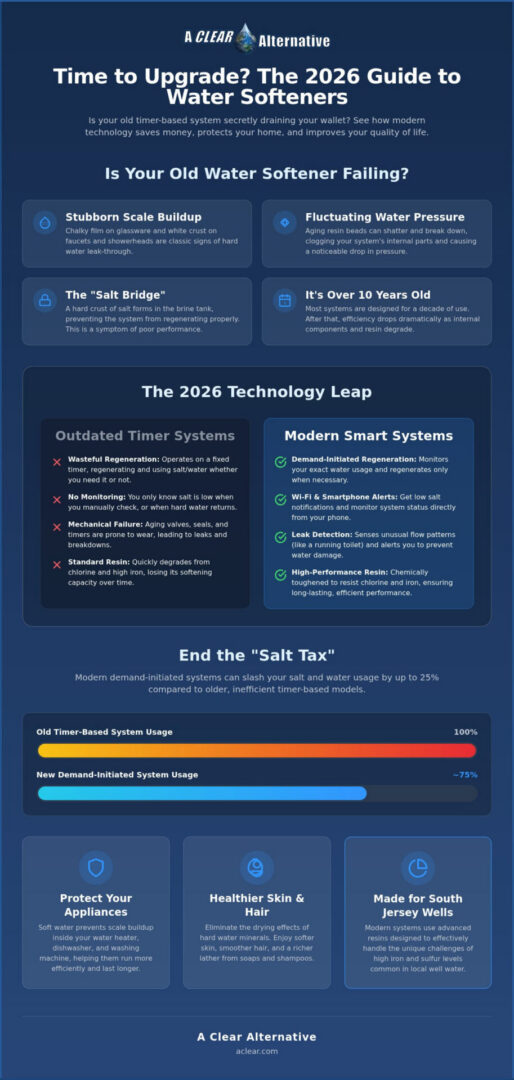
Physical symptoms often hide deeper mechanical failures. Resin beads inside the tank eventually shatter, which causes a noticeable drop in water pressure as the debris clogs the internal distributor. You might also encounter the “salt-bridge” phenomenon; a hard crust forms in the brine tank that prevents salt from dissolving. While you can break a salt-bridge manually, it’s often a symptom of high humidity or poor valve performance. Mechanical valve fatigue is another silent killer. Over years of cycling, the internal seals wear out, leading to internal bypass leaks where hard water sneaks into your home’s pipes without being treated. Modern Water softening technologies have moved far beyond these mechanical limitations, offering much higher reliability for busy households.
The 10-Year Rule: Why Age Is More Than a Number
Most systems are designed to last a decade, but environmental factors often accelerate this timeline. Resin beads lose their ion-exchange capacity over time. Chlorine in municipal water or high iron in South Jersey wells can strip the protective coating from these beads, causing them to swell and lose their ability to trap minerals. By 2026, the efficiency gap between a new unit and a 2010 model is massive. Older units operate on rigid timers, regenerating whether you need it or not. New systems analyze your actual usage. They ensure you never waste a drop of water or a grain of salt by only regenerating when necessary.
Visible Damage vs. Invisible Inefficiency
Hardness leak-through often happens during peak usage times, like when you’re running the dishwasher and the laundry simultaneously. Your old system simply can’t keep up with the flow rate, letting minerals pass through. This leads to ion-exchange fatigue, which is the point where the resin medium is so saturated or chemically damaged that it can no longer effectively swap calcium ions for sodium ions. This failure directly impacts your wallet. It increases plumbing maintenance costs by allowing scale to build up inside your water heater and dishwasher, forcing them to work harder and fail sooner. Upgrading your old water softener stops this invisible drain on your home’s efficiency before it leads to a total appliance breakdown.
2026 Water Softening Technology: What’s New?
The world of home infrastructure has evolved rapidly. If you’re still relying on a system installed a decade ago, you’re likely missing out on significant efficiency gains. Upgrading your old water softener to a 2026 model introduces you to “Demand-Initiated Regeneration.” Unlike old timer-based units that cycle every few days regardless of your actual water use, modern systems monitor your habits in real-time. This prevents the unnecessary waste of water and salt, ensuring you only regenerate when the resin is truly exhausted. When Selecting a water softener, this feature alone can reduce your annual operating costs significantly.
Smart Monitoring and Leak Detection
Digital connectivity has transformed water treatment from a “set it and forget it” chore into an active part of your smart home. 2026 systems integrate directly with your smartphone. You’ll receive instant alerts when your salt levels are low, saving you that last-minute trip to the store. Even more critical is the inclusion of flow-based leak detection. These systems can identify unusual water patterns, like a running toilet or a burst pipe, and notify you before a small drip becomes a catastrophic flood. This reduces the mental load of home maintenance, giving you back time and confidence.
Advanced Resin Technology
The heart of the system has also received a major upgrade. High-performance, cross-linked resins are now standard in premium units. These beads are chemically toughened to resist degradation from chlorine and the heavy iron loads common in South Jersey wells. They provide a higher surface area for ion exchange, which means they require less salt per gallon of treated water. For those seeking the ultimate in water quality, many homeowners are now integrating whole house water filtration systems. This combines the mineral-removing power of a softener with carbon filtration to remove tastes, odors, and chemicals.
Upgrading your old water softener allows you to enjoy these technological leaps while protecting your home’s aesthetic appeal. You don’t have to settle for bulky, outdated equipment that clashes with a modern utility room. If you’re curious about how these smart features would work in your specific home, it’s worth exploring the custom solutions available at A Clear Alternative. These systems are designed to be as discreet as they are powerful, fitting seamlessly into a contemporary lifestyle.
The ROI of Upgrading: Repair vs. Replace
Deciding whether to sink money into a repair or invest in a new system is a common dilemma. You might feel that “one more fix” will buy you another year of service. However, upgrading your old water softener often reveals hidden savings that a simple repair can’t provide. Your aging unit likely carries a “Salt Tax,” an invisible annual cost created by inefficient, timer-based cycles that consume resources regardless of your actual needs. When you factor in the rising cost of salt and the increasing scarcity of parts for obsolete models, the financial argument for a modern replacement becomes clear.
Repairing an obsolete unit often comes with diminishing returns. Finding replacement valves or proprietary motherboards for a 12-year-old system is difficult; labor costs for these specialized repairs can quickly approach a significant portion of a new unit’s price. You aren’t just paying for the part. You’re paying to keep an inefficient machine on life support. By contrast, a 2026 system is a proactive investment in your home’s infrastructure that starts paying dividends from the first day of installation through reduced utility bills and lower maintenance requirements.
Salt and Water Efficiency Gains
Modern systems are designed with a focus on resource conservation. While an older model might use 50 to 75 gallons of water per regeneration cycle, 2026 high-efficiency units can cut that usage significantly. If you use demand-initiated technology, you could reduce your salt consumption by up to 25% compared to traditional models. This efficiency is especially vital for homeowners in South Jersey. Current 2026 New Jersey regulations recommend “as-needed” regeneration to protect septic systems from excessive brine discharge. Switching to a smarter system isn’t just about saving money; it’s about staying compliant with local environmental best practices and extending the life of your soil absorption field.
The global push for sustainability has also inspired the development of salt-free technologies like Hydrokube, which utilizes CO2 to treat water and offers an interesting look at how the industry is moving away from traditional brine discharge.
Extending the Life of Your Home Infrastructure
Hard water is the primary enemy of your home’s most expensive appliances. Scale buildup acts as an insulator in your water heater, forcing it to run longer and hotter to reach the desired temperature. This is particularly damaging to tankless water heaters, where even a thin layer of minerals can lead to a total system failure. Upgrading your old water softener ensures that your dishwasher, laundry machine, and plumbing remain clear of restrictive buildup. You’ll also notice an immediate lifestyle shift in your cleaning routine. Optimized softening allows you to reduce your detergent and soap usage by 50%, as the water’s improved chemistry creates a rich lather with far less product. Investing in a 2026 system essentially functions as a home insurance policy for your plumbing, where the savings on appliance repairs and soap products often exceed the initial cost of the upgrade within just a few years.
Choosing the Right System for South Jersey Well Water
Choosing the right equipment for South Jersey isn’t the same as buying a system in the Midwest. Our local water, drawn largely from the Kirkwood-Cohansey Aquifer, presents a specific cocktail of challenges that generic units simply can’t handle. When you are upgrading your old water softener in areas like Tabernacle or Shamong, you have to account for more than just calcium. You’re often fighting high iron levels and a low pH that can ruin a standard system in just a few years. This is why “one-size-fits-all” systems from big-box stores frequently fail in Medford Lakes; they are designed for municipal water, not the complex chemistry of our local Pinelands wells.
When upgrading your old water softener, you must also consider the 2026 New Jersey environmental recommendations. The state now strongly suggests using demand-initiated systems if you discharge into a septic system to avoid overwhelming your absorption field with unnecessary brine. A local professional ensures your installation meets these modern standards while handling the high iron concentrations typical of our region. Trusting a family-owned expert means you get a system tailored to your specific tap, not a generic box that leaves you with orange stains and dry skin.
Local Water Profile Challenges
Low pH is a silent system killer. If your water is acidic, it can prevent the resin beads in your softener from effectively swapping ions, leading to early failure. We often recommend installing acid neutralizers to balance the water before it even reaches the softening stage. This tandem approach protects your new investment and your plumbing. If you’ve noticed a “rotten egg” smell, that’s sulfur. A standard softener won’t touch it. Part of a successful upgrade involves identifying these secondary issues through professional well water testing so we can size your equipment correctly from the start.
Professional Sizing and Installation
Sizing a system requires more than a guess. We calculate the exact “grains of hardness” plus the compensated iron load to ensure your unit isn’t underpowered for your household’s peak demand. This is crucial for South Jersey septic systems. A professionally installed system ensures your drain lines are configured to protect your soil absorption field while keeping the system running at peak performance. Local expertise matters because we live here, too. We understand the water profiles of Medford Lakes and Shamong better than any national franchise ever could. If you’re ready for a system that actually works for South Jersey, contact A Clear Alternative today to schedule your custom water analysis.
The A Clear Alternative Upgrade Experience
Choosing to partner with a local expert changes the entire dynamic of home maintenance. We don’t view your house as just another service call; we see it as a neighbor’s home that deserves the best possible care. Upgrading your old water softener shouldn’t feel like a technical chore or a confusing DIY project. Our family-owned team, serving South Jersey since 1991, takes the burden off your shoulders. We handle the heavy lifting, from the seamless removal of your clunky, outdated unit to the professional installation of your sleek, 2026-ready system. You gain a partner who understands the specific iron and acidity levels of Tabernacle and Shamong water better than any national franchise ever could.
This transition is about more than just new hardware. It’s about restoring your confidence in your home’s water quality. We use over 30 years of local water data to custom-tailor your system settings. This ensures your new equipment operates at peak efficiency from the very first minute. You won’t have to guess about programming or worry about salt levels. We treat your home with the same respect we show our own, ensuring a clean, professional installation that fits perfectly into your lifestyle. Upgrading your old water softener with us means you’re investing in a long-term relationship built on trust and local expertise.
Our Proven Installation Process
We believe that a perfect installation begins long before we bring the equipment into your home. Our process starts with a comprehensive, lab-grade water analysis to determine the exact mineral profile of your well. This data allows our technicians to calibrate the control head specifically for your family size and daily water usage patterns. You’ll never have to worry about running out of soft water during a busy weekend. We maintain clear communication throughout the day, and our 24/7 emergency support provides ultimate peace of mind. If you ever have a question about your new digital interface, we’re just a phone call away.
Long-Term Maintenance and Salt Delivery
The upgrade experience continues long after the initial installation. You can finally say goodbye to hauling heavy salt bags from the store and down your cellar stairs. With our water softener salt delivery service, we handle the logistics for you. We offer scheduled delivery options that ensure your brine tank is always at the optimal level. Our team also provides annual system health checks to keep your 2026 technology running perfectly. This proactive approach prevents small issues from becoming expensive repairs, protecting your home’s infrastructure for the next decade. Experience the difference of a local partner in Medford Lakes who knows your neighborhood and values your comfort as much as you do.
Transform Your Home’s Water Quality for the Future
Your home deserves more than just “functional” water. By moving away from outdated timer-based systems, you’re choosing lower bills, smarter monitoring, and total protection for your plumbing. We’ve explored how 2026 technology turns a maintenance chore into a seamless digital experience. You don’t have to settle for the stubborn scale or dry skin caused by the unique iron and acidity of South Jersey well water. Upgrading your old water softener is the most effective way to restore your home’s infrastructure and your family’s daily comfort.
Since 1991, our family-owned team has specialized in the specific water profiles of Tabernacle, Shamong, and Medford Lakes. We bring deep local expertise and 24/7 emergency support to every installation, ensuring your transition is effortless. It’s time to stop hauling heavy salt bags and start enjoying the soft, clean water you’ve been missing. Get Your Free Water Analysis and Upgrade Quote Today to see the difference professional local care makes. You’ll love how easy it is to reclaim your home’s water quality and your peace of mind.
Common Questions About Water Softener Upgrades
How long does a typical water softener last in South Jersey?
A high-quality water softener on South Jersey well water typically lasts between 10 and 15 years. Local factors like high iron levels and low pH in the Pinelands region can accelerate the deterioration of internal components and resin beads. Regular maintenance is essential to reach the upper end of this lifespan, especially in areas like Tabernacle and Shamong.
Can I just replace the resin beads in my old water softener?
You can replace just the resin beads, but it’s rarely the best long-term strategy for a system over a decade old. While new resin restores ion-exchange capacity, it doesn’t fix a worn-out control valve or a brittle brine tank. Investing in a full system ensures you benefit from 2026 efficiency standards and a fresh warranty for total peace of mind.
What is the most efficient water softener for well water in 2026?
Demand-initiated regeneration systems are the most efficient choice for well water today. These smart units use sensors to analyze water hardness in real-time, only regenerating when your household usage requires it. This technology can reduce salt and water usage by up to 25% compared to the outdated timer-based models commonly found in older homes.
Do I need an acid neutralizer if I am upgrading my water softener?
You likely need an acid neutralizer if your well water has a pH below 6.8, which is a frequent issue in our local aquifer. A softener is designed to remove hardness, not to balance acidity. Installing a neutralizer alongside your softener protects your new equipment and prevents the acidic water from corroding your copper plumbing and fixtures.
How much salt should a modern water softener use per month?
A modern household of four typically uses one to two 40-pound bags of salt per month. When upgrading your old water softener, you’ll likely notice a significant decrease in salt consumption. Modern demand-based systems are far more precise than old timer-based units that often waste salt by regenerating on a fixed schedule regardless of actual water use.
Will a new water softener fix the blue-green stains in my sinks?
A water softener won’t fix blue-green stains, as these are a hallmark of acidic water corroding your copper pipes. To stop these stains, you need an acid neutralizer to balance your pH levels. However, your new softener will effectively eliminate the white, crusty scale buildup that destroys showerheads and clogs your dishwasher.
Is it difficult to switch from an old timer-based system to a smart softener?
Switching to a smart softener is a seamless process when handled by an experienced professional. The plumbing footprint is usually very similar to your existing setup. We handle all the digital calibration and smartphone integration for you, ensuring your new system is ready to protect your home the moment we finish the installation.
What happens to my old water softener during the upgrade?
We take care of the entire removal and disposal process so you don’t have to lift a finger. When upgrading your old water softener, our team disconnects the old unit, hauls it away, and ensures it is disposed of responsibly. You are left with a clean workspace and a modern, high-efficiency system that’s ready to perform.