
Under Sink Reverse Osmosis System Cost: 2026 Homeowner’s Price Guide
Did you know that over 165 million Americans are currently exposed to toxic PFAS in their drinking water? In South Jersey towns like Medford Lakes and Tabernacle, rising concerns about chlorine and nitrates are making the heavy lifting of bottled water feel like an endless, expensive chore. You want clear, safe water without the plastic waste, but the uncertainty of the under sink reverse osmosis system cost often stands in the way of making a permanent change for your home.
It’s completely normal to feel overwhelmed by technical jargon or the fear of a DIY plumbing project gone wrong. You deserve a water solution that feels like a modern lifestyle upgrade rather than a complex mechanical burden. In this 2026 guide, we’ll reveal the real-world investment required for a high-quality RO system, from the initial setup to the annual filter refreshes. We’ll show you how professional support ensures your system lasts for over a decade, giving you the freedom of pure water at your fingertips and the confidence that your family is protected from local contaminants.
Key Takeaways
- Compare initial hardware prices across different technology levels to find the perfect fit for your home’s aesthetic and needs.
- Discover why the under sink reverse osmosis system cost is often recouped in just 18 months when compared to buying heavy bottled water jugs.
- Identify how South Jersey’s unique acidic or hard water might require specific pre-filtration to protect your investment and ensure peak performance.
- Evaluate the trade-offs between a weekend DIY project and the seamless, leak-free experience of a professional installation.
- Master the schedule for filter and membrane replacements to keep your system running efficiently for ten years or more.
Initial Investment: What Does an Under Sink RO System Cost in 2026?
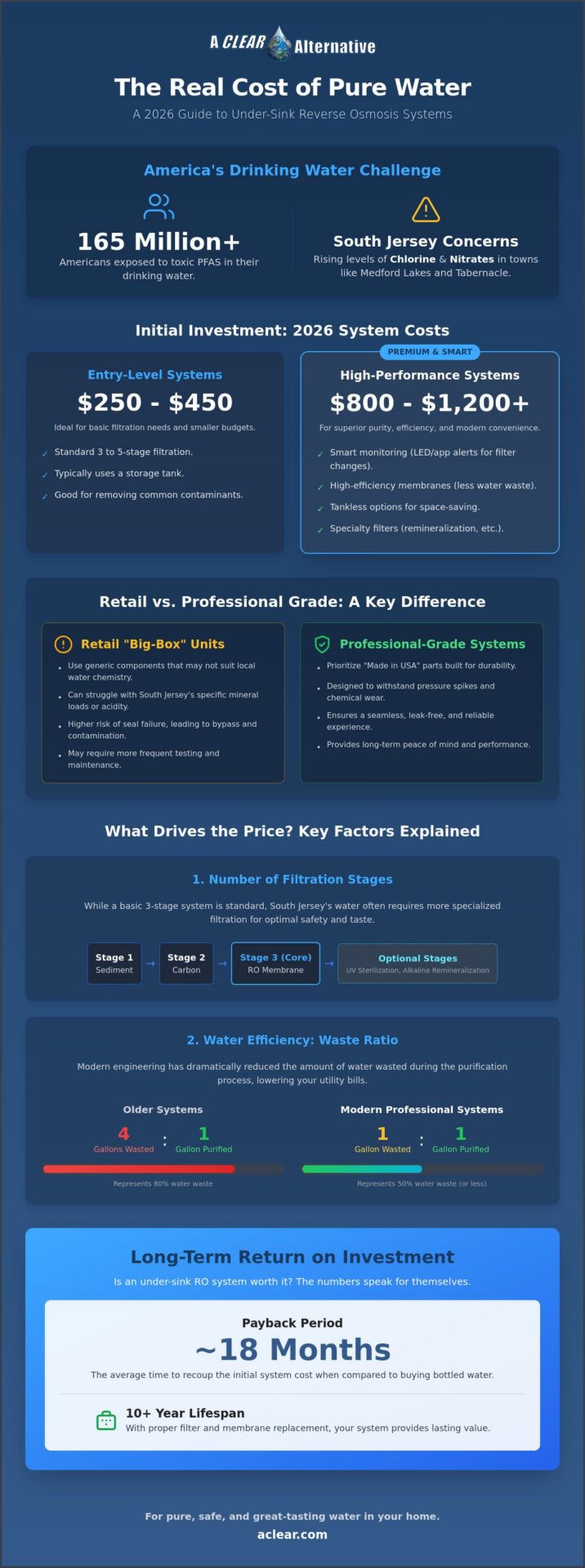
Choosing the right water purification for your home is about balancing your budget with the quality of life you want to achieve. In 2026, the under sink reverse osmosis system cost typically spans from $250 for entry-level models to $1,200 for premium, high-output units. This pricing reflects a major shift toward smarter technology. Today’s systems aren’t just passive filters; they’re intelligent appliances. Many now feature smart-monitoring sensors that track water quality in real time. You won’t have to guess when a filter is spent. A simple LED glow or a notification on your phone tells you exactly when it’s time for maintenance.
The “Total Cost of Ownership” is the most important metric for any homeowner. It’s the sum of the hardware, the initial installation, and the operational costs over the next decade. Reverse osmosis (RO) technology has become significantly more efficient in 2026. Older systems used to waste four gallons of water for every gallon purified. Modern, professional-grade membranes have brought that ratio down toward a 1:1 balance. This efficiency lowers your monthly utility bill and makes the system a much more sustainable choice for your household.
Retail vs. Professional Grade Systems
There’s a massive difference between a $300 “big-box” unit and a $900 professional system. Retail models often rely on generic components that may struggle with the specific mineral load found in South Jersey. Professional systems prioritize “Made in USA” parts. These are built to withstand pressure spikes and the chemical wear common in local plumbing. If you choose the cheapest hardware, you might find yourself needing more frequent well water testing. You’ll need to stay vigilant to ensure those budget seals haven’t failed and allowed contaminants to bypass the membrane. Quality hardware provides a level of discretion and reliability that cheap alternatives simply can’t match.
Standard Tank vs. Tankless RO Costs
Your kitchen’s footprint will likely dictate your choice between a tank and a tankless system. Tankless RO units are incredibly sleek and free up almost your entire under-sink cabinet. However, they usually come with a higher upfront under sink reverse osmosis system cost. Traditional tank systems remain the gold standard for many families in Shamong and Tabernacle. They’re reliable, easy to service, and provide a steady flow of high-pressure water even during power outages. While tankless systems look futuristic, a well-installed tank system offers the robust performance needed to handle the unique water chemistry of our region while staying budget-friendly.
Factors That Drive the Price: Stages, Features, and Efficiency
Price isn’t just a random number. It’s a direct reflection of the technology working behind your cabinet doors to transform your tap water. When you look at the under sink reverse osmosis system cost, you’re essentially paying for three things: the depth of filtration, the efficiency of the process, and the modern “smart” features that make ownership effortless. You deserve a system that doesn’t just work, but fits your lifestyle and aesthetic perfectly. Understanding these drivers helps you decide where to invest for long-term satisfaction and where you might be overpaying for features you don’t actually need.
The Number of Filtration Stages
The core of every system is the “Big Three”: sediment removal, carbon filtration, and the semi-permeable membrane. A basic 3-stage system handles these essentials. However, many South Jersey homeowners opt for 5-stage or even 7-stage configurations. In Medford Lakes, where chlorine levels can hit 1.5 parts per million, extra carbon stages are vital to protect the RO membrane from chemical wear. If you’re on a well in Tabernacle or Shamong, you might consider optional stages like UV sterilization for bacteria or alkaline filters for remineralization. Adding “good” minerals back into the water creates a crisp, refreshing taste that rivals expensive designer bottled brands. If you’re unsure which configuration fits your home, a professional water assessment can pinpoint exactly which stages are necessary for your specific tap.
Water Efficiency and Permeate Pumps
Efficiency is where modern engineering pays for itself over time. Traditional RO systems were often criticized for being “wasteful.” According to the EPA’s guide to RO system efficiency, older models can send up to four gallons of water down the drain for every single gallon produced. In 2026, high-efficiency membranes and permeate pumps have changed the game. These pumps use the energy of the wastewater to boost pressure into the storage tank without using a drop of electricity. This reduces the waste ratio to as low as 1:1. While these high-efficiency components increase the initial under sink reverse osmosis system cost, they significantly lower your monthly utility bills and provide much faster flow at the faucet.
Smart features are the final piece of the pricing puzzle. Modern systems now include WiFi-enabled alerts that sync with your phone to remind you of filter changes. Some even feature integrated leak detection sensors. These sensors provide an incredible sense of security; they can automatically shut off the water supply the moment a drip is detected. This prevents potential damage to your custom kitchen cabinetry, turning your water system into a proactive guardian of your home’s value and your peace of mind.
The South Jersey Factor: How Local Water Quality Affects Cost
Generic price guides often fail South Jersey homeowners because they ignore the raw water chemistry unique to our region. Whether you’re on a municipal line in Medford Lakes or a deep well in Tabernacle, your local water quality dictates your long-term under sink reverse osmosis system cost. If your water has high acidity or heavy mineral loads, a standard off-the-shelf system might fail within months. Investing in a solution tailored to our geography means your system won’t just look good; it will actually survive the specific challenges of the Kirkwood-Cohansey aquifer.
Local testing is the only way to get an accurate quote. In Medford Lakes, chlorine levels have been reported as high as 1.5 parts per million. In Tabernacle, some wells test near the 10mg/L federal limit for nitrates. These aren’t just numbers. They’re factors that determine which contaminants removed by reverse osmosis are your priority, including the PFAS “forever chemicals” that New Jersey now regulates as low as 14 parts per trillion. Without this local data, you’re essentially flying blind with your investment.
Acidic Water and Membrane Erosion
Many South Jersey homes struggle with low pH levels. This acidic water is aggressive. It doesn’t just affect your copper pipes; it can “eat” through the delicate components of a standard RO unit. To protect your equipment, you may need an acid neutralizer as a pre-treatment stage. While this adds to the initial setup, it’s a smart lifestyle choice. We’ve seen Medford Lakes homeowners save $300 annually just by stopping the cycle of replacing eroded membranes every six months. A pH-balancing stage ensures your water is as gentle on your system as it is on your health.
Iron and Sulfur Pre-treatment
If you notice a “rotten egg” odor or orange staining in your sinks, you likely need iron and sulfur filtration before your water even reaches the kitchen. Iron is an RO membrane’s worst enemy. It coats the semi-permeable surface and chokes the flow, leading to a spike in your under sink reverse osmosis system cost through frequent membrane replacements. Integrated pre-filtration ensures your kitchen faucet remains a source of pure, odorless water, preserving both the aesthetic of your fixtures and the longevity of your high-tech filtration system.
Professional Installation vs. DIY: Calculating the Setup Price
Deciding whether to install your own water system or hire a pro is a choice between saving a few dollars today or protecting your home for the next decade. On the surface, a DIY project seems like the most budget-friendly path. You might spend $300 on hardware and another $50 on specialized tools. However, you’ll also need to set aside four to six hours of your weekend. If something goes wrong, like a slow leak behind your custom cabinetry, the true under sink reverse osmosis system cost can skyrocket into thousands of dollars in water damage repairs. A professional installation typically adds between $400 and $800 to your initial investment, but it brings a level of security that a YouTube tutorial simply can’t provide.
Professional setup isn’t just about turning a wrench. It’s about ensuring every connection is airtight and every component is sterilized before the first drop of water reaches your glass. When you hire an expert, you aren’t just paying for labor. You’re paying for a comprehensive warranty and the confidence that comes with 24/7 local support. If a fitting drips at 2 AM, you have a real person to call. This peace of mind is an essential part of the modern, discreet lifestyle that a high-end RO system provides.
What Professional Installation Includes
A master technician handles the high-stakes tasks that make most homeowners nervous. This includes precision drilling through granite, quartz, or marble countertops to mount your dedicated RO faucet without cracking the stone. They also ensure the system is seamlessly integrated with your refrigerator’s ice maker and water dispenser. Beyond the physical connections, a pro performs a full system sterilization and high-pressure testing. This ensures your water is safe from day one and that the system can handle the specific pressure fluctuations of your South Jersey plumbing.
Why Local Service Matters in Tabernacle
The “Amazon Trap” is a real risk for homeowners in our area. It’s easy to find a $200 bargain online, but those systems often lack the robust certifications required by the strict New Jersey plumbing code. Choosing a licensed water treatment company ensures your installation meets all local safety regulations. Local experts also offer long-term service contracts that include pre-scheduled filter changes. This means your system remains a “set it and forget it” luxury rather than a recurring maintenance headache on your to-do list.
Ready to enjoy crystal-clear water without the stress of a DIY project? Contact us for a professional installation quote and let our family-owned team handle the details for you.
Long-Term ROI: Is an Under Sink RO System Worth It?
Investing in your home’s water quality isn’t just about the initial check you write. It’s about the long-term freedom from the grocery store “water run” and the heavy lifting of plastic jugs. When you evaluate the under sink reverse osmosis system cost, you’re looking at a solution that pays for itself while elevating your daily routine. In 2026, the shift away from single-use plastics is more than a trend; it’s a savvy financial move. While bottled water often costs $1.50 per gallon, your RO system produces the same high-quality water for about $0.02 per gallon.
This efficiency extends beyond your drinking glass. Pure water is a guardian for your high-end kitchen appliances. Scale buildup from the hard water common in South Jersey is a leading cause of failure for expensive coffee makers, humidifiers, and steam ovens. By using RO water, you prevent mineral deposits from clogging these machines, effectively extending their lifespan and protecting your investments. It’s a discreet, high-tech upgrade that adds value to your home and your lifestyle every single day.
The 2-Year Payback Period
For a family of four drinking roughly two gallons of water a day, the math is incredibly clear. You’ll consume over 700 gallons of water annually. At bottled water prices, that’s an expense of more than $1,000 per year. Even when you factor in the under sink reverse osmosis system cost for hardware and installation, most systems reach a full “payback” point within 12 to 18 months. For the average New Jersey family, switching to an RO system results in over $600 in annual savings after accounting for all maintenance expenses. You’re not just saving money; you’re reclaiming your time and reducing your environmental footprint.
Maintenance Schedule and Costs
Keeping your water crystal clear requires minimal effort, but consistency is key. To maintain peak performance, you should expect to change your sediment and carbon filters annually. In 2026, high-quality replacement filter sets typically cost between $100 and $250. The RO membrane, which is the heart of the system, generally lasts between three and five years, provided you have the proper pre-treatment for South Jersey’s unique water chemistry.
At A Clear Alternative, we’ve been helping families since 1991 to ensure their systems run perfectly for a decade or more. Scheduling a routine “check-up” with our team takes the guesswork out of maintenance. We handle the pressure testing and sterilization, leaving you with nothing but pure, refreshing water. It’s about creating a worry-free environment where your family’s health and comfort are always the priority.
Start Your Journey to Pure, Effortless Water
Choosing to upgrade your home’s water is a decision that impacts your health, your wallet, and your daily comfort. You now understand that the under sink reverse osmosis system cost is more than just a purchase price; it’s a strategic investment in a lifestyle free from heavy plastic jugs and local contaminants. By accounting for South Jersey’s specific water chemistry and choosing professional-grade hardware, you ensure your system remains a discreet and reliable part of your home for years to come.
Since 1991, our family-owned team at A Clear Alternative has helped neighbors in Tabernacle, Shamong, and Medford Lakes achieve the water quality they deserve. We don’t just install filters; we provide a lifetime of support, including 24/7 emergency care for your peace of mind. You don’t have to navigate technical plumbing codes or worry about potential leaks on your own. Our experts handle every detail so you can simply enjoy the results.
Ready to transform your kitchen into a source of crystal-clear hydration? Get a Professional RO Installation Quote from A Clear Alternative today. You’re one step away from the confidence and freedom that comes with the highest standard of water right at your tap.
Common Questions About Reverse Osmosis Systems
How much does a professional under sink reverse osmosis system installation cost?
Professional installation typically adds between $100 and $500 to your total investment. This range depends on the complexity of your kitchen’s plumbing and your countertop material. Drilling through granite, quartz, or marble requires specialized diamond-tipped tools and expert precision to prevent cracking or damage to your custom surfaces.
Is an under sink RO system cheaper than buying bottled water?
An RO system is significantly more affordable, typically paying for itself within 12 to 18 months. While bottled water costs roughly $1.50 per gallon, your system produces the same quality for about $0.02 per gallon. For a family of four, this transition results in over $600 in annual savings while eliminating the chore of carrying heavy water jugs.
How often do I need to replace the filters in my RO system?
You should plan to replace your sediment and carbon filters once every 12 months to maintain peak performance. The reverse osmosis membrane, which is the heart of the unit, usually lasts between three and five years. Keeping a consistent maintenance schedule ensures your under sink reverse osmosis system cost stays predictable by protecting the more expensive internal components from premature wear.
Will an RO system work with my South Jersey well water?
Reverse osmosis is highly effective for South Jersey wells, though high levels of iron or acidity may require pre-treatment. In towns like Tabernacle and Shamong, minerals can clog a membrane if they aren’t filtered out first. Using an acid neutralizer or water softener alongside your RO system ensures your water stays pure and your equipment lasts for a decade or more.
Does a reverse osmosis system increase my water bill significantly?
Modern high-efficiency systems have a very small impact on your monthly utility bill. Older technology was known for being wasteful, but 2026 models often feature a 1:1 waste ratio. This means for every gallon of purified water you enjoy, only one gallon is used to flush away contaminants, making it a sustainable and budget-friendly choice for your home.
What is the difference between a $200 RO system and a $1,000 system?
The price gap reflects differences in filtration efficiency, component longevity, and smart technology. A $200 budget system often relies on generic parts and higher water waste ratios. A $1,000 premium system offers high-output “Made in USA” membranes, designer faucets, and WiFi-enabled leak detection sensors that provide an extra layer of protection for your cabinetry.
Can I connect my under sink RO system to my refrigerator?
You can absolutely connect your system to your refrigerator’s ice maker and water dispenser. A professional technician can run a discreet line from the under-sink unit directly to your fridge. This setup provides you with crystal-clear ice cubes and chilled water, allowing you to stop buying expensive and less effective refrigerator brand filters.
Does an RO system remove fluoride and lead from my drinking water?
Reverse osmosis technology removes up to 99% of contaminants, including lead, fluoride, and nitrates. It is also one of the most effective ways to filter out PFAS “forever chemicals,” which are strictly regulated in New Jersey. Investing in this technology ensures your under sink reverse osmosis system cost provides a total health shield for your family’s drinking water.