
Troubleshooting Water Softener Problems: The 2026 Homeowner’s Guide
What if your home’s most essential luxury was silently failing you? You’ve noticed the chalky spots on your glassware and that frustrating drop in shower pressure, yet the salt tank looks full. When you start troubleshooting water softener problems, it’s natural to feel concerned that a major, expensive repair is just around the corner. You deserve a home that runs smoothly, where soft water protects your skin and your appliances without constant manual intervention.
It’s incredibly frustrating when your system feels like it’s wasting salt without delivering that silky, soft feeling you expect. This guide is designed to empower you with clarity and restore your confidence in your home’s water quality. We’ll show you how to diagnose exactly what’s happening under the hood, from simple salt bridges to more complex mechanical issues. You’ll learn how to get your system running efficiently again, lowering mineral buildup and ensuring your water remains at a premium level for years to come.
Key Takeaways
- Identify the subtle signs of hard water, like dull skin and spotted glassware, before they compromise your home’s aesthetic.
- Master the art of troubleshooting water softener problems by diagnosing common salt tank issues like hollow salt bridges or mushing.
- Learn to reset your system’s “brain” after power flickers to maintain a seamless, efficient regeneration schedule.
- Discover how to restore low water pressure caused by resin fouling, specifically tailored for the unique demands of South Jersey well water.
- Understand the “24-Hour Rule” to determine when a simple manual fix is enough or if a professional is required to protect your system.
Identifying Common Water Softener Symptoms
Your home’s soft water is a silent partner in your daily beauty and cleaning routines. You notice its absence the moment your skin feels uncomfortably tight after a shower or when your favorite shampoo refuses to create a rich lather. If you’ve begun troubleshooting water softener problems, your first indicators are likely found at the kitchen sink or in the bathroom mirror. To truly diagnose the issue, it’s helpful to understand the fundamentals of the process by exploring What is water softening? and how it protects your plumbing from invisible damage. When the system falters, minerals like calcium and magnesium begin to dominate your water supply again, stripping away the luxury you’ve grown to expect.
Beyond the physical sensations, pay attention to the taste and scent of your tap water. A sudden metallic tang or a “rotten egg” odor can be alarming and often suggests that your filtration media is exhausted or that sulfur is bypassing the system. Another major red flag is a stagnant salt tank. If you haven’t added a new bag of salt in over a month, your system isn’t processing water correctly. A healthy unit should consume salt steadily as it cleans itself and refreshes the resin bed.
Visual and Physical Warning Signs
Take a close look at your laundry basket. Hard water minerals trap soil and detergent in the fibers, leaving your bright colors looking muted and your towels feeling like sandpaper. Your glassware provides another clear signal. If your dishwasher leaves behind stubborn white spots or a cloudy film, the minerals are winning. On glass shower doors, this appears as a hazy etching that won’t wipe away with standard glass cleaner. Hard water breakthrough is a specific failure where the ion exchange process stops completely, allowing raw, mineral-heavy water to flow into your home’s pipes. This isn’t just an aesthetic issue; it’s a sign that your home’s internal systems are at risk of scale buildup that can eventually choke your water flow.
Monitoring System Performance
The control head on top of your tank acts as the brain of your water treatment setup. You should check it periodically to track how often the system enters a regeneration cycle. If the display is blank or the timer is stuck, your soft water schedule is likely compromised by a simple power flicker or a mechanical glitch. You should also keep an eye on the “salt lick” effect. Sometimes the salt forms a hard crust that looks full from the top but is actually hollow underneath, preventing the brine from forming. This is a classic hurdle when troubleshooting water softener problems in modern homes. If your visual checks leave you guessing, investing in professional well water testing provides the hard data you need to confirm if your softener is meeting its performance goals or if the resin needs urgent attention.
Solving Salt Bridges and Brine Tank Issues
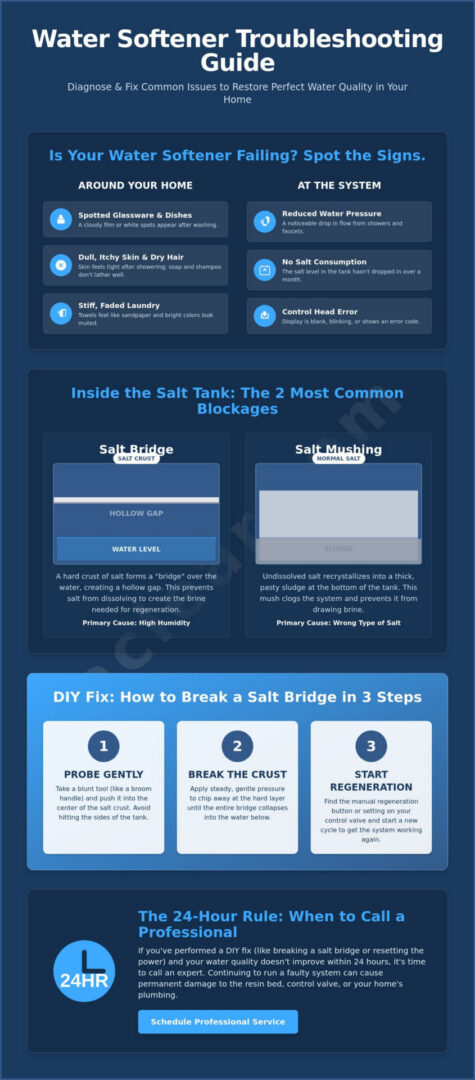
You open your brine tank expecting to see a low salt level, but instead, you find a solid, frozen looking crust that hasn’t moved in weeks. This is the most deceptive hurdle when troubleshooting water softener problems. It’s called a salt bridge. A salt bridge is a “hollow” phenomenon where a hard layer of salt forms across the top of the tank, leaving a cavern of empty space and water underneath. Your system looks full, but the resin isn’t actually being cleaned because the salt isn’t dissolving into the brine solution. In our humid Tri-State climate, this happens more often than you’d think. Salt is naturally hygroscopic, meaning it pulls moisture from the air. In South Jersey summers, that extra humidity acts like a glue, causing salt granules to fuse into a stubborn, impenetrable ceiling.
While a bridge happens at the top, “salt mushing” occurs at the very bottom. This is a thick, pasty sludge of undissolved salt that blocks the intake well. When this happens, your system can’t draw the brine it needs for regeneration. Understanding the environmental impacts of water softeners highlights why fixing these issues is vital. An inefficient system that fails to regenerate properly wastes water and salt, ultimately putting more strain on your local ecosystem. To fix these clogs, you don’t need a heavy hammer or complex machinery. A simple broom handle and a plastic bucket are your best allies.
How to Break a Salt Bridge Safely
- Step 1: Take a blunt tool, like a wooden broom handle, and gently push it into the center of the salt crust. Avoid the sides of the tank to prevent cracking the plastic walls.
- Step 2: Apply steady pressure to chip away at the hard bridge until the entire layer collapses into the water below. You’ll likely hear a satisfying splash as the “cavern” fills.
- Step 3: Use a bucket or a large scoop to remove any thick, mushy “salt sludge” from the bottom of the tank. This ensures the brine well is clear and ready to flow.
Preventing Future Brine Tank Clogs
The easiest way to stop clumping is the “Half-Full Rule.” Never fill your salt tank to the brim. The weight of the salt combined with high humidity creates the perfect environment for bridges to form. Instead, keep your tank between one-third and one-half full. Your choice of salt also matters. While salt crystals are often cheaper, high-quality evaporated pellets are much less likely to mush or bridge because they are processed for uniform solubility. If you want to take the guesswork out of maintenance, a professional salt delivery service ensures you’re always using the right grade of salt without the heavy lifting. Mastering these small habits is the most effective way of troubleshooting water softener problems before they require a professional service call.
Troubleshooting Control Valve and Regeneration Settings
Your water softener’s control valve acts as the command center for your entire home’s water quality. It manages the delicate balance of your water chemistry. It tracks your daily usage and decides exactly when to flush out captured minerals. To understand the underlying mechanics of this process, it’s helpful to review How Water Softeners Work. When you’re troubleshooting water softener problems, the control valve is the first place to look for digital or mechanical hiccups. If this “brain” loses its way, your water quality will plummet almost immediately.
Local residents in Medford and Shamong are no strangers to quick power flickers during storm season. While these blips might only last a second, they can wipe out your softener’s internal timer. If the clock resets to 12:00, your system might start its loud regeneration cycle at 2:00 PM while you’re trying to do laundry, instead of the usual 2:00 AM. If you’ve just fixed a salt bridge or had a house full of guests, your resin bed might be exhausted. You don’t have to wait for the scheduled time. Most modern control heads have a “Regen” button you can hold for a few seconds to force an immediate cleaning. This manual override is a powerful tool when troubleshooting water softener problems caused by sudden high water demand.
Resetting the Timer and Hardness Settings
Check your display for any “E” error codes. These usually indicate a motor jam or a sensor failure. If the screen is blank, ensure the outlet hasn’t tripped a GFI breaker. You should also verify your hardness setting, measured in Grains Per Gallon (GPG). If your water profile has changed, your system might be under-performing because its internal math is wrong. Always set the current time of day accurately. This ensures the regeneration process happens while the house is asleep, preventing hard water from entering your water heater during the cycle.
The Bypass Valve: The Most Overlooked Fix
The bypass valve allows raw water to skip the treatment process entirely. It’s an essential feature for outdoor watering or plumbing repairs, but it’s also the most common “accidental” cause of hard water. Most systems have three positions: Service, Bypass, and Diagnostic. If a technician recently worked on your pipes, they might have left the handles in the bypass position. Ensure the valves are pointed toward the unit to allow water to flow through the resin tank. It’s a simple, zero-cost fix that restores your soft water instantly and ends your search for a mechanical failure that isn’t there.
Fixing Low Water Pressure and Resin Fouling
Sudden drops in water pressure are often blamed on the well pump or old plumbing, but the culprit is frequently hiding inside your water treatment tank. Your resin bed acts as a sophisticated filter. Over time, these tiny beads can become packed with sediment or iron, creating a physical barrier that chokes your home’s water flow. If you’ve noticed your morning shower feels more like a drizzle, troubleshooting water softener problems should start with a look at your system’s internal health. When resin beads reach the end of their 10 to 15 year lifespan, they begin to break down into “fines.” These fragmented pieces of plastic can escape the tank and clog your faucet aerators, further tanking your pressure.
In South Jersey, our ground water presents a unique challenge. In areas like Tabernacle and Shamong, high levels of iron and sulfur are a daily reality. These minerals don’t just pass through; they “foul” the resin by coating each bead in a sticky, metallic film. This prevents the ion exchange process from happening and creates a dense sludge that restricts water passage. You’re not just fighting hard water; you’re fighting the geological makeup of the Tri-State area. Addressing this fouling is a vital part of troubleshooting water softener problems before the damage becomes permanent.
Cleaning the Nozzle and Venturi
The nozzle and venturi assembly is the small but mighty vacuum of your system. It creates the suction necessary to pull brine into the resin tank during regeneration. If this part gets clogged with a single grain of sand or a salt crystal, the entire regeneration cycle fails. You can fix this yourself by unscrewing the cap and cleaning the small plastic parts with warm, soapy water. Avoid using harsh chemicals or wire brushes that could scratch the precision-engineered plastic. If you notice a lingering salty taste in your water after a cycle, it’s a clear sign that a valve is stuck or the venturi isn’t flushing the brine out correctly.
Dealing with Iron Fouling in NJ
If your resin is stained orange from iron, a standard salt regeneration won’t be enough to clean it. You’ll need a specialized resin bed cleaner to strip away the metallic buildup and restore the beads’ capacity. However, if your well water is consistently high in minerals, your softener is likely working overtime. To protect your investment and ensure your water stays crystal clear, consider installing dedicated iron and sulfur filtration systems as a pre-treatment. This modern approach keeps your softener running at peak efficiency, preventing the “rotten egg” smell and orange stains from ever reaching your taps. If your system is over a decade old and cleaning doesn’t restore your pressure, it’s likely time to replace the resin beads entirely to reclaim your home’s water quality.
When to Call a South Jersey Water Specialist
There is a certain pride in mastering the mechanics of your home. However, even the most diligent homeowner reaches a point where troubleshooting water softener problems requires a specialist’s touch. We recommend the “24-Hour Rule.” If you have cleared the salt bridge, cleaned the venturi, and initiated a manual regeneration, but your water still feels hard after 24 hours, it is time to step back. Pushing a system beyond its limits can lead to further damage. Certain components, like the internal seals of a control valve, are precision-engineered. Attempting a DIY repair on these complex parts can accidentally void your manufacturer’s warranty, turning a simple fix into a total system replacement.
Some symptoms are immediate red flags that require professional intervention. If you see standing water around the base of your tank or hear a constant, rhythmic grinding sound coming from the motor, shut off the bypass valve immediately. These are signs of catastrophic mechanical failure or a cracked tank. Residents in Tabernacle, Shamong, and Medford Lakes often face unique water chemistry challenges that standard manuals don’t cover. A local expert understands how the specific mineral content of South Jersey aquifers impacts your equipment over the long term.
The Benefits of Professional Maintenance
Think of a professional service call as a spa day for your water system. An annual tune-up prevents those frustrating emergency failures that always seem to happen right before a holiday gathering. During a visit, we perform a professional water analysis to see if your GPG settings still match your current well conditions. Water quality can shift over time, and your softener needs to evolve with it. Relying on expert water treatment companies gives you the peace of mind that your invisible luxury is being managed by someone who values your home’s aesthetic as much as you do.
Get Your Soft Water Back Today
At A Clear Alternative, we believe that high-quality water is a fundamental part of your lifestyle and self-care. As a family-owned business, our approach is deeply personal. We don’t offer the generic, one-size-fits-all solutions you find with national big-box brands. We provide 24/7 emergency support across the Tri-State area because we know that a water crisis doesn’t follow a schedule. We are here to restore your confidence and your home’s water quality with the latest digital diagnostic tools. Stop troubleshooting water softener problems on your own and let us handle the technical details while you enjoy the results. Schedule a professional water softener inspection today!
Reclaim Your Home’s Pure Water Quality
You now have the tools to identify the subtle shifts in your water quality, from the first sign of spotted glassware to the discovery of a hidden salt bridge. By mastering these initial steps for troubleshooting water softener problems, you are taking active control of your home’s aesthetic and your family’s comfort. Whether it’s a simple timer reset after a local power flicker or cleaning a clogged venturi, your proactive care extends the life of your appliances and keeps your skin feeling its best.
When the manual fixes aren’t enough, you don’t have to navigate complex water chemistry alone. A Clear Alternative has been family-owned since 1991, offering the modern expertise and 24/7 emergency support you need across NJ, PA, NY, and DE. We understand that your time and peace of mind are the ultimate luxuries. Restore your water quality—Contact A Clear Alternative for expert troubleshooting! You are only one step away from returning to the effortless, soft water lifestyle you love. Your home is your sanctuary, and we are here to ensure it stays that way.
Frequently Asked Questions
Why is my water softener full of water?
Your brine tank should only have a few inches of water; if it’s full, you likely have a clogged drain line or a malfunctioning brine valve. This prevents the system from drawing the salt solution needed for cleaning. Check for kinks in the discharge hose or debris in the float assembly. If the water level remains high after a manual cycle, it’s a clear indicator that the suction process has failed.
How often should I clean my brine tank?
Most homeowners should perform a deep clean of the brine tank every 6 to 12 months to maintain peak efficiency. This prevents salt mushing and ensures your treatment system stays hygienic. If you notice a dark ring of sediment or a decrease in water softness, it’s a sign that impurities from the salt have accumulated at the bottom and need to be scrubbed away.
Can a water softener cause low water pressure in the whole house?
A water softener can absolutely cause a whole-house pressure drop if the internal resin bed becomes compacted or fouled with iron. When the beads break down or get coated in minerals, they create a physical barrier that restricts water flow. When troubleshooting water softener problems related to pressure, try switching your bypass valve to the bypass position to see if the pressure returns immediately.
Why does my water softener smell like rotten eggs?
A rotten egg smell usually points to sulfur bacteria trapped within the resin bed or an issue with your water heater’s anode rod. While the softener removes hardness, it can sometimes harbor bacteria if not sanitized regularly. If the smell only occurs with hot water, the softener likely isn’t the culprit, but a full system sanitation can often clear up odors in the cold lines.
What does ‘salt bridging’ look like and how do I fix it?
Salt bridging looks like a solid, dry layer of salt that stays at the same level for weeks, hiding a hollow cavity beneath it. You can fix this by gently breaking the crust with a blunt tool like a broom handle until the salt collapses into the water. Be careful not to puncture the tank walls during the process. Once the bridge is broken, the salt can dissolve properly again.
How do I know if my water softener resin is worn out?
You’ll know your resin is worn out if you see small, sand-like orange particles in your faucet aerators or if your water feels hard shortly after a regeneration cycle. Resin beads typically last between 10 and 15 years depending on your water quality. If troubleshooting water softener problems doesn’t yield results and your system is over a decade old, the resin has likely lost its ion-exchange capacity.
Is it okay to use my water while the softener is regenerating?
You can use water during regeneration, but your system will provide raw, hard water to your home while the cycle is active. Most softeners are programmed to regenerate at 2:00 AM to avoid this inconvenience. Using water while the system is cleaning itself can also draw hard water into your water heater, which leads to long-term scale buildup.
Why is my water softener display flashing an error code?
A flashing error code usually signals a mechanical jam in the control valve or a failure in the electronic sensor. These codes are specific to each manufacturer and often mean the motor can’t move the internal piston to the next cycle position. Try unplugging the unit for 30 seconds to reset the electronic board, but if the code returns, a professional diagnostic is usually required to prevent further damage.