
Troubleshooting Low Water Pressure from Your Shamong Well: The 2026 Homeowner’s Guide
What if that frustrating trickle in your shower isn’t a sign of a dying pump, but a simple “treatment bottleneck” unique to Shamong’s sandy soil? It’s incredibly draining when your morning routine feels like a race against a fading faucet or when your appliances take twice as long to finish a cycle. You deserve a home that works with you, providing the consistent, high-pressure flow that makes daily life feel effortless and premium. We understand that your water quality is about more than just plumbing; it’s about your comfort and your home’s overall health.
If you’re dealing with low water pressure from well Shamong sources, you aren’t alone. With over 400,000 private wells across New Jersey, many homeowners navigate these same hurdles. We’ve designed this 2026 guide to help you reclaim your water’s power and your own peace of mind. You’ll learn how to identify if your issue is a simple filter maintenance task or a more complex mechanical failure. We’ll also explore how the specific mineral makeup of the Pinelands impacts your system’s performance. You’re about to discover how to restore a strong, reliable flow that truly enhances your lifestyle.
Key Takeaways
- Differentiate between PSI and flow rate to understand if your system lacks force or simply can’t keep up with household demand.
- Discover why local issues like sediment buildup or neglected acid neutralizers are often the real culprits behind low water pressure from well Shamong sources.
- Follow a clear DIY troubleshooting checklist to inspect your pressure gauge and switch for common, easy-to-fix mechanical hiccups.
- Learn how upgrading to a modern constant pressure system can eliminate “pressure cycling” and deliver a premium, city-like shower experience.
- Understand why a professional water analysis is the essential first step to identifying hidden “pressure thieves” like underground leaks.
Understanding Low Well Water Pressure in Shamong: PSI vs. Flow Rate
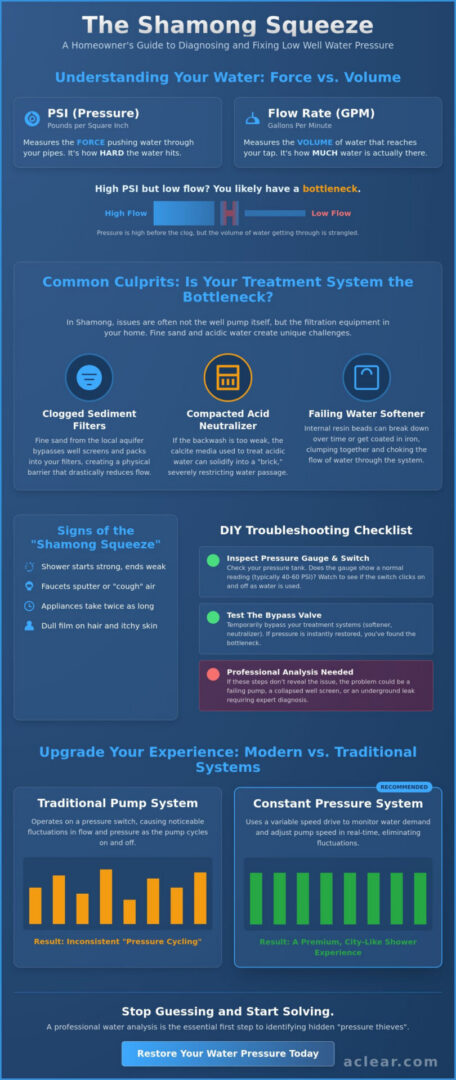
Think of your home’s water system as a high-performance engine. To run smoothly, it needs both force and volume. When you’re diagnosing low water pressure from well Shamong systems, the first step is distinguishing between PSI and flow rate. These two terms are often used interchangeably, but they describe very different parts of your water’s journey. PSI, or Pounds per Square Inch, measures the static force pushing water through your pipes. Flow rate, measured in Gallons Per Minute (GPM), tracks the actual volume of water that reaches your tap. It’s the difference between how hard the water hits and how much of it is actually there.
Many Shamong homeowners feel frustrated when their pressure gauge shows a perfect 50 PSI, yet the kitchen faucet barely produces a stream. This usually happens because a “bottleneck” is restricting the volume. In our local area, the Kirkwood-Cohansey Aquifer plays a major role in your well’s baseline performance. This shallow, sandy aquifer provides a plentiful supply, but that same fine sand can easily bypass basic screens and clog your filtration media. When your filters are packed with silt, you might have plenty of pressure stored in your pressure tank, but the flow rate is strangled before it ever reaches your showerhead.
The Symptoms of the “Shamong Squeeze”
You might be experiencing what we call the “Shamong Squeeze.” This occurs when your shower starts with a strong, satisfying burst but quickly fades into a weak drizzle. It’s a classic sign that your system is relying on stored water but can’t replenish it fast enough. You may also notice sputtering faucets that “cough” air, or appliances like your dishwasher and laundry taking twice as long to cycle. These aren’t just minor annoyances. They are clear signals that your home’s infrastructure is struggling to keep up with your daily rhythm.
The Aesthetic Impact of Low Flow
Low water pressure from well Shamong sources does more than slow down your chores; it affects your self-care. High-performance water is a lifestyle choice that directly impacts your confidence. If your flow rate is too low, soaps and shampoos don’t rinse away completely. This leaves a dull film on your hair and can cause dry, itchy skin. A strong, consistent flow ensures that your detergents work at peak effectiveness, leaving your clothes brighter and your skin feeling refreshed. Restoring your water’s power is about reclaiming the premium experience you expect from your home.
Common Causes of Pressure Loss: Why Your Treatment System Might Be the Culprit
Most homeowners immediately blame the pump when they experience low water pressure from well Shamong sources. It’s a logical guess, but it’s often wrong. In our experience, the problem isn’t usually deep underground. It’s often sitting right in your utility room. Your water treatment equipment is designed to enhance your lifestyle by purifying your flow, but without proper care, these systems can become the very barriers that choke your pressure. Understanding these common causes of pressure loss is the first step toward a high-performance home.
Shamong’s geology presents unique challenges. The fine silt and sand from the Kirkwood-Cohansey aquifer are notorious for slipping past standard well screens. This sediment doesn’t just disappear. It settles into your filter beds and pipe elbows, creating a physical wall. We also see frequent issues with water softeners. When the internal resin beads break down or become coated in iron, they lose their ability to pass water efficiently. Instead of a refreshing, soft flow, you get a struggling stream that makes simple tasks feel like chores.
The Acid Neutralizer Bottleneck
Shamong water is naturally acidic, which is why acid neutralizer systems are so common here. These systems use crushed calcite media to balance your pH levels. However, if the system doesn’t backwash with enough force, that media can compact. Over time, it can solidify into a literal “brick” of stone inside the tank. If your pressure starts strong but vanishes after thirty seconds, your neutralizer might be the bottleneck. You can test this by temporarily turning the bypass valve on the unit. If your flow returns to normal, your system needs professional media service.
Clogged Iron and Sulfur Filters
Iron is a persistent guest in South Jersey wells. When iron bacteria takes hold, it creates a thick, gelatinous slime. This “well gunk” creates massive resistance inside your plumbing. Modern iron and sulfur filtration systems are designed to trap this, but they aren’t “set it and forget it” appliances. When these filters clog, they don’t just stop cleaning; they stop the water entirely. Regular maintenance prevents that “rotten egg” smell from turning into a total loss of flow. If you haven’t had your system checked recently, a quick professional water analysis can pinpoint exactly where the blockage is hiding.
DIY Troubleshooting for Shamong Homeowners: A Step-by-Step Checklist
Dealing with low water pressure from well Shamong sources doesn’t always require a professional service call. Sometimes, the solution is right in front of you. Before you worry about major mechanical failures, take a few minutes to walk through this checklist. Many common causes of low water pressure are simple maintenance issues that you can identify yourself. Reclaiming your home’s water flow starts with understanding your system’s basic heartbeat. You’ve got the power to diagnose these issues and restore the comfort your household deserves.
- Step 1: Check the Pressure Gauge. Locate the dial near your pressure tank. It should typically read between 30-50 or 40-60 PSI. If the needle stays below 30 even when water is running, your pump isn’t kicking in as it should.
- Step 2: Inspect the Pressure Switch. This is the small gray box near the tank. Look for burnt contacts or debris like spider webs or insects. These tiny intrusions can block the electrical connection and stall your system.
- Step 3: Test the Tank Air Bladder. Give the top of your tank a firm knock. It should sound hollow. If it sounds “thuddy” or full of water, your air bladder might have failed.
- Step 4: Check the “Whole House” Filter. This is the most common five-minute fix. If your sediment filter looks dark brown or black, swap it out. A fresh filter can instantly transform a weak trickle into a powerful stream.
- Step 5: Bypass Your Treatment. Move the valves on your softener or neutralizer to the “bypass” position. If your pressure returns immediately, you’ve successfully isolated the clog to your treatment equipment.
Testing Your Pressure Tank Health
Your tank is the lungs of your system. If your pump cycles on and off every time you crack a tap, your tank is likely “waterlogged.” This means the internal air bladder has lost its charge or ruptured. To check the pre-charge, turn off the power and drain the system completely. Use a standard tire gauge on the air valve. It should read exactly 2 PSI below your pump’s “cut-in” pressure. Ignoring a failed tank will eventually burn out your pump. Keeping this component healthy ensures your water feels strong and consistent every day.
Pressure Switch Basics
The pressure switch is the brain that tells your pump when to work. Safety is paramount here. Never remove the cover or touch the internal springs without turning off the breaker first. You’re looking for clean, silver-colored metal contacts. If they look pitted or black, they aren’t making a good connection. Sometimes, a tiny adjustment to the springs can temporarily boost your flow. However, a failing switch usually needs a modern replacement to maintain that city-like pressure you desire. A clean, responsive switch is essential for a high-performance home.
Modern Solutions: Constant Pressure Systems vs. Traditional Pumps
Traditional well pumps operate on a simple, binary cycle. They kick on at a low point and shut off at a high point. This leads to “pressure cycling,” a phenomenon where your water starts strong and then noticeably weakens before the pump restarts. It’s a relic of older technology that doesn’t fit the modern, high-performance home. If you’re tired of fluctuating flow, upgrading to a constant pressure system is the most effective way to eliminate low water pressure from well Shamong sources. This upgrade isn’t just a technical fix; it’s a commitment to a better daily experience.
Evaluating your well’s performance is about more than just checking for a pulse. We look at whether your well is actually running dry or if it’s just a “slow recoverer.” Modern controllers can often bridge the gap between a struggling well and a luxury lifestyle. These systems are also significantly more energy efficient. By only running the pump as fast as needed, you’ll see a noticeable reduction in the wear and tear on your electrical components and a lower monthly utility bill.
The Magic of VFD (Variable Frequency Drive)
A Variable Frequency Drive (VFD) acts as the brain of your water system. Instead of the “all or nothing” approach of traditional pumps, a VFD adjusts the pump’s motor speed in real-time based on your actual usage. If you’re just rinsing a glass, the pump hums along at a low speed. When you turn on the master shower and the laundry simultaneously, the controller instantly ramps up the speed to maintain the exact PSI you’ve set. It’s seamless, quiet, and incredibly reliable.
This technology is the “gold standard” for whole house water filtration systems. High-end filtration requires a steady, predictable flow to ensure every drop of water is perfectly purified. Beyond the luxury of city-like pressure, VFDs also protect your home’s infrastructure. Steady pressure reduces the “water hammer” effect, which can rattle pipes and shorten the lifespan of your appliances. It’s a smarter way to power your home that prioritizes both comfort and longevity.
Storage Tanks for Low-Yield Wells
Sometimes, the issue isn’t the pump; it’s the well itself. If your well has a low yield, it simply can’t keep up with peak demand. While some might suggest drilling a new, deeper well, there’s often a more elegant solution. An atmospheric storage tank and booster pump system allows your well to slowly fill a large reservoir during off-peak hours. When your family needs water, you have hundreds of gallons of pressurized water ready to go, regardless of how slow the well is recovering.
This approach is often more cost-effective and reliable than gambling on a new 300-foot well. For Shamong residents navigating dry spells or slow-recovery wells, smart water management provides total peace of mind. You get the freedom of high-pressure water without the massive disruption of a drilling rig in your yard. It’s about working with what you have to achieve the results you want.
Ready to transform your water experience and enjoy consistent flow? Schedule your free water analysis with A Clear Alternative to find the perfect modern solution for your Shamong home.
Expert Support in Burlington County: When to Call A Clear Alternative
Sometimes, even the best DIY efforts can’t solve the mystery of low water pressure from well Shamong sources. When your troubleshooting checklist doesn’t yield results, it’s time to bring in a partner who understands the local landscape. We don’t believe in guesswork or selling you a pump you don’t need. Every solution we provide starts with comprehensive well water testing. This data-driven approach ensures we identify the root cause, whether it’s a chemistry issue in your filtration media or a mechanical failure deep in the well.
There are also “invisible” pressure thieves that only a professional can track down. An underground leak between your well and your home can bleed off pressure before it ever reaches your taps. We use specialized diagnostic tools to monitor your system’s performance and find these hidden leaks without tearing up your yard. Since 1991, our family-owned team has been serving the Shamong and Tabernacle communities. We know the unique challenges of the Kirkwood-Cohansey aquifer because we live and work here too. This local expertise is what allows us to deliver a premium, worry-free experience for your home.
Emergency Potable Water Delivery
If your well fails completely, the stress can be overwhelming. We offer a unique safety net that most plumbing companies simply can’t match: emergency bulk water delivery. We can provide potable water to keep your home running, filling cisterns or temporary storage tanks while we complete your repairs. This means your family can still bathe and use the kitchen while you wait for a part or a pump replacement. It’s about more than just fixing a pipe; it’s about ensuring your life doesn’t stop just because your well did.
Long-Term Maintenance Plans
The best way to handle low water pressure from well Shamong systems is to prevent it from happening in the first place. Our preventative maintenance plans are designed to keep your water treatment systems running at peak efficiency. We perform annual well inspections to monitor pump health and check the amp draw of your motor. This “early warning system” allows us to catch minor issues before they turn into major, expensive emergencies. You deserve the confidence that comes with a high-performance water system that works perfectly every single day.
Don’t settle for a weak trickle when you could have a powerful, refreshing flow. Schedule a pressure evaluation with A Clear Alternative today and reclaim the lifestyle you deserve.
Reclaim Your Home’s High-Performance Flow
You don’t have to settle for a weak trickle that disrupts your daily rhythm and self-care. Reclaiming your home’s water power starts with understanding the vital difference between force and volume. Whether your struggle is caused by a compacted acid neutralizer or a failing pressure tank, the path to a premium lifestyle is clearer than ever. By modernizing your system with constant pressure technology, you can enjoy consistent, city-like flow that enhances every shower. This isn’t just about plumbing; it’s about the comfort and confidence you feel in your own space.
If you’re tired of dealing with low water pressure from well Shamong sources, we are ready to assist. A Clear Alternative has been serving the Shamong, Tabernacle, and Medford Lakes communities since 1991. We bring decades of local expertise to every project, offering 24/7 emergency support and licensed potable water hauling to ensure you’re never left stranded. You deserve a water system that matches the quality of your home.
Restore Your Water Pressure – Contact Our Shamong Well Experts
Believe in the potential of your home’s infrastructure. A more powerful, refreshing flow is just a professional evaluation away.
Frequently Asked Questions
Is it normal for well water pressure to drop when two showers are running?
While this is common in traditional well systems, it isn’t an ideal standard for a modern home. This drop happens because your pump can only deliver a fixed amount of water at once. If your flow rate can’t meet the demand of multiple taps, the pressure will plummet. Upgrading to a constant pressure system solves this by automatically adjusting the pump speed to maintain steady PSI regardless of how many showers are running.
Can a clogged water softener cause low water pressure throughout the house?
Yes, a malfunctioning water softener is a frequent cause of low water pressure from well Shamong sources. If the internal resin beads become fouled with iron or sediment from the local aquifer, they create a physical blockage. You can easily verify this by switching your softener to the “bypass” position. If your water flow improves instantly, your softener needs professional cleaning or a resin bed replacement.
How much does it cost to fix low water pressure in a Shamong well home?
The investment required to restore your flow depends entirely on the root cause of the issue. A simple sediment filter change is very affordable, while replacing a deep submersible pump or installing a modern constant pressure system involves a higher cost. Because every well in Burlington County is unique, we recommend starting with a professional analysis to identify the most cost-effective solution for your specific infrastructure.
How do I know if my well pump is failing or if it’s just a pressure switch issue?
A failing pump often causes a total loss of water or visible surging, while a pressure switch issue usually prevents the pump from starting at all. If you hear your pump clicking but no water flows, or if the electrical contacts inside the gray switch box look burnt or pitted, it’s likely a switch problem. We can test the electrical draw of your pump to confirm its health before you commit to a replacement.
What is the ideal PSI setting for a residential well water system?
Most residential well systems are designed to operate between 40 and 60 PSI. This range provides enough force for high-performance showers and modern appliances without putting excessive strain on your plumbing joints or filtration media. If your gauge consistently reads below 40 PSI during use, it’s a clear signal that your system is struggling with a bottleneck or a mechanical failure that needs attention.
Can acidic water in Shamong actually damage my well pump and pressure tank?
Yes, the high acidity levels common in the Pinelands can be very aggressive toward your home’s infrastructure. Over time, acidic water corrodes metal components, leading to pinhole leaks in your pressure tank and damaging the internal seals of your pump. Using an acid neutralizer protects your investment and ensures your water remains safe and gentle on your plumbing fixtures and your skin.
Does A Clear Alternative offer emergency water if my well stops working entirely?
Yes, we are a licensed potable water hauler and provide emergency bulk water delivery to homeowners in Shamong and the surrounding areas. If your well goes dry or fails, we can fill your storage tanks or cisterns to keep your household running while we perform repairs. This service provides essential peace of mind, ensuring your family has access to water even during a total system failure.
How often should I have my well and filtration system serviced in South Jersey?
We recommend an annual inspection for your well pump and a semi-annual check for your filtration equipment. The unique chemistry of South Jersey water, including high iron and sediment, can lead to rapid buildup in your pipes and filters. Regular maintenance is the best way to prevent low water pressure from well Shamong sources and extend the overall lifespan of your expensive mechanical components.