
Testing Well Water for Iron and Sulfur: 2026 Guide
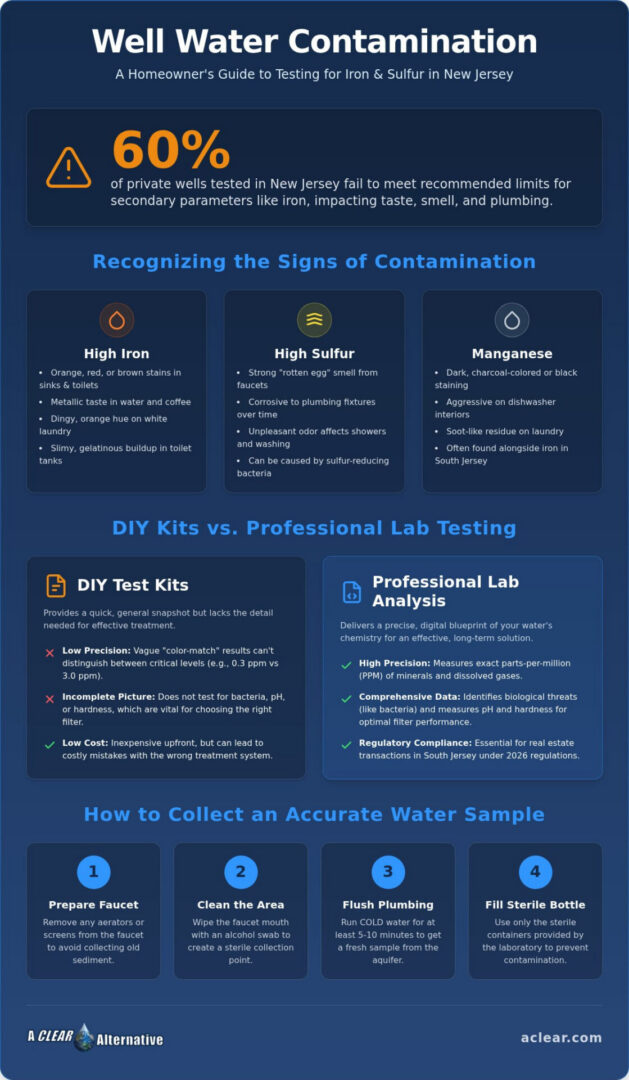
Did you know that nearly 60% of private wells tested in New Jersey fail to meet recommended limits for secondary parameters like iron? It’s a staggering figure, especially when you’re the one dealing with orange-stained porcelain or that embarrassing rotten egg smell every time a guest visits your home in Shamong or Tabernacle. You deserve a living space that feels fresh and sophisticated, not one where you’re constantly battling rust streaks in the laundry or metallic-tasting coffee.
We understand the confusion that comes with choosing between a cheap hardware store kit and a professional analysis. That’s why we’ve created this guide to help you master the process of testing well water for iron and sulfur. Our goal is to replace your frustration with a clear, actionable blueprint for restoration. We’ll explore the latest 2026 New Jersey standards, compare the reliability of various testing methods, and preview the modern filtration technologies that can finally return clarity and comfort to your daily routine.
Key Takeaways
- Identify the specific visual and olfactory triggers, like metallic streaks and sulfur odors, that signal a need for immediate water quality intervention.
- Learn why professional laboratory testing well water for iron and sulfur is essential for obtaining the precise parts-per-million data that DIY kits simply can’t provide.
- Understand the critical relationship between pH levels and mineral removal to ensure your filtration equipment operates at peak efficiency.
- Navigate the 2026 New Jersey regulatory landscape, including mandatory testing requirements for real estate transactions in South Jersey.
- Compare advanced air-injection and filtration technologies to choose a discreet, high-performance system that restores your home’s water clarity.
Recognizing the Signs of Iron and Sulfur in Your Well Water
Living with well water shouldn’t feel like a constant compromise on your lifestyle or home’s aesthetic. If you’ve noticed a sharp, “rotten egg” smell when you turn on the shower, you’re likely dealing with hydrogen sulfide gas. It’s more than just a nuisance; it’s an aesthetic dealbreaker that affects how you feel in your own space. This gas can be corrosive to your plumbing over time, and it certainly ruins the atmosphere when you’re hosting guests. Beyond the scent, your morning coffee might taste like pennies, and your white linens could come out of the wash with a dingy, orange hue that no amount of bleach seems to fix.
Identifying these sensory red flags is the first step toward testing well water for iron and sulfur to reclaim your home’s clarity. You might also spot physical evidence in the form of orange, red, or brown streaks in your toilets and sinks. Sometimes, you’ll find a gelatinous, “slimy” buildup inside your toilet tank or around your faucet aerators. This is often caused by iron-oxidizing bacteria. These organisms thrive in iron-rich environments, creating a biofilm that can clog pipes and reduce the efficiency of your water-using appliances.
Clear Water Iron vs. Red Water Iron
Not all iron looks the same at the tap, which often leads to confusion during a visual inspection. Ferrous iron, commonly called “clear water iron,” is a master of disguise. It looks perfectly clear when you pour a glass, but once it hits the air and oxidizes, it turns into those stubborn orange stains. Ferric iron, or “red water iron,” is already oxidized. It comes out of the faucet looking like rusty tea. Because these two forms exist in different chemical states, they require distinct testing approaches and specialized filtration strategies to resolve effectively. A solution that works for one might fail completely for the other.
The Nuisance of Manganese
Iron rarely travels alone. In the Kirkwood-Cohansey aquifer and other South Jersey water sources, manganese is a frequent, unwanted companion. While iron leaves orange streaks, manganese is responsible for dark, charcoal-colored or black staining. It’s particularly aggressive on dishwasher interiors and delicate laundry. Testing for manganese is a vital part of a comprehensive water profile. Without addressing it, you might fix the orange stains only to be left with black, soot-like residue that continues to degrade your plumbing longevity and appliance performance. We look at the whole picture to ensure your water is truly pristine.
DIY Kits vs. Professional Lab Testing: Which Is Best?
When you’re standing in the plumbing aisle of a big-box store, those $20 DIY test kits look like an easy win. These “color-match” strips provide a quick snapshot of your water quality, but they often leave you with more questions than answers. A slight shade of pink or orange on a paper strip won’t tell you the exact concentration of minerals in your pipes. For homeowners in South Jersey, relying on a vague visual estimate is a gamble. You need to know if your iron level is 0.3 ppm or 3.0 ppm. The difference between those two numbers determines whether you need a simple softener or a robust filtration system. Following EPA well water testing guidelines ensures you aren’t just guessing about your home’s health and comfort.
How to Properly Collect a Water Sample
Accuracy begins at the source. Before you fill a sample bottle, remove any aerators or screens from your faucet. These components can harbor old sediment or biofilm that will contaminate your reading. Clean the faucet mouth with an alcohol wipe to ensure a sterile environment. Run the cold water for at least five to ten minutes. This step is vital because it flushes the standing water out of your household plumbing, allowing you to capture a “fresh” sample directly from the aquifer. Always use the sterile containers provided by your lab. If you’re looking for a stress-free experience, our professional well water testing service handles every detail of this collection process for you.
What a Professional Test Uncovers
A certified laboratory analysis provides a digital blueprint of your water’s chemistry. While a strip might indicate “high sulfur,” a professional report measures the exact parts per million of dissolved gases. It also identifies the presence of specific biological threats, such as sulfur-reducing bacteria. These organisms require a completely different treatment approach than simple dissolved gas. Beyond the primary minerals, a lab test establishes a baseline for pH, hardness, and total dissolved solids. This is the most critical part of testing well water for iron and sulfur. Without knowing your pH level, even the most expensive iron filter might fail to trigger the necessary chemical reaction to clean your water. Precision testing replaces trial and error with a guaranteed path to clarity.
Interpreting Your Results: The Role of pH and Hardness
Receiving your lab report is a pivotal moment, but the raw data requires a professional eye to translate into a clear plan of action. One of the most critical figures to look for is the Saturation Index. This value predicts whether your water is corrosive, which can damage your plumbing and leach metals from your pipes, or scale-forming, which leaves unsightly white deposits on your high-end fixtures. While many homeowners focus solely on the iron count, the relationship between hardness and mineral content is equally vital. A standard water softener can sometimes manage trace amounts of iron if the water is sufficiently hard, but it isn’t a substitute for dedicated filtration when concentrations are high. Precision in testing well water for iron and sulfur allows us to determine if your current equipment is being overwhelmed or if a more specialized solution is necessary to protect your home’s infrastructure.
The Critical Link Between pH and Iron
Most advanced filtration systems rely on a process called oxidation to turn dissolved iron into a solid particle that can be physically trapped and removed. This chemical reaction is highly dependent on your water’s pH level. For oxidation to occur efficiently, your water typically needs a neutral pH of 7.0 or higher. If your test results show a pH below 7.0, your water is acidic. In this environment, iron remains stubbornly dissolved and can pass right through a filter. This is why we often recommend installing an acid neutralizer as a foundational step. By balancing your water’s chemistry first, we create the ideal conditions for iron removal, ensuring your investment in filtration actually delivers the crystal-clear results you expect. We focus on balancing the entire chemical profile to provide a sustainable, long-term solution.
Sulfur and Bacteria Levels
When analyzing sulfur issues, your report might include a measurement of “Colony Forming Units” (CFU). This number helps us interpret the concentration of bacteria present in your well. While CDC recommendations for well testing emphasize the importance of checking for harmful pathogens, it’s also necessary to identify nuisance organisms like sulfur-reducing bacteria. These aren’t typically a health hazard, but they are the primary culprits behind that aggressive “rotten egg” odor. The specific gas levels and bacterial counts found during testing well water for iron and sulfur dictate the technology required for your home. A mild scent might be resolved with carbon filtration, whereas high concentrations often require sophisticated air-injection systems. Understanding these nuances ensures you aren’t overspending on unnecessary equipment or, conversely, installing a system that is too small to handle the job.
South Jersey Well Water: Local Challenges in 2026
Living in the Pinelands offers a unique aesthetic, but the Kirkwood-Cohansey aquifer system presents specific challenges for homeowners. This water source is famous for its “Pinelands profile”: naturally acidic, soft, and heavily laden with iron. While soft water is usually a luxury, here it often pairs with low pH levels that make mineral staining even more aggressive. You might notice that sulfur odors intensify during seasonal shifts, particularly when heavy rains or drought conditions alter the groundwater table. Understanding these local nuances is the key to successfully testing well water for iron and sulfur in our region. In fact, historical data shows that approximately 59% of wells tested under state programs exceeded recommended limits for pH, iron, or manganese.
Specific Issues in Tabernacle and Shamong
In areas like Tabernacle and Shamong, many properties rely on shallow wells that are particularly vulnerable to surface-level iron contamination. These wells react quickly to environmental changes, meaning your water quality can shift after a heavy storm. Contrast this with the deeper wells often found in Medford Lakes, where hydrogen sulfide gas is a more common culprit for that “rotten egg” smell. We’ve seen great success in Medford Lakes by using modern air-injection systems to strip away these gases. Whether your issue is surface-level staining or deep-well odors, a localized approach is essential for a permanent fix. You don’t have to settle for orange fixtures or smelly water just because of your zip code.
NJ Private Well Testing Act (PWTA) Standards
If you’re buying or selling a home in South Jersey, the Private Well Testing Act (PWTA) is a mandatory part of your journey. New Jersey law requires specific well water testing during real estate transactions. The state sets a secondary standard of 0.3 mg/L for iron, a level where staining and metallic tastes become undeniable. As of 2026, these standards prioritize aesthetic contaminants because they directly impact a home’s market value. A well that fails for iron isn’t just a daily annoyance; it’s a hurdle for your closing. Staying compliant doesn’t have to be a headache. By proactively addressing these mineral levels, you protect your property value and your family’s quality of life simultaneously.
Ready to ensure your home sale stays on track with a certified analysis? Book your professional PWTA water test today to meet every state requirement with confidence.
From Testing to Treatment: Choosing the Right System
Once you’ve completed the process of testing well water for iron and sulfur, you finally have the blueprint needed to fix your water for good. Think of your lab results as a custom prescription for your home. While many people hope a standard water softener will solve every issue, these systems are primarily designed to handle calcium and magnesium. When faced with high iron levels, a softener can quickly become “iron fouled,” leading to reduced water pressure and expensive internal damage. For a truly pristine result, you need a system that targets the specific chemical state of your minerals. Transitioning from a state of frustration to one of total confidence means selecting equipment that aligns with your 2026 lifestyle: discreet, efficient, and highly effective.
Advanced Filtration Technologies
Modern iron and sulfur filtration systems utilize sophisticated media like Birm or manganese greensand to act as a catalyst. These materials trap oxidized particles, ensuring they never reach your faucet. For those battling the aggressive “rotten egg” smell of sulfur, air-injection systems offer a clean, chemical-free solution by using oxygen to strip away gas. If your sulfur levels are exceptionally high, we might suggest ozone or peroxide injection for maximum odor elimination. The best part? Modern smart valves handle the backwashing and media regeneration cycles automatically. It’s a “set it and forget it” experience that fits perfectly into a busy, modern schedule while keeping your water crystal clear and fresh.
Why Professional Installation Matters
Choosing the right technology is only half the battle; the installation determines how well that technology performs in your specific home. A professional setup ensures that your drainage lines are sized correctly and that your home’s flow rate can support the necessary backwashing cycles. DIY attempts often lead to significant pressure drops or systems that fail to regenerate properly, leaving you right back where you started with stained fixtures. We focus on the fine details, from plumbing aesthetics to long-term system longevity. You’ve already taken the most important step by testing well water for iron and sulfur. Now, let us help you finish the journey with a system that restores your peace of mind and your home’s brilliance. Ready for clear water? Schedule your professional water analysis today.
Restore Your Home’s Clarity and Comfort
You don’t have to tolerate the sulfur odors or metallic stains that have been clouding your daily routine. Mastering the process of testing well water for iron and sulfur is the most important step toward reclaiming a lifestyle defined by freshness and ease. By moving beyond hardware store guesses and embracing a professional, lab-grade blueprint, you ensure that every drop of water in your home meets the high standards you deserve. Successful filtration depends on balancing your water’s unique chemistry, particularly in the acidic environments of South Jersey’s aquifers.
Since 1991, our family-owned team has specialized in custom-engineered iron and sulfur filtration solutions that fit your modern home perfectly. We understand the local challenges from Medford Lakes to Tabernacle and offer 24/7 emergency support to ensure your system never skips a beat. It’s time to stop worrying about stained porcelain and start enjoying the crystal-clear water you’ve been waiting for. Get a Professional Water Analysis from A Clear Alternative today and experience the difference that expert care makes. You’re just one precise test away from a more confident, refreshing home environment.
Frequently Asked Questions
Is iron in well water a health risk?
Iron is classified as a secondary contaminant by the EPA, meaning it primarily impacts the aesthetic quality of your water rather than posing a direct health threat. The New Jersey recommended limit is 0.3 mg/L to prevent metallic tastes and orange staining. While it isn’t typically harmful to ingest, high iron levels can promote the growth of bacteria that clog plumbing and ruin water-using appliances over time.
Why does my water smell like sulfur only when I run the hot water?
If the “rotten egg” odor is exclusive to your hot water, the issue likely resides in your water heater rather than the well. A magnesium anode rod in the tank can react with sulfates to produce hydrogen sulfide gas. Replacing this with a powered or aluminum rod often fixes the problem. However, if the smell is present in cold water too, testing well water for iron and sulfur is essential to find the source.
How often should I test my well water for iron and sulfur?
You should test your well water at least once a year for basic minerals and bacteria to ensure consistent quality. Immediate testing is also recommended if you notice new staining, a change in taste, or a sudden onset of odors. In New Jersey, the Private Well Testing Act mandates this analysis during home sales, but regular monitoring helps you protect your home’s fixtures and appliances from long-term mineral damage.
Can a standard water softener remove sulfur smells?
No, a traditional water softener is designed to remove hardness minerals like calcium and magnesium, not dissolved gases. While softeners can handle very low levels of clear water iron, they are ineffective against the hydrogen sulfide gas that causes sulfur odors. Eliminating that pungent smell requires specialized technology, such as air-injection systems or carbon filtration, which are specifically engineered to strip gases from your water supply.
What is the most effective way to remove iron bacteria?
The most reliable method involves a professional shock chlorination treatment followed by the installation of a specialized iron filter. Shocking the well kills the existing bacterial colonies, while a dedicated filtration system prevents the “slimy” biofilm from rebuilding in your pipes. Because these bacteria are particularly stubborn, a system with a strong backwashing cycle is necessary to keep the filter media clean and ensure your water remains pristine and clear.
Will iron and sulfur staining affect my home’s resale value?
Yes, visible orange streaks and foul odors can significantly deter potential buyers and lower your home’s perceived value. Aesthetic issues are often viewed as signs of a problematic well system. In New Jersey, testing well water for iron and sulfur is a standard part of the real estate process. Proactively resolving these issues ensures your home shows beautifully and prevents water quality from becoming a major hurdle during price negotiations or closing.
How much does professional well water testing cost in South Jersey?
While we provide tailored quotes for our services, 2026 industry data shows that basic mail-in lab kits generally range from $120 to $200. A comprehensive, state-certified laboratory panel typically costs between $199 and $400. Choosing a professional local analysis provides you with the most accurate data for South Jersey’s specific geological conditions, allowing for a more precise and effective treatment plan for your home’s unique water profile.
Can I use bleach to get rid of the sulfur smell in my well?
Bleach is used during the shock chlorination process to temporarily disinfect a well, but it isn’t a permanent solution for sulfur gas. While it may kill odor-producing bacteria for a few weeks, the smell usually returns as fresh water moves through the aquifer. For a sophisticated, long-term solution that doesn’t require constant chemical maintenance, an air-injection filtration system is a much more effective way to ensure your water stays odor-free.