
Professional Well Water Testing Near Me: Tabernacle, Shamong, and Medford Lakes, NJ
Last Wednesday, a Medford Lakes resident discovered a stubborn blue-green stain in their porcelain sink that scrubbing simply couldn’t touch. It’s a common story across Tabernacle and Shamong, where the unique South Jersey geology can turn your tap water into a source of stress rather than refreshment. You’ve likely felt that same frustration when catching a whiff of a rotten egg smell or worrying if your home meets the strict NJ Private Well Testing Act requirements for a real estate closing. Searching for reliable well water testing near me shouldn’t feel like a chore or a cold medical appointment.
While our focus is ensuring purity for local homes, it’s a valuable reminder that access to safe water is a critical issue for many communities globally. Organizations such as Global Fund for Assistance Inc. are dedicated to providing this essential resource as part of their humanitarian relief efforts.
We agree that your home’s water should be a source of health and vitality, not a list of scary, unanswered questions. You deserve to know exactly what’s flowing through your pipes without getting lost in complex laboratory jargon. Our local expert testing and certified analysis provide a clear, digital map of your water quality tailored to our specific region. You’ll learn how to transform confusing data into an actionable plan that restores your confidence and protects your family’s modern lifestyle.
Key Takeaways
- Understand how the unique South Jersey Pinelands geology affects your plumbing and why acidic soil often leads to costly pinhole leaks in copper pipes.
- Identify the specific biological and chemical contaminants, such as E. coli and nitrates, that pose the greatest risks to your family’s long-term health.
- Discover the critical accuracy gap between basic DIY home kits and professional well water testing near me using certified laboratory standards.
- Navigate the requirements of the NJ Private Well Testing Act (PWTA) to ensure a smooth, compliant real estate transaction in Burlington and Camden Counties.
- Learn how to transform complex lab data into a clear, customized filtration plan designed specifically for the unique water chemistry of your local well.
Why Well Water Testing is Critical in Tabernacle, Shamong, and Medford Lakes
Living in the heart of the Pine Barrens brings a unique lifestyle that you won’t find anywhere else in New Jersey. Your home likely relies on the Kirkwood-Cohansey aquifer, a massive underground water source that defines the region. While the Pinelands offer incredible natural beauty, the specific geology of South Jersey creates challenges for private well owners. You deserve to know exactly what is coming out of your kitchen tap. Regular testing isn’t just a chore; it’s a vital part of maintaining your home’s value and your family’s long-term health.
The Impact of South Jersey Geology on Your Water
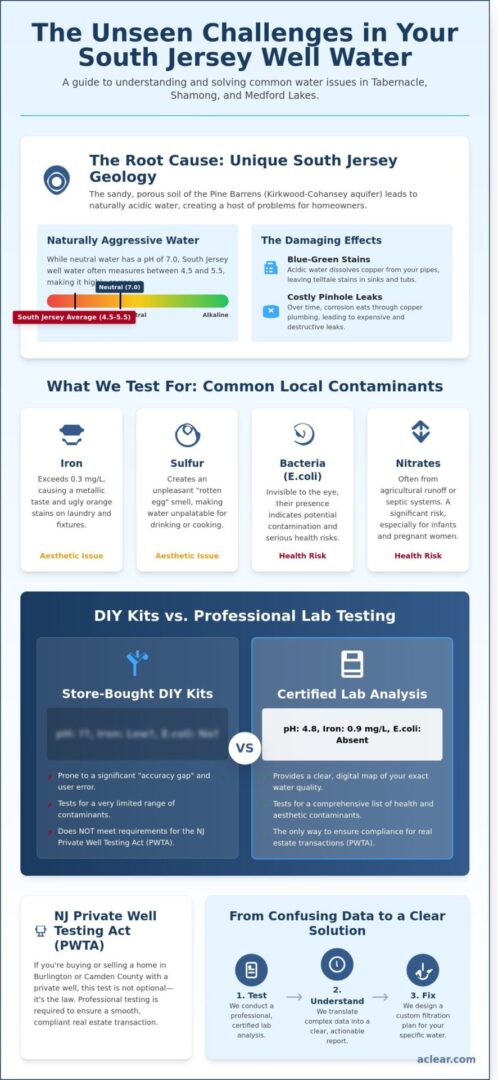
The sandy, porous soil in Tabernacle and Shamong acts differently than the clay found in northern parts of the state. It doesn’t filter out certain minerals effectively, and it’s naturally high in organic matter. This environment leads to extremely low pH levels, often registering between 4.5 and 5.5 on a standard scale. In South Jersey, the same soil that gives the Pinelands its character also makes your well water naturally acidic and aggressive toward plumbing.
When your water is this acidic, it acts as a solvent. It slowly eats away at copper pipes, leading to the “pinhole leaks” that plague many Medford Lakes homeowners. If you see blue or green stains in your bathtub, your plumbing is literally dissolving from the inside out. Beyond acidity, wells in this area frequently deal with iron concentrations exceeding 0.3 mg/L. This causes that familiar metallic taste and orange staining on your laundry and fixtures. While iron is often considered a nuisance, high levels of manganese and sulfur also contribute to poor water quality that can make daily life frustrating.
Because the EPA doesn’t regulate private wells, the responsibility for safety falls entirely on you. Following standardized water testing procedures is the only way to identify invisible threats like nitrates or coliform bacteria. When you search for well water testing near me, you’re taking the first step toward ensuring your water is as clear and safe as it looks.
When Should You Schedule a Water Test?
You should schedule a professional lab analysis at least once every 12 months. Bacteria and nitrates can seep into the groundwater without changing the taste or smell of your water. However, certain “trigger events” require immediate action. If you experience heavy local flooding within 20 feet of your well head, or if there’s significant construction nearby, your water quality can change in a matter of hours.
- Annual Checks: Test for total coliform bacteria, nitrates, and pH levels every spring.
- Physical Signs: Schedule a test if you notice a “rotten egg” smell, a bitter metallic taste, or cloudy water.
- Infrastructure Changes: If you’ve recently replaced a well pump or performed any plumbing repairs, a follow-up test ensures no contaminants entered the system.
Finding well water testing near me helps you catch these issues before they become expensive disasters. At A Clear Alternative, we’ve spent the last 31 years mastering the specific water chemistry of South Jersey. We don’t just provide a list of confusing numbers. We offer a direct, professional path to water that boosts your confidence and improves your quality of life. We understand the Pinelands because we live here too, and we’re committed to keeping our neighbors’ water crystal clear and perfectly balanced.
What We Test For: Common Contaminants in South Jersey Wells
Your water might look crystal clear, but what is happening at a molecular level defines your daily comfort and long-term health. In South Jersey, our unique sandy soil and rich agricultural history create a specific profile of minerals and chemicals that require professional oversight. Understanding these elements isn’t just about meeting state regulations; it’s about the confidence that every glass of water supports your family’s lifestyle. When you start looking for well water testing near me, you are taking the first step toward a home environment that is both safe and refreshing.
Health-Related Contaminants
Bacteria represent the ultimate non-negotiable safety marker. We test specifically for Total Coliform and E. coli. Coliform bacteria act as a “canary in the coal mine.” Their presence suggests that surface water or potentially harmful pathogens have found a way into your well system. E. coli is more direct, indicating fecal contamination that requires immediate disinfection. These aren’t just minor inconveniences; they are serious health risks that demand professional intervention.
Nitrates and Nitrites are another major focus, especially in the farming communities of Burlington and Atlantic Counties. These compounds often stem from local agricultural runoff or failing septic systems. For infants under six months, nitrate levels exceeding the 10 mg/L federal limit can lead to “Blue Baby Syndrome,” a condition that interferes with the blood’s ability to carry oxygen. It’s a invisible threat that only a precise laboratory analysis can reveal.
In certain NJ regions, we also prioritize testing for Volatile Organic Compounds (VOCs). These are man-made chemicals used in industrial processes that have historically leached into the state’s groundwater. Because they are often tasteless and odorless, you won’t know they’re there without a modern diagnostic approach. This rigorous screening is a core part of the NJ Private Well Testing Act (PWTA), which ensures that property transfers in our state meet high safety benchmarks.
Aesthetic and Nuisance Issues
Sometimes your water is technically safe to drink but creates a miserable user experience. Iron and manganese are the primary culprits here. If you see orange streaks in your dishwasher or black flecks in your shower, you’re dealing with these metallic nuisances. They don’t just look bad; they ruin your appliances and stain your laundry. In places like Medford Lakes, many residents also struggle with Hydrogen Sulfide. This gas produces that unmistakable “rotten egg” smell that can make a simple morning shower feel unpleasant.
Water hardness and pH levels are where South Jersey geology gets interesting. Much of our water is naturally “soft,” which sounds like a benefit. However, this often means the water is highly acidic, frequently dipping below a 6.5 pH level. Acidic water is aggressive. It acts as a solvent, eating away at your copper pipes and lead solder. If you notice blue-green staining on your fixtures, your plumbing is literally dissolving into your water supply. Even in Shamong, where water might feel soft, the lack of mineral balance can cause significant damage to your home’s infrastructure over time.
This concern for a home’s hidden infrastructure extends beyond plumbing. Issues like damp can also cause significant structural problems. While based in the UK, specialists like CavClear offer valuable insights into cavity wall maintenance that can help homeowners everywhere identify potential risks.
Choosing a professional for well water testing near me provides you with a digital-grade map of your water’s chemistry. Once you have these concrete numbers, you can move past the guesswork. You can then implement a personalized water treatment plan that restores your water to its most pristine, natural state. Don’t settle for water that smells, stains, or creates doubt. Your home deserves a water profile that is as clean and clear as your vision for a healthy life.
Professional Lab Testing vs. Store-Bought DIY Kits
Choosing between a $20 hardware store kit and professional analysis isn’t just about price. It’s about the difference between a guess and a guarantee. While DIY strips offer instant gratification, they frequently provide a false sense of security that puts your family’s health at risk. When searching for well water testing near me, you’re looking for certainty, not a science project. Your home deserves a modern, tech-driven approach that ensures every drop is safe.
Professional laboratories operate under strict EPA and NJDEP protocols. These facilities use calibrated equipment that detects contaminants at parts per billion (ppb). A store-bought kit might show your water is “fine” because it can’t detect lead until it reaches 50 ppb. In reality, the federal action level is 15 ppb. Missing that gap means consuming neurotoxins daily without knowing it. For real estate transactions, DIY kits are legally useless. You must follow the NJ Private Well Testing Act (PWTA) to ensure your data is recognized by the state and your mortgage lender. This legal chain of custody ensures that the sample was taken correctly, transported at the right temperature, and analyzed by experts.
Why DIY Kits Can Be Misleading
Shelf life is the silent killer of DIY accuracy. Most reagent strips degrade after 12 months in a warehouse. If those strips sat in a hot delivery truck or a humid store aisle, their chemical sensitivity drops by 35% or more. They lack the precision to identify dangerous levels of arsenic or volatile organic compounds (VOCs) common in New Jersey soil. Professional tech-driven analysis creates a permanent digital footprint of your water quality. We use advanced spectrometry to see what the naked eye and cheap paper strips miss. It’s a modern, data-backed approach to your home’s most vital resource.
The A Clear Alternative Testing Process
We’ve streamlined the experience to make it as effortless as a lifestyle choice. Our technicians visit your home in Tabernacle or Medford to collect sterile samples using specialized containers. This prevents cross-contamination that often ruins home-collected samples. We rush these samples to our partner state-certified laboratories within a strict 48-hour window. You won’t get a confusing spreadsheet of chemical symbols. Instead, we provide a comprehensive, easy-to-read report. It explains exactly what the numbers mean for your health and your home’s plumbing. It’s professional well water testing near me designed for the modern homeowner who values time and transparency.
Cost is always a factor, but value is the true metric. A DIY kit costs $20 and gives you a shrug. A professional test provides a legal document and total confidence. Investing in a certified analysis ensures you aren’t spending $3,000 on a filtration system you don’t actually need. Or worse, it prevents you from ignoring a problem that requires immediate action. We bring the lab’s precision directly to your doorstep, ensuring your water is as clear and safe as it looks. You get the peace of mind that comes from knowing your results are backed by 2024 scientific standards.
The NJ Private Well Testing Act (PWTA): What Home Buyers and Sellers Need to Know
The law is clear. Since September 2002, the Private Well Testing Act has mandated that every real estate contract in New Jersey include a provision for water quality analysis. You can’t skip this step. It’s a consumer protection measure designed to ensure that every family moving into a home with a private well knows exactly what’s in their glass. If you’re searching for “well water testing near me” to satisfy a closing requirement, you need more than just a simple kit; you need a state-certified process that meets NJDEP standards.
Mandatory Testing Parameters in South Jersey
Burlington and Camden Counties have specific geological profiles that require a comprehensive testing panel. The state doesn’t just look for basic dirt. They require testing for a long list of invisible contaminants that can impact your health and your home’s infrastructure. In our local area, the mandatory PWTA panel includes:
- Total Coliform Bacteria: If this is present, the lab also tests for E. coli.
- Nitrates and Lead: These are critical for homes with children or pregnant residents.
- Volatile Organic Compounds (VOCs): A group of 26 different chemicals often linked to industrial runoff.
- Secondary Parameters: This includes pH, Iron, and Manganese, which affect taste and staining.
One unique requirement for South Jersey is Gross Alpha testing. Our local geology, specifically the Kirkwood-Cohansey aquifer system, contains naturally occurring radioactive elements. The NJDEP requires a 48-hour rapid gross alpha test to check for these radionuclides. Additionally, the sandy soil in our region often leads to low pH levels. If your results show acidic water, you may need Acid Neutralizers for Well Water in South Jersey to prevent copper pipe corrosion and blue-green staining in your sinks.
The PWTA Process for Real Estate Transactions
The seller is typically responsible for initiating the test and paying the laboratory fees. However, the buyer and seller can negotiate these terms. Once a state-certified lab collects the samples, the results are sent to the NJDEP and the person who requested the test. This usually takes 5 to 10 business days. Don’t wait until the week before closing to start looking for “well water testing near me” because lab backlogs can happen during peak moving seasons.
What happens if the well fails? A “failed” test doesn’t mean the sale is over. It simply means a remediation system must be installed to bring the water into compliance. At A Clear Alternative, we specialize in keeping real estate deals on track. We provide digital estimates for water treatment systems within 24 hours of receiving your lab results. Our team works directly with realtors and homeowners to ensure the equipment is installed and the water is re-tested before the moving trucks arrive. We focus on fast, transparent solutions that turn a potential deal-breaker into a non-issue.
From Results to Solutions: Fixing Your Water with A Clear Alternative
You’ve completed your search for well water testing near me and received your lab report. Now comes the most important part of the process. A stack of papers filled with chemical symbols and parts-per-million data doesn’t fix your water. It only identifies the problems. At A Clear Alternative, we believe a report without a solution is unfinished work. We translate those complex numbers into a clear, actionable plan designed to restore your home’s water quality and your family’s peace of mind.
Your water quality directly impacts your daily life. It’s about the confidence you feel when pouring a glass of water for your children or the comfort of a shower that doesn’t smell like sulfur. We don’t believe in guesswork. Our team analyzes your specific NJ DEP certified lab results to build a treatment strategy that targets your well’s exact issues. This personalized approach ensures you aren’t paying for equipment you don’t need while guaranteeing the contaminants that actually exist are fully neutralized.
New Jersey wells require specialized knowledge because our soil is unique. A generic, one-size-fits-all filter from a big-box retailer cannot handle the specific mineral demands of the Garden State. For example, the high iron content in Shamong requires different media than the sediment issues found in other regions. We’ve spent over three decades perfecting filtration systems that thrive in local conditions, ensuring your water feels as good as it looks.
Our Specialized Treatment Systems
Iron and sulfur are the two biggest enemies of South Jersey homeowners. If your sinks have orange stains or your kitchen smells like rotten eggs, our high-efficiency filtration systems can help. We install advanced media beds that oxidize and remove these minerals permanently, achieving a 100% odor reduction. You’ll stop scrubbing stains and start enjoying pure, fresh-smelling water throughout your entire home.
Acid neutralizers are essential for homes near the Pine Barrens. It’s common to see pH levels as low as 4.5 or 5.5 in this area, which is acidic enough to eat through copper plumbing and leave blue-green stains on your fixtures. Our systems use natural calcite to raise the pH to a neutral 7.0. This simple adjustment saves you thousands of dollars in future plumbing repairs and pipe replacements.
Reverse osmosis and UV sterilizers provide the ultimate safety net. While standard filters handle minerals, these technologies focus on purity at the molecular level. Our reverse osmosis systems remove up to 98% of dissolved solids, providing bottled-water quality at your tap. For biological safety, our UV lights kill 99.99% of bacteria and viruses without using harsh chemicals like chlorine.
Why South Jersey Trusts A Clear Alternative
Experience matters when it comes to your health. We’ve been a family-owned and operated staple in the community since 1991. Over these 33 years, we’ve learned that water emergencies don’t stick to a 9-to-5 schedule. If your well pump fails or your filtration system stops working at 2 AM on a Saturday, you aren’t alone. We provide 24/7 emergency support for our neighbors in Tabernacle, Shamong, and Medford Lakes.
We treat every home as if it were our own. Our technicians are experts in the local geology and the specific challenges of New Jersey well water testing near me. We offer more than just a service; we offer a long-term partnership in home wellness. You deserve water that enhances your lifestyle rather than complicating it. Take the first step toward total water confidence by reaching out to our experts today.
Ready to transform your home’s water quality? Schedule your professional well water test today and let our family take care of yours.
Take Control of Your Home’s Water Quality Today
Your family’s health shouldn’t be a guessing game based on a cheap store-bought strip. Whether you’re navigating the strict requirements of the NJ Private Well Testing Act or simply want peace of mind in Tabernacle, Shamong, or Medford Lakes, professional analysis is the only way to ensure your tap is safe. We’ve been a family-owned local staple since 1991, helping South Jersey residents identify invisible threats like arsenic or mercury that standard filters often ignore. These contaminants are common in our local soil, and a professional lab provides the precision you need to protect your household.
Finding reliable well water testing near me shouldn’t be a stressful process. We provide a seamless path from detailed laboratory results to custom filtration solutions. As a Licensed Potable Water Hauler with 24/7 emergency support, we don’t just hand you a report; we give you a clear plan for pure, refreshing water. You deserve to feel confident every time you turn on the faucet. Let’s make your home’s water perfect for your lifestyle.
Get Your Water Tested by South Jersey Experts
Frequently Asked Questions
How often should I have my well water tested in South Jersey?
You should test your well water at least once every 12 months for bacteria and nitrates. The NJ Department of Environmental Protection (NJDEP) recommends this annual schedule to catch seasonal shifts in groundwater quality. If you live near agricultural zones in Burlington County, quarterly testing for pesticides provides extra peace of mind and keeps your family’s health on track.
What is the NJ Private Well Testing Act (PWTA)?
The NJ Private Well Testing Act (PWTA) is a 2002 law requiring sellers or landlords to test well water before closing a real estate contract or signing a lease. It ensures transparency by mandating that both parties review a certified lab report for 32 specific contaminants. This regulation protects your investment and guarantees that the water in your new home meets state safety standards from day one.
Why does my well water smell like rotten eggs in Medford Lakes?
A rotten egg smell in Medford Lakes usually indicates the presence of hydrogen sulfide gas or sulfur-reducing bacteria in your aquifer. This often occurs when naturally occurring minerals break down in the low-oxygen environments found in South Jersey’s sandy soil. While it’s usually a cosmetic issue, a professional water test can confirm if levels exceed the 0.05 mg/L threshold where odors become noticeable.
Can I test my own well water with a kit from Home Depot?
You can use a DIY kit for a quick check, but these retail strips don’t provide the certified accuracy required for health compliance or real estate transactions. Most home kits only track 5 to 10 basic parameters with limited precision. For a complete picture of your home’s safety, choosing professional well water testing near me ensures a state-certified lab analyzes your sample using high-tech mass spectrometry.
How much does professional well water testing cost near me?
Professional well water testing typically costs between $450 and $650 for a full PWTA-compliant panel in New Jersey. Basic bacteria and nitrate tests are more affordable, often ranging from $100 to $150 depending on the lab’s location. Investing in this digital analysis gives you a clear, data-driven roadmap for any filtration systems your home might actually need.
What should I do if my water test shows coliform bacteria?
You must stop drinking the water immediately and boil it for at least 60 seconds before any use if coliform bacteria appear in your results. This result indicates that surface water or waste may have entered your well system through a cracked cap or casing. Contact a licensed well driller to perform a shock chlorination treatment, which typically kills 99.9% of bacteria within 24 hours.
How long does it take to get water test results back?
You will typically receive your official lab results within 5 to 10 business days after the sample collection. While some basic bacteria cultures show growth in 24 hours, complex chemical analyses for lead or volatile organic compounds require more time in the lab. We provide a clear digital report as soon as the data is verified, so you can make fast, confident decisions about your water quality.
Is it safe to drink well water in Tabernacle without a filter?
Drinking unfiltered well water in Tabernacle is only safe if your latest certified lab report shows zero coliform bacteria and nitrate levels below 10 mg/L. Because the Kirkwood-Cohansey aquifer is shallow and prone to pH fluctuations, 75% of local residents find that a neutralizing filter improves taste and prevents pipe corrosion. For comprehensive guidance on maintaining safe water quality, our essential guide for well water testing in Tabernacle, Shamong, and Medford Lakes provides detailed steps for testing and interpreting results. Regular well water testing near me is the only way to prove your tap water is truly pure.