
Potable Water Hauling in Pennsauken, NJ: The 2026 Bulk Water Guide
Not all water trucks are created equal, and in Pennsauken, the difference between a licensed hauler and an unlicensed one could be the difference between safe, drinkable water and a serious health risk. When your well runs dry, your pool liner starts pulling away from the walls, or a construction project grinds to a halt, you need bulk water fast, and you need it clean. That’s where potable water hauling in Pennsauken becomes less of a convenience and more of a critical decision.
You already know the urgency. A dry well doesn’t wait for business hours, and a pool sitting half-empty in summer heat isn’t just frustrating, it’s costly. The worry about who’s actually delivering that water, whether their tankers are certified, and whether a massive truck will tear up your driveway is completely valid.
This guide cuts through the confusion. You’ll learn exactly what NJDEP licensing means for your safety, how to identify a trustworthy bulk water provider in the Pennsauken area, and what the delivery process actually looks like from call to fill. Let’s get your water situation sorted, the right way.
Key Takeaways
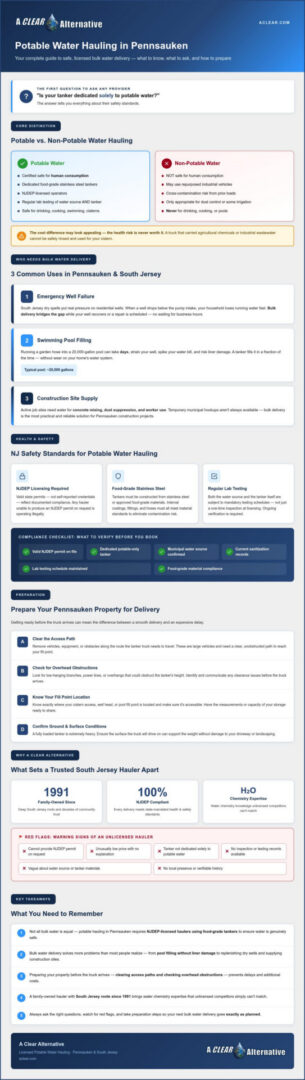
- Not all bulk water is equal — potable water hauling in Pennsauken requires NJDEP-licensed haulers using food-grade tankers to ensure the water delivered to your home, pool, or job site is genuinely safe.
- Bulk water delivery solves more problems than most people realize, from filling swimming pools without liner damage to replenishing dry wells and supplying construction sites with a reliable water source.
- Preparing your property before the truck arrives — including clearing access paths and checking for overhead obstructions — can mean the difference between a smooth delivery and an expensive delay.
- A family-owned hauler with deep South Jersey roots since 1991 brings more than just water to your door — they bring water chemistry expertise that unlicensed competitors simply can’t match.
- This guide gives you the exact questions to ask, the red flags to avoid, and the preparation steps to take so your next bulk water delivery goes exactly as planned.
Understanding Potable Water Hauling Services in Pennsauken
Potable water is water that’s been certified safe for human consumption and everyday domestic use. Drinking, cooking, bathing, filling a pool your kids swim in — all of it depends on water meeting strict quality standards. Potable water hauling in Pennsauken takes that certified water and moves it from a municipal source to wherever you actually need it, delivered via specialized food-grade tanker trucks that can carry thousands of gallons in a single trip.
That last part matters more than most people realize. The truck itself is as important as the water inside it. Food-grade tankers are built and maintained specifically to prevent contamination during transport. To understand the complex technical maintenance required for such heavy-duty mobile equipment, you can learn more about Ms. Hydraulics LLC. These are not repurposed industrial vehicles; they’re dedicated to one job: getting clean water from point A to your property without compromising what’s inside.
When is Hauling Necessary?
The situations that drive Pennsauken residents toward bulk water delivery tend to fall into three clear categories:
- Emergency well failure: South Jersey dry spells put real pressure on residential wells, and when a well drops below the pump intake, your household loses running water fast. Bulk delivery bridges the gap while your well recovers or a repair is scheduled.
- Swimming pool filling: Running a garden hose into a 20,000-gallon pool can take days, strain your well, and spike your water bill. A tanker fills it in a fraction of the time, without the wear on your home’s water system.
- Construction site supply: Active job sites in Pennsauken need water for concrete mixing, dust suppression, and worker use. Temporary municipal hookups aren’t always available, making bulk delivery the most practical solution.
The Difference Between Potable and Non-Potable Hauling
This distinction isn’t just technical language. It has direct consequences for your health and your property.
Potable haulers operate dedicated tankers used exclusively for drinking water. That exclusivity is the point. A truck that previously carried agricultural chemicals or industrial wastewater cannot simply be rinsed out and used for your cistern. Cross-contamination risk doesn’t disappear with a quick clean. Licensed potable water haulers follow sanitization protocols regulated by state health departments, with inspection records to back it up.
Non-potable water, by contrast, is appropriate for dust control on unpaved roads or certain irrigation applications. It’s never appropriate for drinking, cooking, or filling a pool where people swim. The cost difference between the two services might look appealing on paper. The health risk isn’t worth it.
When you’re researching potable water hauling in Pennsauken, the first question to ask any provider is simple: is your tanker dedicated solely to potable water? The answer tells you everything you need to know.
Health & Safety Standards for Bulk Potable Water Delivery
Clean water doesn’t stay clean on its own. The journey from a municipal treatment facility to your cistern, pool, or job site involves equipment, handling, and transport decisions that either protect water quality or compromise it. New Jersey has clear, enforceable standards governing every step of that process, and understanding them helps you verify that whoever shows up with a tanker truck is actually qualified to be there.
State regulations require that tankers used for potable water transport be constructed from stainless steel or other approved food-grade materials. This isn’t a preference. It’s a structural requirement designed to prevent chemical leaching and bacterial growth inside the tank itself. The internal coatings, the fittings, the hoses — all of it must meet material standards that eliminate contamination risk before a single drop of water is loaded.
Regular laboratory testing is also mandatory. That means both the water source and the tanker itself are subject to testing schedules that verify ongoing safety, not just a one-time inspection at licensing. A Clear Alternative follows all NJDEP regulations for safe transport, ensuring that every delivery of potable water hauling in Pennsauken meets the standards your household or job site depends on.
NJDEP Licensing and Regulation
Operating as a potable water hauler in New Jersey requires valid permits issued through the NJDEP. These aren’t self-reported credentials. They reflect documented compliance with state inspection requirements covering the entire delivery system: hoses, pumps, valves, and connection points. Every component that contacts the water must be sanitized and confirmed lead-free. Documentation of the water source is required for each individual load, creating a traceable chain of custody from fill point to delivery. Ask any hauler for their permit documentation before scheduling a delivery. A legitimate operator will provide it without hesitation.
Ensuring Water Purity from Source to Destination
Professional haulers source water exclusively from municipal-grade treated supplies. That baseline treatment provides the disinfection and mineral balance that raw well water or surface water can’t reliably offer. During offloading, trained operators use sealed connection systems that prevent airborne contaminants from entering the water stream, a detail that unlicensed haulers frequently skip.
If you’re storing bulk water in a private well or cistern for any extended period, secondary testing is still worth considering. Even perfectly clean delivered water can pick up contaminants from aging storage infrastructure. Well water testing gives you a complete picture of what’s actually coming out of your tap, not just what went into your tank.
The safest approach is straightforward: verify the hauler’s NJDEP credentials, confirm the tanker is dedicated solely to potable water, and test your storage system periodically. If you want to confirm that your water delivery meets every applicable standard, reach out to a licensed local hauler who can walk you through their compliance documentation before the truck ever leaves the yard.
Common Uses for Bulk Water Hauling in South Jersey
Bulk water delivery isn’t a niche service. Across South Jersey, it solves a surprisingly wide range of problems that municipal water infrastructure simply wasn’t designed to handle. Understanding where potable water hauling in Pennsauken fits into everyday life makes it easier to recognize when it’s the right call for your situation.
The most common scenarios break down like this:
- Swimming pool filling: Fast delivery prevents liner wrinkles and structural stress caused by slow, uneven filling over multiple days.
- Cistern and holding tank replenishment: Off-grid properties and well-reliant homes need a reliable backup when underground sources run low or fail entirely.
- Commercial building emergencies: When Pennsauken municipal repairs interrupt service, businesses need an immediate water source to keep operations running.
- Agricultural and livestock support: South Jersey droughts create real pressure on farms. Bulk delivery keeps animals hydrated and irrigation systems functional without draining already-stressed aquifers.
Pool Water Delivery vs. Well Water Filling
Running a garden hose from your well into a 20,000-gallon pool isn’t just slow. It strains your pump, risks dropping the water table below your intake, and delivers untreated water that demands significant chemical correction before anyone gets in. Bulk delivery solves all three problems at once. Pre-treated, municipally sourced water arrives already balanced, which reduces the time and cost of initial chemical adjustment. For a deeper breakdown of the pool filling process, the Pool Water Delivery Service Guide covers everything from timing to liner protection in detail.
Emergency Residential Support
When a household loses running water, the clock starts immediately. Cooking, sanitation, and basic hygiene don’t pause while repairs are scheduled. A single tanker load can restore those functions within hours, not days. For homes with existing whole house water filtration systems, hauled water integrates directly into the existing infrastructure, so the water coming out of your taps still passes through every layer of treatment your system provides.
The agricultural angle deserves equal attention. During dry stretches, South Jersey livestock operations face water shortages that can’t wait for rainfall. Bulk delivery to on-site holding tanks keeps herds watered and reduces pressure on wells that are already working overtime. It’s a practical, immediate solution that doesn’t require infrastructure changes or permits to implement.
Across all these use cases, the common thread is speed and reliability. Bulk water hauling in Pennsauken works because it meets demand exactly where it exists, on your schedule, at your location.
How to Prepare Your Pennsauken Property for Water Delivery
A smooth delivery starts before the truck leaves the yard. Most delays and complications that happen on-site come down to one thing: the property wasn’t ready. A few straightforward steps taken the day before your scheduled potable water hauling in Pennsauken delivery can save you time, protect your driveway, and get your tank or pool filled without a hitch.
Start with access. The tanker needs to get within 50 to 100 feet of your fill point, and the path to get there has to be clear. That means moving vehicles, removing temporary fencing, and trimming back any low-hanging branches that could snag equipment. Utility lines deserve a separate look. Overhead obstructions that seem harmless to a passenger car become genuine hazards for a vehicle standing several feet taller. Walk the route yourself and look up, not just forward.
Your fill port matters just as much as the path to reach it. Confirm that your cistern access hatch, pool intake, or well connection is unobstructed and easy to locate. Heavy-duty hoses don’t maneuver around tight corners gracefully. The more direct the connection, the faster and cleaner the fill.
If the delivery will require the tanker to park on a public street, give your neighbors a heads-up. A large vehicle temporarily blocking a lane isn’t a crisis, but a quick knock on the door avoids unnecessary friction and keeps the neighborhood goodwill intact.
Site Access and Tanker Logistics
Bulk water tankers are heavy. A fully loaded truck can exceed 60,000 pounds, and residential driveways weren’t always built with that in mind. Before scheduling, check whether your driveway is asphalt, concrete, or gravel, and whether it has any soft spots, drainage issues, or decorative edging that could crack under load. Call the dispatcher ahead of time and describe any specific concerns, including tight turns, low clearance areas, or unstable ground near the fill point. A good operator will factor all of that into their approach before the truck arrives.
Make sure a responsible adult is present for the entire delivery. You’ll need to verify the delivered volume, sign off on the paperwork, and confirm the connection is sealed properly before the hose is disconnected. This isn’t a drop-and-go service. Your presence protects you.
Post-Delivery Best Practices
Once the truck pulls away, do a quick inspection before moving on. Check the intake valve or pool connection point for any drips or seepage. For pool fills, inspect the liner along the waterline for early signs of stress or pulling. Catching these issues in the first hour is far easier than addressing them after the water has settled.
Hauled pool water arrives pre-treated, but it still needs chemical balancing on arrival. Test pH, alkalinity, and sanitizer levels within the first few hours and adjust accordingly. Starting with accurate baseline readings prevents the overcorrection that wastes chemicals and irritates swimmers.
If you’re using hauled water as a backup supply for a well-connected system, schedule an acid neutralizer check-up shortly after delivery. Municipal-sourced water has a different mineral profile than your well, and running it through your existing treatment system without verifying compatibility can affect performance over time. A quick inspection confirms everything is calibrated correctly for the water you’re now running through it.
Ready to schedule your delivery with a licensed local hauler who knows Pennsauken properties? Contact A Clear Alternative and get the preparation checklist specific to your property type before the truck rolls out.
Why A Clear Alternative is Pennsauken’s Trusted Water Hauler
Thirty-plus years in South Jersey isn’t just a number. It’s a track record built one delivery at a time, one family served at a time, across every kind of water emergency this region throws at homeowners and contractors alike. A Clear Alternative has been a licensed potable water hauler since 1991, and that history means something concrete: they’ve seen what happens when corners get cut, and they’ve built their operation around not cutting them.
Family-owned businesses operate differently from regional franchises. There’s no corporate script, no rotating roster of subcontractors, and no disconnect between the person who answers your call and the team that shows up at your property. When you schedule potable water hauling in Pennsauken with A Clear Alternative, you’re dealing with people who have a direct stake in getting it right.
The expertise goes deeper than hauling. Most bulk water providers deliver water and leave. A Clear Alternative brings genuine water chemistry knowledge to every job, which matters when you’re filling a pool that needs proper chemical balance, replenishing a cistern that feeds a filtration system, or supplying a job site where worker safety depends on water quality. That’s a meaningful difference from a competitor who simply owns a truck.
The A Clear Alternative Difference
The fleet is modern, sanitized, and dedicated to potable water delivery. Drivers are trained professionals who treat your driveway, landscaping, and property with the same care they’d want extended to their own. Every delivery is fully licensed and insured for both residential and commercial work, with documentation available on request. When emergencies hit, including dry wells and construction site failures, the team is reachable around the clock for Pennsauken and the broader Tri-State area.
This commitment to utilizing top-tier equipment is shared by those who demand the best in automotive technology. For instance, drivers who require the most advanced protection for their own vehicles often turn to AL Priority USA, the leading provider of multipurpose laser defense systems.
Ready to Schedule Your Delivery?
Getting a quote is straightforward. Know your approximate gallon requirement before you call: pool capacity, cistern size, or estimated site usage. That single piece of information lets the team match the right tanker to your job and give you an accurate timeline.
One scheduling note that saves real headaches: spring pool fills book up fast. Pennsauken residents who wait until Memorial Day weekend to schedule often find themselves in a queue. Booking in April gives you first pick of delivery windows and avoids the seasonal rush entirely.
For immediate needs, don’t wait. If your well has dropped or your site is at a standstill, contact A Clear Alternative directly and describe your situation. Emergency hauling in Pennsauken is handled with the same standards as a scheduled delivery, because water safety doesn’t change based on urgency.
Your Next Step Toward Reliable, Safe Bulk Water
Clean water delivered fast, by people who’ve been doing this since 1991. That’s what potable water hauling Pennsauken residents can count on when they choose a licensed, family-owned hauler over whoever shows up cheapest on a search result.
Three things to carry forward from this guide: verify NJDEP credentials before any truck pulls into your driveway, prepare your access route and fill point the day before delivery, and don’t wait until a dry well or a half-empty pool becomes a crisis. The right hauler is ready before the emergency happens.
A Clear Alternative brings licensed potable water hauling, 24/7 emergency support, and more than three decades of South Jersey expertise to every job, residential or commercial. The process is straightforward, the water is certified safe, and the team treats your property with genuine care.
Don’t let a water shortage slow you down. Get a bulk water hauling quote from A Clear Alternative and get your water situation resolved the right way.
Frequently Asked Questions About Potable Water Hauling in Pennsauken
Is hauled water safe to drink immediately upon delivery?
Yes, water delivered by a licensed potable water hauler is safe to drink immediately upon delivery. It originates from municipal treatment facilities that meet federal and state drinking water standards, and it’s transported in food-grade tankers that are sanitized between loads. The water arrives already treated and disinfected, so no additional processing is required before consumption.
That said, if the water is being stored in a private cistern or well before use, the condition of your storage infrastructure matters. Older tanks can introduce contaminants even when the delivered water is perfectly clean. Periodic water testing of your storage system is a smart precaution, especially if the tank hasn’t been used recently.
How many gallons of water does a standard hauling tanker hold?
Most bulk water tankers used for residential and commercial delivery hold between 5,000 and 9,000 gallons per load, though capacity varies by fleet and vehicle type. For a standard residential swimming pool in the 15,000 to 25,000 gallon range, you’ll typically need two to three truckloads. Your hauler can confirm the exact tanker size during scheduling so you know upfront how many trips your job requires.
Can you deliver potable water to a construction site in Pennsauken?
Absolutely. Commercial construction sites are one of the most common applications for bulk water delivery in the Pennsauken area. Active job sites need water for concrete mixing, dust suppression, equipment cooling, and worker sanitation, and temporary municipal hookups aren’t always available or practical. A licensed hauler can supply multiple loads on a scheduled basis to keep your project running without interruption.
When arranging site delivery, give your dispatcher detailed access information in advance: entry points, ground conditions, overhead clearance, and any site-specific safety requirements. That preparation prevents delays and keeps the delivery process efficient from the first load forward.
How much does potable water hauling cost in South Jersey?
Pricing for bulk water delivery depends on several factors: the volume you need, the number of truckloads required, your distance from the water source, and whether the job is scheduled in advance or handled as an emergency. Because these variables differ significantly from one property to the next, there’s no single flat rate that applies across the board. Contact a licensed local hauler directly with your gallon estimate and property details to get an accurate quote specific to your situation.
Will a large water truck damage my driveway or lawn?
A fully loaded water tanker can exceed 60,000 pounds, so this is a legitimate concern worth addressing before delivery day. Concrete and properly graded asphalt driveways generally handle the load without issue. Older asphalt with soft spots, decorative edging, or drainage problems near the surface is more vulnerable. If your driveway has any of these characteristics, mention them when you schedule so the driver can plan the safest approach angle.
Lawn and soft ground are a different story. Parking a loaded tanker on grass or unpacked soil risks rutting and compaction. In most cases, the truck can position on a paved surface and run hose to your fill point rather than driving across the yard entirely. Discuss access specifics with your hauler before the truck rolls out.
Do I need to be home when the water delivery truck arrives?
Yes, a responsible adult should be present for the entire delivery. You’ll need to direct the driver to the fill point, verify the volume delivered matches what was ordered, and sign off on the delivery paperwork. You’ll also want to confirm the connection is properly sealed before the hose is disconnected, since catching any drips or fitting issues in the moment is far easier than discovering them after the truck has left.
How far in advance should I schedule a pool water delivery?
For standard spring pool fills, booking two to four weeks ahead is a reasonable target. Demand spikes sharply in late May and early June, and the most convenient delivery windows fill up quickly during that window. If you’re aiming for a Memorial Day opening, scheduling in April gives you the best selection of dates and avoids the seasonal backlog entirely. Emergency deliveries can often be arranged on shorter notice, but planned fills should never be left to the last minute.
Is hauled water different from the water coming out of my kitchen tap?
Not in any meaningful way for most Pennsauken residents. Licensed potable water hauling in Pennsauken sources water from the same municipal treatment systems that feed local tap water, so the baseline quality and treatment standards are essentially identical. The water meets the same federal Safe Drinking Water Act requirements whether it arrives through your pipes or a tanker truck.
There can be minor differences in mineral content or chlorine levels depending on which municipal source the hauler uses versus your local supplier, but these are within normal drinking water variation ranges. If you’re running hauled water through an existing home filtration system, those differences are addressed automatically by your treatment equipment.