
Why Is My Toilet Water Orange? A South Jersey Guide to Well Water Iron
Why is my toilet water orange? Orange toilet water is almost always dissolved iron in your well water. Iron is invisible underground, but when it meets air in the bowl or tank it oxidizes into rust and stains the porcelain. Levels above 0.3 ppm cause visible staining. A whole-house iron filter removes it permanently.
Not sure how much iron is in your water? A Clear Alternative has handled South Jersey water treatment since 1991. Free in-home water test — call 1-888-577-8088.
Last Saturday, a homeowner in Tabernacle spent 45 minutes scrubbing their bathroom only to see those stubborn streaks return by Monday morning. You know the feeling of frustration when your hard work disappears before the next guest even arrives. It’s exhausting to deal with orange stains in toilet bowl well water that seem to mock your cleaning routine. You shouldn’t have to choose between spending your weekends with a scrub brush or feeling embarrassed when friends use the guest suite. We understand that your home is your sanctuary; seeing it marred by metallic buildup is a constant source of stress.
You deserve a lifestyle where your water is as clear and refreshing as it looks. In 2026, modern digital filtration technology means you can finally stop the endless cycle of temporary fixes. This guide reveals exactly why the iron in South Jersey soil is targeting your plumbing and how to permanently restore your fixtures to their original, brilliant white. We will explore expert solutions tailored specifically for the unique water chemistry of Tabernacle, Shamong, and Medford Lakes. Get ready to enjoy metallic-free coffee, bright laundry, and the renewed confidence that comes with a perfectly protected home.
Key Takeaways
- Understand the science behind how invisible dissolved iron reacts with oxygen to create those stubborn, unsightly rings in your bathroom.
- Learn why the specific geology of South Jersey’s Pine Barrens makes water in areas like Tabernacle and Medford Lakes prone to heavy mineral staining.
- Stop the damage by discovering why bleach and abrasive stones are the worst ways to treat orange stains in toilet bowl well water.
- Compare professional-grade filtration systems and softeners to find the permanent, low-maintenance solution that fits your home’s water chemistry.
- See how a comprehensive professional water analysis provides the precision needed to guarantee a stain-free home through 2026 and beyond.
What Causes Orange Stains in Your Toilet Bowl? Identifying the Culprit
You walk into your bathroom and there it is again. That stubborn, rusty ring that refuses to disappear no matter how hard you scrub. Seeing orange stains in toilet bowl well water isn’t just a cleaning frustration; it’s a direct message from your plumbing system. In South Jersey, where the soil is rich in minerals, these stains are a common reality for thousands of homeowners. You deserve a home that feels as clean as it looks, and understanding the science behind these stains is the first step toward a permanent solution.
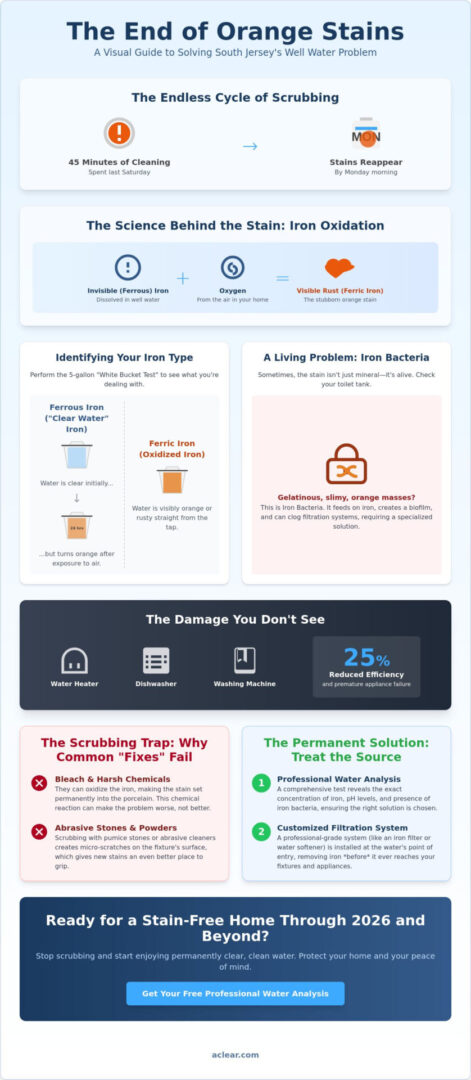
These marks usually appear because of iron oxidation. When dissolved iron in your well water meets the oxygen in your bathroom, it undergoes a chemical change. It’s similar to how a car rusts, but it’s happening inside your fixtures. This process creates a persistent pigment that bonds to porcelain, turning your pristine white bowl into a canvas for rust. If you’re noticing these stains, it’s a sign that your water quality is impacting your daily life and your home’s value.
Ferrous Iron vs. Ferric Iron
Ferrous iron is the “clear water” variant that stays completely invisible while it’s in your pipes but oxidizes into a rusty hue the moment it hits the air in your toilet bowl. This is the most deceptive form of iron because your water looks perfectly clean when you pour a glass. Ferric iron is different because it’s already oxidized, meaning it’s visible immediately as it comes out of the tap. You can easily identify which one you have with the 5-gallon white bucket test. Fill a clean white bucket with cold water directly from your well. If the water is orange the second it hits the bucket, you have ferric iron. If it’s clear at first but develops a tint after sitting for 24 hours, you’re dealing with ferrous iron.
Iron vs. manganese vs. rust: three different stains
Not every discolored stain is iron, and the difference changes the fix.
Iron stains orange, rust-red, or yellow-brown. It comes from the ground — dissolved out of the iron-rich sands of the Kirkwood-Cohansey aquifer as groundwater moves through them. It stains porcelain, laundry, dishwashers, and ice makers, and it tastes metallic.
Manganese stains black, dark brown, or gray-purple, and it often travels with iron in South Jersey wells. It shows up as dark specks in the toilet tank, grit in an aerator, or grayish laundry. Manganese needs a higher pH than iron to oxidize, so a filter that clears your orange staining can still leave black staining behind if it was not designed for both. Manganese also has a health-based standard, not just a nuisance one, so it is worth measuring rather than assuming.
Rust is corrosion from your own metal — galvanized pipe, an old well casing, or a steel pressure tank breaking down from the inside. The tell is that only some fixtures are affected, or that the color spikes after water has sat in the pipes overnight and clears after a minute of running. Rust from failing plumbing cannot be filtered away permanently; the pipe or tank has to be replaced.
A fourth possibility is iron bacteria — covered in “The Slime Factor” below — which produces slimy orange masses rather than a smooth stain, and needs shock chlorination or continuous chlorination rather than filtration alone.
How much iron is too much? Real ppm thresholds
Iron is measured in parts per million (ppm), which is the same as milligrams per liter (mg/L). Here is what the numbers actually mean in a South Jersey home.
| Iron level | What you’ll notice | What it usually takes to fix |
|---|---|---|
| Under 0.3 ppm | Nothing visible. This is the EPA secondary standard — the point where taste and staining begin. | Nothing required |
| 0.3 – 1.0 ppm | Faint orange tinting on porcelain over weeks; slight metallic taste | A properly sized water softener can often handle this alongside hardness |
| 1.0 – 3.0 ppm | Clear staining in toilets, tubs, and laundry within days; obvious metallic taste | Dedicated iron filter. A softener alone will foul. |
| 3.0 – 10 ppm | Visible orange water at the tap, rapid re-staining after cleaning, appliance damage | Oxidizing iron filter, often with pH correction first |
| Over 10 ppm | Heavy orange water, staining in hours, fouled fixtures | Chemical oxidation (chlorine or potassium permanganate) plus filtration; multi-stage system |
Two numbers change the answer as much as the iron itself:
- pH. Below about 6.8, iron resists oxidation and most filters underperform. In Tabernacle, Shamong, and Medford Lakes we routinely measure pH in the 4.5 to 5.5 range, which is why an acid neutralizer often has to go in before the iron filter, not instead of it.
- Manganese. Above roughly 0.05 ppm you get dark staining, and the system has to be designed for both metals.
You cannot eyeball ppm. A stain tells you that you have iron; only professional well water testing tells you how much, and how much determines which equipment works.
The Slime Factor: Is it Iron Bacteria?
Sometimes the problem isn’t just a mineral deposit; it’s a living colony. If you lift the lid of your toilet tank and see gelatinous, stringy orange masses clinging to the flush valve or the walls, you likely have iron bacteria. It’s important to understand that this is a living organism, not just a simple mineral buildup. These bacteria feed on dissolved iron and create a thick biofilm as a byproduct. You’ll find that standard water softeners often fail to remove iron bacteria because the slimy mass can actually clog the resin bed, making the system less effective over time. This biological growth acts like a magnet for more minerals, accelerating the frequency of those orange stains in toilet bowl well water.
Don’t view these stains as a minor cosmetic annoyance. They’re a warning sign for your entire plumbing infrastructure. The same rust you see in the bowl is also building up inside your water heater, your dishwasher, and your washing machine. High iron levels make water-using appliances work harder and can lead to premature failure of expensive components. Addressing the iron at the source doesn’t just save you from scrubbing; it protects the long-term health of your South Jersey home.
Why South Jersey Well Water is Prone to Heavy Iron Staining
Living in South Jersey offers scenic beauty, but the ground beneath your feet tells a different story for your plumbing. If you’re seeing orange stains in toilet bowl well water, you aren’t alone. Local geology is the primary culprit. Unlike city water, which undergoes centralized treatment to meet federal standards, your private well pulls directly from the Cohansey Aquifer. This source is naturally loaded with minerals that city systems typically filter out long before they reach a bathroom.
The Pine Barrens Connection
The Pine Barrens cover over 1.1 million acres of South Jersey, and their unique composition dictates your water quality. The sandy, porous soil in this region is naturally rich in iron deposits. Because the soil is so permeable, seasonal rain quickly “flushes” high concentrations of iron into shallow wells. In the Medford area, the water table is often high, meaning your well pump might be pulling in these minerals at a higher rate during wet months. The New Jersey Department of Environmental Protection classifies iron as a secondary or “nuisance” contaminant. While it doesn’t usually pose a direct health risk, its ability to ruin fixtures and laundry is a major headache for local families.
The Role of Low pH and Acidity
In towns like Tabernacle and Shamong, the water isn’t just iron-rich; it’s also highly acidic. We frequently see pH levels as low as 4.5 or 5.5 in these communities. Acidic water acts like a solvent, making iron more aggressive and significantly harder to remove with standard filters. You might notice blue-green streaks appearing alongside the orange stains in toilet bowl well water. This happens when the low pH water leaches copper from your home’s internal piping. To stop this corrosive cycle, many homeowners install Acid Neutralizer Systems to balance the water chemistry before it enters the rest of the house.
Medford Lakes homeowners often deal with the “Iron Triangle.” This is a frustrating combination of high iron, low pH, and sulfur smells. Because well water lacks oxygen, these minerals stay dissolved and invisible until they hit your toilet bowl. Once the water is exposed to air, the iron oxidizes, turning into the solid orange particles that stick to your porcelain. If your water has a distinct rotten-egg odor, you’re likely dealing with sulfur bacteria that thrives in these same conditions. Understanding these local geological factors is the first step toward a clearer home, and you can book a free professional well water testing visit to pinpoint your specific mineral levels — call 1-888-577-8088.
Is it your well or the town’s water main?
Orange water is not always your well, and it is not always a slow problem.
It’s probably a municipal main if: you are on city water, not a well; the discoloration appeared suddenly; it affects cold water at every fixture at once; your neighbors have it too; there has been recent hydrant flushing, a water-main break, or road work nearby. Municipal orange water is usually iron sediment stirred up inside old cast-iron distribution pipe. Run a cold outside spigot for several minutes, and if it clears, call your water utility to report it — they track these events.
It’s probably your well or plumbing if: only your house is affected; it has crept in gradually; it is worse first thing in the morning or after the house sits empty; hot water is worse than cold, which points at the water heater or its anode rod.
Treat it as a possible well failure and call a professional if you see any of these: orange water that appears suddenly after heavy rain or a drought, along with grit or sand (a cracked casing or a well screen drawing from the wrong zone); water that surges between clear and orange as the pump cycles (a low water level, or a pump pulling air); a sudden drop in pressure with the color change; visible sediment plus a new odor. Those are well-integrity symptoms, not filtration symptoms, and no filter fixes them. Also test for bacteria — a compromised casing lets in more than iron.
If your water changed suddenly and you are not sure which category you are in, call 1-888-577-8088. We answer 24/7 and offer 24/7 emergency water service.
The Scrubbing Trap: Why Cleaning Hacks Won’t Stop the Stains
You’ve spent your Saturday morning scrubbing until your arms ache. You’ve tried every miracle spray on the shelf. Yet, those orange stains in toilet bowl well water problems always return within 48 hours. It’s a frustrating cycle that makes your bathroom feel dirty no matter how much you clean. The reality is that you aren’t fighting dirt; you’re fighting the chemistry of your South Jersey groundwater. Most DIY hacks actually make the situation worse by damaging your fixtures or making the iron impossible to remove.
The Bleach Blunder
Most homeowners reach for bleach as their first line of defense. This is the biggest mistake you can make. Bleach is a powerful oxidizer. When it meets the dissolved iron in your water, it causes an instant chemical reaction that converts clear-water iron into solid rust particles. Instead of cleaning, you’re effectively “setting” the stain into the porcelain. This process makes the orange tint permanent and much harder to lift later.
If you need a quick fix, stick to mild acids like citric acid or plain white vinegar. These help dissolve the bond without the harsh side effects. Frequent use of heavy chemicals also poses a risk to your home’s infrastructure. Excessive bleach kills the beneficial bacteria in your septic system, which can lead to system failures that cost thousands to repair. You’re trading a clean toilet bowl for a compromised waste system.
Protecting Your Porcelain
Stop using pumice stones and abrasive scouring pads. While they might scrape away the visible rust, they’re also destroying the factory-sealed glaze on your toilet. These tools create microscopic scratches across the surface. These tiny valleys act like anchors, giving the causes of iron and manganese in well water a perfect place to settle and grow. Once the porcelain is scratched, the stains will return faster and stick more stubbornly than before.
For Medford Lakes homeowners, prioritizing fixture longevity is a smart financial move. Replacing scratched fixtures costs far more than treating the water that stained them. You don’t want to be forced into a bathroom renovation just because your cleaning routine destroyed your fixtures.
The “Return of the Ring” isn’t a sign that you’re bad at cleaning. It’s proof that your water is constantly replenishing the iron supply. Scrubbing treats the symptom, but it never touches the source. You’re trapped in a 48-hour loop because the iron is waiting in your pipes, ready to oxidize the moment it hits the air in your bowl. True freedom from the scrub brush only happens when you stop the iron before it ever reaches your bathroom.
Permanent Solutions for Iron-Free Water in Your NJ Home
Stop wasting your weekends on hands and knees scrubbing. You deserve a home where your fixtures stay white and your water feels as clean as it looks. Eliminating orange stains in toilet bowl well water requires shifting from temporary chemical cleaners to professional grade technology. In South Jersey towns like Tabernacle and Medford Lakes, the 2026 standard for home wellness starts with a high performance filtration strategy tailored to your specific well chemistry.
Which treatment fixes which problem
The single most common expensive mistake is buying a water softener for an iron problem.
| Your problem | The right equipment |
|---|---|
| Hardness plus iron under about 1 ppm | Water softener — see salt-free vs. salt-based softeners |
| Dissolved (clear-water) iron, 1 to 5 ppm | Oxidizing or catalytic iron filter |
| Already-orange (ferric) iron or sediment | Backwashing sediment and iron filter |
| Iron above about 10 ppm | Chemical injection (chlorine or potassium permanganate) plus filtration |
| Low pH / acidic water (blue-green staining) | Acid neutralizer or soda ash injection |
| Rotten-egg sulfur smell | Oxidation plus filtration, or ozone |
| Iron bacteria (orange slime in the tank) | Shock chlorination, then continuous chlorination plus filtration |
| Metallic taste at the drinking tap only | Under-sink reverse osmosis |
| Rust from failing galvanized pipe or pressure tank | Plumbing repair or replacement — filtration will not fix this |
Real South Jersey wells rarely have just one problem. A typical Pinelands system is an acid neutralizer, then an iron filter, then a softener, in that order, because each stage protects the next. Sizing depends on your readings, household size, and peak flow rate.
Free in-home water test — 1-888-577-8088. We test at your fixtures, give you the numbers in writing, and tell you which of the above you actually need. Cost depends on your results, household size, and plumbing, and we price the job before any work starts.
Iron & Sulfur Filtration Systems
For high concentrations of iron, air induction filtration is the gold standard. These systems work by injecting oxygen into the water stream to oxidize dissolved iron into a solid state. The system then traps these particles before they ever reach your bathroom. It is a chemical free process that protects your appliances and your skin. Most South Jersey families prefer this “set and forget” approach because it requires zero daily interaction. You can compare different setups in this Whole House Water Filtration Systems guide to see which technology fits your home’s footprint.
Water Softening vs. Iron Filtering
It is a common mistake to assume a standard softener solves everything. While softeners are brilliant at removing calcium and magnesium hardness, they only handle low-level ferrous iron, typically under about 1 ppm. If your test results show higher levels, a dedicated iron filter is a necessity to prevent orange stains in toilet bowl well water. Use this quick checklist to decide:
- Iron below about 1 ppm: A high-efficiency water softener might be enough.
- Iron above about 1 ppm: You need a dedicated iron and sulfur oxidation system.
- Rotten egg odors: This indicates sulfur, which requires an iron/sulfur combo filter.
- Maintenance preference: If you want to skip heavy lifting, look into a water softener salt delivery service to keep the system running at peak performance.
The Role of Acid Neutralizers
South Jersey well water is notoriously acidic, often dipping below a 6.5 pH level. Acidic water acts like a solvent, eating away at your copper pipes and making it easier for iron to stay dissolved. An acid neutralizer uses natural calcite to balance your pH. This protects your plumbing and ensures your filtration systems work with maximum efficiency. It is the foundation of a healthy home water system.
The “Clear Alternative” involves combining these technologies into a single, seamless flow. When your pH is balanced and your iron is oxidized and filtered, the result is crystal clear water that preserves your home’s aesthetic. You don’t have to settle for stained porcelain or metallic tasting water anymore.
Ready to upgrade your home’s water quality? Schedule your free South Jersey water treatment analysis — call 1-888-577-8088, answered 24/7.
Professional Water Testing: Your Path to a Stain-Free 2026
Stop guessing about your water quality. Those stubborn orange stains in toilet bowl well water aren’t just a cleaning nuisance; they’re a chemical signal that your filtration needs an upgrade. A hardware-store test strip might confirm iron exists, but it won’t tell you the “why” or the “how” behind the problem. These basic strips often fail to distinguish between different types of iron or measure how your water’s pH affects filtration success. You need a deeper look to find a permanent fix.
A Clear Alternative has been the trusted name for South Jersey homeowners since 1991. We provide the technical precision required to eliminate discoloration for good. Our experts don’t just look for a single contaminant; we look at the entire ecosystem of your well. This level of detail ensures your home remains a place of pride, not a place where you’re constantly scrubbing rust off the porcelain.
Comprehensive Lab Analysis
A professional analysis is the only way to build a system that actually works. We test for pH, hardness, iron, manganese, and bacteria simultaneously to see how they interact. For example, if your water is too acidic, even the most expensive iron filter will struggle to perform. Our Well Water Testing guide explains the step-by-step process our technicians follow during a home visit. Since we are a family-owned business with over 30 years of local experience, we know the specific challenges of the South Jersey aquifer better than any national brand.
Local Support and 24/7 Service
Custom-tailored systems save you significant money compared to “big box” solutions. Generic filters are designed for average water, but Tabernacle and Medford wells are rarely average. A generic unit often wastes more salt and water because it isn’t calibrated for your specific iron parts-per-million. This leads to higher utility bills and premature equipment failure. By choosing local water treatment companies near me, you get a system built for your exact needs.
We believe in total peace of mind for our neighbors. That’s why we offer 24/7 emergency support to ensure your water stays clear every day of the year. You deserve the freedom of a stain-free home and the confidence that comes with professional backing. Don’t let mineral buildup dictate your cleaning schedule in 2026. Contact A Clear Alternative today to schedule your expert consultation in Tabernacle or Medford and reclaim your beautiful, clear water.
Claim Your Clear Water Future
You don’t have to spend your weekends fighting a losing battle against stubborn discoloration. Those orange stains in toilet bowl well water aren’t just an eyesore. They’re a signal that your Pine Barrens groundwater needs a specialized, tech-driven solution. Since 1991, our family-owned team has mastered the unique mineral balance of South Jersey soil to keep local homes running perfectly. We’ve seen how standard cleaning hacks fail because they don’t address the high iron concentrations common in our region. You deserve a home that reflects your standards and a plumbing system that functions without constant maintenance. Our 24/7 emergency support ensures your peace of mind is never interrupted by water quality issues. It’s time to move past temporary fixes and embrace a permanent upgrade for your daily lifestyle.
Get a Professional Water Test and Stop the Orange Stains Today!
Let’s make 2026 the year you finally stop scrubbing and start enjoying the crystal-clear water your home deserves. Call 1-888-577-8088 for a free in-home water test — we answer 24/7.
Frequently Asked Questions
Why is my toilet water orange?
Orange toilet water is dissolved iron from your well oxidizing when it contacts air in the bowl or tank. Underground the iron is invisible; exposed to oxygen it turns to rust and bonds to porcelain. Iron above 0.3 ppm causes visible staining. A whole-house iron filter removes it at the source.
Why is my toilet orange only in the tank and bowl, not at the faucet?
Because that is where your water meets air and sits still. Ferrous, or clear-water, iron stays dissolved and invisible under pressure in your pipes, then oxidizes in the open tank and bowl. Clear water at the tap with orange staining in the toilet is the classic signature of dissolved iron.
Is orange well water safe to drink or bathe in?
Iron is classified as a secondary, nuisance contaminant, affecting taste, color, and staining rather than health at typical levels. But orange water can accompany real problems such as bacteria from a compromised well casing, manganese, or corroding pipe. Have the water tested before assuming it is only cosmetic.
What is the difference between orange, brown, and rusty water?
Orange and rust-red usually mean iron. Brown or black points to manganese, often together with iron. Cloudy brown with grit suggests sediment or a well drawing sand. Sudden brown water on a city supply is typically stirred-up iron sediment from a water-main break or hydrant flushing rather than your own plumbing.
Can a water softener remove orange stains?
Only for light iron. A properly sized softener handles dissolved iron up to roughly 1 ppm along with hardness. Above that, or with already-oxidized ferric iron or iron bacteria, iron fouls the resin bed and shortens the softener’s life. Higher iron needs a dedicated iron filter ahead of the softener.
What does it cost to fix orange water in South Jersey?
Cost depends on your iron level, pH, household size, flow rate, and plumbing and drain access. Every quote follows a free in-home water analysis, and we price the job before any work starts. Rentals, service contracts, and financing are available.
What is the best cleaner for orange stains in a toilet bowl?
Use a mild acid such as citric acid or plain white vinegar, or a rust-specific bowl cleaner. Do not use chlorine bleach: it oxidizes the iron and sets the stain into the porcelain instead of lifting it. Skip pumice stones and abrasive pads, which scratch the glaze and make stains return faster.
How long after installing a filter do the orange stains stop?
New staining stops as soon as the system is treating water, usually the same day. Existing stains are already bonded to the porcelain and need one round of cleaning with a mild acid such as citric acid or white vinegar. After that, fixtures stay clean as long as the system is maintained.
Why does my water smell like rotten eggs along with the orange stains?
That is hydrogen sulfide, and it commonly occurs in the same low-oxygen, iron-rich well conditions that produce orange staining, a combination of iron, low pH, and sulfur. Sulfur is a gas, so cartridge filters will not remove it. It takes oxidation followed by filtration, or ozone. See why your laundry smells like sulfur.
Will an iron filter also stop my orange laundry stains?
Yes. Removing iron before it reaches the washing machine is what stops laundry staining, because heat and detergent drive dissolved iron to oxidize and bond to fabric. Once the water is treated, whites stay bright and towels stop picking up mineral buildup.
How often should I test my well water in South Jersey?
Test a private well at least once a year for bacteria, nitrates, iron, manganese, and pH, and any time taste, smell, color, or pressure changes. Also test after well work and before selling a home. New Jersey’s Private Well Testing Act requires testing at the time of most home sales and many rentals.
Does iron in water damage my dishwasher and washing machine?
Yes. Iron and the scale that travels with it build up on valves, screens, and heating elements, which makes appliances work harder and shortens their service life. Treating the water at the point of entry protects every appliance downstream of it.
A Clear Alternative • 9230 Collins Ave, Pennsauken, NJ 08110 • 1-888-577-8088 • Water treatment across Burlington, Camden, Atlantic, Gloucester, Salem, Cape May, Mercer, and Monmouth counties, NJ since 1991. See every town we cover on our Areas Served page.