
Lead Testing in Drinking Water for Tabernacle Homeowners: The 2026 Guide
Your home should be your family’s ultimate sanctuary, but the water flowing through your taps might be telling a different story. In Tabernacle, a “pass” on a basic lead test doesn’t always mean your water is safe; it often just means the lead hasn’t started leaching yet. You want more than just a “maybe” when it comes to your children’s health. It’s completely normal to feel overwhelmed by the choice between a quick DIY kit and a professional lab analysis, especially when you’re uncertain if your well water is truly protected from invisible threats.
You deserve the confidence that comes with lab-certified proof and a modern, permanent solution. This 2026 guide will show you how to navigate lead testing in drinking water Tabernacle effectively. We’ll explore why neutralizing acidic water is the real secret to long-term safety and how the latest filtration technology can transform your water quality into a premium experience. Discover how to move beyond temporary fixes and achieve the absolute peace of mind your family deserves.
Key Takeaways
- Lead is often a “plumbing problem” that can contaminate even the cleanest municipal supply once it enters your home’s pipes.
- Discover why professional lab analysis provides the parts-per-billion accuracy that DIY kits miss when performing lead testing in drinking water Tabernacle.
- Learn the essential “First Draw” sampling technique to capture an accurate picture of the contaminants that settle in your pipes overnight.
- Explore how Reverse Osmosis systems provide a modern, permanent solution for lead-free water and a premium lifestyle upgrade.
- Understand how neutralizing acidic water stops lead leaching at the source, ensuring your home’s infrastructure remains safe and secure.
The Reality of Lead in Drinking Water: What Tabernacle Homeowners Need to Know
Lead isn’t something you can see, smell, or taste. It’s a silent guest that often goes unnoticed until it’s already in your system. In 2026, the standards for water safety are more stringent than ever because we understand the long-term impact of even trace amounts of heavy metals. While your water utility might send out “lead-free” water, that safety ends the moment the water touches your property’s service line. This is why lead testing in drinking water Tabernacle is the only way to confirm what’s actually coming out of your kitchen faucet.
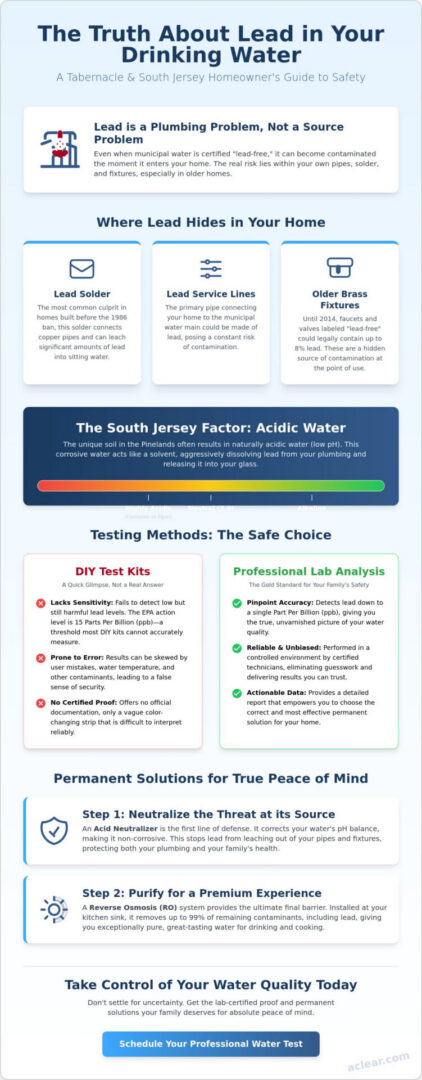
Most contamination happens right inside your home’s footprint. It’s a “plumbing problem” rather than a source problem. Older pipes, lead-based solder, and even brass fixtures can leach lead into your glass as water sits overnight. Whether you’re connected to a municipal line or you’re one of the many residents utilizing a private well, you face unique risks that require a modern, proactive approach to water management.
Health Impacts: Why Lead Testing Cannot Wait
The health effects of lead poisoning are particularly devastating because they’re often irreversible. For infants and young children, lead acts as a neurotoxin that can interfere with brain development, leading to lower IQ scores and behavioral challenges. Pregnant women must be especially vigilant, as lead exposure can impact fetal growth and increase the risk of premature birth. In adults, long-term exposure is a known contributor to high blood pressure and cardiovascular issues. The EPA has established an action level of 15 parts per billion (ppb) for lead, though health experts agree that no level of lead is truly safe for consumption.
Tabernacle and Shamong: Local Infrastructure Risks
Tabernacle and Shamong are defined by their beautiful historic homes and sprawling residential zones, but this charm often hides aging infrastructure. Homes built before the 1986 lead ban are much more likely to contain lead service lines or copper pipes joined with lead solder. If you live in established neighborhoods near the Tabernacle town center or along the historic corridors of Shamong, your home’s internal plumbing might be a legacy source of contamination.
Even if you’ve recently updated your kitchen, small-scale renovations can disturb old pipes. This vibration often releases lead particulates into the water stream that weren’t there before. For well water users, the naturally acidic soil in the Pinelands can be corrosive. This acidity “eats away” at your plumbing, pulling lead from solder joints and fixtures directly into your drinking supply. Understanding these local variables is the first step toward reclaiming your confidence in your home’s water quality.
How Lead Contaminates Your Home’s Water Supply
Lead is rarely a natural feature of the water source itself. Instead, it’s almost always a “plumbing problem” that occurs after the water leaves the treatment plant or your well. Think of your water as a solvent; as it travels through pipes and sits in your fixtures, it can pick up microscopic particles of whatever it touches. This is why lead testing in drinking water Tabernacle focuses heavily on the age and material of your home’s internal network. Even if your water starts pure, it can be compromised by the very system designed to deliver it.
Several key components in older homes contribute to this risk:
- Lead Service Lines: These are the large pipes that connect your home directly to the municipal water main under the street.
- Pre-2014 Brass Fixtures: Until recently, “lead-free” brass could still contain up to 8 percent lead. Modern standards are much stricter, but older chrome-plated faucets can still be a source.
- The Silent Solder: Before the 1986 ban, lead solder was the standard for joining copper pipes. It remains one of the most common ways lead enters the water stream in South Jersey homes.
According to the EPA guidelines on lead in drinking water, the physical condition of your pipes and the chemistry of your water are the two biggest factors in contamination. If your plumbing is aging, the risk isn’t just a possibility; it’s a daily reality that requires professional monitoring.
The Role of Acidic Water in South Jersey
Tabernacle sits in a region known for its unique soil chemistry, which often results in water with a low pH. This acidic water is aggressive. It literally eats through metal pipes and solder joints over time. If you’ve noticed blue-green staining in your tubs or sinks, that’s a clear sign your water is corroding your copper plumbing. This corrosion process is what leaches lead into your glass. Installing a modern acid neutralizer can stop this chemical reaction, protecting both your health and your home’s resale value.
Well Water vs. Municipal Water Risks
While municipal users worry about the utility’s service lines, Tabernacle well owners have a different set of responsibilities. If you’re on a well, you are your own utility manager. You must ensure the well cap is secure and the submersible pump doesn’t contain leaded components. Groundwater levels in the Pine Barrens fluctuate with the seasons, which can change the corrosivity of your water overnight. These shifts make regular lead testing in drinking water Tabernacle essential for well users. Unlike municipal systems that are monitored daily, your well’s safety depends entirely on the proactive steps you take to test and treat your supply.
Professional Lab Testing vs. DIY Lead Kits: Making the Safe Choice
It’s tempting to grab a $20 test strip from a big-box retailer while you’re picking up home supplies. While these kits offer instant gratification, they often lack the precision required to detect dangerous, low-level contamination. Most hardware store strips are insensitive to lead levels below 50 parts per billion. Considering the New Jersey action level is 15 parts per billion, a “pass” from a DIY kit can create a dangerous false sense of security. Lead testing in drinking water Tabernacle homes requires a higher standard of accuracy that only a professional lab can provide.
A Clear Alternative offers a sophisticated approach to water safety through our comprehensive water testing. We use EPA-approved methods to identify lead concentrations at the parts-per-billion level. This isn’t just about a color-changing strip; it’s about a scientific breakdown of your water’s chemistry. Our process ensures that you aren’t just guessing about your family’s health. You receive clear, lab-certified proof that your water meets or exceeds modern safety standards, providing a level of confidence that a retail kit simply cannot match.
Why Certification Matters for Your Peace of Mind
A certified lab report is more than just a piece of paper. It’s a legal document that carries significant weight. In New Jersey, the Private Well Testing Act (PWTA) mandates certified testing during real estate transactions to protect both buyers and sellers. If you’re buying or selling a home in the area, a DIY kit won’t satisfy these legal requirements. Beyond the legalities, a professional can interpret complex chemical data for you. We help you understand how different minerals interact, turning a confusing spreadsheet into a clear, actionable plan for your home’s water quality.
Comprehensive Analysis: Looking Beyond Lead
Lead rarely travels alone. In our region, it’s vital to look at the bigger picture of your water’s health. We recommend testing for nitrates and coliform bacteria alongside lead to ensure total safety. High levels of iron or sulfur, which are common throughout the Pine Barrens, can sometimes mask other underlying issues. For a deep dive into the specific challenges facing local wells, explore our Well Water Testing guide. This holistic view is what transforms a simple check-up into a premium lifestyle upgrade, giving you the certainty that every drop in your home is pristine.
The Lead Testing Process: From Sampling to Results
The journey to total water confidence starts with a precise sampling process. We don’t just turn on the tap and hope for the best. To get a true picture of your home’s safety, we look at how lead behaves in your specific plumbing environment. Lead testing in drinking water Tabernacle involves two distinct methods to ensure no stone is left unturned. First, we use the “First Draw” method. This captures the water that has sat in your pipes overnight, which is when lead concentrations are typically at their highest. Next, we use the “Flushed” method to test the water coming directly from the source, helping us determine if the issue is in your home’s pipes or the supply itself.
Accuracy depends on preparation. We provide specialized, laboratory-grade bottles that are pre-treated to ensure no cross-contamination occurs. From the moment we collect your samples to the delivery of the final report, the process is streamlined and professional. You can typically expect your comprehensive results within a few business days. This data provides the clarity you need to make informed decisions about your family’s health and your home’s value.
Step-by-Step: How to Collect a Valid Sample
Collecting a valid sample is a simple but precise task. You’ll need to ensure that no water has been used in your home for at least six to eight hours before collection. This includes toilets, dishwashers, and showers. Most homeowners find it easiest to collect the sample first thing in the morning. You’ll draw the water from the cold tap in your kitchen, which is the primary source for drinking and cooking. Once the bottle is filled to the designated line, it must be sealed immediately and labeled with the date and time. This attention to detail ensures the lab receives a “snapshot” of your water at its most stagnant state.
Interpreting Your Water Quality Report
When your report arrives, the terminology can feel a bit technical. A “Non-Detect” result is the ultimate goal; it means lead was not found at the lab’s sensitive detection limits. However, any result above 5 parts per billion should be a signal for a proactive conversation. While the official EPA action level is 15 ppb, many modern homeowners choose to address lead levels well before they reach that threshold. If your results show elevated levels, it’s time to look at a permanent solution. You can take the first step toward total safety by scheduling your comprehensive water testing today, ensuring your home meets the highest standards of purity.
Beyond Testing: Permanent Solutions for Lead-Free Water in South Jersey
Confirming the presence of lead is only the first step toward a healthier home. While some suggest temporary habits like flushing your pipes for several minutes before every use, this is a wasteful and unreliable strategy. You deserve a structural solution that works silently in the background, providing you with a premium lifestyle upgrade rather than a daily chore. Lead testing in drinking water Tabernacle provides the necessary diagnostic data, but the real magic happens when you implement a permanent filtration strategy tailored to your home’s unique chemistry.
Effective water treatment generally falls into two categories. Point-of-Use (POU) systems, like kitchen-sink filtration, target the water you consume directly. Point-of-Entry (POE) systems treat every drop that enters your home, protecting your appliances and your skin. For many Tabernacle residents, a combination of both offers the most comprehensive protection. This dual approach ensures that even if lead is leaching from older solder inside your walls, the water reaching your glass is pristine and safe.
Reverse Osmosis: Pure Water for Your Kitchen
Reverse Osmosis (RO) remains the gold standard for removing lead at the kitchen tap. This sophisticated technology uses a semi-permeable membrane to physically block lead molecules while allowing pure water to pass through. It’s like having a high-end bottled water plant right under your sink. Beyond just safety, RO water enhances the flavor of your coffee, tea, and home-cooked meals. For those seeking the ultimate in home protection, our Whole House Water Filtration guide explores multi-stage options that can transform your entire home’s water quality. The convenience of a dedicated pure water faucet means you never have to guess about the safety of your family’s drinking supply again.
However, filtration is only half the battle if your water remains corrosive. Acid neutralizers are essential in South Jersey because they stop lead leaching at the source. By balancing your pH levels, these systems prevent your water from “eating” your pipes. To keep these systems performing at their peak, regular maintenance is vital. Simple filter changes and system check-ups ensure that your investment continues to deliver 100 percent safe water year after year.
Choosing a Local Partner in Tabernacle
National brands often apply one-size-fits-all solutions, but a family-owned business understands the specific challenges of Pine Barrens groundwater. We know how local pH fluctuations and mineral content interact with aging plumbing. Our team provides the modern, technology-driven care your home requires, backed by the human touch of a neighbor who cares. With 24/7 emergency support for our systems, we ensure your family is never left unprotected. Don’t leave your safety to chance; schedule your professional lead test with A Clear Alternative today and take the first step toward a permanent, lead-free future.
Take Control of Your Home’s Water Quality
Your family’s safety shouldn’t be a guessing game. Lead contamination is often a hidden byproduct of aging plumbing and the acidic water common in our region. By choosing professional lead testing in drinking water Tabernacle over unreliable DIY kits, you’re investing in the absolute certainty that comes with lab-certified results. Whether it’s neutralizing acidity at the source or installing a premium Reverse Osmosis system, a permanent solution is always within your reach. You have the power to turn your tap into a source of pure, refreshing health.
A Clear Alternative has been a trusted partner for South Jersey families since 1991. As a family-owned and operated business, we prioritize your peace of mind with modern technology and 24/7 emergency support. It’s time to move beyond temporary fixes and embrace a lifestyle of water security and confidence. We understand the specific needs of our community and are here to guide you every step of the way.
Protect your family with a certified Lead Water Test from A Clear Alternative. You deserve the confidence of knowing every drop in your home is 100 percent safe and life-enhancing.
Frequently Asked Questions
Can I tell if my water has lead by the way it tastes or smells?
You cannot detect lead through taste, smell, or sight. It’s a silent contaminant that only reveals itself through professional laboratory analysis. This is why many homeowners are surprised to find issues in water that looks crystal clear and tastes perfectly fine.
Is lead testing required for selling a home in Tabernacle or Shamong?
Yes, the New Jersey Private Well Testing Act (PWTA) mandates testing for lead and other contaminants during real estate transactions. Both the buyer and seller must receive the certified results before the closing can proceed. It’s a critical legal step for lead testing in drinking water Tabernacle property transfers.
How often should I have my drinking water tested for lead?
We recommend testing your water at least once a year if you’re on a private well. For municipal users, you should consider a test whenever you notice blue-green staining on fixtures or after any major plumbing renovations. Regular monitoring ensures your home’s safety remains a top priority.
Does boiling water remove lead contaminants?
Boiling water does not remove lead; it actually makes the concentration worse. As water evaporates during the boiling process, the lead stays behind. This means there’s more lead per cup of water than before you started, increasing the risk to your family.
Are refrigerator filters effective at removing lead?
Most standard refrigerator filters are designed primarily for taste and odor, not heavy metal removal. Unless the filter is specifically certified to NSF/ANSI Standard 53 for lead reduction, it likely isn’t protecting you. A dedicated Reverse Osmosis system is a much more reliable choice for total purity.
What is the Safe Drinking Water Act and how does it protect me?
The Safe Drinking Water Act is the federal law that protects public tap water in the United States by setting health standards for contaminants. While it provides a baseline for municipal systems, it doesn’t regulate private wells. This leaves the responsibility for safety and lead testing in drinking water Tabernacle private wells entirely in your hands.
How much does a professional lead water test cost in South Jersey?
Professional testing costs vary depending on the depth of the analysis and the specific lab you choose. You should check with NJ-certified laboratories for their current rates on lead and copper packages. A certified report is a small investment that provides invaluable peace of mind for your household.
Can lead enter my water if I have plastic (PEX) piping?
Lead can still enter your water even if your internal pipes are plastic. Contamination often leaches from brass faucets, shut-off valves, or the older service line connecting your home to the street. Even fixtures marketed as “lead-free” can contain trace amounts that accumulate in stagnant water overnight.