
Is Tabernacle Well Water Safe to Drink? The 2026 Homeowner’s Guide
Did you know that up to 40% of private wells in New Jersey fail bacteria testing? Living in the heart of the Pinelands means your home sits on unique geology that brings both beauty and hidden challenges to your kitchen tap. You might notice blue-green staining in your sinks or a metallic smell that makes you wonder: is Tabernacle well water safe to drink? While state regulations provide a baseline for safety, your family deserves water that feels as good as it looks.
It’s frustrating when your morning shower leaves your hair feeling brittle or your expensive appliances are slowly being damaged by Pinelands acidity. We know you want total confidence in every glass you pour for your children. This guide reveals the specific factors affecting Tabernacle’s water in 2026 and how to transform standard well water into a pure, premium resource. You’ll get a clear plan for water purification that protects your health, your home, and your daily peace of mind.
Key Takeaways
- Understand your role as the primary guardian of your home’s water supply and learn how to determine if Tabernacle well water is safe to drink using 2026 standards.
- Discover how the Pinelands’ naturally acidic soil can damage your plumbing and how acid neutralizers provide a simple, effective shield for your home.
- Identify hidden contaminants like nitrates and PFAS that require specialized testing to ensure your family’s long-term health and confidence.
- Learn why a professional, multi-point water test is the essential first step in creating a personalized purification plan for your specific well.
- Explore modern filtration solutions that transform standard well water into a high-quality, premium resource that enhances your daily life.
Is Your Tabernacle Well Water Actually Safe? Understanding the Local Landscape
When you turn on your tap, you expect more than just “wet” water. You want something that supports your family’s health and preserves your home’s value. In the context of New Jersey regulations, “safe” drinking water is defined by the EPA and NJ DEP through Maximum Contaminant Levels (MCLs). These standards are designed to limit substances like bacteria, nitrates, and lead. However, there is a catch. These agencies only enforce these rules for public municipal systems. As a Tabernacle resident, you are the manager of your own private water utility. You are 100% responsible for ensuring your supply meets these safety benchmarks.
A common misconception among homeowners is that clear water is automatically safe water. You might pour a glass that looks sparkling and tastes crisp, but that doesn’t tell the whole story. Many of the most significant threats in South Jersey, such as PFAS or certain VOCs, are completely invisible, odorless, and tasteless. Determining if your Tabernacle well water is safe to drink requires looking beyond the surface and understanding the invisible chemistry at play. The Kirkwood-Cohansey aquifer serves as the primary water source for Tabernacle, providing the foundation for your home’s water supply.
The Kirkwood-Cohansey Aquifer: Tabernacle’s Water Source
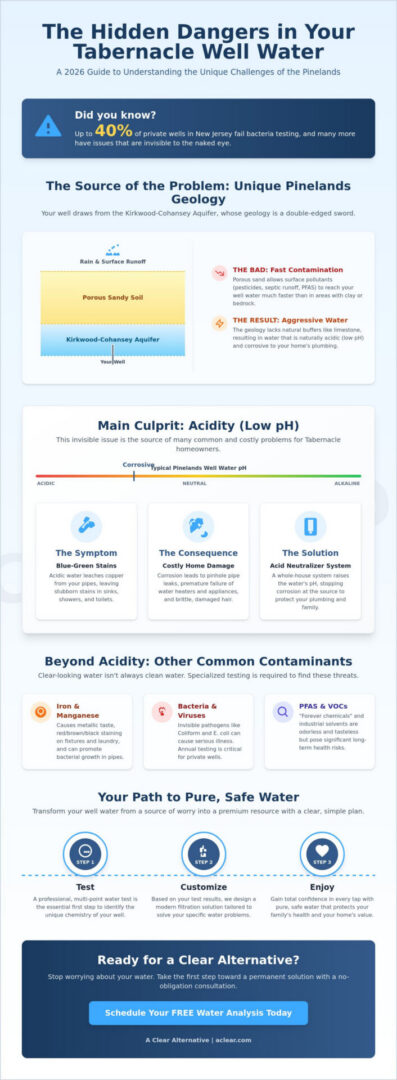
Your well draws from a unique geological feature. This aquifer system is remarkably shallow, often sitting just a few feet below the surface in some Pinelands areas. Because our local soil is dominated by porous sand, rainwater and surface runoff move downward with incredible speed. This rapid infiltration is a double edged sword. While it recharges our water supply quickly, it also means that surface pollutants can reach your well screen much faster than they would in the heavy clay or bedrock found in North Jersey. This geography makes Tabernacle wells highly sensitive to the local environment.
Private Wells vs. Municipal Water in South Jersey
Living with a private well offers a level of independence that “town water” users don’t have. You aren’t subject to rising municipal rates or large scale system failures. But this freedom comes with a duty. While city dwellers have teams of scientists monitoring their water 24/7, you have to be your own advocate. There is no federal oversight for your private well once it’s installed. Maintaining this “water freedom” requires a proactive mindset. Annual checks aren’t just a chore; they’re your primary tool for ensuring the high quality life you’ve built in the Pinelands remains protected from hidden contaminants.
The Pinelands Problem: Why Tabernacle Water is Naturally Acidic and Metallic
Living in Tabernacle means being surrounded by the unique beauty of the Pinelands National Reserve. While the cedar-colored streams are scenic, the chemistry beneath the soil is quite aggressive. The most common issue for local homeowners is low pH, or high acidity. This isn’t just a technical detail; it’s a constant chemical reaction happening inside your walls. Because our local geology lacks natural buffers like limestone, the water stays acidic as it moves through the ground and into your well.
This natural acidity is why the question of whether is Tabernacle well water safe to drink is so nuanced. While the water may be free of bacteria, its corrosive nature can lead to secondary safety issues. When water is too acidic, it becomes a solvent that eats away at everything it touches. This leads to a cascade of plumbing problems and aesthetic issues that affect your daily quality of life and your home’s long-term health.
The Blue-Green Stain: A Sign of Low pH
When acidic water sits in your copper pipes, it slowly dissolves the metal. This process, known as leaching, manifests as stubborn blue-green stains in your sinks, tubs, and toilets. It’s more than a cleaning headache. Over time, this corrosion thins your pipes, leading to costly pinhole leaks and destroying the heating elements in your water heater and dishwasher. If you’re tired of scrubbing stains and worrying about your plumbing, exploring modern acid neutralizer systems provides a permanent, hands-off fix that restores your water’s balance and protects your investment.
Iron and Sulfur: The Metallic Reality
Tabernacle water often carries a heavy load of iron and manganese. You might deal with ferrous iron, which looks clear at first but turns orange once it hits the air in your toilet bowl. Or you might see ferric iron, which comes out of the tap already discolored. Then there’s the “rotten egg” smell. This is caused by hydrogen sulfide gas or sulfur bacteria that thrive in the low-oxygen, acidic environments of South Jersey wells. These minerals create a significant lifestyle impact:
- Orange or brown staining on white laundry and linens.
- A metallic aftertaste that ruins the flavor of coffee and tea.
- Hair that feels “straw-like” and skin that feels dry or itchy after showering.
- Reduced water pressure as iron deposits build up inside your fixtures.
A comprehensive water analysis can pinpoint exactly which minerals are affecting your lifestyle and how to remove them for good, giving you back the pure water experience you deserve.
Beyond Bacteria: Understanding Secondary Contaminants and Long-Term Health
While the orange stains and sulfur smells we discussed earlier are obvious, the most critical factors in determining if is Tabernacle well water safe to drink are often the ones you can’t see, smell, or taste. Bacteria is a common concern, but in 2026, homeowners must look deeper into the chemical makeup of their supply. Modern contaminants and legacy plumbing issues can turn a “clear” glass of water into a long-term health risk. Your home should be your sanctuary; ensuring your water is truly pure is the foundation of that peace of mind.
The transition from “safe enough” to “high-quality” water involves identifying invisible threats like nitrates and PFAS. These substances don’t give you the warning signs that iron or sulfur do. They require a sophisticated approach to testing and filtration that matches the modern standards of South Jersey living. By taking control of these hidden variables, you move beyond basic compliance and into a lifestyle of total confidence in your family’s health.
The PFAS Factor in New Jersey
In 2026, PFAS (per- and polyfluoroalkyl substances) have become a primary focus for New Jersey health officials. These “forever chemicals” are notorious because they don’t break down in the environment or the human body. Because Tabernacle sits on the sandy, porous soil of the Pinelands, these chemicals move with startling speed into the groundwater. New Jersey has implemented some of the nation’s strictest standards for PFOA, PFOS, and PFNA, recognizing that even trace amounts can be significant. Installing whole house water filtration systems is the most effective way to intercept these modern contaminants, providing a digital-age solution for a complex environmental challenge.
Nitrates and Lead: The Silent Contaminants
Tabernacle’s proximity to agricultural areas in Shamong and surrounding towns introduces the risk of nitrate runoff from fertilizers. High nitrate levels in drinking water pose significant health risks for infants, potentially causing methemoglobinemia, or “blue baby syndrome,” which limits the blood’s ability to carry oxygen. This is a critical concern for growing families who rely on private wells.
Lead is another silent threat that often surprises homeowners. Even if your well water is lead-free at the source, the acidic water typical of the Pinelands can leach lead from older brass fixtures or lead solder in your home’s internal plumbing. You won’t know it’s there without a specific test. When you ask if is Tabernacle well water safe to drink, the answer depends as much on your home’s pipes as it does on the aquifer itself. Combining pH neutralization with advanced carbon filtration ensures that your water isn’t just safe at the well, but pure at the point of use.
The Step-by-Step Guide to Testing Well Water in Tabernacle
Determining whether is Tabernacle well water safe to drink isn’t a matter of guesswork or holding a glass up to the light. It’s a scientific process that gives you the data needed to protect your family. You start with professional well water testing to establish a baseline. This isn’t just about filling a single bottle. To get a true picture of your home’s health, samples should be collected from multiple points. Testing at the well head tells us what the aquifer is delivering. Testing at the kitchen tap reveals what your home’s plumbing might be adding to the mix, such as lead or copper from older pipes we discussed earlier.
Once the lab results arrive, you need to analyze the report for both Primary and Secondary standards. Primary standards focus on health risks like bacteria and nitrates. Secondary standards address the aesthetic issues that ruin your morning coffee or stain your laundry. In the unique geology of the Pinelands, these results require expert interpretation. A local specialist understands how to read between the lines of a laboratory report to create a personalized plan for your specific well.
When Should You Test Your Well?
Annual testing for bacteria and nitrates is the standard rule for every private well owner. However, certain trigger events should prompt an immediate check. If you notice a sudden change in taste, a new “rotten egg” smell, or if there’s significant local flooding, don’t wait for your annual date. The New Jersey Private Well Testing Act (PWTA) mandates comprehensive testing during real estate transactions. In Burlington County, this includes a specific analysis for mercury, which is a unique requirement for our local area. Landlords must also test every five years and provide those results to tenants to ensure ongoing safety.
Understanding Your Results
Laboratory reports use specific terms like “mg/L” (milligrams per liter) and “pH” to describe your water’s chemistry. The NJ DEP sets “Action Levels” for common South Jersey contaminants; if your water exceeds these, treatment is strongly recommended. It’s vital to remember that a “pass” on bacteria testing doesn’t automatically mean your water is high quality. Your water could be bacteria-free but still have a pH below 6.5, which is common in Tabernacle. This acidity will slowly destroy your appliances and leach metals into your drinking supply. High quality water is about more than just avoiding illness; it’s about achieving a premium standard for your home.
Ready to see what’s actually in your tap? Schedule your comprehensive water analysis today and get a clear, actionable plan for your home’s water quality.
A Clear Alternative: Modern Filtration Solutions for South Jersey Homes
The path to perfect water starts with a shift in perspective. Instead of asking if your supply meets a bare minimum standard, consider the “Personalized Water” concept. Every well in the Pinelands has its own unique chemical fingerprint. A one size fits all approach often fails because it doesn’t account for the specific mineral ratios or the aggressive acidity of the local aquifer. When you tailor treatment to your specific results, the question of whether is Tabernacle well water safe to drink becomes a secondary concern to the reality of having premium, high quality water at every tap.
For most Tabernacle residents, the first line of defense is a high performance acid neutralizer. As we explored in previous sections, the naturally low pH of our groundwater is a silent threat to your plumbing. A modern neutralizer doesn’t just stop the blue green staining; it acts as a protective shield for your water heater, dishwasher, and expensive fixtures. By balancing your water’s chemistry at the point of entry, you preserve your home’s value and ensure your plumbing lasts for decades. Choosing a local water treatment company that understands Pinelands geology is essential for setting these levels correctly.
The Power of Reverse Osmosis (RO)
If you want “bottled water quality” without the plastic waste, a Reverse Osmosis (RO) system is the gold standard. While whole house filters handle large scale issues, an RO system acts as a final, sophisticated barrier at your kitchen sink. It’s incredibly effective at removing the “unseen” contaminants we discussed earlier, including PFAS, lead, and nitrates. You’ll notice an immediate difference in the clarity of your ice cubes and the flavor of your cooking. Over time, the cost savings are significant. You can stop lugging heavy cases of water from the store and enjoy pure, crisp water directly from your own dedicated faucet.
Whole-House Iron and Sulfur Filtration
Nothing ruins a relaxing shower like the smell of rotten eggs or the sight of orange streaks on your tile. Modern iron and sulfur filtration systems have evolved significantly. We now utilize advanced air injection technology that oxidizes these minerals without the need for harsh chemicals or constant maintenance. These systems are designed to handle the heavy mineral loads common in South Jersey wells, providing a seamless lifestyle upgrade. A Clear Alternative has been the local expert for these specific NJ issues since 1991. We understand that your water isn’t just a utility; it’s the foundation of your home’s comfort and your family’s health.
Secure Your Family’s Health and Home with Expert Water Care
Your home in the Pinelands is a major investment, and your water quality is the heartbeat of that home. We have explored how the unique geology of the Kirkwood-Cohansey aquifer creates specific challenges, from corrosive acidity that damages your plumbing to hidden modern contaminants like PFAS. Understanding whether is Tabernacle well water safe to drink is the essential first step, but transforming that water into a premium resource is where your quality of life truly improves. You don’t have to settle for metallic tastes or blue-green stains when personalized, high-tech solutions are available right now.
Since 1991, our family-owned and operated team has specialized in the complex chemistry of South Jersey groundwater. We provide total water security through 24/7 emergency support and our status as licensed potable water haulers. Don’t leave your family’s health or your home’s infrastructure to chance. Schedule your comprehensive Tabernacle water analysis with A Clear Alternative today! It is time to enjoy the crisp, pure water your family deserves and the total confidence that comes with expert care.
Frequently Asked Questions
Is Tabernacle well water safe for babies to drink?
Your well water is only safe for babies if a certified lab has confirmed it is low in nitrates and lead. High nitrate levels from local agricultural runoff can cause methemoglobinemia, or “blue baby syndrome,” which is a serious condition for infants. Since Tabernacle sits near farming areas, you must verify these levels before using the water for formula or drinking.
Why does my Tabernacle well water smell like sulfur or rotten eggs?
This distinct odor is caused by hydrogen sulfide gas or sulfur bacteria that thrive in the low-oxygen environment of the Kirkwood-Cohansey aquifer. While the smell is off-putting, it usually doesn’t pose an immediate health risk. However, it significantly impacts your quality of life. An air-injection filtration system can effectively remove this gas and restore a fresh scent to your home.
How often should I test my well water in South Jersey?
You should test for bacteria and nitrates at least once every year to maintain a basic safety baseline. If you are a landlord in Tabernacle, New Jersey law requires you to conduct a comprehensive test every five years and share the results with your tenants. Regular testing is the only way to be certain if Tabernacle well water is safe to drink as environmental conditions change.
Can I use a Brita filter to make my Tabernacle well water safe?
No, standard pitcher filters are not designed to handle the specific chemical challenges found in Pinelands groundwater. They cannot neutralize the high acidity of our soil or remove heavy iron and sulfur loads. To effectively eliminate modern threats like PFAS or high nitrate levels, you need a professional-grade solution like a Reverse Osmosis system.
What causes blue-green stains in my Tabernacle sinks?
These stains are the result of acidic water leaching copper from your home’s internal plumbing pipes. The naturally low pH of Tabernacle groundwater makes it corrosive, which allows it to dissolve metal as it sits in your lines. This process doesn’t just leave stains; it eventually leads to pinhole leaks and destroys your water heater and dishwasher.
Does New Jersey require well water testing when selling a house?
Yes, the Private Well Testing Act (PWTA) mandates that all sellers or buyers of a property with a private well must test the water before closing. Both parties have to review the results for contaminants like lead, nitrates, and mercury. In Burlington County, mercury testing is a specific requirement that must be included in your laboratory report.
Is it safe to bathe in acidic well water?
It is generally safe for your skin, but the secondary effects of acidic water can be very frustrating. You might find that your hair feels brittle or your skin feels itchy and dry due to the dissolved metals the water carries. While it isn’t a medical emergency, neutralizing the water will improve your daily grooming routine and protect your bathroom fixtures from damage.
How much does a professional water test cost in Tabernacle?
A comprehensive, PWTA-compliant well water test in New Jersey typically costs between $1,200 and $1,500. This fee covers the extensive laboratory work required to check for bacteria, volatile organic compounds, and “forever chemicals” like PFAS. Investing in this professional analysis is the most reliable way to confirm if Tabernacle well water is safe to drink for your family.