
How to Fix Low Water Pressure in Your Shamong Well Water Home
That weak, trickling shower isn’t just an annoyance; it’s a sign that your home’s vital systems are struggling. You might assume a failing pump is to blame, but the truth is often much simpler. In many Shamong homes, low pressure is actually caused by sediment-clogged filtration or an outdated water softener rather than a total mechanical collapse. It’s stressful to watch your appliances take forever to fill while you worry about the cost of a major repair.
We understand that you want a home that runs smoothly and supports your daily comfort. Learning how to fix low water pressure in house with well Shamong systems doesn’t always require a massive investment. In this guide, we’ll help you identify the specific causes of your flow issues and provide step-by-step solutions to restore that refreshing, high-pressure experience. You’ll discover how to tell if your problem is a quick DIY fix or if it’s time to consult a local expert who understands the unique mineral makeup of Burlington County water.
Key Takeaways
- Distinguish between water pressure (PSI) and flow rate (GPM) to pinpoint whether your problem is a lack of force or a volume bottleneck.
- Master the basics of how to fix low water pressure in house with well Shamong setups by inspecting your pressure gauge and power connections first.
- Uncover how sediment buildup in filtration systems or acid neutralizers can silently kill your pressure even when your pump is healthy.
- Learn the specific sounds and symptoms that signal it’s time to bring in a professional for a submersible pump evaluation.
- Discover how modern upgrades like Constant Pressure Systems can transform your daily routine with consistent, high-performance water flow.
Understanding the ‘Shamong Squeeze’: PSI vs. Flow Rate
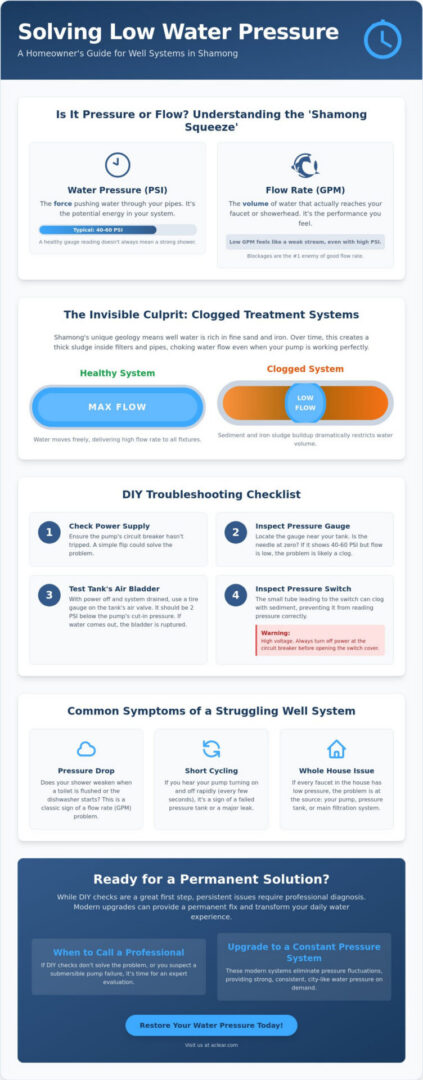
If you’ve lived in Shamong for any length of time, you’ve likely experienced the “Shamong Squeeze.” This happens when your basement gauge says everything is fine, but your kitchen faucet barely produces a stream. To understand how to fix low water pressure in house with well Shamong systems, you first need to distinguish between pressure and flow. Water Pressure (PSI) is the static force pushing water through your pipes. Think of it like the tension in a spring. Flow Rate (GPM) is the actual volume of water that makes it out of the tap. You can have high pressure but zero flow if something is blocking the path.
Most Well water systems in Burlington County use a pressure tank equipped with a gauge. Usually, these are set to cycle between 30-50 PSI or 40-60 PSI. If you head to your basement and look at the circular dial near the bottom of your tank, you’ll see where your system currently stands. If the needle is within those ranges but your shower is still weak, the issue isn’t the pump’s power. It’s a restriction somewhere in the line that’s stealing your comfort.
Why Shamong Wells Are Different
Shamong sits right in the heart of the Pine Barrens, which means our water travels through incredibly sandy soil. This fine sand often finds its way into your system. Additionally, high local iron levels can create a thick, orange “sludge” inside your pipes and filtration units. This buildup creates massive friction. Even if your pump is pushing at a perfect 50 PSI, that sludge mimics the symptoms of a failing pump by choking the flow before it reaches your bathroom. It’s a unique local challenge that requires a specific approach to maintenance.
Identifying the Symptoms of Low Pressure
Start with the “shower test.” Turn on your shower, then flush a toilet or start the dishwasher. If the shower pressure drops significantly, you have a flow rate issue. You should also check if the problem is localized. If the kitchen sink is fine but the master bath is weak, it’s likely a clogged aerator or a single pipe issue. However, if the whole house is struggling, your pressure tank might be “short-cycling.” This is when the pump turns on and off rapidly. It’s a clear sign that your system’s internal balance is off. Recognizing these signs is the first step toward a more comfortable, high-pressure lifestyle.
The DIY Troubleshooting Checklist for Shamong Homeowners
Before you assume your well pump has reached the end of its life, it’s essential to rule out simple mechanical failures. Learning how to fix low water pressure in house with well Shamong systems often starts with a flashlight and a bit of patience. Many pressure issues aren’t caused by a broken pump but by a system that has lost its internal balance. By following a logical checklist, you can identify if your problem is a minor adjustment or a sign that you need professional intervention.
Your first move should be checking the basics. Verify that the circuit breaker for your pump hasn’t tripped and that the power supply to your pressure switch is secure. Next, look at the pressure gauge located on the manifold near your well tank. In most Burlington County homes, this should show a steady reading between 30 and 50 PSI, or 40 and 60 PSI. If the needle is sitting at zero, your pump isn’t receiving power or has failed completely. However, if the gauge shows high pressure but your faucets are still trickling, the blockage is likely further down the line.
Testing Your Pressure Tank Air Bladder
A healthy pressure tank is the heart of a consistent home water experience. To test it, you must first turn off the power to the pump and drain the system by opening a nearby faucet. Use a standard tire gauge on the air valve at the top of the tank. The air pressure should be exactly 2 PSI below your pump’s “cut-in” setting. If water squirts out of the valve, the internal bladder has ruptured. This failure causes the pump to turn on and off too frequently, a process known as short-cycling, which can burn out your motor prematurely.
Inspecting the Pressure Switch
The pressure switch tells your pump when to start and stop. Over time, the small sensing tube that connects the switch to the water line can become clogged with the fine sand and iron sediment common in Shamong. This prevents the switch from “feeling” the actual pressure in the tank. Warning: The pressure switch contains high-voltage wiring. If you choose to remove the cover, ensure the power is completely disconnected at the breaker. Look for burnt or pitted contacts, which often resemble the worn-out points of an old car engine. If the contacts are black or the tube is packed with grit, the switch cannot function correctly.
Finally, check your main shut-off valves. Old-fashioned gate valves are notorious for breaking in a partially closed position, silently strangling your home’s flow. If your valves are clear, try bypassing your water treatment equipment. If the pressure suddenly returns to your shower, your filter media is likely clogged. To keep your system running beautifully, the EPA recommends annual well water testing to track sediment and mineral levels. If you find that your filtration is the culprit, a professional water system evaluation can help you decide if it’s time for a modern, high-flow upgrade.
The Invisible Culprit: Clogged Water Treatment Systems
Many Shamong residents begin their search for how to fix low water pressure in house with well Shamong by eyeing their well pump with suspicion. Yet, the true bottleneck is frequently sitting right in your utility room. Your water treatment equipment is designed to catch contaminants, but without consistent care, it becomes a literal wall that water cannot easily pass through. In our region, the fine sand of the Pine Barrens acts like a slow-motion clog. It gradually reduces your shower’s power until you’re left with a frustrating trickle.
A whole house water filtration system is an investment in your home’s health, but it requires regular backwashing to stay effective. Backwashing flushes out the trapped sediment and iron that would otherwise compact into a dense layer. When this process fails or the system is undersized, the pressure drop across the unit becomes significant. You might have 60 PSI at the tank, but only 20 PSI making it to your faucets. This hidden resistance is one of the most common causes of low flow in Burlington County homes.
Acid Neutralizers and Sediment Clogs
Shamong water is naturally acidic, which is why a high-quality acid neutralizer is a staple in local homes. These systems use Calcite media to raise your water’s pH level. Over time, these minerals can “brick” or solidify into a hard mass, especially if the system hasn’t been serviced in over a year. If you notice blue-green stains in your sinks alongside a sudden drop in pressure, your neutralizer is likely the culprit. Regular maintenance ensures the media remains loose and porous, allowing water to flow freely while protecting your copper pipes from pinhole leaks.
Water Softener Pressure Drops
High iron levels are another Shamong trademark. While softeners are great at removing hardness, they can suffer from iron fouling. This occurs when iron sludge coats the resin beads, preventing them from doing their job and physically blocking the water’s path. You can easily test this by using the Bypass Test. Locate the bypass valve on the back of your softener and turn it to the bypass position. If your water pressure immediately improves at the tap, you’ve found your bottleneck. While a water softener salt delivery service keeps your brine tank full, it won’t fix resin that has been physically damaged by years of iron buildup. In these cases, a professional resin cleaning or system upgrade is the only way to restore your home’s flow and your peace of mind.
When to Call a Professional for Well Pressure Issues
Sometimes, the DIY checklist isn’t enough to bring your home back to its full potential. If you’ve bypassed your filters and checked your breaker but the shower still feels like a light rain, you’re likely facing a mechanical or structural failure. This is where knowing how to fix low water pressure in house with well Shamong systems shifts from a weekend project to a professional diagnostic. A failing submersible pump often gives itself away through sound. If you hear grinding or a low, persistent humming coming from your well head or pressure tank, the motor is likely struggling against internal wear or electrical resistance.
Electrical issues are another common culprit that requires an expert touch. Your well’s control box or the deep-well wiring can degrade over time, especially in the moist environment of a basement or well pit. One of the most dangerous scenarios is a pump “running dry.” This happens when the water table fluctuates or the pump is incorrectly positioned, causing it to suck in air. This lack of lubrication quickly destroys internal impellers and can lead to a total system meltdown. If your pressure remains stubbornly low after checking the basics, it’s a sign that your home’s water “heartbeat” needs expert attention.
Professional Water Analysis
A professional diagnostic always begins with the water itself. Comprehensive well water testing is the only way to see the invisible minerals that are choking your flow. High concentrations of iron or manganese don’t just stain your tubs; they create systemic clogging that mimics a dying pump. At A Clear Alternative, we use detailed lab results to size filtration hardware correctly. This ensures your system can handle the specific mineral load of your property without sacrificing the water pressure you deserve for a modern, comfortable lifestyle.
Identifying Underground Leaks
Shamong’s unique soil conditions can be tough on infrastructure over the long term. If your pump runs constantly even when no taps are open, you likely have a leak in the “well line” between your house and the well head. The acidic nature of our local environment can lead to pipe corrosion over several decades. These underground leaks act as “pressure thieves,” stealing your flow before it ever reaches your front door. Finding and fixing these requires specialized equipment and a deep understanding of local well construction.
Don’t let a weak shower ruin your morning routine or cause unnecessary anxiety. If you’re tired of trickling taps and want a definitive solution, schedule a professional system evaluation today to restore the pressure and quality your home needs.
Long-Term Solutions for Consistent Water Pressure
Restoring your flow is just the beginning. To truly elevate your home’s quality of life, you need a system that delivers high performance every single day. If you’ve been searching for how to fix low water pressure in house with well Shamong, the ultimate answer often lies in modernizing your infrastructure. Moving away from traditional, fluctuating pressure tanks toward advanced technology ensures you never have to choose between running the dishwasher and taking a comfortable shower.
One of the most effective upgrades is installing larger diameter piping throughout your main distribution lines. This change reduces friction loss, which is the resistance water faces as it travels through your home. When combined with a twin-tank water softener, you guarantee an uninterrupted flow of treated water. Unlike single-tank units that may drop pressure during a regeneration cycle, twin-tank systems provide a seamless experience. Partnering with professional water treatment companies near me ensures these components are integrated perfectly into your property’s unique layout.
The Magic of Constant Pressure Systems
Imagine your well pump having its own “cruise control.” That is exactly what a Variable Frequency Drive (VFD) or Constant Pressure System does. Traditional pumps are either 100% on or 100% off, leading to noticeable dips in flow. A VFD controller monitors your water usage in real-time and adjusts the pump speed to match the demand. Whether you’re filling a large soaking tub or running a high-volume irrigation system for a Shamong estate, the pressure remains rock-solid. Since a well pump’s average lifespan is 10 to 15 years, upgrading to a VFD when your current pump nears that age is a smart, forward-thinking investment. It eliminates the annoying “pressure drop” when a toilet flushes, providing a premium water experience.
Preventative Maintenance Plans
Consistency requires care. A dedicated maintenance plan is the best way to avoid future emergencies and keep your pump from working harder than necessary. A professional “Flush and Fill” service for acid neutralizers prevents the Calcite media from solidifying, which is a major cause of flow restriction in Burlington County. Technicians should also inspect your pressure tank’s pre-charge annually. Keeping the air-to-water ratio perfect extends the life of your equipment and maintains the balance of your entire system. By staying proactive, you transform your water system from a source of anxiety into a reliable, invisible luxury that supports your modern lifestyle. This is the most sustainable way to address how to fix low water pressure in house with well Shamong once and for all.
Restore the Flow and Comfort Your Home Deserves
You shouldn’t have to plan your morning routine around a weak shower or appliances that take forever to fill. We’ve explored how distinguishing between static pressure and actual flow rate is the first step toward a solution. Whether the culprit is a sediment-clogged acid neutralizer or a pump that has reached the end of its lifespan, identifying the root cause is essential for a lasting fix. Learning how to fix low water pressure in house with well Shamong systems often comes down to choosing modern technology that is specifically designed for our unique South Jersey environment.
Since 1991, our family-owned team has been dedicated to helping neighbors achieve the high-performance water experience they deserve. We provide 24/7 emergency support for well failures and are licensed potable water haulers, ensuring you’re never left without a supply during a crisis. Don’t settle for a trickling tap when a modern, high-pressure lifestyle is within reach. Get a Professional Water Pressure Diagnostic in Shamong Today and take the first step toward a home that runs beautifully. Your comfort and peace of mind are just one expert evaluation away.
Frequently Asked Questions
Is it normal for well water pressure to fluctuate?
Minor fluctuations are a standard part of traditional well system operation. You’ll likely feel a slight dip in flow as the pressure tank empties before the pump kicks back in to refill it. However, if the changes are dramatic or your lights flicker when the pump starts, it’s a sign of an aging pressure tank or an electrical issue that needs attention.
How do I know if my well pump is going bad or if it’s just the tank?
Listen to the rhythm of your system. If the pump turns on and off rapidly every time you open a faucet, your pressure tank’s air bladder has likely failed. If the pump runs continuously but the gauge never reaches the “off” setting, or if you hear grinding noises from the well head, the pump itself is the likely culprit.
Can a clogged water filter cause low water pressure in the whole house?
Yes, a single clogged sediment filter or an unmaintained acid neutralizer can act as a bottleneck for your entire home. If you’re investigating how to fix low water pressure in house with well Shamong systems, always check your filtration units first. A simple filter change or media flush can often restore your flow without expensive mechanical repairs.
How much does it cost to fix low water pressure in Shamong?
The total cost depends on which component has failed. Industry data shows that well pump repairs generally range from $375 to $1,600, while a full pump replacement averages around $1,775. If the issue is limited to the pressure tank, replacement costs typically fall between $450 and $1,500. Minor electrical repairs or switch replacements are often much less expensive.
Can I increase my well water pressure by adjusting the switch myself?
We don’t recommend adjusting the pressure switch without professional guidance. While it’s possible to turn the adjustment nuts, doing so incorrectly can lead to a burst pressure tank or a burned-out pump motor. The switch also houses high-voltage wiring, which creates a significant safety risk if you aren’t trained to handle it.
Why does my water pressure start strong then fade away quickly?
This is a classic sign of a flow restriction, usually located in a water softener or iron filter. The pressure tank provides an initial burst of pressurized water, but once that small reserve is used, the water can’t pass through the clogged filter media fast enough to keep up. Bypassing your treatment system can help confirm this diagnosis.
Does a water softener affect water pressure?
A healthy water softener should have a negligible impact on your flow. However, if the internal resin beads become fouled with iron or sediment, they physically block the water’s path. This creates a significant pressure drop across the unit. Regular maintenance and using the correct resin cleaners can prevent this from strangling your home’s water supply.
What is the ideal PSI for a house with a well in South Jersey?
Most residential well systems in our area are designed to operate between 40 and 60 PSI. This range offers a perfect balance, providing enough force for invigorating showers and efficient appliance use without stressing your pipes. If you desire a perfectly steady stream that never wavers, a constant pressure system is the modern solution to explore.