
How Much Does Bulk Water Cost? 2026 Price Guide for NJ & PA
You’re staring at a bone-dry well or a massive, empty pool liner, and the only thing on your mind is getting it filled before the weekend. It’s an urgent situation that shouldn’t be complicated by confusing math or hidden delivery fees. If you’re wondering how much does bulk water cost in 2026, you’ve likely realized that the price isn’t just about the liquid itself. It’s a combination of volume, distance, and the peace of mind that comes with certified potability.
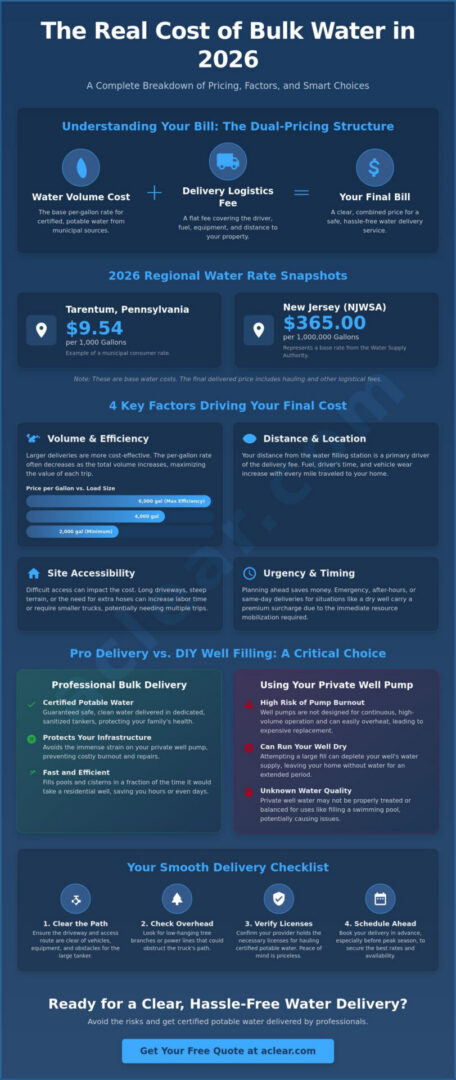
We understand that clarity is just as important as the water. Whether you’re in Pennsylvania facing Tarentum’s $9.54 per thousand gallon rate or in New Jersey where the Water Supply Authority has set a total rate of $365.00 per million gallons for FY2026, the logistics of delivery add another layer. This guide simplifies the process. We’ll walk you through the current regional tariffs, explain why “cheap” water can sometimes cost more in the long run, and show you how to secure a fast, hassle-free delivery that keeps your home running and your water safe.
Key Takeaways
- Understand the dual-pricing structure of bulk water, which balances the base cost of certified potable water with the logistical fees of hauling.
- Discover how much does bulk water cost in 2026 by evaluating regional rate shifts and the impact of delivery distance on your final bill.
- Protect your home’s infrastructure by weighing the convenience of professional hauling against the high risk of burning out a private well pump.
- Ensure a seamless delivery day by preparing your property for large tanker access and verifying your provider’s potable water licenses.
- Learn how scheduled deliveries and volume efficiency can significantly reduce your total investment compared to emergency top-offs.
Understanding Bulk Water Pricing: Fees vs. Gallonage
Planning your home maintenance shouldn’t feel like a guessing game. When you start investigating how much does bulk water cost, it’s helpful to look at the bill as two distinct parts. You aren’t just buying a commodity; you’re investing in a specialized delivery service. The final price you see is a balance between the volume of water you need and the logistics required to get it into your pool or cistern safely.
Potable water hauling is the backbone of this service. This isn’t just “water in a truck.” It’s the transport of certified safe drinking water in tankers dedicated exclusively to that purpose. These vehicles meet strict health standards to ensure that every gallon remains as pure at your home as it was at the source. This level of care is what separates professional hauling from simple construction-grade water transport.
Efficiency drives the industry. Most tankers are built to carry between 2,000 and 6,000 gallons per trip. Because the operational costs of the truck remain the same regardless of how full it is, haulers use a “minimum load” concept. If your project only requires a small top-off, you’ll usually still pay for the truck’s minimum capacity. However, there’s a silver lining: per-gallon rates often drop significantly as your order volume increases, rewarding you for larger fills.
The Delivery Fee and Minimums
The delivery fee is a flat charge that covers the driver’s expertise, fuel, and the maintenance of heavy-duty equipment. Companies charge this fee because the biggest expense isn’t the water; it’s the time and energy spent moving a 30-ton vehicle to your property. Your distance from the filling station is the primary factor here. A delivery to a remote corner of New Jersey or Pennsylvania will naturally carry a higher hauling fee than a drop-off just a few miles away. In 2026, industry minimums reflect these rising operational costs, ensuring that every delivery is handled with the proper equipment and safety protocols.
Per-Gallon Rates for Potable Water
Water is priced as a commodity, and those rates are set by the municipal sources that provide it. The broader U.S. Water Supply and Sanitation network determines these base costs. Potable water always costs more than non-potable alternatives because it undergoes extensive filtration and testing. You’re paying for the peace of mind that your family is swimming in or drinking water that is free from contaminants. Bulk water costs are a calculated combination of the source price per gallon and the logistical overhead required to get that water to your location.
Key Factors That Influence Your Final Bill
You’ve seen the base rates, but your final invoice depends on the unique details of your property and your timeline. It’s rarely a one size fits all calculation. When you ask how much does bulk water cost, you’re really asking about the total logistics of moving a massive volume of liquid to a specific spot in your yard. Whether you live in the wooded outskirts of Tabernacle or a lakeside home in Medford Lakes, the geography of your delivery plays a starring role in the final price.
Distance is the most obvious variable. Every mile the tanker travels from the filling station adds to the fuel consumption and the driver’s time. The Economics of Bulk Water Transport confirm that logistical overhead often outweighs the cost of the water itself. This is why local expertise matters. A provider who knows the South Jersey and Pennsylvania backroads can often navigate more efficiently than a long distance hauler who might struggle with regional weight limits or bridge restrictions.
Logistics and Site Accessibility
The path from the street to your pool or cistern isn’t always a straight line. If your delivery requires extra hose lengths to reach a backyard pool, it increases the labor time for the setup and breakdown. In rural South Jersey, long, narrow driveways or steep terrain can prevent a standard tractor trailer from getting close to the drop off point. This might require a smaller 10 wheeler truck, which carries less volume and could necessitate multiple trips. You can keep costs down by clearing low hanging branches and ensuring the driver has a wide, stable path to work with before they arrive.
Time-Sensitive and Emergency Surcharges
Timing is everything. A scheduled pool fill booked weeks in advance is the most cost effective way to manage your water needs. If you wait until the peak of the summer heat, you might encounter seasonal demand surcharges. On the other hand, emergency water hauling for a dry well is a different priority. When your home loses water entirely, the value shifts from “convenience” to “necessity.” 24/7 support for commercial facilities or homes in crisis involves rapid mobilization, which naturally carries a premium over a planned delivery. To secure the best rate for your project, consider booking your Bulk Potable Water Delivery early in the spring season.
Bulk Delivery vs. Filling from a Private Well
It’s tempting to think that “free” water from your own backyard is the ultimate budget hack. You just drop the garden hose into the pool, turn the spigot, and walk away. But this convenience often masks a series of expensive risks that can dwarf the price of a professional delivery. When you’re weighing how much does bulk water cost, you’ve got to compare the upfront fee of a tanker truck against the potential for a multi-thousand dollar plumbing disaster.
Residential well systems aren’t designed for high-volume, continuous output. Filling a 20,000-gallon pool from a standard well requires the pump to run for 24 to 48 hours straight. This is a mechanical marathon that can lead to catastrophic failure. Beyond the mechanical strain, over-taxing your well can cause “sediment pull.” This happens when the water level drops rapidly, drawing up sand, grit, and minerals from the bottom of the aquifer. If you’re determined to use your own source, starting with well water testing is a non-negotiable first step to understand what you’re actually pumping into your pool.
Equipment Wear and Tear Costs
Replacing a deep well pump in 2026 is a major financial hit. When you factor in the labor of a licensed plumber and the cost of the unit itself, you’re often looking at a bill that far exceeds the cost of several water deliveries. High-volume pumping also wreaks havoc on your home’s treatment equipment. Pushing massive amounts of raw water through iron and sulfur filtration systems can saturate the media and clog control valves. It’s a classic case of a “free” resource ending up costing a fortune in avoidable repairs. While Understanding Bulk Water Pricing helps explain municipal rate structures, the true cost of DIY filling is found in the shortened lifespan of your home’s infrastructure.
Water Quality: Hauled vs. Ground Water
Hauled water offers a level of chemical predictability that raw well water simply cannot match. Municipal sources are pre-balanced and filtered, making it significantly easier to stabilize your pool’s chemistry after the fill. This is especially critical for new pool liners, which are sensitive to mineral imbalances. Hauled water eliminates the risk of permanent staining caused by acidic or mineral-heavy well water. You get a crystal-clear result from day one, allowing you to focus on enjoying your investment rather than fighting a losing battle against brown or green tints.
Preparing for Your Bulk Water Delivery in NJ & PA
A successful water delivery is about more than just a truck showing up at your curb. It’s a coordinated effort that ensures your property remains protected and your water stays pure. Before you finalize your plans and ask how much does bulk water cost for your specific project, you need to verify the credentials of your provider. In New Jersey and Pennsylvania, potable water hauling is strictly regulated. For instance, the Township of Lower Municipal Utilities Authority requires specific agreements approved by the NJ Department of Environmental Protection for bulk sales in 2026. Always confirm your hauler is licensed to transport drinking water to avoid contamination risks.
Preparation is the key to a stress free experience. You’ll need to clear a wide, stable path for the delivery vehicle. Most professional haulers use 10 wheelers or full tractor trailers, which can weigh upwards of 30 tons when fully loaded. Having someone on-site is essential. You’ll want to direct the driver to the exact fill point and ensure the hoses won’t cross delicate landscaping or block neighbors. This simple step prevents delays and ensures the job is done right the first time.
How to Calculate Your Gallonage
Knowing your exact needs prevents the mid-delivery realization that you’re short on water. For a rectangular pool, multiply the length by the width and then by the average depth. Multiply that result by 7.48 to get the total gallons. For round pools, multiply the diameter by the diameter, then by the average depth, and finally by 5.9. If you’re filling a residential cistern, check the manufacturer’s plate for the maximum capacity. It’s always better to over estimate slightly. Ordering a full tanker is usually more cost effective than calling for a second, smaller “top off” trip later.
Driveway and Property Requirements
Heavy water trucks require a solid foundation. If your driveway is made of thin asphalt or has soft edges, the weight of a 6,000 gallon tanker could cause cracking. Communicate any concerns about terrain or weight limits to your provider during the quoting process. Look up for a moment, too. Low hanging tree branches or low power lines can obstruct a large truck. By checking the distance from the street to your fill point, you can help the team bring the right amount of hose. If you’re ready to schedule your high quality fill, reach out for a Bulk Potable Water Delivery to get started with a professional team.
Reliable Bulk Water Solutions with A Clear Alternative
A Clear Alternative has been a cornerstone of the Tri-State area since 1991. We’ve spent over three decades perfecting the art of water delivery, focusing on the specific needs of families in New Jersey and Pennsylvania. We don’t just move liquid from point A to point B. We provide a modern, aesthetic focused service that prioritizes your peace of mind and your home’s infrastructure. When you reach out to ask how much does bulk water cost, you won’t get a vague estimate. You’ll receive a transparent, professional quote based on your exact location and the volume required for your project.
Our expertise extends across every residential and commercial need. Whether you’re filling a brand new swimming pool, topping off a cistern, or facing a dry well emergency, our team handles the logistics with precision. We’ve integrated our hauling with a comprehensive pool water delivery service to ensure that your summer starts without a hitch. We believe that professional service should be direct, encouraging, and entirely hassle free.
Why Choose a Licensed Potable Hauler?
There is a massive difference between “clean” water and certified potable water. Clean water might look clear, but certified potable water meets rigorous health standards for human consumption and contact. Our commitment to these standards is unwavering. We maintain strict tanker sanitation protocols to ensure every drop is safe for your family. This isn’t just about filling a tank; it’s about protecting your health. Families filling swimming pools or drinking water cisterns deserve the confidence that only a licensed potable hauler can provide. Safety isn’t a suggestion here. It’s our standard.
Beyond Delivery: Total Water Care
Our relationship with your water doesn’t end when the truck pulls away. We understand that hauled water is just one part of your home’s ecosystem. If you’re managing a private well, we support your long term water quality with specialized equipment like an acid neutralizer or advanced filtration systems. This ensures that once your pool or tank is filled, the water remains balanced and clear. We also offer 24/7 emergency support for residential wells and commercial sites because we know that water crises don’t follow a schedule. We’re here to make your life easier and your water better. Let’s get your project started today.
Get a Bulk Water Delivery Quote Today
Secure Your Water Supply with Professional Confidence
Managing your home’s water needs shouldn’t be a source of stress. We’ve explored how the dual nature of pricing, which balances gallonage with hauling logistics, determines how much does bulk water cost in 2026. By choosing professional delivery over the risks of over-taxing a private well, you’re protecting your property’s long-term value and ensuring your family has access to certified potable water. Efficiency and safety are the hallmarks of a modern water solution that respects your time and your infrastructure.
A Clear Alternative has provided expert, family-owned service across NJ, PA, NY, and DE since 1991. As a licensed potable water hauler, we prioritize your health and convenience, offering 24/7 emergency support when you need it most. Don’t leave your pool fill or cistern top-off to chance. Take the next step toward a crystal-clear experience today with a team that understands the nuances of regional water delivery.
Request an Accurate Bulk Water Quote for Your NJ or PA Home
We’re ready to help you refresh your home with the speed, reliability, and professional care you deserve.
Frequently Asked Questions
How many gallons of water does a standard tanker truck hold?
Most standard tanker trucks used for residential delivery hold between 2,000 and 6,000 gallons of water. Smaller 10 wheeler trucks are often utilized for properties with tighter access or weight restricted driveways. Larger tractor trailers handle high volume fills for commercial sites or large swimming pools. Knowing these capacities helps you determine if your project requires a single trip or multiple loads.
Is it cheaper to fill a pool with a garden hose or a water truck?
A garden hose might seem cheaper on your monthly utility bill, but a water truck is often the more cost effective choice when you factor in long term risks. Using a hose can take days, putting immense strain on your well pump and filtration system. A professional delivery provides pre balanced, filtered water instantly. This prevents the “hidden” expenses of equipment repairs and heavy chemical corrections.
Can bulk water delivery trucks reach my backyard pool?
Trucks typically remain on a solid driveway or the street to avoid damaging your lawn or underground utilities. Drivers use heavy duty, long range hoses to reach backyard pools or cisterns located far from the curb. It’s vital to communicate the exact distance from the truck’s parking spot to your fill point. This ensures the team arrives with enough hose to complete the job safely.
What is the average cost per gallon for bulk potable water in NJ?
The base price for water is set by municipal tariffs, like the NJ Water Supply Authority’s 2026 rate of $365.00 per million gallons. When you’re calculating how much does bulk water cost for a home delivery, the per gallon rate includes the hauling fee, fuel, and labor. Prices vary based on your distance from the filling station and the total volume of your order.
How long does it take to unload a 6,000-gallon water tanker?
Unloading a full 6,000 gallon tanker usually takes between 30 and 45 minutes once the hoses are connected. High capacity pumps on the truck move the water quickly, making it a much faster alternative to the 24 to 48 hours required for a hose fill. The total time on site includes setup and breakdown, so you can expect the truck to be there for about an hour.
Is the water delivered by bulk trucks safe for drinking?
Yes, water from a licensed potable hauler is certified safe for drinking and cooking. These tankers are dedicated exclusively to potable water and undergo strict sanitation and inspection protocols required by state health departments. This level of certification gives you peace of mind that the water entering your pool or cistern meets the same safety standards as the water from your kitchen tap.
What happens if I order too much water for my cistern?
If you order a volume that exceeds your tank’s capacity, the driver will stop the pump once the cistern is full. However, you’ll generally still be charged for the full load or the minimum delivery fee agreed upon during the quote. Accurate measurements are the best way to manage how much does bulk water cost for your project and avoid paying for water you can’t use.
Do I need to be home for my bulk water delivery?
We strongly recommend that someone is on site to direct the driver to the correct fill point and oversee the property logistics. Being present allows you to confirm the delivery is completed to your satisfaction and ensures the driver can navigate your driveway safely. It’s a simple way to guarantee a professional, hassle free experience that protects your landscaping and your home’s infrastructure.