
How Does a Water Softener Work? The 2026 Guide to Soft Water in South Jersey
Did you know that the moderately hard water flowing through South Jersey taps can slash your water heater’s lifespan by up to 30%? It’s a hidden tax on your home that manifests as high energy bills and white, crusty buildup on your favorite fixtures. You’ve likely noticed your skin feeling itchy or your hair looking dull after a shower, even when using premium products. It’s a frustrating reality for many families in Tabernacle and Shamong, but it’s one you can easily change.
We believe your home should be a place of comfort and confidence. This guide explains exactly how does a water softener work to transform your daily routine. Through a smart process called ion exchange, these systems swap out damaging minerals for clean, soft water that protects your investment. You’ll learn the step by step science behind this technology and how it shields your appliances from premature failure. We’ll also preview how modern softening solutions provide the aesthetic and lifestyle benefits you deserve in 2026.
Key Takeaways
- Understand how calcium and magnesium impact your home’s longevity and your daily beauty routine.
- Discover exactly how does a water softener work by using ion exchange technology to swap harsh minerals for gentle, soft water.
- Identify the key components of a modern softening system and how they work together to protect your expensive appliances.
- Learn about the regeneration cycle, the vital process that keeps your system refreshed and performing at its peak.
- See why professional water testing in South Jersey is the essential starting point for a customized home solution.
The Science of Softening: Why Your South Jersey Water Needs Help
South Jersey water, particularly for those of us in Tabernacle or Shamong, has a unique personality. It’s often rich in minerals like calcium and magnesium, which are essentially “invisible rocks” flowing through your pipes. While the median tap water hardness in New Jersey is approximately 5.1 grains per gallon (GPG), local well water often tests much higher. Understanding The Science of Softening is the first step toward reclaiming your home’s water quality and your own comfort.
You might find yourself asking, how does a water softener work to fix these issues? At its core, the system acts as a sophisticated gatekeeper. It identifies these heavy minerals and removes them before they can reach your kitchen tap or showerhead. By the time the water touches your skin, those abrasive elements are gone, replaced by water that feels light and behaves exactly as it should. This isn’t just about plumbing; it’s about upgrading the fundamental foundation of your daily life.
Understanding Hard Water Minerals
Hardness is measured in grains per gallon (GPG). This represents the actual weight of dissolved calcium and magnesium in your water. These minerals are incredibly stubborn. They don’t just “wash away” when you use soap. Instead, they react chemically with soap to create a sticky, grey curd. This reaction is why you see that stubborn white film on your glass shower doors and why your laundry often feels stiff or scratchy. In South Jersey, where we also deal with low pH and iron in Medford Lakes, these minerals can become even more difficult to manage without the right technology.
The ‘Invisible’ Damage to Your Home
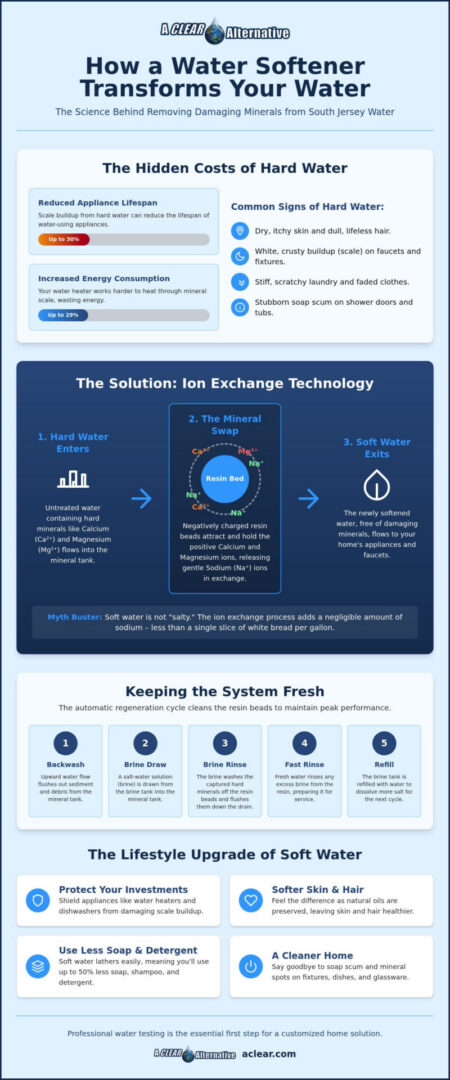
The real damage happens where you can’t see it. Inside your water heater, scale buildup acts as a thick layer of insulation. This forces the unit to work up to 29% harder just to reach the temperature you’ve set on the dial. Over time, this constant strain can reduce the lifespan of your water-using appliances by up to 30%. It’s a quiet, expensive drain on your household budget.
Beyond the pipes, hard water affects your personal aesthetic and self-care. It strips the natural, protective oils from your skin and hair. This often leads to that dry, itchy sensation that no amount of expensive moisturizer can quite solve. For a comprehensive solution that addresses these mineral challenges along with other local contaminants, many residents choose to invest in Whole House Water Filtration Systems. These systems ensure every drop of water in your home is as soft and pure as possible.
The Ion Exchange Process: How a Water Softener Actually Works
So, how does a water softener work in practice? While it might look like a simple tank, the interior is a high-tech environment designed for a specific chemical trade. The secret lies in a process called ion exchange. Think of it as a microscopic trade-off where the system selectively removes the minerals you don’t want and replaces them with something much gentler. This ensures your South Jersey home enjoys the luxury of soft water without the constant battle against scale.
As hard water enters the mineral tank, it flows through a dense bed of resin beads. These beads act like magnets, pulling the positively charged calcium and magnesium ions out of the water. This ion exchange process ensures that by the time the water leaves the tank, it’s stripped of the hardness that causes skin irritation and plumbing clogs. It’s a fast, efficient, and completely automatic solution for your household.
The Resin Bead: The Heart of the System
The real heroes of this process are the resin beads. These are tiny, negatively charged plastic spheres. Because opposites attract, the negative charge on the beads pulls in the positive mineral ions like a magnet. These beads are incredibly durable. With professional maintenance and the right local water conditions, they can last for many years. They don’t just sit there; they actively grab onto the “invisible rocks” that would otherwise ruin your appliances.
The Sodium Swap
A common question we hear is whether soft water tastes salty. It’s a common misconception. The system doesn’t “add salt” to your water in the way you’d season a meal. Instead, it performs a precise swap. For every mineral ion the bead catches, it releases a tiny sodium ion. The amount of sodium added is negligible. In fact, most soft water contains less sodium than a single slice of bread, making it perfectly fine for most diets.
It’s also vital to understand that a softener is not a simple filter. It doesn’t just trap dirt or sediment; it chemically alters the water’s mineral profile. If you’re looking to remove things like chlorine or lead in addition to softening, you might consider pairing your unit with a Reverse Osmosis System for the ultimate in purity. This combination offers a premium water experience for every tap in your home.
Ready to see the difference for yourself? You can start by scheduling a professional water test to see exactly what’s in your South Jersey supply.
Anatomy of a Softener: Key Components and Their Roles
To truly understand how does a water softener work, you have to look past the sleek exterior. Every system is a carefully engineered partnership between three primary components. These parts work in total harmony to ensure you have soft, luxurious water available at every tap, 24 hours a day. When these elements are sized and programmed correctly for the specific mineral levels in South Jersey, the result is a seamless experience that protects your home without you ever having to think about it.
The Mineral Tank vs. The Brine Tank
The mineral tank is the workhorse of the system. It’s directly connected to your home’s main water line. As water enters your house, it’s routed into this tank to pass through the resin bed. This is where the actual softening happens. The tank is designed to handle the constant pressure of your plumbing while providing enough surface area for the ion exchange to occur efficiently. It’s the silent protector of your pipes and fixtures.
Standing next to it is the brine tank. This is a shorter, wider reservoir that holds your salt pellets or potassium. Its job is to create a highly concentrated salt solution used during the cleaning cycle. Without a steady supply of salt, the resin beads eventually lose their “magnetic” charge. This is why many families in Medford Lakes and Shamong rely on a professional Water Softener Salt Delivery service. It removes the heavy lifting from your routine and ensures your brine tank is always ready for the next cycle.
The Control Valve: The Brain of the System
If the tanks are the body, the control valve is the brain. Usually sitting right on top of the mineral tank, this digital command center manages every drop of water that moves through the system. Modern valves are incredibly sophisticated. They track your household’s water usage in real time to determine exactly when the resin needs to be refreshed. This is known as demand-based or meter-based regeneration, and it’s far more efficient than the old-fashioned time-clock systems that ran on a set schedule regardless of use.
A professional setup is vital here. We program the valve based on your specific grains per gallon (GPG) hardness level. In South Jersey, where hardness can vary significantly between Tabernacle and Medford, this precision is what prevents salt waste. A correctly calibrated valve ensures the system only regenerates when absolutely necessary. This saves you money on salt and water while maximizing the life of your resin beads. It’s the difference between a generic appliance and a custom-tuned water solution.
The Regeneration Cycle: How the System Cleans Itself
Regeneration is the system’s way of hitting the reset button. After days of swapping ions, the resin beads inside the mineral tank eventually become saturated with calcium and magnesium. They simply don’t have any room left to hold more minerals. This is where the regeneration cycle takes over. It’s a multi-stage cleaning process that ensures your water remains soft and your system stays efficient. Without this cycle, the ion exchange process would eventually stop working altogether.
Understanding how does a water softener work during this phase helps you appreciate the automation behind your home’s comfort. The system uses a concentrated salt solution to “recharge” the resin. This solution is powerful enough to break the bond between the minerals and the beads, allowing the system to flush the hardness away. The wastewater is then safely discharged through a dedicated drain line, leaving your resin beads refreshed and ready for another round of softening.
Backwashing and Brine Draw
The cycle begins with backwashing. The control valve reverses the water flow to flush out any dirt or sediment that might have been trapped in the resin bed. This is especially important for South Jersey homes on well water, where fine particles can often find their way into the plumbing. By loosening the resin bed, the system ensures the cleaning solution can reach every single bead.
Once the bed is clean, the brine draw begins. The system pulls the concentrated salt solution from the brine tank into the mineral tank. This is the core of how does a water softener work during its maintenance phase. The high concentration of sodium in the brine is strong enough to “knock” the calcium and magnesium ions off the resin beads. These minerals are then carried away in the wastewater and safely discharged into your home’s drain system, far away from your drinking water.
Rinsing and Service Restoration
After the minerals are flushed out, the system enters the slow rinse phase. This ensures that every bit of brine and mineral debris is moved completely through the resin bed. It’s a thorough, precise step that guarantees no salty taste lingers in your pipes. We focus on this precision to ensure your water quality remains consistent and refreshing.
Next comes the fast rinse. The valve directs a high-velocity stream of water through the tank to pack the resin beads back down into a tight, effective bed. This prepares the system to return to “service” mode, where it can once again provide soft water to your household. The final step is the brine tank refill, where the system adds a precise amount of water back into the brine tank to dissolve more salt for the next cycle. If you want to ensure your system is running at peak efficiency, you can schedule a professional system checkup with our expert team today.
Choosing the Right System for Tabernacle, Shamong, and Medford Lakes
Understanding how does a water softener work is only half the battle. The real secret to a maintenance free lifestyle is choosing a system tailored to the specific chemistry of your South Jersey home. In areas like Tabernacle and Shamong, water quality isn’t just about hardness. We often deal with a complex mix of low pH, iron, and sulfur that can overwhelm a generic, off the shelf unit. A professional approach ensures your system doesn’t just work; it thrives in our unique local environment.
Local water testing is the non negotiable first step in this process. Since the median tap water hardness in New Jersey is 5.1 grains per gallon (gpg), many homeowners assume a standard model will suffice. However, private wells in the Pine Barrens often exceed these levels significantly. Without a precise analysis, you risk installing a system that regenerates too often, wasting salt and water, or one that fails to remove the iron that leaves orange stains on your pristine white porcelain.
Sizing Your System Based on Local Water
Sizing isn’t just about the physical footprint of the tank. It’s about “daily grain capacity.” To find the right fit, we calculate your household’s total daily hardness load. This involves multiplying the number of people in your home by the average water usage and then by your specific hardness level. A “one size fits all” approach often leads to hard water leaks during high usage times or unnecessary wear on the resin beads. For a deeper look at what might be hiding in your supply, check out our guide to Well Water Testing in Tabernacle.
For Medford Lakes residents, we also look for specific contaminants like iron and manganese, which were found in over 15% of local wells in recent decades. If your water has a “rotten egg” smell or metallic taste, a standard softener might need to be paired with one of our specialized Iron and Sulfur Filtration Systems. This layered approach is how does a water softener work best, protecting your appliances and your family’s comfort simultaneously.
The A Clear Alternative Difference
Choosing a water treatment partner is about more than just the equipment. It’s about trust and longevity. A Clear Alternative has been a family owned and operated staple in the Tri State area since 1991. Unlike national franchises with rotating staff, we bring decades of local expertise to every installation. We understand the nuances of the Cohansey Aquifer and the specific challenges faced by South Jersey homeowners.
We provide 24/7 emergency support because we know that water issues don’t always happen during business hours. Our goal is to make your water quality an afterthought by providing a system that is discreet, efficient, and perfectly tuned to your needs. You deserve the confidence that comes with professional grade water. Schedule your professional water analysis today and take the first step toward a clearer, softer home experience.
Reclaim Your Home’s Comfort and Style
Soft water is a fundamental upgrade for your modern lifestyle. It’s the difference between scratchy laundry and vibrant fabrics; between dry, itchy skin and a healthy, hydrated glow. Understanding exactly how does a water softener work gives you the clarity to stop fighting stubborn mineral buildup and start enjoying your home again. By choosing a system tuned to the specific needs of South Jersey, you ensure every appliance runs at peak performance while your plumbing remains scale-free for years to come.
We’ve been family-owned and operated since 1991, providing reliable 24/7 emergency support to our neighbors across NJ, PA, NY, and DE. As a licensed potable water hauler, we bring a deep level of expertise to every home we serve. Don’t settle for mediocre water when a premium, aesthetic experience is just a professional test away. We’re ready to help you transform your daily routine with a solution that’s as sophisticated as it is effective.
Get Your Water Tested by South Jersey’s Trusted Experts
Frequently Asked Questions
Is soft water safe to drink?
Soft water is safe for most people to drink. If you’re wondering how does a water softener work in relation to your health, the answer is simple. The process adds a tiny amount of sodium, but it’s usually less than what you find in a single slice of bread. For those on strictly sodium-restricted diets, we recommend adding a Reverse Osmosis System to your kitchen tap. This ensures your Tabernacle home enjoys perfectly soft water everywhere.
How much salt does a water softener add to my water?
The amount of sodium added depends entirely on your water’s initial hardness. For every grain of hardness removed, about 8 milligrams of sodium are added per liter. Understanding how does a water softener work helps clarify that the salt is used to clean the resin, not to season your water. In Shamong, where hardness varies, this increase is usually negligible. It’s a small trade-off for protecting your home’s expensive plumbing and fixtures.
How long does a water softener last?
A high-quality water softener typically lasts between 10 and 15 years. With professional maintenance and regular system checkups, some units in Medford Lakes have performed well for 20 years or more. Factors like local water chemistry and the frequency of the regeneration cycle play a big role in this longevity. Since we’ve served the area since 1991, we’ve seen how proper care significantly extends the life of these essential home investments.
Can I use potassium chloride instead of salt?
You can absolutely use potassium chloride as an alternative to traditional salt pellets. It works identically in the ion exchange process but releases potassium instead of sodium. This is a popular choice for South Jersey homeowners who are conscious of sodium intake or those who want to be even more eco-friendly. Just keep in mind that potassium pellets are generally more expensive and may require slight adjustments to your control valve settings for peak efficiency.
How do I know if my water softener is working correctly?
The easiest way to tell is by observing your water’s behavior. You’ll notice rich, bubbly lather from your soap and a lack of white, crusty scale on your showerheads. If you start seeing spots on your glassware or feel “sticky” after a shower, your system might need a checkup. We recommend a quick professional water test if you suspect your unit isn’t performing its mineral exchange effectively to keep your home protected.
Does a water softener remove iron or lead?
Standard softeners can remove small amounts of “clear water” iron, but they aren’t designed to handle lead or heavy iron loads common in Shamong wells. To address lead, we typically recommend a Carbon Filtration System or Reverse Osmosis. If your water has a metallic taste or leaves orange stains, we often pair a softener with one of our specialized Iron and Sulfur Filtration Systems for complete, 24/7 protection of your water quality.
What happens if I run out of salt in my softener?
If your brine tank goes empty, your water will simply turn hard again. The system won’t be able to “recharge” the resin beads during the next regeneration cycle, so the minerals will pass right through into your home. It won’t damage the unit immediately, but you’ll quickly notice the return of dry skin and scale buildup. Our salt delivery service is a great way to ensure you never have to worry about this inconvenience.
Do I need a water softener if I am on city water in NJ?
Yes, city water in South Jersey is often classified as “moderately hard.” While municipal plants treat for safety, they don’t always remove the minerals that cause scale and skin irritation. Installing a softener ensures your modern fixtures and high-end appliances stay protected from the long-term damage city water can cause. It’s a smart lifestyle choice that improves your water quality far beyond the basic standards set by your local township or municipality.