
Commercial Water Softener Installation in Tabernacle, NJ: The 2026 Business Guide
Could the water flowing through your building be the invisible factor quietly eroding your profit margins? While Tabernacle is famous for its Pinelands beauty, the specific water chemistry here can be surprisingly demanding on commercial infrastructure. You’ve likely felt the frustration of inconsistent water quality affecting your daily operations or the sting of rising maintenance costs for your boilers and dishwashers. It’s a common hurdle for local business owners who want to focus on their customers rather than their plumbing.
Choosing a professional commercial water softener installation Tabernacle is a strategic move to safeguard your equipment and enhance your overall service quality. This guide will show you how modern water treatment reduces your chemical overhead, extends appliance lifespans, and ensures your facility remains compliant with the latest 2024 National Standard Plumbing Code. We’ll also dive into Law S2188 requirements to make sure your business is ready for the upcoming 2026 enforcement deadlines. It’s time to turn your water into a reliable asset that supports your vision of a premium, efficient operation.
Key Takeaways
- Learn why Tabernacle’s specific blend of minerals and low pH levels makes high-capacity softening a necessity for protecting your business assets.
- Master the technical basics of GPM and peak flow demand to ensure your commercial water softener installation Tabernacle perfectly matches your facility’s needs.
- See why investing in industrial-grade components offers a level of durability and performance that consumer-grade plastics simply can’t match.
- Get ahead of the 2026 plumbing code updates and Law S2188 mandates to keep your operations smooth, safe, and fully compliant.
- Find out how partnering with a local expert provides the peace of mind that comes with 24/7 emergency support and 35 years of regional experience.
Why Tabernacle Businesses Require Commercial-Grade Water Softening
The water flowing through your facility isn’t just a utility; it’s a core component of your business’s operational health. This is true for any enterprise that relies on pristine results, from local restaurants to professional services like Suds Detailing. Commercial water softening is a high-capacity ion exchange process engineered specifically for the rigorous, high-volume demands of professional environments. Unlike standard setups, a commercial water softener installation Tabernacle ensures your system can handle thousands of gallons daily without a dip in performance. This technology works by swapping out troublesome minerals for sodium or potassium ions, creating water that supports your infrastructure rather than destroying it.
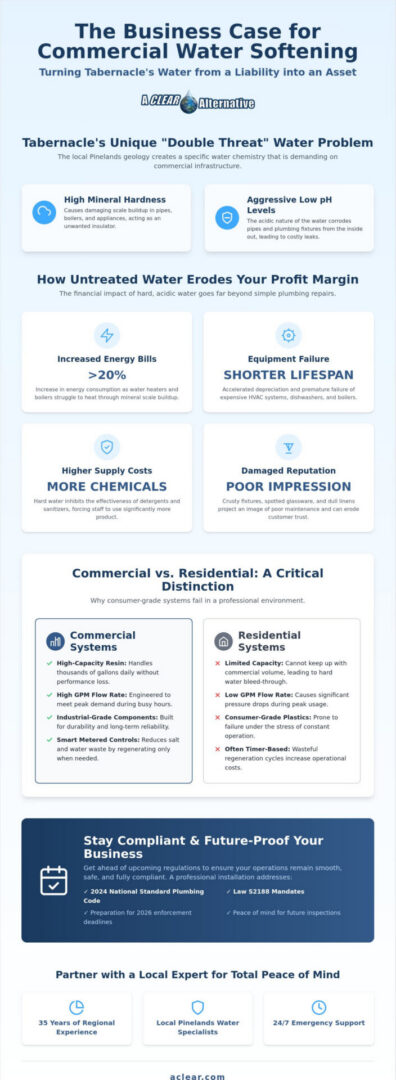
Understanding The Mechanics of Commercial Water Softening is essential for any local stakeholder. In our region, the water profile is notoriously complex. We often see a “double threat” of mineral hardness combined with aggressive, low pH levels. This isn’t just a plumbing issue; it’s a financial one. Hard water causes rapid scale buildup that acts as an unwanted insulator on heating elements. This forces your commercial boilers and HVAC systems to work harder, accelerating depreciation and leading to premature equipment failure. For restaurants and office buildings, the aesthetic impact is just as damaging. Crusty fixtures and spotted glassware project a lack of care that can quietly erode customer trust.
The Pinelands Water Challenge
Tabernacle and Shamong sit atop unique geological formations that define our water quality. While the Pinelands offer natural beauty, they also present specific challenges for untreated water. Standard residential softeners often fail in these commercial environments because they lack the flow rate and resin capacity to keep up with peak business hours. The local soil composition in the Pinelands region directly dictates the specific mineral hardness and acidic nature of the groundwater found in Tabernacle. Without a system designed for this specific chemistry, your business remains vulnerable to the hidden costs of poor water quality.
Impact on Commercial Overhead
Scale is the enemy of your bottom line. Even a thin layer of mineral buildup in your water heater can increase energy consumption by over 20% as the system struggles to heat through the stone-like barrier. Hardness also kills the efficiency of your cleaning supplies. Detergents and sanitizers can’t lather or bond correctly in hard water, meaning your staff must use significantly more chemicals to achieve the same results. To truly protect your assets, you must also address the acidity that often accompanies our local hardness. Integrating a pH-balancing solution, such as an Acid Neutralizer, ensures your pipes stay clear and your overhead stays low. Investing in the right softening technology isn’t just a maintenance task; it’s a modern lifestyle choice for your business that prioritizes longevity and excellence.
The Mechanics of Commercial Water Softening for Local Facilities
Your business doesn’t stop, and neither should your water quality. At its core, a commercial system relies on a sophisticated ion exchange process. To truly understand how water softeners work, you have to look at the high-capacity resin beads that pull hardness minerals out of the stream. In a professional setting, the most critical metric is GPM, or Gallons Per Minute. This represents your peak flow demand. If your system is undersized, you’ll experience a drop in water pressure exactly when you need it most, such as during a lunch rush or a heavy laundry cycle. A proper commercial water softener installation Tabernacle accounts for these spikes, ensuring your operations remain fluid and uninterrupted.
Modern systems are remarkably efficient thanks to metered control valves. Unlike old-fashioned timers that regenerate on a fixed schedule, metered controls monitor your actual usage. They only trigger a cleaning cycle when the resin is nearly exhausted. This smart approach drastically reduces your salt and water waste, making it a more sustainable choice for your budget and the local environment. It’s a simple upgrade that transforms a technical necessity into a strategic advantage.
Sizing the System for Your Tabernacle Business
Calculating your needs starts with your industry profile. A boutique hotel has vastly different requirements than a small cafe. We look at your daily water usage and the “grain capacity” of the resin. This determines how much hardness the system can remove before it needs to refresh. You’ll also need to choose the right housing for your components:
- Fiberglass tanks: These offer incredible corrosion resistance for most standard commercial applications.
- Heavy-duty steel: Often the preferred choice for high-pressure industrial environments or extreme temperatures.
Twin-Alternating vs. Single Tank Systems
For 24-hour operations, a single-tank system presents a challenge. When it regenerates, it either stops providing soft water or bypasses the system entirely, sending hard water into your pipes. Twin-alternating systems solve this by using two tanks. While one tank is cleaning itself, the other stays online. This ensures a constant, 24/7 supply of treated water. It’s a seamless transition that protects your equipment around the clock. Investing in a twin-alternating commercial water softener installation Tabernacle means you never have to worry about scale buildup during late-night shifts or early-morning prep. If you want to see how this fits into a broader strategy, exploring our guide on whole-house filtration can help you visualize a complete water management plan.
Commercial vs. Residential Systems: Selecting the Right Capacity
Choosing between a residential and a commercial system isn’t just about size; it’s about the fundamental engineering of your business’s infrastructure. While a residential unit is designed for the intermittent needs of a family, a professional commercial water softener installation Tabernacle is built to handle sustained, high-volume flow. Residential systems usually top out at low flow rates that can’t support the simultaneous demands of a commercial kitchen, multiple guest rooms, or industrial cooling towers. When you push a consumer-grade unit beyond its limits, you don’t just get hard water; you risk a total system collapse that halts your productivity.
Durability is where the two worlds truly diverge. Commercial systems utilize industrial-grade components, such as reinforced fiberglass or stainless steel, rather than the lightweight plastics found in big-box store models. This robust construction is vital for maintaining water softener efficiency and selection standards over years of heavy use. There’s also a significant legal and financial catch: using a residential unit in a commercial setting almost always voids the manufacturer’s warranty. While the initial investment for a commercial-grade system is higher, the total cost of ownership is much lower. You’ll spend less on emergency repairs, part replacements, and the inevitable early replacement of an overstressed residential model.
Why Residential Units Fail Commercial Demands
The primary culprit behind residential failure in a business setting is “short-cycling.” When a system is undersized, it’s forced to regenerate far too often to keep up with the load. This puts immense physical stress on the control valves, leading to mechanical failure within months rather than decades. If you’re a Tabernacle manager, look for these warning signs of undersized equipment: frequent salt refills, noticeable drops in water pressure during busy hours, or scale appearing on fixtures despite having a softener in place. These symptoms suggest your current setup is gasping for air under the weight of your operational needs.
The Role of Professional Water Testing
You can’t solve a problem you haven’t fully measured. Every successful installation begins with a comprehensive water test to map out the exact mineral profile of your site. In Tabernacle, we aren’t just looking for calcium; we’re often battling iron, sulfur, and manganese that can foul a softener’s resin if not addressed. This testing phase is your financial safeguard. It prevents you from purchasing unnecessary equipment or, conversely, buying a system that lacks the specific filtration stages required for Pinelands water. It’s about precision, ensuring your technology is a perfect match for your building’s unique chemistry.
Planning Your Installation: Costs, Plumbing, and Local Regulations
Designing your space for a commercial water softener installation Tabernacle is about more than just finding a corner in the mechanical room. It’s a precise engineering project that requires a clear roadmap. Pipe diameter is a primary variable; it must accommodate your peak flow demand without creating a bottleneck. You’ll also need reliable drainage access for the regeneration cycles and a dedicated electrical outlet to power the smart control valves. We always prioritize the installation of bypass valves. These allow your team to perform routine maintenance or resin cleaning without ever cutting off the water supply to your building. It’s a simple addition that prevents costly downtime.
Integrating whole house filtration as a pretreatment step is often the smartest move for local businesses. In the Pinelands, we frequently see a “one-two punch” of high iron and low pH. A softener alone isn’t designed to handle acidic water, which is why we often pair them with an acid neutralizer. This combination protects your softener’s resin and your building’s pipes simultaneously. A standard commercial installation in Tabernacle typically follows a structured timeline, often concluding within one to two business days depending on the complexity of your existing plumbing.
Pretreatment and Post-Installation Support
Iron filtration is often a non-negotiable first step. If iron reaches the softener’s resin bed, it can cause “fouling,” which drastically reduces the system’s lifespan and efficiency. We also look at carbon filtration to strip away organic contaminants or chlorine that can affect the taste of your water and the health of your equipment. Once the system is live, the focus shifts to consistency. Many local managers opt for a scheduled salt delivery service to ensure they never run dry. It’s one less thing for your maintenance team to track, keeping your operations seamless and stress-free.
Regulatory and Safety Compliance
New Jersey takes water safety seriously. All commercial plumbing must adhere to the National Standard Plumbing Code (NSPC). Currently, the 2021 NSPC is the law of the land, though we’re already preparing for the 2024 updates introduced in early 2026. This includes the mandatory installation of backflow preventers to ensure treated water never siphons back into the public supply. Brine discharge is another critical factor. Whether you’re on a septic system or a municipal sewer, your discharge must meet local environmental standards to prevent groundwater contamination. We handle the heavy lifting of verifying local Tabernacle permit requirements so you can stay focused on your business. If you’re ready to modernize your facility’s water management, reach out to us for a professional evaluation.
Partnering with A Clear Alternative for Your Tabernacle Business
Your business deserves a water treatment strategy as unique as your brand. Choosing A Clear Alternative means you’re not just buying a piece of hardware; you’re gaining a partner with a 35-year history of excellence in the Tri-State area. As a family-owned business, we understand that downtime isn’t just an inconvenience. It’s a threat to your revenue and reputation. That’s why we provide 24/7 emergency support specifically for our commercial clients. If a system issue arises at 3:00 AM, you won’t be navigating a corporate call center. You’ll be speaking with experts who prioritize your facility’s uptime as much as you do.
We reject the “one-size-fits-all” models often pushed by national franchises. Those systems are frequently under-engineered for the aggressive water chemistry found in the Pinelands. Instead, we take a custom-engineered approach to every commercial water softener installation Tabernacle. By tailoring the resin capacity and flow rates to your specific building, we ensure your investment delivers the maximum return. Our commitment to the Tabernacle, Shamong, and Medford Lakes communities goes beyond service. It’s about building a sustainable local economy where businesses can thrive without the burden of water-related equipment failures.
Our Commercial Process
Precision is our starting point. Our process begins with laboratory-grade water testing to identify the exact mineral and pH challenges at your site. From there, we move into a custom system design phase, selecting industrial components that match your peak demand. Professional installation is always handled by our licensed water treatment specialists, ensuring your system meets every NJ plumbing code requirement. We don’t just walk away once the water is soft. We offer ongoing maintenance programs designed to extend the life of your resin and keep your salt levels optimized, making the entire journey effortless for your team.
Why Local Expertise Matters
National brands often lack the deep geological knowledge required to handle the Kirkwood-Cohansey Aquifer. We live and work here, which gives us a specialized understanding of South Jersey well water that outsiders simply can’t match. This local expertise allows us to anticipate issues like seasonal iron fluctuations or acidity spikes before they damage your boilers. You also get the benefit of direct access to our owners for high-stakes projects. It’s a level of personalized, professional service that turns a technical necessity into a source of renewed confidence for your business. Let’s work together to create a water profile that reflects the premium quality of your operations.
Elevate Your Business Operations with Precision Water Quality
Modernizing your facility’s water management is a powerful step toward long-term operational freedom. By addressing the unique mineral profile of the Pinelands, you’re not just fixing a plumbing issue; you’re protecting your most valuable business assets and reducing daily overhead. We’ve explored how the right capacity and professional compliance with 2026 standards can transform your water from a liability into a silent partner in your success. For those who manage mission-critical facilities, partnering with experts like Secure Supplies Group for large-scale energy solutions ensures that your entire infrastructure remains resilient against future challenges. Securing a professional commercial water softener installation Tabernacle is the most effective way to ensure your facility meets these modern standards while providing a premium experience for your customers.
At A Clear Alternative, we’ve been family-owned since 1991, bringing over three decades of local expertise to every project. Whether you need 24/7 emergency support or the reliability of a licensed potable water hauler, our team is ready to support your vision. Don’t let hard water dictate your maintenance schedule any longer. Take control of your building’s health and feel the difference that precision-engineered water treatment makes. It’s an investment in your business’s future and your own peace of mind.
Schedule Your Commercial Water Consultation with A Clear Alternative today and start your journey toward effortless water quality.
Frequently Asked Questions
How much does commercial water softener installation cost in Tabernacle?
The total investment for your facility depends on several variables, including your peak flow demand, pipe diameter, and the complexity of your existing plumbing. While every project is unique, larger systems designed for high-capacity use naturally require more robust components and labor. A custom assessment is the most accurate way to determine the specific requirements for a commercial water softener installation Tabernacle that fits your business goals.
How long does a commercial water softener last in a business environment?
A well-maintained commercial system typically lasts between 10 and 20 years, depending on the volume of water processed and the quality of the incoming supply. High-capacity resin beads and industrial-grade control valves are built for durability, but they do require regular attention. Investing in professional maintenance ensures that your system continues to perform efficiently, protecting your appliances and infrastructure for the long haul.
Does my Tabernacle business need an acid neutralizer before a water softener?
Most businesses in the Pinelands region benefit from an acid neutralizer because our local groundwater often has a low pH level. Softeners are excellent at removing minerals, but they aren’t designed to handle acidic water, which can corrode your pipes and foul the softener’s resin. Pairing these two systems provides a complete shield for your building, ensuring your water is both soft and pH-balanced.
What is the difference between a single tank and a twin-alternating softener?
A single tank system must go offline to regenerate, which means your business could receive hard water during that cleaning cycle. Twin-alternating systems utilize two tanks to provide a seamless, 24/7 supply of soft water. While one tank refreshes itself, the other stays active. This setup is the gold standard for laundromats, hotels, and any facility that operates around the clock without interruption.
How often should a commercial water softener be serviced?
You should schedule a professional service check at least once a year to ensure all mechanical components and sensors are calibrated correctly. Beyond that, your team should monitor salt levels monthly to keep the regeneration process consistent. Regular service prevents small issues from turning into expensive repairs, keeping your water quality stable and your overhead predictable throughout the year.
Can a water softener help reduce my business’s energy bills?
Yes, removing mineral hardness prevents scale from forming on the heating elements of your boilers and water heaters. Scale acts as an insulator, forcing your equipment to use significantly more energy to reach the desired temperature. By keeping these surfaces clean, your systems operate at peak efficiency. This reduction in energy waste directly lowers your monthly utility costs while extending the lifespan of your expensive machinery.
Is professional water testing required before installation?
Detailed water testing is a non-negotiable first step for any successful commercial project. We need to identify the exact concentrations of calcium, iron, and other minerals to size your system correctly. Testing also reveals if other contaminants like sulfur are present, which might require additional filtration stages. This data-driven approach ensures your commercial water softener installation Tabernacle is perfectly matched to your site’s specific chemistry.
Do you provide emergency repair services for commercial water systems?
We provide 24/7 emergency support specifically for our commercial clients because we know that water issues can’t wait until Monday morning. If your system fails or your water quality drops unexpectedly, our team is ready to respond immediately. This rapid support helps you avoid operational downtime and ensures you can continue serving your customers with total confidence, regardless of the hour.