
Are Water Softeners Worth It in South Jersey? The 2026 Homeowner’s ROI Guide
What if the water flowing through your pipes is actually a hidden tax on your bank account and your self-care routine? You likely notice the chalky white film on your designer fixtures or the way your skin feels tight and itchy after every shower. It’s frustrating to invest in a beautiful home only to watch mineral buildup age your appliances and dull your hair before its time. Because South Jersey relies heavily on groundwater, many homeowners find themselves asking: are water softeners worth it in South Jersey?
The short answer is that soft water is a financial hedge, not just a luxury. With local mineral levels often exceeding the “hard” threshold of 7 GPG, your water heater and plumbing are likely working overtime. This guide breaks down the real ROI of switching to soft water, from slashing your utility bills to reclaiming the glow of your skin and hair. We’ll explore the latest 2026 water quality data and show you how a modern system protects your home’s infrastructure while delivering the vibrant laundry and renewed confidence you deserve.
Key Takeaways
- Understand the specific mineral profile of South Jersey groundwater and why local hardness levels often require targeted treatment to protect your home.
- Discover why are water softeners worth it in South Jersey by calculating the “appliance tax” and seeing how soft water can extend your water heater’s life by up to 50%.
- Learn why a softener alone might not be enough; identifying high acidity and iron is crucial to stopping blue-green stains and metallic tastes.
- Reclaim your self-confidence and comfort by eliminating the dry skin, dull hair, and high detergent costs associated with hard water.
- Get a clear roadmap for selecting a system that fits your lifestyle, starting with a professional water analysis to determine your exact GPG and pH needs.
The Reality of South Jersey Water Quality: Hardness vs. Local Standards
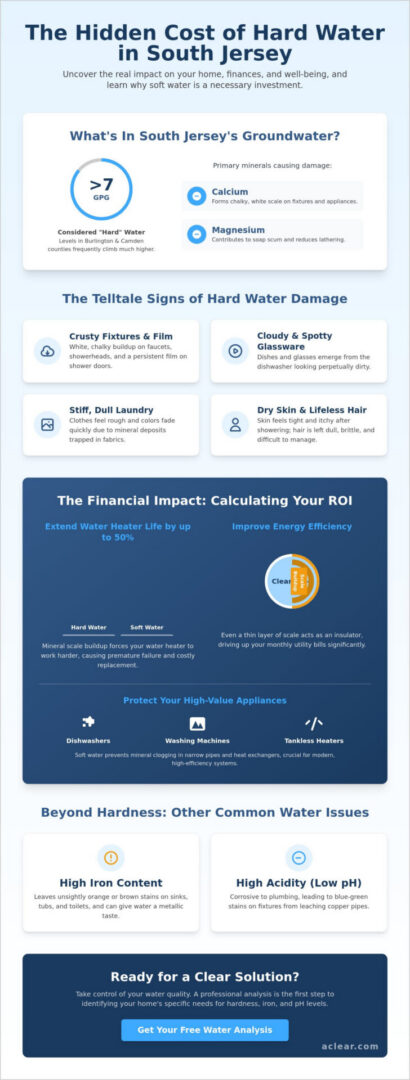
South Jersey homeowners often deal with an invisible intruder: hard water. When we talk about water hardness, we measure it in Grains Per Gallon (GPG). In our region, anything above 7 GPG is considered hard, and levels in Burlington and Camden counties frequently climb much higher. This isn’t just a technical measurement. It’s a description of how many dissolved minerals, like calcium and magnesium, are hitching a ride into your home. If you’re wondering are water softeners worth it in South Jersey, the answer starts with understanding that your local geology is working against your plumbing.
While towns like Medford Lakes might rely on municipal systems, areas like Tabernacle and Shamong often depend on private wells. These wells draw from aquifers that are rich in minerals and occasionally iron. Water softening is the process of removing these minerals before they can cause damage. Unlike surface water used in North Jersey, our groundwater has spent centuries filtering through mineral-heavy bedrock, picking up a “mineral load” that municipal treatment plants aren’t required to remove. It’s not just about the water’s safety; it’s about the water’s impact on your daily life and the longevity of your home’s infrastructure.
Identifying Hard Water Signs in Tabernacle and Shamong
Living on a well in Tabernacle or Shamong means you’re the manager of your own water quality. You’ll notice hard water first in the places you value most. Check for these common signs:
- White, crusty buildup on your designer faucets and showerheads.
- Glassware that looks cloudy or spotty even after a heavy dishwasher cycle.
- Laundry that feels stiff or colors that look dull after just a few washes.
- A persistent film on shower doors that won’t scrub away.
These aren’t just cleaning nuisances. They are symptoms of mineral saturation that is also happening inside your pipes and water heater. Beyond calcium, you might also be dealing with iron, which leaves orange or brown stains on your porcelain fixtures, effectively aging your home from the inside out.
Hard Water vs. Municipal Standards in Medford Lakes
Many Medford Lakes residents assume city water is treated for hardness. It’s a common misconception. The EPA sets standards for health and safety, focusing on contaminants like lead or bacteria. They don’t regulate hardness because it isn’t considered a health risk. This means your water can be perfectly “legal” while still being hard enough to ruin a high-end dishwasher in five years. Local infrastructure handles the basics, but it leaves the aesthetic and plumbing-saving minerals for you to manage. It’s a gap between what is safe to drink and what is actually good for your home’s health and your own comfort. Investing in a system is about closing that gap and taking control of your home’s environment.
Calculating the ROI: Is a Water Softener Financially Worth It?
When homeowners ask are water softeners worth it in South Jersey, they often focus on the upfront cost. However, the real story lies in the “appliance tax” you pay every month without realizing it. Hard water minerals act like a slow-moving abrasive, coating the heating elements of your water heater with rock-hard scale. The U.S. Geological Survey defines water hardness by the concentration of calcium and magnesium, and much of our region falls into categories where these levels are high enough to cause significant mechanical stress. For a traditional water heater, this scale buildup can slash its operational lifespan by up to 50 percent, forcing a replacement years earlier than expected.
Energy efficiency is another major factor in the ROI equation. Even a thin layer of scale inside your pipes or heater acts as an insulator. This means your system has to run longer and use more energy just to reach the desired temperature. By eliminating this barrier, you’re not just saving on repairs; you’re lowering your monthly utility bills from the moment the system is installed. Over time, these savings frequently offset the initial investment of the unit itself.
Protecting Your High-Value Appliances
High-efficiency tankless water heaters are especially vulnerable to local water conditions. These modern systems use narrow heat exchangers that can clog quickly when exposed to the 7 GPG or higher hardness levels found in many local wells. Dishwashers and washing machines also suffer as internal seals and pumps wear down from mineral friction. Before you can calculate your exact savings, professional well water testing is the first step to determining your mineral load and protecting these high-value investments.
Daily Savings on Household Consumables
The savings extend to your grocery list too. Soft water allows soap to lather more effectively, meaning you can use up to 50 percent less laundry detergent, shampoo, and dish soap. You’ll also stop buying expensive descalers and harsh “hard water” cleaning chemicals that strip the finish off your fixtures. Beyond the bottle, your wardrobe lasts longer. Hard water minerals trap dirt in fabric fibers, making clothes feel scratchy and look faded. Soft water preserves these fibers, keeping your favorite pieces looking new and saving you on wardrobe replacements over time. Investing in a high-efficiency water softener transforms these invisible costs into tangible home equity and daily comfort.
Beyond Softening: Addressing Iron and Acidity in South Jersey
Many homeowners ask are water softeners worth it in South Jersey only to find that their water issues are more complex than simple mineral hardness. While there are numerous advantages to water softening, such as protecting your water heater and improving soap efficiency, a softener is designed specifically to swap calcium and magnesium for sodium ions. It isn’t a magic fix for every local water problem. In our local aquifers, hard water frequently coexists with low pH levels and high iron content. If you only install a softener, you might still wake up to blue-green rings in your sinks or that unmistakable metallic taste in your morning coffee.
The reality of our region’s geology means your treatment plan needs to be as unique as your home. A standalone system might handle the “rock” in your water, but it leaves other aesthetic and structural threats untouched. To get the best return on your investment, you have to look at the total chemistry of what’s coming out of your tap. This often means moving beyond basic softening to a more comprehensive, multi-stage solution.
When a Softener Needs an Acid Neutralizer
Acidity is a silent killer for South Jersey plumbing. If you see blue-green staining on your porcelain fixtures, your water is likely acidic, meaning it has a pH below 7.0. This water is hungry for minerals and will eat away at your copper pipes to get them. This leads to the nightmare of pinhole leaks hidden behind your walls. To truly protect your home, an acid neutralizer is often the essential partner to a water softener. Combining these systems ensures your water is both soft on your skin and gentle on your home’s infrastructure. It’s the difference between a partial fix and total peace of mind.
Dealing with Iron and Sulfur Staining
Shamong and Tabernacle residents often face a different kind of aesthetic battle: iron and sulfur. If your laundry is coming out with orange spots or your bathroom smells like rotten eggs, a standard softener will quickly become overwhelmed. Iron is heavy and sticky. It clogs the resin bed of a softener, reducing its efficiency and lifespan. Specialized iron and sulfur filtration systems are designed to oxidize and remove these contaminants before they reach your softener. By using a multi-stage approach, you ensure each component does its job perfectly. This configuration doesn’t just improve your water quality; it protects your investment by preventing the softener from burning out prematurely. Your water should feel like a spa experience, not a chemistry experiment.
Choosing the Right System for Your Medford Lakes Home
Selecting a water treatment system is about more than just picking a box off a shelf. It’s a decision that impacts your home’s value, your daily comfort, and your monthly budget. When you evaluate if are water softeners worth it in South Jersey, you have to look at the specific needs of your property. You aren’t just buying hardware; you’re investing in a lifestyle upgrade that protects your designer fixtures and your skin. The process should be simple, logical, and based on data rather than guesswork.
The journey starts with five clear steps. First, get a professional water analysis to determine your exact GPG and pH levels. Second, size the system based on your household size and peak water usage. Third, choose the technology that matches your hardness levels. Fourth, look for modern features like smart monitoring and bypass valves that make maintenance a breeze. Finally, select a local installer who understands the unique mineral profiles of Burlington and Camden counties. This structured approach ensures you get a system that performs perfectly from day one.
Sizing Your System for Family Needs
Capacity is the heartbeat of your water softener. It’s measured in grains, and getting it right is a balancing act. If you undersize your system, you’ll experience “hard water breakthrough” during high-usage times, like when the dishwasher and shower are running simultaneously. This leads to mineral leaks that slowly damage your plumbing. Conversely, an oversized system is a waste of money because it uses more salt and water than necessary during its regeneration cycles. Think about your future too. If you’re planning to expand your family or add a new bathroom, sizing up now is a smart way to future-proof your investment.
Salt-Based vs. Salt-Free: The NJ Verdict
In the South Jersey environment, the verdict is clear: salt-based ion exchange is the gold standard. While “salt-free” conditioners are popular in some regions, they don’t actually remove minerals. They simply temporarily alter the mineral’s shape to prevent some scale. For the heavy mineral loads found in Medford Lakes or Shamong, only ion exchange truly eliminates the “rock” in your water. This technology delivers the soft skin, vibrant laundry, and spot-free dishes that homeowners expect. Maintenance is predictable and easy, usually involving a simple salt top-off every few weeks. To ensure your home gets the protection it deserves, start with a professional water analysis to find the perfect fit for your specific water profile.
Professional Installation: The A Clear Alternative Difference
Choosing the right equipment is only half the battle. The true value of your investment depends on how that system is integrated into your home’s unique environment. Since 1991, A Clear Alternative has served the Tri-State area as a family-owned business, bringing a level of local expertise that big-box retailers simply can’t match. When you ask if are water softeners worth it in South Jersey, you have to consider the long-term reliability of the installation. A system tuned to our specific groundwater chemistry lasts longer and performs better. It isn’t just about plumbing; it’s about engineering a solution that fits your aesthetic and lifestyle needs.
Many homeowners choose to expand their protection by pairing their softener with a whole house water filtration system. This comprehensive approach ensures that every drop of water in your home is free from sediment, chlorine, and minerals. It transforms your daily routine into a premium experience, where the water is as clear as it is soft. By addressing everything from hardness to taste in one seamless setup, you’re making a decision that improves your self-care and your home’s market value simultaneously.
Why Local Expertise Matters in the Tri-State Area
South Jersey’s geography creates distinct challenges for every town. Residents in Tabernacle and Shamong face different mineral profiles than those in Medford Lakes, and we understand these nuances intimately. We don’t just guess; we use our decades of local data to calibrate your system perfectly. Beyond softening, we are also a licensed potable water hauler. This means we can provide emergency water hauling or bulk potable water delivery if your well fails or you have an immediate need. Our 24/7 emergency support ensures that you never have to navigate a water crisis alone. It’s the kind of peace of mind that only comes from a partner who lives and works in your community.
Ongoing Maintenance and Salt Delivery
A premium water system should deliver freedom, not extra chores. Traditional water softening often meant lugging heavy bags of salt from the store to your basement. We’ve changed that. Our water softener salt delivery service ensures your system is always topped off without you lifting a finger. It’s part of our commitment to making modern water treatment feel effortless and discreet. You get all the benefits of soft water without the physical strain or the mental load of tracking salt levels.
We also provide scheduled check-ups to ensure your Reverse Osmosis systems and Ultraviolet (UV) sterilizers are performing at peak efficiency. Having a single, reliable provider for all your water needs, from acid neutralizers to carbon filtration, simplifies your home maintenance. You get to enjoy the benefits of soft, pure water while we handle the technical details. It’s a modern lifestyle choice that prioritizes your comfort, your confidence, and your home’s future.
Reclaim Your Home’s Vitality and Value
Your home is your sanctuary, and every detail should reflect the quality of life you’ve worked to build. Investing in water treatment isn’t just about plumbing; it’s about the confidence of knowing your appliances are protected and your self-care routine is elevated. By addressing the unique mineral and acidity profiles of our local aquifers, you’re choosing a path of long-term savings and daily comfort. You’re moving away from the “appliance tax” of hard water and toward a lifestyle defined by efficiency and ease.
When you weigh the facts, the question of are water softeners worth it in South Jersey becomes clear. The protection of your home’s infrastructure and the renewal of your skin and hair offer a return on investment that goes far beyond the initial setup. Since 1991, our family-owned team has helped neighbors navigate these decisions with local expertise and 24/7 emergency support. As a licensed potable water hauler, we’re ready for any challenge your well or municipal line presents.
Get Your Water Tested Today by A Clear Alternative and take the first step toward a clearer, softer future. You deserve water that works for you, not against you. Let’s make your home’s water as premium as your lifestyle.
Frequently Asked Questions
Is South Jersey water considered hard?
Yes, much of the water in South Jersey is classified as hard because it is drawn from mineral-rich underground aquifers. In counties like Burlington and Camden, hardness levels frequently exceed 7 grains per gallon (GPG), which is the threshold where treatment is recommended. This high mineral content is what causes the white scale buildup you see on your fixtures and inside your appliances.
How much does a water softener cost in New Jersey?
The investment for a system depends on several factors, including the capacity of the unit, the specific technology used, and the complexity of your home’s plumbing. Systems designed for larger households or those that need to handle high iron levels will vary in price compared to basic models. It is best to view this as a long-term capital improvement that pays for itself through lower utility bills and fewer appliance replacements.
What is the difference between a water softener and an acid neutralizer?
A water softener specifically removes minerals like calcium and magnesium to prevent scale buildup, while an acid neutralizer raises the pH of your water. If your water has a pH below 7.0, it is acidic and can corrode your copper pipes, often leaving blue-green stains. Many South Jersey homes require both systems to ensure the water is neither “hard” nor “hungry” for the minerals in your plumbing.
Can a water softener remove the rotten egg smell from my well water?
No, a standard water softener is not designed to remove the rotten egg smell caused by hydrogen sulfide gas. While homeowners often wonder are water softeners worth it in South Jersey for fixing all well issues, this specific odor requires specialized sulfur filtration. A softener targets minerals, but it won’t eliminate the gas responsible for that unpleasant scent.
How long do water softeners last in South Jersey?
A professionally installed, high-quality water softener typically lasts between 10 and 15 years. Its lifespan depends heavily on the mineral load it processes and how consistently it is maintained. Regular check-ups and using high-purity salt help ensure the resin bed remains effective for as long as possible, protecting your home’s infrastructure for over a decade.
Is it better to rent or buy a water softener in NJ?
Buying is generally the better financial decision for homeowners who plan to stay in their property for more than a few years. When you buy, you build equity in your home and avoid the long-term cost of monthly rental fees. Ownership also allows you to choose a premium system that is specifically calibrated for your local water chemistry rather than a generic rental unit.
Do I need a water softener if I have city water in Medford Lakes?
You likely do if you want to avoid scale buildup and enjoy the aesthetic benefits of soft water. Municipal water treatment focuses on meeting health and safety standards, but it rarely removes the minerals that cause hardness. Even if your city water is “safe,” it can still be hard enough to dull your laundry and shorten the life of your dishwasher.
What happens if I don’t treat the hard water in my South Jersey home?
Ignoring hard water leads to a gradual decline in your home’s efficiency and the premature failure of expensive appliances. Scale will accumulate inside your water heater, pipes, and fixtures, making it harder and more expensive to heat your water. When considering are water softeners worth it in South Jersey, you must factor in the high cost of emergency plumbing repairs and the frequent replacement of scale-damaged appliances.