
Annual Well Water Testing in Tabernacle: The 2026 Homeowner’s Safety Guide
What if the most vital health check for your family isn’t happening at a doctor’s office, but right at your kitchen tap? In the heart of the Pine Barrens, your well water is a direct reflection of the local environment. You might already be dealing with the frustration of blue-green stains on your fixtures or a faint rotten egg smell that ruins a morning shower. It’s natural to feel concerned about hidden contaminants like lead or confused by the latest New Jersey water regulations.
We believe your home should be your sanctuary, and you deserve total confidence in every drop of water you use. This guide will show you exactly why annual well water testing Tabernacle is a modern wellness ritual that protects your family’s health and your property’s long-term value. You’ll discover how to navigate the 2026 safety standards with ease while ensuring your drinking water remains pure and refreshing.
We are going to dive into the specifics of the Private Well Testing Act, including the mandatory mercury testing required for homes here in Burlington County. You will learn about the latest 2026 updates regarding PFAS “forever chemicals” and see how simple it is to move from uncertainty to absolute peace of mind. Let’s clear the water together.
Key Takeaways
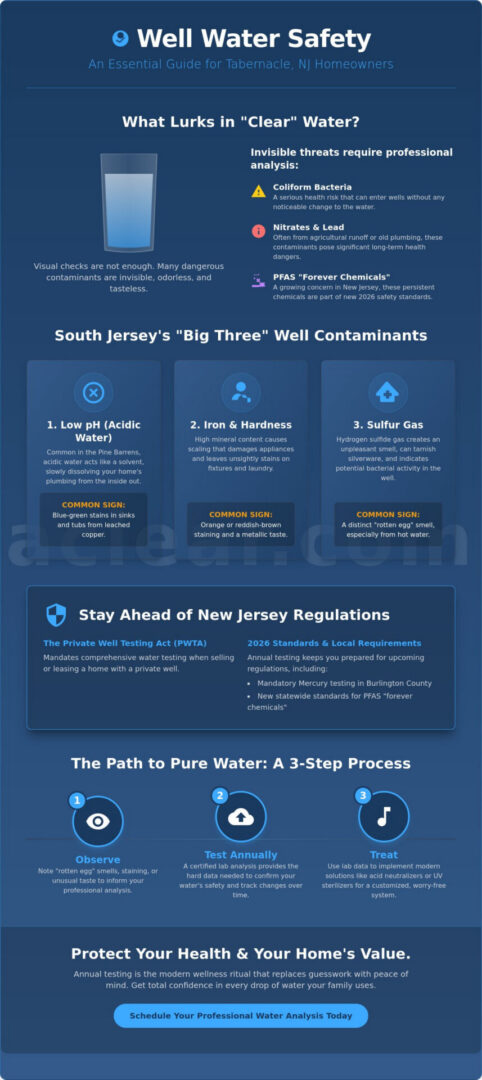
- Understand why visual clarity is deceptive and why invisible threats like coliform or nitrates require professional analysis to detect.
- Identify the unique chemistry of Tabernacle wells, including the prevalence of acidic water and the “Big Three” contaminants common in South Jersey.
- Discover how annual well water testing Tabernacle keeps you ahead of NJ regulations while providing year-round peace of mind for your family.
- Learn the simple steps to prepare for your analysis, from noting “rotten egg” smells to selecting the right certified professional for collection.
- Explore how modern solutions like acid neutralizers and UV sterilizers can turn lab data into a customized plan for a more vibrant, worry-free lifestyle.
Why Annual Well Water Testing is Essential in Tabernacle
Think of your well as a living, breathing part of your home’s ecosystem. It’s easy to assume everything is fine if the water looks clear and tastes crisp, but that’s a dangerous gamble. In Tabernacle, our unique geography within the Pine Barrens means our groundwater is constantly in motion. Seasonal shifts, heavy rains, and local land use all influence the chemistry of what comes out of your tap. Annual well water testing Tabernacle is more than just a chore; it’s a preventative health checkup that ensures your home’s most vital resource remains pure.
Visual checks simply aren’t enough to guarantee safety. Invisible threats like coliform bacteria or nitrates don’t leave a scent, a color, or a metallic tang. You could be drinking contaminated water for months without realizing it. Because private wells are not regulated by the EPA, the responsibility for monitoring this safety falls entirely on you. Moving away from the old-fashioned “set it and forget it” mentality is the first step toward a modern, health-conscious lifestyle. Today’s standards demand a proactive approach that prioritizes data over guesswork.
The 2026 Standard for Private Well Safety
Yearly testing has become the industry gold standard for a reason. A single snapshot of your water quality from five years ago doesn’t tell you anything about your water today. By committing to annual well water testing Tabernacle, you create a digital health record for your well. This regular data helps you track subtle changes in pH or mineral levels before they become expensive problems. A certified laboratory analysis provides the hard evidence you need to feel confident. It’s about replacing “I think it’s okay” with “I know it’s safe.”
Protecting Your Home’s Value and Infrastructure
Key Contaminants to Watch for in South Jersey Wells
Living in Tabernacle offers a unique landscape, but that beauty comes with specific geological quirks. The Pine Barrens are famous for sandy soil and cedar-colored streams, but these same features create a distinct profile for your groundwater. While general guides mention universal risks, your annual well water testing Tabernacle needs to focus on the “Big Three” local challenges: pH levels, bacteria, and nitrates. Understanding these allows you to move from worrying about “what if” to enjoying your home with total confidence.
Beyond the invisible risks, many homeowners notice aesthetic issues like orange iron staining or a sulfurous “rotten egg” smell. While these are annoying and can ruin the experience of a fresh glass of water, the invisible threats often do the most damage. For instance, agricultural runoff from nearby farms can seep into shallower wells, spiking nitrate levels. This makes regular monitoring essential for maintaining a healthy home environment. You aren’t just testing for the sake of a report; you’re auditing the safety of your family’s daily life.
The Impact of Low pH and Acidic Water
Tabernacle’s soil is naturally acidic, which directly translates to low pH water in your well. You might think acidic water is just a minor technicality, but it acts as a slow-motion solvent in your plumbing. It’s a silent intruder. As this water travels through your home, it leaches copper from your pipes and brass from your fixtures. This isn’t just a plumbing issue; it’s a water quality issue that affects the very integrity of your home.
The most common sign of this process is a telltale blue-green stain in your sinks, tubs, or showers. If you see these marks, your water is likely aggressive and needs correction. Installing a modern acid neutralizer can stop this corrosion instantly. It protects your high-end appliances and ensures your water isn’t carrying unwanted metals into your glass. It’s a simple, elegant fix for a common local problem.
Microbial Risks: Bacteria and Nitrates
Safety isn’t just about chemistry; it’s about biology. Total coliform and E. coli are the primary microbial concerns for private systems. Since these bacteria can enter your well through cracked seals, heavy flooding, or even nearby septic issues, yearly checks are your only reliable defense. The Private Well Testing Act (PWTA) sets the standard for these tests because microbial contamination can happen overnight. It is a vital benchmark for any New Jersey homeowner who values precision and safety.
Nitrates are equally critical, especially if you have infants or elderly family members at home. High levels interfere with the blood’s ability to carry oxygen. In South Jersey, where farming is part of our heritage, these levels can fluctuate based on seasonal fertilizer use and rainwater patterns. For those looking for a chemical-free way to ensure safety, UV water sterilizers offer a sophisticated, low-maintenance solution that neutralizes 99.9% of harmful pathogens. If you’re unsure about your current levels, you can easily schedule a comprehensive test to get the clarity you need today.
The Private Well Testing Act (PWTA) and NJ Regulations
New Jersey has some of the strictest water safety laws in the country, and for good reason. The Private Well Testing Act (PWTA) is the cornerstone of these protections. While it’s technically a consumer information law triggered by real estate deals, it’s actually a blueprint for a healthier, more informed lifestyle. Many residents believe they only need a lab report when they’re moving. That’s a missed opportunity. By adopting these standards for your annual well water testing Tabernacle, you ensure your home meets the highest safety benchmarks year after year, regardless of whether a “For Sale” sign is in the yard.
For South Jersey residents, the NJDEP requires a specific battery of tests that go beyond basic checks. This includes total coliform bacteria, nitrates, lead, arsenic, and volatile organic compounds (VOCs). Because we’re in Burlington County, testing for mercury is also mandatory. These aren’t just bureaucratic hurdles; they’re essential data points for your family’s wellness. Using a PWTA-compliant, NJDEP-certified lab for your yearly checkup ensures the results are scientifically accurate and legally defensible. It’s about bringing professional-grade precision to your kitchen tap.
Buying or Selling a Home in Tabernacle?
If you’re in the middle of a property transfer, timing is everything. The PWTA requires that the well be tested and the results shared between buyer and seller before the closing happens. Usually, the results stay valid for one year, but the bacteria test is only good for six months. While the law doesn’t specify who pays for the analysis, it’s typically a negotiable item in the contract. If a well fails a required NJDEP test, it isn’t a deal-breaker. It’s simply a signal that your water system needs a modern upgrade to bring it back to peak performance. Most issues are easily solved with the right technology.
Understanding Your NJ Water Test Results
Looking at a lab report can feel overwhelming, but it’s simpler than it looks. The most important column is the “Maximum Contaminant Level” (MCL). This is the safety ceiling set by the state. If your result is below the MCL, you’re in the clear. For bacteria, the report will simply say “Present” or “Absent.” There is no safe amount of E. coli; it must be absent for the water to be considered potable. The EPA recommends annual well testing as a baseline, but keeping a digital archive of your annual well water testing Tabernacle results allows you to spot long-term trends. If your nitrate levels are slowly climbing toward the MCL over three years, you can act before it becomes a health risk. It’s about staying one step ahead and maintaining total control over your home’s environment.
How to Prepare for Your Annual Water Analysis
Preparing for your annual well water testing Tabernacle is the ultimate way to stay in control of your home’s wellness. It isn’t just about filling a bottle; it’s about capturing an accurate snapshot of your system’s performance. Start by identifying your primary concerns. Have you noticed new blue-green staining in the shower? Is there a subtle “rotten egg” scent during your morning routine? These observations allow for a more customized and effective analysis. Once you’ve noted any changes, you can choose between scheduling a professional collection or using a certified sterile kit. Both paths lead to clarity, but the professional route offers an extra layer of oversight that many modern homeowners value.
If you choose to collect the sample yourself, precision is your best friend. You must follow strict sampling protocols to avoid cross-contamination. This means avoiding any contact with the inside of the bottle cap or the rim of the container. Even a microscopic amount of bacteria from your hands can skew the results. Finally, ensure your samples are delivered to the lab within the required timeframe. Bacteria samples are particularly sensitive to temperature and time. If they sit too long, the data becomes unreliable, and you’ll have to start the process over. Speed and cleanliness are the keys to a successful test.
Professional Collection vs. DIY Sampling
Professional collection is the gold standard for anyone who values accuracy and convenience. While DIY kits are available, they often lead to “false positive” bacteria results due to simple handling errors. A trained technician knows exactly how to purge the lines and collect a pristine sample. Beyond just taking the water, they perform a vital visual inspection of your well head. They look for small cracks in the cap or signs of insect intrusion that could compromise your safety. For real estate transactions or legal compliance, professional collection is often a requirement rather than a suggestion. It’s a seamless way to ensure your annual well water testing Tabernacle is done right the first time.
When to Test More Than Once a Year
While a yearly checkup is the baseline for a healthy home, certain situations call for immediate action. Heavy flooding in the Pine Barrens can sometimes overwhelm well seals, introducing surface contaminants into your groundwater. You should also schedule a test if there is significant local construction or if you’ve recently had repair work done on your well pump. Any time your system is opened for maintenance, there’s a risk of introducing new elements. If you notice a sudden change in the clarity, taste, or smell of your water, don’t wait for your anniversary date. If you’re ready to secure your home’s safety, schedule your professional water analysis today and let the experts handle the technical details for you.
Professional Solutions for Tabernacle Well Owners
Receiving your lab report is a major milestone, but the real magic happens when you turn those numbers into a plan for a more vibrant, worry free lifestyle. At A Clear Alternative, we’ve been the local, family owned experts since 1991, helping our neighbors navigate the unique water chemistry of the Pine Barrens. We don’t just hand you a list of contaminants; we translate complex data into actionable home improvement plans. Whether your report shows a need for a simple adjustment or a modern system upgrade, we’re here to ensure your transition to pristine water is effortless and inspiring.
Our approach is built on precision and local experience. We use your specific annual well water testing Tabernacle data to calibrate every piece of equipment we install. This isn’t a one size fits all service. We understand that a home near the edge of the woods might have different iron levels than one closer to the town center. To give you total peace of mind, we provide 24/7 emergency support for our Tabernacle and Shamong residents. If you ever have a concern about your system’s performance, you’ll never have to wait for answers. We’re committed to keeping your water flowing perfectly around the clock.
From Analysis to Modern Treatment
Once we have your test results, we can design a filtration strategy that matches your home’s aesthetic and functional needs. For those dealing with the heavy orange staining or metallic taste common in South Jersey, we use your data to perfectly tune iron and sulfur filtration systems. These modern solutions work behind the scenes to restore the clarity and freshness you deserve. If your report indicates issues with nitrates or lead, our sophisticated reverse osmosis systems provide a high tech safety net at your kitchen tap. Having a professional partner for ongoing maintenance means your systems stay as efficient as the day they were installed, allowing you to focus on enjoying your home.
The A Clear Alternative Difference
Our deep roots in the Tabernacle, Shamong, and Medford Lakes communities give us an edge that national providers simply can’t match. We’ve spent decades studying the mineral profile of the Tri-State area, and we know exactly how local soil shifts and seasonal patterns affect your well. We believe that clean water is a fundamental part of your self care and home value. It’s an investment in your health that pays off every time you fill a glass or step into a refreshing shower. Don’t leave your family’s safety to guesswork. Schedule your 2026 annual well test with A Clear Alternative today!
Elevate Your Home Wellness with Total Water Clarity
Your home is the foundation of your family’s health and confidence. Prioritizing annual well water testing Tabernacle is a proactive lifestyle choice that leaves nothing to chance. We’ve seen how regular analysis protects your high-end appliances from acidic Pine Barrens water and keeps invisible threats like nitrates or bacteria away from your kitchen tap. This simple yearly ritual transforms uncertainty into absolute peace of mind.
At A Clear Alternative, we’ve been family-owned and operated since 1991. We bring NJDEP-aligned testing protocols and 24/7 emergency support to every homeowner we serve in South Jersey. We don’t just deliver a lab report; we provide the expert guidance needed to maintain a pristine home environment. It’s time to stop wondering about your water quality and start enjoying the refreshing clarity you deserve.
Secure Your Family’s Water Safety – Schedule Your Annual Test Today
Take the next step toward a more vibrant, worry-free home life. Your sanctuary deserves the very best, and we’re here to ensure every drop of water meets that standard. Let’s keep your Tabernacle home running perfectly.
Frequently Asked Questions
How often should I test my well water in Tabernacle?
You should schedule annual well water testing Tabernacle at least once every twelve months. This frequency is the industry standard for monitoring bacteria, nitrates, and pH levels. Regular testing allows you to catch subtle environmental shifts in the Pine Barrens before they impact your family’s health or your home’s infrastructure.
What are the most common contaminants found in South Jersey wells?
South Jersey wells frequently show low pH levels, which indicates naturally acidic water that can corrode your plumbing. You’ll also likely find iron and sulfur, which cause staining and odors. In Burlington County, testing for mercury is a specific mandatory requirement, alongside monitoring for nitrates that can seep into groundwater from local agricultural activities.
Is the Private Well Testing Act (PWTA) required for every home?
The PWTA is legally required during real estate transactions and for landlords every five years. While it isn’t a universal law for every homeowner every year, the NJDEP suggests that all private well owners follow these same rigorous standards. It is the most reliable way to ensure your drinking water remains safe even if you aren’t planning to sell your property.
Can I test my own well water with a store-bought kit?
Store-bought kits provide a quick glimpse into your water chemistry, but they lack the scientific precision of a certified laboratory. These DIY methods often produce “false positives” for bacteria due to simple handling errors during collection. For results that carry legal weight and professional accuracy, a NJDEP-certified lab collection is the only choice that offers total peace of mind.
What should I do if my water test comes back positive for bacteria?
If your results show bacteria, stop using the water for drinking or cooking immediately. You’ll need to inspect your well cap for damage and consider professional disinfection of the system. Many modern homeowners choose to install an ultraviolet (UV) sterilizer to provide a permanent, chemical-free shield against future microbial issues and ensure the water is always safe.
How much does a comprehensive well water test cost in NJ?
A comprehensive, PWTA-compliant well water test in New Jersey typically ranges between $925 and $1,500. This investment covers the professional collection by a certified technician and the detailed analysis of dozens of regulated contaminants. While prices vary based on the specific parameters required for your location, this cost provides an entire year of documented safety for your household.
Does a water softener protect me from bacteria or nitrates?
A water softener is specifically designed to remove “hardness” minerals like calcium and magnesium, not biological or chemical threats. It won’t protect your family from bacteria or nitrates. To handle those specific issues, you’ll need to look at an ultraviolet (UV) sterilizer for microbial protection or a reverse osmosis system for effectively reducing nitrate levels.
Why does my well water smell like rotten eggs only in the summer?
Warmer temperatures in the summer can increase the activity of sulfur-reducing bacteria in your well or hot water heater. Changes in the water table during dry spells can also concentrate certain minerals. If the smell is only present when you run hot water, it’s often a sign that your water heater’s anode rod is reacting to the water chemistry and needs a modern replacement.