
Water Softener Resin Replacement in Tabernacle: The 2026 Homeowner’s Guide
That signature slippery feeling in your shower didn’t just vanish by chance; it’s the first warning sign that your home is losing its defense against mineral damage. You’ve likely noticed your soap won’t lather or you’re tired of scrubbing stubborn white scale off your kitchen fixtures. It’s frustrating when your morning routine starts feeling like a chore instead of a refresh. If you’re considering a water softener resin replacement Tabernacle homeowners often reach this point when their system hits the 10 to 15 year mark. Neglecting those beads doesn’t just ruin your skin’s glow; it risks over $5,000 in damage to your expensive appliances from hard water exposure.
We know the choice between a $200 DIY kit and a $600 professional service can feel overwhelming when you just want your water back to normal. This guide will help you identify failing resin, compare the real costs of maintenance, and plan a performance upgrade tailored to our local water conditions. You’ll learn how to restore your home’s water quality and protect your plumbing with total confidence. We’re going to break down the process so you can get back to the soft, clean water you deserve without the guesswork.
Key Takeaways
- Learn how to spot “mushy” resin beads before they restrict your home’s water flow and cause permanent system clogs.
- Discover why a water softener resin replacement Tabernacle is the most cost-effective way to restore that perfect lather and protect your skin’s natural glow.
- Compare the technical reality of DIY repairs versus professional service, including the specialized tools like riser tube plugs and gravel underbedding required for success.
- Master the step-by-step process of depressurizing your tank and safely removing the control valve without damaging delicate O-rings.
- Find out how professional system optimization goes beyond a simple bead swap to ensure your water quality feels like a premium lifestyle choice.
Signs You Need Water Softener Resin Replacement in Tabernacle
You’ve likely noticed that “crusty” white buildup returning to your kitchen faucet despite your best cleaning efforts. It’s a clear signal that your soft water luxury is fading. When your soap stops lathering and your skin starts feeling tight after a shower, your system is likely failing to swap minerals effectively. Even with a full salt tank, the water just isn’t the same. This is the moment many homeowners realize they need a water softener resin replacement Tabernacle service to get their home’s plumbing back on track and restore that premium feel to their daily routine.
Beyond the scale, watch out for physical debris. If you find orange or gold sand-like particles in your sink aerators, you’re looking at a broken distributor tube. This allows the beads to escape the tank and enter your pipes, which can cause long-term clogs. Another red flag is a sudden drop in water pressure. As resin beads age, they can clump together or turn into a “mush” that restricts flow; making your morning shower feel like a drizzle instead of a downpour. It’s about more than just plumbing; it’s about the confidence of knowing your home is running at peak performance.
Testing Your Water Quality at Home
You can start with a simple hardness test kit from a local hardware store to see if your grains per gallon are climbing. Check the “slippery” feel in your shower; if that’s gone, your system isn’t working. For a truly accurate picture of what’s happening in your pipes, a professional well water testing session is the best move. It identifies exactly which minerals are bypassing your system so you can plan your next steps with precision and avoid unnecessary appliance damage.
The Tabernacle Water Factor: Iron and Chlorine
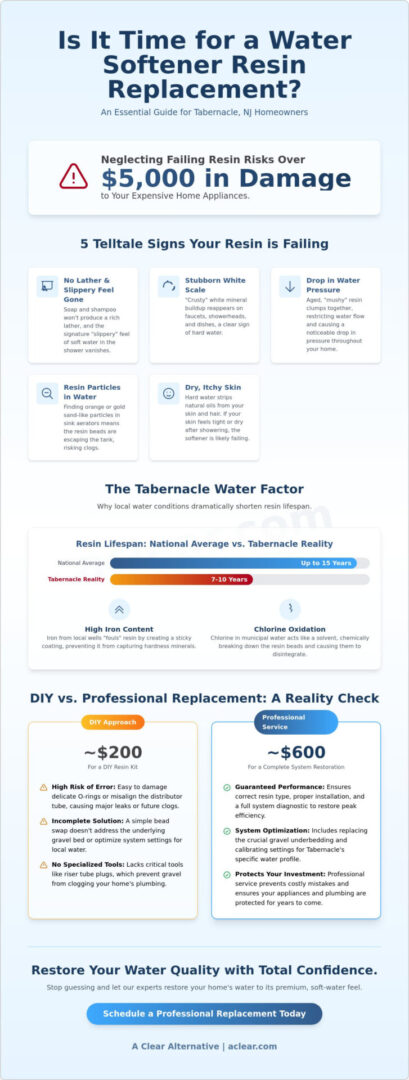
South Jersey water presents unique challenges that national guides often ignore. While national averages suggest beads last 15 years, the reality in Tabernacle is often closer to 7 or 10 years. High iron content in our local wells can “iron out” or coat the ion-exchange resins, making them unable to grab onto hardness minerals. Even though Burlington County averages 8.7 PPM hardness, which is technically soft, individual wells in Tabernacle often spike much higher or carry heavy iron loads. If you’re near Medford Lakes and on municipal water, chlorine is the enemy. It oxidizes the beads, causing them to swell and eventually disintegrate. This local environmental stress makes a regular water softener resin replacement Tabernacle essential for maintaining a high-performing home.
The Science: Why Water Softener Resin Fails
Your water softener isn’t just a tank of salt; it’s a sophisticated chemical processor. At its heart are millions of microscopic resin beads that act like tiny magnets. These beads perform a continuous “swap” through ion exchange, trading sodium ions for the calcium and magnesium that cause hard water. It’s helpful to understand how water softeners work at a molecular level to see why they eventually wear out. Over time, these beads lose their magnetic strength and physical integrity, leading to the scale and soap issues you’re seeing now.
Physical breakdown is the most common cause of failure. As the beads age, they can turn into a mushy consistency that restricts water flow and drops your home’s water pressure. Chemical oxidation is another silent killer. Chlorine, which is frequently found in municipal water supplies, eats away at the “glue” or cross-linking that holds each bead together. Once this internal structure is gone, the beads swell and eventually disintegrate. This degradation is why a water softener resin replacement Tabernacle service is more than just a repair; it’s a necessary system reset to maintain your home’s performance.
Fouling is a specific challenge for our local environment. In Tabernacle, iron is the primary culprit. Iron creates a sticky, orange coating over the beads that prevents them from ever reaching the minerals in your water. Bacteria can also thrive in this mineral-rich environment, creating a biofilm that renders the system useless. When your resin is fouled or oxidized, no amount of salt will fix the problem. You need fresh, high-quality beads to restore that signature soft-water feel.
High-Capacity vs. Fine Mesh Resin
For the high-iron wells common in Shamong and Tabernacle, fine mesh resin is often the gold standard because its smaller size provides more surface area to trap iron particles. You’ll also see ratings for 8% or 10% cross-link resin. Cross-linking refers to the internal plastic “bridges” that give a resin bead its strength and resistance to chemical damage. In 2026, 10% cross-link resin is the preferred choice for homeowners who want to maximize their system’s durability against local chlorine and high mineral loads.
Lifespan Expectations in South Jersey
While some generic guides claim resin lasts 20 years, the reality in South Jersey is different. Environmental factors like fluctuating iron levels and acidic water mean 10 years is usually the “sweet spot” for replacement. If you want to extend this lifespan, installing whole house water filtration systems can remove chlorine and sediment before they ever reach your softener. This proactive step keeps your resin beads clean and functioning at peak efficiency for much longer. If you’re unsure about your current resin’s health, scheduling a professional system check can save you from a mid-winter plumbing emergency.
DIY vs. Professional Resin Replacement: A Comparison
Deciding between a weekend DIY project and calling a pro is often the biggest hurdle for homeowners. You want that signature soft water back because you’ve likely felt the health impacts of hard water on your skin and hair. But let’s talk about the “mess factor” first. Extracting thousands of tiny, wet beads from a heavy, water-logged tank is a logistical nightmare. If you tip the tank improperly, you’re dealing with a slippery slurry that sticks to every surface in your basement. A water softener resin replacement Tabernacle project can quickly turn from a simple task into a multi-day plumbing disaster if you aren’t prepared for the cleanup.
You’ll need specialized gear that isn’t in a standard homeowner’s toolbox. We’re talking about riser tube plugs to prevent resin from entering your home’s pipes, specific wide-mouth funnels, and fresh gravel underbedding for the tank’s base. The biggest risk is the internal distributor pipe. If you accidentally crack this delicate plastic tube while vacuuming out the old resin, your system won’t just fail to soften; it’ll start shooting beads into your dishwasher and water heater. Professionals use high-suction vacuums and protective inserts designed for this exact purpose, ensuring every bead is removed without stressing the tank’s structure.
Cost is usually the deciding factor for many. DIY kits range from $50 to $200, while professional service typically falls between $300 and $600. While saving $100 to $300 on labor sounds tempting, you have to weigh that against the value of a professional warranty. If a DIY repair fails in 12 months because of low-quality resin beads, you’re paying for the materials all over again. A pro ensures the job is done right the first time, protecting your $5,000 appliance investment and giving you back your peace of mind.
The DIY Difficulty Scale
If you’re brave enough to try, you’ll need a pipe wrench, a shop vac with a narrow attachment, and a sturdy bucket for the old “mush.” One common pitfall is getting resin inside the control valve during the refill process. This ruins the delicate internal gears and seals. Don’t forget that Burlington County has specific rules for disposing of chemical waste. You can’t just toss 50 pounds of old, mineral-heavy resin in your regular trash bin; it requires a trip to a proper disposal facility, adding another layer of complexity to your weekend.
The Benefits of Professional Service
Choosing expert water treatment companies means you’re getting more than just new beads. A pro will sanitize your tank during the swap to kill bacteria that often thrive in old resin beds. They also calculate the exact resin volume and cross-link percentage your specific tank size needs based on local water tests. It’s about the freedom to enjoy your weekend while experts handle the heavy lifting, the technical precision, and the messy disposal for you.
How to Replace Water Softener Resin (Step-by-Step)
Restoring your system’s performance starts with proper preparation. You’ve already identified the signs of failure; now it’s time for the technical execution. First, turn your bypass valve to the “off” position to isolate the unit from your home’s plumbing. You must depressurize the tank by starting a manual regeneration cycle and waiting for the pressure to drop before you touch any bolts. Skipping this step can lead to a dangerous burst of water and salt. Once the pressure is gone, you can unplug the unit and disconnect the brine line and drain line with confidence.
Removing the control valve requires a steady hand. Carefully unscrew the head from the tank, making sure not to torque the delicate internal O-rings. These small seals are the only thing standing between a dry basement and a constant leak. Once the valve is off, you’ll face the messy reality of media removal. You have two main options: the “Siphon Method” or the “Dump Method.” Siphoning with a garden hose is much easier on your back; whereas dumping requires two people to tilt a 150-pound, water-logged tank. This is where the mess factor peaks, so keep a few heavy-duty buckets nearby to catch the old, mushy resin beads. After the tank is empty, inspect the distributor tube and the bottom basket for any hairline cracks. If these plastic parts are damaged, your new resin will simply wash away into your pipes.
Refilling and Reassembling
Successful water softener resin replacement Tabernacle requires a specific layering technique. Start by adding a few inches of water to the tank to cushion the impact of the new media. Follow this with a gravel underbed; a step many generic guides skip. This gravel layer is essential for even water distribution during backwashing. Use a riser tube plug or a piece of tape to seal the top of the center pipe before pouring in the resin. If even a few beads fall down that tube, they’ll end up in your kitchen faucet. Leave about 12 to 15 inches of empty space at the top of the tank. This “freeboard” area allows the beads to expand and move freely during the cleaning cycle.
System Startup and Testing
Don’t just flip the water back on at full blast. Slowly open the bypass valve to let air escape through the drain line; this prevents a “water hammer” that can rattle and damage your pipes. Once the tank is full, perform a manual regeneration to “charge” the new resin beads with sodium. This initial cycle also flushes out any fine dust from the manufacturing process. Finish the job by running a hardness test to verify your water is back to its premium, soft state. If the process feels like more than a weekend project, you can always contact a professional for a system optimization to ensure your home’s water quality is perfectly restored.
Restore Your Water Quality with A Clear Alternative
You shouldn’t have to spend your weekend wrestling with a heavy, water-logged tank or scrubbing orange stains off your basement floor. While the technical steps of a water softener resin replacement Tabernacle are straightforward on paper, the physical reality is often a messy, multi-hour ordeal. At A Clear Alternative, we believe your home’s water quality is a lifestyle choice that should bring you comfort, not a list of chores. We’ve spent over 30 years perfecting our process so you can enjoy the confidence of soft water without lifting a finger. We don’t just swap out your old beads; we perform a comprehensive system optimization to ensure your control valve, distributor tube, and brine settings are all working in perfect harmony.
Our team handles the heavy lifting, the technical precision, and the specialized disposal of your old resin. We understand that your time is valuable. By letting professionals manage the transition, you avoid the risks of cracked pipes or resin escaping into your home’s plumbing. To make your life even easier, we recommend pairing your fresh resin with our water softener salt delivery service. This creates a truly hands-off experience where your only job is to enjoy the premium feel of clean, soft water on your skin and the sparkling finish on your dishes. It’s about giving you the freedom to focus on what matters while we maintain the “invisible” technology that keeps your home running beautifully.
Family-Owned Service Since 1991
Since we opened our doors in 1991, we’ve remained a family-owned business dedicated to the families of Tabernacle, Shamong, and Medford Lakes. We aren’t a distant corporate franchise; we’re your neighbors who understand the specific mineral challenges of South Jersey wells. Every technician we send to your door is licensed and insured, providing a level of professional security that a DIY kit simply can’t match. We provide 24/7 emergency support to ensure your home’s water system never leaves you in a bind during a sudden failure.
Schedule Your Resin Inspection Today
Getting your water back to its peak performance is simpler than you think. When you call our local team, we’ll start with a clear, honest quote for your professional resin replacement based on your specific tank size and water usage. During the service call, we’ll inspect your entire system for wear and tear, replace the media, and test the results before we leave. You won’t be left with a mess or a half-finished project; you’ll just have perfectly soft water. Contact A Clear Alternative to restore your soft water today!
Enjoy the Luxury of Soft Water Again
Your home’s water quality isn’t just about plumbing; it’s about the confidence you feel every single morning. We’ve explored how “mushy” resin beads and local iron levels can quietly sabotage your system, leading to mineral buildup and lost pressure. By choosing a professional water softener resin replacement Tabernacle, homeowners can skip the mess of DIY attempts and protect their $5,000 appliance investment. You deserve a system that works as hard as you do, providing that perfect lather and scale-free fixtures without the constant maintenance or confusion.
Since 1991, our family-owned team has been the trusted partner for clean water solutions in South Jersey. As a licensed potable water hauler with 24/7 emergency support, we bring a level of technical precision that ensures your system is optimized, not just repaired. Don’t let hard water mineralize your lifestyle or dull your home’s shine any longer. You’re just one service call away from a brighter smile and a more comfortable, refreshed home environment.
Schedule your professional resin replacement with A Clear Alternative
Frequently Asked Questions
How much does water softener resin replacement cost in Tabernacle?
Professional resin replacement typically ranges from $300 to $600 based on national industry averages. If you choose a DIY kit, expect to pay between $50 and $200 for the materials alone. These costs fluctuate depending on your tank’s capacity and whether you select a premium 10% cross-link resin. Investing in professional service ensures the job includes a warranty that protects your home’s $5,000 appliance investment from mineral damage.
Can I replace the resin beads myself or do I need a professional?
You can replace the beads yourself if you’re comfortable handling heavy equipment, but professional installation is safer for your plumbing. A water softener resin replacement Tabernacle project involves maneuvering a water-logged tank that can weigh over 150 pounds. If you accidentally crack the internal distributor tube during a DIY attempt, resin beads will flood your pipes and clog your water heater, leading to expensive repair bills that far exceed the cost of professional service.
How long should water softener resin last in South Jersey?
Resin typically lasts between 7 and 10 years in our region due to specific local water challenges. While national guides often suggest a 15 year lifespan, the high iron levels in Tabernacle wells and chlorine in municipal supplies cause beads to degrade much faster. Replacing your resin within this 10 year “sweet spot” ensures your system continues to swap minerals effectively and prevents the return of crusty white scale on your fixtures.
What type of resin is best for well water with high iron?
Fine mesh resin with a 10% cross-link rating is the gold standard for high-iron wells. This resin has a smaller bead size, which provides more surface area to trap iron particles that standard beads might miss. The 10% cross-linking provides a stronger internal structure that resists the physical breakdown caused by iron fouling and chemical oxidation, making it the most durable choice for the challenging water conditions found in Burlington County.
Should I replace the whole water softener or just the resin?
You should replace just the resin if your control valve and tank are less than 10 years old and functioning well. If your system is older than 15 years, the internal gears and seals are likely near the end of their lifespan, making a full system replacement more cost-effective. A professional inspection can help you decide if a simple bead refresh will restore your water quality or if it’s time for a modern, high-efficiency upgrade.
Is it normal for my water softener to smell like rotten eggs after resin replacement?
A rotten egg smell is usually caused by sulfur bacteria in the tank or brine line rather than the new resin itself. During a professional water softener resin replacement Tabernacle, the technician should sanitize the entire system to kill any lingering bacteria. If the smell persists after a few cycles, you may need to address high sulfur levels in your well water with a specialized iron and sulfur filtration system to maintain a fresh scent.
What do I do with the old water softener resin beads?
Old resin beads are non-biodegradable plastics that shouldn’t be tossed in your regular household trash in Burlington County. They have spent years trapping minerals and heavy metals, which means they require proper disposal at a designated waste facility. Most professional water treatment companies include the removal and eco-friendly disposal of this old media as part of their service, saving you the hassle of transporting 50 pounds of wet, heavy material yourself.
Will replacing the resin fix low water pressure in my house?
Replacing your resin will fix low water pressure if the old beads have disintegrated into a mushy sludge that restricts flow. When resin fails, it clumps together at the bottom of the tank and acts like a physical plug in your plumbing. Swapping this “mush” for fresh, high-capacity beads restores your home’s original water pressure, ensuring your morning shower feels powerful again and your appliances fill with water 30% faster than they did with failing resin.