
Bacteria in Well Water Symptoms: A Guide for Tabernacle, Shamong, & Medford Lakes
Relying on your sense of smell to detect water safety is the most dangerous gamble you can take in South Jersey. You want to feel absolute confidence when you pour a glass of water for your family, yet the fear of invisible contaminants often lingers. It’s frustrating when DIY kits provide vague results and NJ well regulations feel like a maze of paperwork. You deserve a home where every tap provides pure, life-enhancing water without the constant guesswork.
In this guide, you’ll learn to identify the subtle bacteria in well water symptoms that range from persistent digestive issues to unexpected changes in water clarity. We’ll explore why our unique local landscape requires a more sophisticated approach to filtration than standard systems provide. You’ll gain a clear list of health signs to check, an understanding of local risks in Tabernacle, Shamong, and Medford Lakes, and a definitive plan to sanitize your well. It’s time to stop worrying and start enjoying the premium water quality your lifestyle demands.
Key Takeaways
- Identify the bacteria in well water symptoms that disrupt your family’s wellness, from persistent digestive issues to subtle skin irritations after showering.
- See why the unique geography of the Pine Barrens makes Tabernacle and Shamong wells more susceptible to surface runoff and septic interference.
- Decode the labels of Coliform and E. coli so you can distinguish between a minor safety alert and a serious health risk.
- Discover how discrete, tech-forward solutions like UV Sterilization offer a chemical-free path to total water confidence.
- Get a clear, professional plan to sanitize your system and eliminate the stress of invisible contaminants forever.
Physical and Health Symptoms of Bacteria in Well Water
Most homeowners believe they can see or smell a problem with their water long before it becomes a danger. This is a risky assumption. Bacteria are the ultimate invisible intruders. While iron leaves a rust-colored stain and hard water creates a chalky scale, harmful pathogens like E. coli are masters of disguise. Your water might look like a premium bottled brand while harboring microscopic threats that compromise your family’s health. Recognizing bacteria in well water symptoms requires you to look past the surface and pay close attention to how your body and your home’s fixtures react to your daily water use.
Short-Term Health Warning Signs
When your well’s natural defenses fail, your body is usually the first to sound the alarm. Gastrointestinal distress is the most frequent indicator of E. coli or fecal coliform. This isn’t just a mild discomfort; it often mirrors a severe, flu-like state that can sideline you for days. According to the CDC, symptoms of a waterborne infection typically appear within 24 to 48 hours after ingestion, though some strains can take longer to manifest.
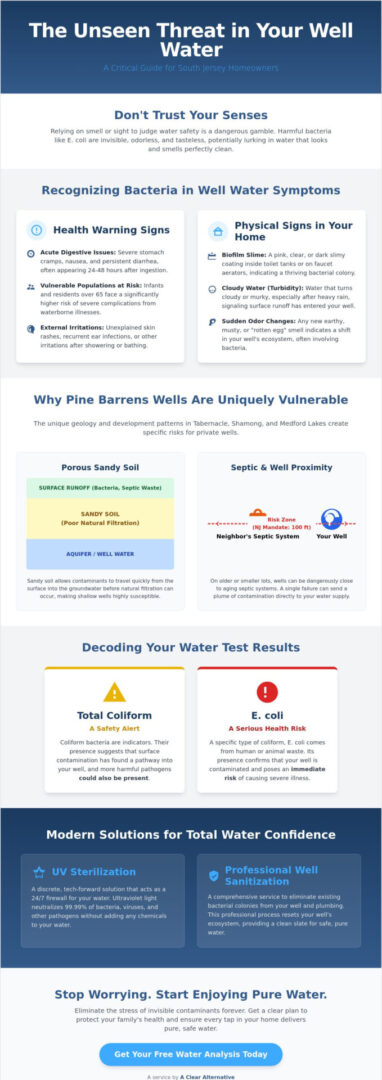
- Acute Digestive Issues: Severe stomach cramping, nausea, and persistent diarrhea are the primary red flags.
- Vulnerable Populations: In communities like Medford Lakes, where many homes rely on older well infrastructure, infants and residents over age 65 face a significantly higher risk of complications from dehydration.
- External Irritations: Don’t ignore what happens after you step out of the shower. Recurrent ear infections or unexplained skin rashes are common signs that your water is carrying high bacterial loads.
It’s easy to mistake these issues for a standard stomach bug. However, if multiple family members experience these symptoms at the same time, your well is the likely culprit. You shouldn’t have to play detective with your family’s wellness.
Physical Changes in Your Fixtures
Sometimes the evidence isn’t in your body, but in your plumbing. Bacteria can create physical clues if you know where to look. If you notice a pink or clear slimy coating inside your toilet tank or around your faucet aerators, you’re looking at a biofilm. This is a living colony of bacteria that has anchored itself to your fixtures. While the biofilm itself might not be the pathogen making you sick, its presence proves your water is an environment where bacteria can thrive.
South Jersey rainstorms often trigger sudden changes in water quality. If your water turns cloudy or “turbid” after a heavy downpour, it’s a sign that surface runoff is bypassing your well’s filtration layers. This runoff frequently carries bacteria from nearby septic systems or wildlife. Additionally, while a “rotten egg” smell usually points to sulfur-reducing bacteria, any sudden earthy or musty scent is a signal that your well’s ecosystem has shifted. Relying on a “wait and see” approach only gives these contaminants more time to spread throughout your home.
Why Bacteria is Common in Tabernacle, Shamong, and Medford Lakes
Living in the heart of the Pine Barrens offers a unique aesthetic, but the very soil that supports our iconic cedar forests poses a specific challenge for your water supply. In towns like Tabernacle and Shamong, the geology isn’t working in your favor. Unlike clay-heavy regions that act as a natural barrier, our sandy terrain is incredibly porous. This means that surface contaminants don’t just stay on the surface; they migrate. If you’ve been monitoring bacteria in well water symptoms like digestive changes or skin flare-ups, the local landscape might be the primary reason why.
The Impact of Sandy Soil on Well Safety
The Cohansey Aquifer sits beneath much of our region, and its primary filter is sand. While sand is excellent for drainage, it’s a poor filter for microscopic pathogens. Bacteria can travel through sandy soil much faster than through denser earth. Groundwater leaching occurs when water moves rapidly through porous soil, carrying surface-level pollutants directly into the underlying aquifer before natural filtration can occur. Shallow wells, which are common in older South Jersey properties, are especially vulnerable because they lack the deep bedrock protection found in other parts of the state.
Local Septic and Well Proximity
In Medford Lakes and Shamong, septic density is a significant factor. Many homes were built decades ago when land use regulations were less stringent. Today, NJ Administrative Code 7:9A requires a 100-foot distance between a well and a septic disposal field. However, on smaller or older lots, your well might be uncomfortably close to a neighbor’s aging system. A single septic failure nearby can send a plume of contamination toward your intake, often without any visible signs on your lawn.
Heavy rain and seasonal flooding exacerbate these risks. When South Jersey sees significant rainfall, such as the record-breaking storms of 2023, the rising water table can push septic effluent and agricultural runoff from local farms directly into your well casing. This is why your well is most vulnerable during the spring thaw or after a hurricane. If you haven’t checked your system lately, a comprehensive water analysis can provide the clarity you need to protect your home’s lifestyle and health. Relying on luck isn’t a strategy when it comes to the water your family drinks every day.
Understanding Coliform and E. coli: The Indicators of Contamination
Seeing a positive result on a water report can feel overwhelming, but it’s the first step toward reclaiming your peace of mind. Understanding your lab results is just as vital as recognizing physical bacteria in well water symptoms like cloudy water or digestive issues. Testing doesn’t usually search for every individual pathogen. Instead, labs look for “indicator” bacteria. These groups tell us if your well’s protective seal has been breached, allowing outside contaminants to enter your home’s ecosystem.
Total Coliform isn’t a single type of bacteria. It’s a broad group that includes species found in soil and vegetation. A positive result for Total Coliform is a signal that your well’s natural defenses are down. While these bacteria aren’t always harmful on their own, they act as a gateway. They show that surface water or soil organisms have found a way into your drinking supply. If your family is already experiencing bacteria in well water symptoms, a positive E. coli test confirms the source of the illness. E. coli is a subgroup of fecal coliform and provides direct evidence of sewage or animal waste contamination. This is a “red light” situation that requires immediate intervention.
What Your Water Test Results Actually Mean
NJ lab reports typically use “Absent” or “Present” terminology rather than a specific count. In the world of water safety, there is no “safe” amount of E. coli. Even a “Present” result for Total Coliform suggests your system is vulnerable to future contamination. Relying on a single test from three years ago isn’t enough to guarantee current safety. For a deeper look at how to manage your specific local risks, explore our guide on Well Water Testing in Tabernacle, Shamong, and Medford Lakes. Annual monitoring is the only way to ensure your water remains as pure as it looks.
When to Call a Professional Immediately
If your test comes back positive for E. coli, you must initiate a “Boil Water” advisory for your household immediately. Don’t use the water for brushing teeth, washing produce, or making ice. While DIY kits are popular, they often provide false negatives because they lack the sensitivity of professional laboratory equipment. You might also encounter “nuisance” bacteria. Iron and sulfur bacteria create those familiar orange stains or “rotten egg” smells. While these are technically aesthetic issues, they often mask more serious pathogens by creating biofilms that protect harmful bacteria from standard treatments.
Modern Solutions: UV Sterilizers and Well Sanitization
Once you recognize the bacteria in well water symptoms that threaten your home’s comfort, you need a solution that fits a modern lifestyle. You don’t want to rely on harsh chemicals or clunky, high-maintenance systems. In South Jersey, we often see homeowners trying to “shock” their way out of a problem. Well shocking with chlorine acts as a temporary reset button, effectively sanitizing the well and plumbing after a flood or repair. However, it isn’t a permanent shield. For ongoing protection that doesn’t change the taste or feel of your water, Ultraviolet (UV) Sterilization is the definitive choice.
A Clear Alternative recommends UV systems for our neighbors in Tabernacle and Shamong because they offer 99.9% neutralization of bacteria without adding a single drop of bleach to your supply. While a water softener handles minerals and an iron filter manages staining, only a dedicated sterilizer ensures that pathogens never reach your glass. It’s a discrete, tech-forward approach that works silently behind the scenes to maintain your water’s purity. Protecting every tap in your home ensures that your morning shower is just as safe as the water you use to prepare dinner.
How UV Water Purification Works
The science is elegantly simple. As water passes through a stainless steel chamber, it’s exposed to concentrated UV-C light. This light penetrates the cell walls of bacteria and viruses, disrupting their DNA so they can no longer reproduce. It’s an invisible barrier that provides total peace of mind. Unlike chemical injectors, a UV system requires very little attention; usually, you only need to replace the lamp every 12 months to ensure peak performance. To see how this fits into a complete home setup, check out our Whole House Water Filtration Systems guide.
The Limitations of Standard Filters
Many homeowners are surprised to learn that their existing equipment might be leaving them exposed. Standard sediment filters and water softeners are designed for aesthetics, not safety. They cannot trap or kill microscopic pathogens. In fact, if your water has high levels of iron or sediment, it can actually hinder a UV system. This is known as “shadowing,” where physical particles in the water act as tiny umbrellas, shielding bacteria from the UV light as they pass through the chamber. This is why we always pair sterilization with proper pre-filtration. You deserve a customized water treatment plan that addresses every variable of your South Jersey well, ensuring your protection is 100% effective.
Protect Your South Jersey Home with A Clear Alternative
Since 1991, A Clear Alternative has been the trusted partner for families across the Tri-State area who refuse to compromise on their quality of life. We understand that your home is your sanctuary. When you suspect bacteria in well water symptoms, you need more than just a quick fix; you need a partner who understands the unique challenges of the South Jersey landscape. Our family-owned expertise ensures that your water treatment isn’t just a generic installation. We provide a precision-engineered solution tailored to your specific property in Tabernacle, Shamong, or Medford Lakes.
The A Clear Alternative Difference: Local Knowledge
Proper system sizing depends entirely on local variables that outsiders often overlook. In Medford Lakes and Tabernacle, the water table fluctuates significantly between seasons, affecting how contaminants move through the sandy Pine Barrens soil. A system designed for a different region will often fail here because it hasn’t been calibrated for our specific pH levels and mineral content. We live and work in these communities. This proximity gives us an edge in diagnosing issues before they become household emergencies.
We believe in total reliability, which is why we offer 24/7 emergency support for well failures or sudden contamination scares. If your system goes offline, we are among the few providers in the region licensed for emergency potable water hauling. Whether you need a bulk delivery of water to keep your household running or a complete reset of your well’s health, we have the specialized equipment to handle it. You don’t have to navigate these technical hurdles alone.
Next Steps: Schedule Your Professional Water Test
Don’t wait for health issues to confirm your fears. A professional, certified lab analysis is the only way to get a definitive answer about what is happening inside your well. We provide comprehensive water testing that goes far beyond the basic, often inaccurate results of a hardware store DIY kit. Our team will walk you through the results with total transparency, explaining exactly what is in your water and how to fix it for good.
Our custom-engineered solutions, from high-efficiency Reverse Osmosis systems to medical-grade UV sterilizers, are designed to integrate seamlessly into your modern lifestyle. We offer simple, transparent pricing for all system installations, ensuring you know exactly what to expect from the start. It’s time to reclaim your confidence and enjoy the peace of mind that comes with perfectly pure water. Schedule your comprehensive well water test today and take the first step toward a healthier, safer home.
Take Control of Your Home’s Water Quality Today
You’ve learned that the porous, sandy terrain of the Pine Barrens and the high septic density in Shamong and Tabernacle create a unique risk environment for your private well. Recognizing bacteria in well water symptoms early is the most effective way to prevent health disruptions and protect those you love. Whether you’ve noticed a change in water clarity after a heavy rain or simply want to move past the skepticism of DIY kits, a professional solution is within reach. You deserve a home where every tap provides pure, life-enhancing water without the stress of the unknown.
A Clear Alternative has been family-owned and operated since 1991, serving the Tri-State area with tech-forward water solutions. We combine over 30 years of local expertise with 24/7 emergency well support to ensure your system never fails you. From advanced UV sterilization to comprehensive lab testing, we provide the clarity your lifestyle demands. Protect your family with expert well water testing and UV purification from A Clear Alternative and start enjoying the confidence of a perfectly sanitized home. Your path to a safer, more vibrant life is just one professional analysis away.
Frequently Asked Questions
Can bacteria in well water cause a skin rash?
Yes, skin rashes and ear infections are common physical responses to contaminated water. High bacterial loads can cause folliculitis or aggravate eczema when you shower or bathe. If you notice these bacteria in well water symptoms after your morning routine, it’s a clear sign that pathogens are thriving in your plumbing. Professional sterilization is the only way to ensure your skin remains as healthy as your drinking water.
How often should I test my well water for bacteria in South Jersey?
You should test your private well for bacteria at least once every 12 months. The New Jersey Private Well Testing Act mandates testing during real estate transfers, but annual checks are vital for ongoing safety in our region. Because the water table in Medford Lakes is so dynamic, testing after major plumbing repairs or heavy flooding is also a smart lifestyle choice to maintain your peace of mind.
Will boiling my water remove all bacterial contaminants?
Boiling water at a rolling boil for at least 60 seconds will kill bacteria, viruses, and protozoa. While this is an effective emergency measure, it doesn’t remove nitrates, lead, or other chemical contaminants. It’s a temporary, inconvenient fix that lacks the long-term benefits of a modern, whole-house UV sterilization system. You deserve a solution that provides safety without the extra work.
What happens if I drink well water with coliform bacteria?
Drinking water with coliform bacteria can lead to gastrointestinal distress, including nausea, vomiting, and diarrhea. While total coliform isn’t always harmful on its own, its presence indicates that your well’s protective barrier has failed. This breach allows more dangerous pathogens to enter your supply, potentially leading to severe infections that require medical attention and sideline your family for days.
Can a heavy rainstorm cause bacteria to enter my well?
Yes, heavy rainfall is a primary trigger for well contamination in South Jersey. Our porous, sandy soil allows surface runoff to carry animal waste and septic effluent directly into the groundwater. Data from 2023 shows that bacterial levels in private wells can spike significantly within 48 hours of a major storm event. This is why consistent, automated protection is better than relying on the weather.
Does a standard water softener kill bacteria?
No, a standard water softener is designed to remove calcium and magnesium, not biological threats. It uses ion exchange to manage hard water but has no mechanism to kill or filter out microscopic pathogens. In fact, if you don’t maintain your system properly, a softener can sometimes become a breeding ground for bacterial biofilms that further compromise your water quality.
What is the difference between E. coli and total coliform?
Total coliform is a large group of bacteria found in the environment that acts as a “warning light” for your system’s integrity. E. coli is a specific type of fecal coliform that originates only in the intestines of humans and warm-blooded animals. While total coliform suggests your well is vulnerable, E. coli is definitive proof of sewage or waste contamination that requires immediate professional intervention.
How much does a UV water sterilizer cost to maintain?
Maintaining a UV sterilizer is remarkably simple and involves replacing the UV lamp once every 365 days. You should also clean the quartz sleeve periodically to prevent mineral buildup from blocking the light’s path. This low-maintenance schedule ensures your water remains 99.9% pathogen-free without the need for constant chemical monitoring or the unpleasant taste of chlorine in your morning glass.