
Whole Home Water Filtration Systems in Tabernacle, Shamong, & Medford Lakes: The 2026 Guide
Last Tuesday, a family in Medford Lakes realized their luxury bathroom renovation was already showing signs of defeat. Faint blue-green rings began circling the drains of their brand-new porcelain tubs, a calling card of the acidic water common across the Pinelands. If you’ve noticed these stains or a persistent metallic smell, you know that South Jersey water often feels more like a chore than a comfort. Installing a modern whole home water filtration system is no longer just a utility upgrade; it’s a lifestyle decision that restores your home’s aesthetic and your own peace of mind.
You shouldn’t have to worry about your pipes corroding or your morning shower smelling like sulfur. We agree that your home should be a sanctuary where every drop of water is crystal clear and safe. This 2026 guide will show you exactly how to transform your local water supply into a premium, healthy resource that protects your appliances and your family. We’ll walk through the specific challenges of Tabernacle, Shamong, and Medford Lakes water, then preview the discreet, high-tech solutions that make pure water effortless.
Key Takeaways
- Learn why a Point-of-Entry solution is the ultimate lifestyle upgrade, ensuring every tap in your home delivers pure, refreshing water.
- Discover how to eliminate frustrating “rotten egg” smells and neutralize the unique chemical profile of South Jersey well water for good.
- Master the differences between RO, UV, and carbon technologies to choose the perfect whole home water filtration system for your family’s specific needs.
- Follow our professional two-step guide to analyzing your water quality and calculating the exact peak flow rate your household requires.
- See why partnering with a licensed potable water hauler with over 30 years of local expertise ensures a seamless, premium installation experience.
What is a Whole Home Water Filtration System?
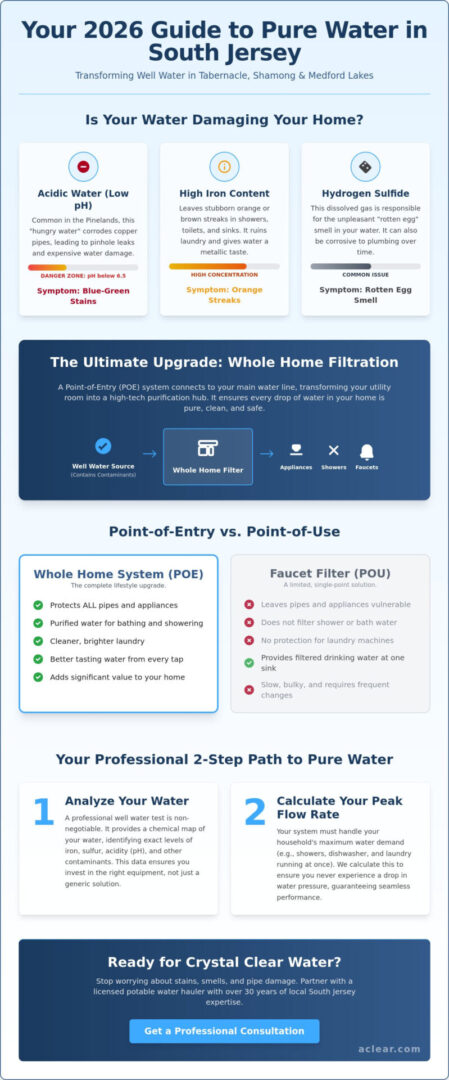
A whole home water filtration system is your property’s first line of defense against impurities. Unlike small filters attached to a single faucet, this is a point-of-entry (POE) solution. It sits at the main water line where your supply enters the house. This means every drop of water in your Tabernacle home is treated before it ever reaches a tap. You get purified water for your morning coffee, your evening shower, and even your garden hose simultaneously. It’s a modern upgrade that transforms your utility room into a high-tech purification hub.
Many homeowners confuse filtration with water softening. They aren’t the same. A softener specifically targets “hard” minerals like calcium and magnesium to prevent scale buildup. A filtration system focuses on removing harmful contaminants, chemicals, and sediment. To truly understand the mechanics, you might ask, What is a Water Filter? and how does it differ from a basic sediment trap? In South Jersey, a comprehensive approach often requires both technologies to ensure your water is both soft and safe. Don’t rely on a plastic pitcher filter. It’s slow, bulky, and does nothing to protect your $3,000 designer dishwasher or your high-efficiency washing machine from internal damage.
Point-of-Entry vs. Point-of-Use Systems
Medford Lakes homes benefit most from treating water at the source. Point-of-use systems, like under-sink reverse osmosis units, only provide clean water at one specific spot. They’re great for drinking but leave your skin and hair vulnerable in the bathroom. A POE system ensures you’re bathing in filtered water, which prevents the dryness and irritation caused by chlorine or minerals. It’s a lifestyle choice that prioritizes your comfort and your home’s longevity. You’ll notice the difference in the vibrancy of your laundry and the lack of spotting on your glass shower doors.
Common Contaminants in South Jersey Water
The unique geology of the Pinelands significantly impacts local well water quality. Shamong residents often deal with high levels of iron and sulfur, which create metallic tastes and “rotten egg” odors. The sandy Pinelands soil also contributes to high acidity. Low pH water is defined as water with a pH level below 7.0, which creates an acidic environment that aggressively corrodes copper plumbing and causes distinct blue-green staining in your sinks. Installing a dedicated system stops this corrosion, protecting your pipes and your investment for the long term.
How Whole House Filtration Solves Tabernacle’s Toughest Well Water Issues
Living in South Jersey means you likely rely on a private well tapping into the Kirkwood-Cohansey aquifer. While this water source is naturally abundant, it carries a specific chemical profile that can be tough on your home and your health. In 2026, homeowners in Tabernacle and Shamong are increasingly turning to a whole home water filtration system to handle the high levels of dissolved minerals and gases found in our local soil.
If you’ve noticed a “rotten egg” smell when you turn on the tap, you’re dealing with hydrogen sulfide gas. It’s a common issue in our region that doesn’t just smell bad; it can also be corrosive to your plumbing. Then there’s the iron. It leaves those stubborn orange streaks in your shower and makes your morning coffee taste like pennies. These aren’t just minor annoyances. They’re signs that your water is actively working against your lifestyle and your home’s value.
Neutralizing Acidic Water in Shamong
Shamong’s ground water often tests at a pH level below 6.5, which is considered acidic. This “hungry water” is aggressive and eats away at copper pipes, eventually causing pinhole leaks that lead to expensive water damage. Installing acid neutralizers is the most effective way to balance your pH levels and protect your plumbing infrastructure. Before you choose a system, professional well water testing is a non-negotiable first step. It gives you a clear map of your water’s chemistry so you don’t waste money on the wrong equipment.
Managing Iron and Sulfur for a Cleaner Home
Removing iron and sulfur requires a sophisticated, multi-stage approach. Modern systems use oxidation to turn dissolved minerals into solid particles that can be easily trapped and flushed away. This process stops the orange staining on your laundry and prevents heavy buildup on your bathroom fixtures. For more detailed guidance on technology types, you can check these EPA resources on choosing a water filter to understand how different media beds work to clean your water.
Beyond the pipes, the benefits are deeply personal. You’ll notice clearer ice cubes, softer skin after a shower, and much better-tasting food. A whole home water filtration system ensures that every drop in your house is crisp and clean, from the kitchen sink to the guest bathroom. If you’re ready to reclaim your water quality, get a custom water analysis to find the perfect fit for your family’s needs.
- Eliminate the “rotten egg” odor instantly.
- Prevent orange staining on white laundry and porcelain.
- Stop acidic water from causing pinhole leaks in your walls.
- Enjoy better-tasting drinking water from every tap.
Comparing Filtration Technologies: Which One is Right for You?
Choosing the right technology for your home is about your family’s health and your property’s longevity. You don’t need a degree in chemistry to make a smart choice. You just need to understand how different systems solve specific South Jersey water problems. The goal is a whole home water filtration system that works silently in the background while delivering clinical-grade purity to every tap.
Reverse Osmosis vs. Carbon Filtration
Carbon filters are the reliable workhorses of the industry. They use activated media to scrub away chlorine, pesticides, and those metallic tastes common in Medford Lakes. They’re perfect for treating every gallon that enters your home. Reverse Osmosis (RO) is different. It’s a high-precision process that forces water through a semi-permeable membrane, removing up to 99 percent of dissolved solids and heavy metals.
While RO provides the highest purity, it’s rarely used for the entire house. It creates “brine” or waste water during the cleaning process. In Tabernacle and Shamong, where most homes rely on septic systems, this is a critical factor. Sending an extra 3 to 5 gallons of waste down the drain for every gallon of pure water produced can overwhelm your leach field. Most homeowners choose carbon for the whole house and keep RO as a dedicated tap for drinking and cooking.
The Role of UV Sterilization
If you’re on a private well, UV sterilization is your essential safety net. It doesn’t use chemicals to treat your water. Instead, it uses a specific light frequency to scramble the DNA of bacteria and viruses. For families with young children or seniors, this provides an invisible layer of protection against E. coli or coliform outbreaks that can occur after heavy South Jersey rains.
UV systems are “finishers” rather than filters. They don’t remove physical particles or smells. For a UV lamp to be 100 percent effective, the water must be clear first. If your water contains sediment or iron, the bacteria can “shadow” or hide behind the particles, escaping the light. This is why we always install UV lamps after a primary sediment or carbon filter.
The best results usually come from a hybrid approach. Combining technologies allows you to target specific minerals while ensuring biological safety. Expert water treatment companies near me can analyze your specific water chemistry to build a custom stack. This ensures your whole home water filtration system isn’t just powerful, but also efficient enough to protect your plumbing without wasting a drop of water.
- Carbon: Best for taste, odor, and chemical removal.
- Reverse Osmosis: Best for high-purity drinking water.
- UV Sterilization: Essential for well water bacteria protection.
- Maintenance: Carbon media typically lasts 3 to 5 years, while UV bulbs need annual replacement.
Selecting the Right System for Your South Jersey Home
Choosing a whole home water filtration system isn’t a one-size-fits-all decision. It’s a strategic upgrade for your lifestyle. To get the results you want, you need a plan that moves past guesswork and focuses on the specific chemistry of your local supply. Follow these five steps to ensure your home enjoys crystal clear water for years to come.
- Step 1: Start with a professional water analysis. You can’t fix what you haven’t measured. This identifies the exact “enemies” in your pipes, from hidden chemicals to staining minerals.
- Step 2: Calculate your peak water usage. We look at your number of bathrooms and family size to determine the necessary Gallons Per Minute (GPM).
- Step 3: Determine your technology needs. Depending on your results, you might require a water softener for mineral scale, a neutralizer for low pH, or a specialized chemical-free iron filter.
- Step 4: Evaluate the long-term commitment. Look at the maintenance costs and how often the internal media needs a refresh to keep the system at 100% efficiency.
- Step 5: Choose a local partner. Always opt for an installer that provides 24/7 emergency support so you’re never left without water during a holiday or weekend.
Why Water Testing is Non-Negotiable
You wouldn’t choose a treatment plan without a diagnosis. Our team at A Clear Alternative analyzes South Jersey samples for specific lab parameters, including iron parts per million, pH acidity, and manganese levels. We also measure your home’s flow requirements. GPM stands for Gallons Per Minute, and it represents the maximum amount of water your filtration system can process at any given moment to ensure your shower pressure never falters when the laundry is running.
Maintenance and Long-Term Performance
A high-end system stays high-end because of consistent care. Most filtration media in our region requires replacement every 3 to 7 years to maintain peak performance. If you have a combined system, you can skip the heavy lifting by using our water softener salt delivery service. This keeps your system running without you ever having to haul 40-pound bags from the store. Regular check-ups are the best way to prevent system failure during high-demand summer months when your water usage naturally spikes.
Ready to transform your home’s water quality? Contact A Clear Alternative today to schedule your professional water analysis and take the first step toward a healthier home.
Professional Installation with A Clear Alternative
Choosing the right team for your water needs makes all the difference in your daily quality of life. At A Clear Alternative, we’ve been perfecting local water quality since 1991. We aren’t just another service provider; we’re a family-owned business that has spent over 30 years serving the Tri-State area. Our team understands that a whole home water filtration system is an investment in your family’s health and your home’s longevity. We bring decades of hands-on experience to every installation, ensuring the process is seamless and stress-free.
What truly sets us apart is our status as a licensed potable water hauler. This is a unique local differentiator that most plumbing companies simply can’t match. It means we have a deep, technical understanding of water safety standards and transport that goes far beyond basic pipe fitting. We don’t just guess what’s in your water. We use our specialized background to provide solutions that work for the specific chemistry of New Jersey’s groundwater. If an issue arises at 2:00 AM, you don’t have to worry. We provide 24/7 emergency support for residents in Tabernacle, Shamong, and Medford Lakes because we know that water quality can’t wait.
The “A Clear Alternative” difference is built on a simple philosophy: local water, local people, and local solutions. We live where you live. We drink the same water you do. This personal connection drives us to provide a level of service that national franchises can’t replicate. We treat your home with the respect it deserves, delivering a premium experience that focuses on your long-term confidence and comfort.
Our Local Service Area and Commitment
Our commitment to the Tabernacle, Shamong, and Medford Lakes communities runs deep. We specialize in both residential and commercial water quality, adapting our methods to meet the high demands of modern households and local businesses alike. Our expertise isn’t limited to what’s inside your walls. For those who enjoy the South Jersey summers, our pool water delivery service complements our filtration expertise perfectly. We ensure that every drop of water on your property, whether it’s in your glass or in your pool, meets our rigorous standards for purity and clarity.
Get Started with a Water Consultation
Taking the first step toward better water is easy and transparent. We begin with a professional water analysis to identify exactly what your home needs. You won’t deal with high-pressure sales tactics or confusing jargon. Instead, we provide a clear explanation of your results and a straightforward breakdown of pricing for installation and labor. Our goal is to make the transition to a whole home water filtration system as rewarding as the first glass of crisp, clean water you’ll drink. Contact us today to schedule your consultation and start your journey toward a clearer, healthier home.
Take Control of Your Home’s Water Quality
Your property in Tabernacle, Shamong, or Medford Lakes deserves better than stubborn iron stains and acidic pH levels. Investing in a whole home water filtration system protects your plumbing and transforms your daily routine into a premium experience. We’ve spent decades mastering the unique challenges of South Jersey well water. Since 1991, our family-owned company has delivered tailored solutions that prioritize your comfort and confidence. We don’t just install equipment; we provide a modern lifestyle upgrade that ensures every tap in your house delivers pure results.
We operate as a Licensed NJ Potable Water Hauler and provide 24/7 emergency support to ensure your home stays protected. This isn’t just about maintenance; it’s about the peace of mind that comes from knowing your water is pristine and safe. You can stop worrying about mineral buildup or strange odors today. It’s time to embrace the clarity and health benefits of professional filtration. We’re here to make the process simple, fast, and effective.
Schedule Your Professional Water Analysis Today
Let’s get started on bringing the best possible water to your South Jersey home.
Frequently Asked Questions
Is a whole home water filtration system a good investment in South Jersey?
Yes, installing a whole home water filtration system is a smart investment because South Jersey groundwater often contains elevated levels of iron and manganese. According to New Jersey Department of Environmental Protection data, over 20 percent of private wells in the state exceed secondary standards for these minerals. You’ll protect your plumbing fixtures from permanent staining and increase your home’s resale value by providing clean water to every tap.
Do I need a plumber to install a whole house water filtration system in Tabernacle?
You should hire a licensed plumber to install your system to ensure it meets local Tabernacle building codes and maintains your manufacturer’s warranty. Professional installation prevents leaks that cause thousands of dollars in water damage. A certified technician will also calibrate the system to your specific flow requirements, ensuring your home remains compliant with the 2024 New Jersey Residential Plumbing Code standards.
Will a whole house filter reduce the water pressure in my Medford Lakes home?
A correctly sized whole home water filtration system won’t noticeably reduce your water pressure. Most modern systems are designed for a flow rate of 10 to 15 gallons per minute, which exceeds the needs of a standard three bedroom home in Medford Lakes. If you experience a drop in pressure, it usually indicates the filter is full of sediment and requires a quick cartridge swap to restore flow.
How often do I need to replace the filters in my whole home system?
You’ll typically replace your sediment pre-filters every 6 months and your main carbon tank media every 5 to 7 years. These timelines depend on your specific water usage and the concentration of contaminants in your local supply. Monitoring your system’s pressure gauge is the best way to tell; a 5 PSI drop usually signals it’s time for a new filter to maintain peak performance.
Can a whole house filter remove the rotten egg smell from my well water?
Yes, a specialized whole house filter using air injection or catalytic carbon effectively removes the hydrogen sulfide gas responsible for that rotten egg smell. This is a common issue in the Pinelands region where organic matter decomposes in the aquifer. These systems neutralize the gas on contact, so your laundry and showers smell fresh and clean without using harsh chemicals like bleach or chlorine.
What is the difference between a water softener and a whole house filter?
A water softener specifically targets calcium and magnesium to prevent scale buildup, while a whole house filter removes impurities like chlorine, lead, and pesticides. Think of a softener as protection for your appliances and a filter as protection for your health. Many homeowners in Shamong combine both technologies to achieve the ultimate level of water purity and skin friendly softness for their families.
How much does a whole home water filtration system cost to maintain annually?
Annual maintenance typically ranges from 150 to 300 dollars for replacement cartridges and basic service. This cost is significantly lower than the 600 dollars the average American household spends on bottled water each year according to industry reports. Staying on top of this schedule ensures your system continues to run at peak efficiency and prevents sediment from reaching your high end kitchen and bathroom appliances.
Does a whole house filter remove lead and nitrates common in NJ wells?
Yes, specific filtration media like KDF or reverse osmosis membranes are designed to remove lead and nitrates from your water supply. The 2023 NJ Private Well Testing Act data shows that some areas in Burlington County have localized nitrate issues from agricultural runoff. Choosing a system certified to NSF/ANSI Standard 53 ensures these specific health hazards are reduced to safe, undetectable levels for your peace of mind.