
Water Filtration for Sensitive Skin: What Can Help?
What if your skin-care routine isn’t the only thing affecting how your skin feels after a shower? Chlorine and hard water are different water-quality concerns, and either may be worth investigating if your skin often feels dry or uncomfortable. That doesn’t mean water is the cause or that a filter can treat a skin condition. Water filtration for sensitive skin can be a practical option to explore when you know what’s in your household water.
It’s easy to wonder whether you need a shower filter, a water softener, or a whole-house system. The right choice depends on the water concern you want to address and where you need treatment, not on the latest skin-care trend. Testing first can help you compare options before investing in equipment.
In this guide, you’ll learn which water characteristics may matter, how filtration differs from softening, and what each option is designed to do. We’ll also explain how to take a sensible next step for your home, including how a free water analysis can help inform treatment choices.
Key Takeaways
- Water filtration for sensitive skin means addressing an identified water-quality concern, not treating a skin condition.
- Chlorine and hardness are different factors to investigate. Skin symptoms alone can’t identify a water issue or prove that water is the cause.
- Compare a shower filter, water softener, and whole-house system by what each is designed to treat and where it treats water.
- Note your concerns, identify your water source, and use water-analysis results to guide your next step. A Clear Alternative offers free water analysis.
- A Clear Alternative is family-owned and NJ-licensed since 1991, with 9,000+ customers served.
Water filtration for sensitive skin: how household water may matter
If your skin feels uncomfortable after washing or bathing, it’s reasonable to wonder whether household water could be one factor. That doesn’t mean water causes every skin concern. Skin comfort can be influenced by many things, and a symptom alone can’t identify a water-quality issue. Start by separating what you notice from what can be established about your water.
Households don’t all have the same water. The source, treatment, and plumbing can affect its characteristics, so a neighbor’s experience or a general description of local water may not reflect your home. Chlorine and hardness are two separate characteristics you may want to investigate. Neither is a confirmed explanation for an individual’s symptoms without further assessment.
Can water quality affect how skin feels?
Water is part of your regular washing and bathing routine, so its characteristics may be relevant to how that experience feels. Public water systems may use chlorine for disinfection, while hard water contains more dissolved minerals, especially calcium and magnesium. These are different water-quality questions, not proof that water is irritating your skin. A water softener is designed to address hardness, not to serve as a general treatment for every water concern.
Pay attention to patterns, but don’t treat them as a diagnosis. Note whether discomfort tends to follow bathing, occurs in other settings, or is experienced by other household members. These observations can help you describe your concern, but they can’t confirm a contaminant or establish that water caused a skin problem. If symptoms persist or worsen, consult a qualified healthcare professional.
What does sensitive-skin water filtration mean?
Water filtration for sensitive skin means treating household water to address a specific water-quality concern identified through testing. It isn’t a skin-care treatment or a medical remedy. The right approach depends on what the water analysis finds and where treatment is needed. A system designed for one water characteristic shouldn’t be assumed to address another.
That distinction keeps the decision practical. Filtration and softening are water-treatment choices that target particular substances or characteristics. Skin-care products and medical care have a different role: they support skin or address health concerns, while water treatment changes the water used in the home. Neither should be presented as a substitute for the other.
In short: water treatment addresses water quality; medical skin care addresses skin health. If you’re exploring options, start with information about the water rather than choosing equipment based on symptoms alone. Testing can help clarify which characteristics are present, while a healthcare professional can assess persistent skin concerns. This approach doesn’t promise a change in how your skin feels. It gives you a clearer basis for deciding whether household water treatment is relevant to your needs.
Chlorine and hard water: two different questions to investigate
Hardness and chlorine can both come up when you’re looking into household water, but they aren’t interchangeable concerns. Hardness relates to dissolved minerals; chlorine is a disinfectant used in public water systems. Identifying which characteristic is present helps narrow down what treatment may be relevant. A system selected for one issue shouldn’t be assumed to address the other.
What is hard water, and why consider it?
Hard water contains dissolved minerals, primarily calcium and magnesium. Mineral deposits around faucets or showerheads and residue left after washing may prompt you to look into hardness. Soap can also be harder to rinse away in some conditions. These signs may be clues, but they don’t reveal the water’s hardness level or prove that hardness is causing skin discomfort.
Visible scale is a household clue, not a skin diagnosis. Water testing can assess hardness and provide more useful information than appearance alone. A water softener is designed to address hardness minerals; whether it’s appropriate depends on the water and your household’s needs. People don’t all respond to the same water in the same way, so don’t treat a possible connection as a certainty.
Why ask about chlorine separately?
Chlorine is used to disinfect public drinking water, while calcium and magnesium are associated with hardness. The U.S. Environmental Protection Agency sets a maximum residual disinfectant level of 4.0 mg/L for chlorine in public water systems. The EPA Drinking Water Regulations provide information about drinking water standards. That standard offers context about public water; it doesn’t establish what’s in a particular home’s water or explain an individual skin concern.
Carbon filtration is one treatment category used in water treatment, but its relevance depends on the specific water-quality concern and the system’s purpose. Don’t assume a filter intended for chlorine also softens water, or that a softener addresses chlorine. Those are different treatment goals, and equipment shouldn’t be chosen based on a symptom alone.
Treatment choice depends on the substance or water characteristic identified, not on a general “sensitive skin” label. That’s the practical distinction to keep in mind as you explore water filtration for sensitive skin. Testing can help determine whether hardness, chlorine, both, or neither is relevant to your home.
A Clear Alternative offers free water analysis to help households understand their water before considering treatment. For homeowners in Tabernacle, Shamong, and Medford Lakes, the same principle applies: start with what’s present, then match the next step to the results.
Shower filter, water softener, or whole-house filtration?
Choosing a system gets easier when you answer two questions: what water concern are you addressing, and where do you need treatment? A shower filter treats water at that shower. A whole-house system treats water at the home’s supply, serving multiple fixtures. A water softener has a different purpose, focused on hardness minerals. None should be chosen as a guaranteed way to improve skin or as a substitute for medical care.
| Option | Treatment target | Point of use | What to establish before choosing |
|---|---|---|---|
| Shower filter | Specific water characteristics stated for that filter | At an individual shower | Which concern is present and whether the filter is designed for it |
| Water softener | Hardness associated with calcium and magnesium | Typically treats household water at its point of entry | Whether testing identifies hardness as a household concern |
| Whole-house filtration | Depends on the filtration system and its intended treatment | Household supply, serving multiple fixtures | Which water characteristics are present and what the system is designed to address |
When might a shower filter be considered?
A shower filter may be worth exploring if you want to treat water at one specific shower rather than across the home. Its suitability depends on the water concern and the filter’s stated capabilities, so don’t assume every shower filter addresses the same substances. Compare the identified concern with what the filter is designed to treat. A point-of-use option can be targeted, but it won’t address a concern affecting other household taps.
When might softening or whole-house treatment fit?
If testing identifies hardness, a water softener may be relevant because it addresses the minerals associated with hard water. Whole-house filtration is a broader point-of-entry approach for treating water used at multiple fixtures. The target depends on the selected system. For more household-level context, see the guide Whole House Water Filtration Systems for Tabernacle, Shamong, & Medford Lakes: The 2026 Homeowner’s Guide.
Think about how widely the concern matters in your home. If you’re investigating water used only at one shower, a point-of-use option may fit that scope. If the concern relates to water throughout the household, consider whether treatment at the home’s supply makes more sense. A softener and a filter aren’t interchangeable, and a system’s name alone doesn’t tell you what it treats.
For water filtration for sensitive skin, let the water results guide the comparison. First identify the target, then match it to the treatment approach and point of use. That keeps the decision focused on household water quality, without promising a skin outcome.
How to choose water treatment for sensitive skin concerns
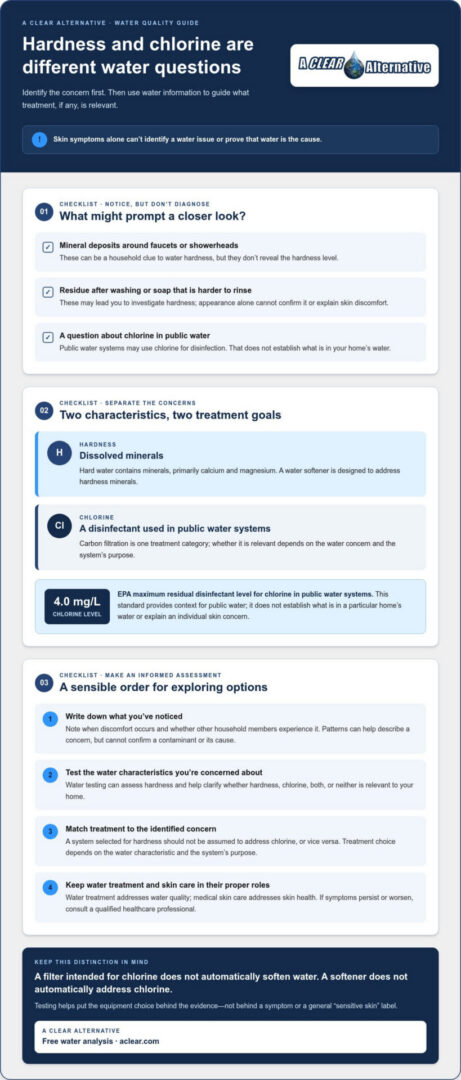
A clear decision starts with water information, not a guess based on how your skin feels. Symptoms alone can’t identify a contaminant or prove that household water is the cause. Water characteristics can vary by home and source, so don’t assume your water has a particular profile. Use this sequence to move from concern to a more informed next step.
- Note what you’ve noticed. Record when discomfort occurs, such as after showering or washing, and whether it happens consistently. These observations can help focus your questions, but they aren’t a diagnosis of a water issue.
- Identify your water source. Find out whether your household uses public water or a private well. Source information helps guide what to assess, but it doesn’t tell you by itself which characteristics are present.
- Test the water. A Clear Alternative offers free water analysis to help identify characteristics including chlorine, iron, hardness, and bacteria. Testing gives you household-specific information instead of relying on assumptions about South Jersey water generally.
- Interpret the results. Consider what the analysis identifies and how it relates to the concern you’re investigating. A finding can guide a water-treatment decision, but it can’t establish that a water characteristic caused a skin symptom.
- Consider treatment based on the findings. Match any option to the identified water concern and the way your household uses water. You don’t need to choose equipment simply because a product is marketed for sensitive skin.
Start with water analysis, not assumptions
A water analysis can help clarify whether characteristics such as chlorine, iron, hardness, or bacteria are present. For homeowners using well water, the guide Well Water Testing in Tabernacle, Shamong, and Medford Lakes: Essential Guide for Homeowners offers related local context. The goal is to understand your water first, not to infer a cause from skin symptoms or from someone else’s test results.
Match a treatment option to the result
If the analysis identifies hardness, a water softener may be worth considering for that specific concern. If it points to a filtration need, carbon filtration or a whole-house treatment approach may be relevant, depending on what the results show and where treatment is needed. These options address water quality, not skin conditions, and no treatment choice guarantees a change in skin comfort.
Keep health questions on a separate track. If symptoms persist or worsen, consult a qualified healthcare professional rather than relying on a water-treatment change alone. The phrase water filtration for sensitive skin describes an approach to investigating water, not a medical treatment or diagnosis.
Start with a clearer picture of your household water. Learn about A Clear Alternative’s free water analysis to help inform your next step.
A Clear Alternative’s next step for South Jersey water concerns
If you’re considering water filtration for sensitive skin, begin with the water itself, not an equipment purchase. A Clear Alternative offers free water analysis to help households in South Jersey, including Tabernacle, Shamong, and Medford Lakes, understand their water characteristics before considering treatment. It’s a practical way to replace assumptions with information specific to your home. The results can help guide a discussion about whether a water softener, carbon filtration, or another treatment option fits the identified concern.
Water analysis doesn’t diagnose a skin condition or prove that water caused a symptom. It helps clarify water quality so you can make a more informed household decision. If skin concerns persist or worsen, continue to seek guidance from a qualified healthcare professional.
What happens after you request a free water analysis?
The analysis is complimentary and helps identify relevant characteristics of your household water. You can use the findings to understand what may be worth addressing and consider treatment options suited to those results. There’s no need to choose a system based only on how your skin feels or on assumptions about water in the region.
Why work with a local water treatment team?
A Clear Alternative is family-owned and NJ-licensed, serving South Jersey since 1991. The business has served 9,000+ customers and holds a 4.6-star Google rating with 98+ reviews. Its South Jersey service focus includes 8 New Jersey counties, as well as parts of Pennsylvania, New York, and Delaware. That local experience offers context while keeping the recommendation centered on your water analysis.
For additional local context, the guide Expert Water Treatment Companies Near Tabernacle, Shamong, and Medford Lakes: 2026 Homeowner’s Guide discusses water treatment in the area. Your household’s results remain the useful starting point: nearby homes may have different sources or water characteristics, so a neighbor’s treatment choice may not suit your needs.
After reviewing the findings, you can consider whether an identified issue calls for treatment and what type may be appropriate. Hardness results, for example, can inform whether to consider a water softener. A filtration need may point toward carbon or whole-house treatment, depending on the concern and where you want water treated. These options address water quality; they don’t promise a skin outcome or replace medical care.
Explore A Clear Alternative’s free water analysis as a practical first step toward understanding your household water before choosing equipment.
Make your next step a confident one
The most useful outcome of investigating water filtration for sensitive skin may be a clearer decision, not a guaranteed change in how your skin feels. Treat water information as one piece of the picture. Keep a simple record of what you’re noticing and what your water analysis shows, so you can make choices based on your household’s needs rather than pressure to buy a particular system.
If your skin concerns continue, keep working with a qualified healthcare professional. Water treatment and medical care serve different purposes, and you don’t have to choose one instead of the other. A measured approach gives you room to explore water quality without expecting equipment to diagnose or treat a condition.
Ready to take a practical first step? Request your free water analysis and get a clearer picture of your household water before deciding what comes next.
Frequently Asked Questions
Can water filtration help sensitive skin?
It may help address a specific water-quality concern if the system is suited to what’s present, but it can’t be presented as a treatment or cure for a skin condition. A system selected for one water characteristic may not address another. Identify your household’s water characteristics before choosing equipment, and speak with a qualified healthcare professional about persistent symptoms. Water filtration for sensitive skin is a water-quality step, not a diagnosis.
Does hard water cause eczema?
Hard water contains minerals such as calcium and magnesium, but finding those minerals in household water doesn’t establish the cause of eczema. Skin conditions can have many contributing factors, and an individual diagnosis requires medical guidance. If you’re concerned about your water, testing can help clarify its characteristics. If you’re concerned about eczema, consult a qualified healthcare professional for advice on diagnosis and treatment rather than relying on water observations alone.
Is a shower filter or a water softener better for sensitive skin?
Neither is universally better; they’re designed for different treatment purposes. A shower filter treats water at that shower, according to the filter’s stated capabilities. A water softener is a separate approach for addressing hardness. For instance, a shower-only concern and a household hardness concern may call for different considerations. Base your choice on water-analysis findings and how your household uses water, not on a promise of a particular skin result.
Can a shower filter remove hard water minerals?
Don’t assume a shower filter softens water. Its capabilities depend on the specific system, and filtration isn’t automatically the same as treating hardness. Hardness is associated with minerals such as calcium and magnesium, while a water softener is a separate treatment category. If you’re comparing options, review the system’s stated purpose and compare it with your water-analysis results before choosing.
Does filtered water cure dry or itchy skin?
No. Water filtration isn’t a medical cure, and it can’t guarantee relief from dryness or itching. If testing identifies a water-quality concern, treatment may address that concern, but it can’t establish that water caused your symptoms or predict how your skin will respond. For continuing, severe, or worsening symptoms, consult a qualified healthcare professional instead of relying on water treatment alone.
How do I know whether my home water contains chlorine or is hard?
Skin sensations and water’s appearance can’t reliably tell you whether chlorine or hardness is present. A water analysis can assess those characteristics; A Clear Alternative offers free water analysis. Results can inform a water-treatment decision, but they can’t diagnose a skin condition or show that water caused symptoms. Keep health questions with a qualified healthcare professional, and use testing to answer water-quality questions.
Is whole-house water filtration different from a shower filter?
Yes. A shower filter treats water at the shower, while a whole-house system is intended to treat household water for use at multiple fixtures. The purpose and capabilities depend on the system selected and the water concern. Treating one shower is different in scope from treating water used at sinks and other fixtures. Start with water analysis rather than assuming one approach fits every home.