
Well Water Issues: Symptoms, Causes, and What to Do Next
Could water that looks perfectly clear still have a problem? An unpleasant taste, a rotten-egg odor, cloudy water, or rusty stains can all point to well water issues, but none reveals the exact cause. Water that looks and tastes normal isn’t necessarily free of contaminants, either.
If you’re unsure whether to worry or what to test, don’t guess at a filter. Start by documenting what you notice, then use water testing to understand what’s in your water. The results can help you choose a suitable next step.
This guide explains common warning signs, what they may indicate, and what testing can reveal. You’ll learn why symptoms aren’t a diagnosis, how different water conditions call for different treatment approaches, and how to investigate a private well in South Jersey. For homeowners in Tabernacle, Shamong, and Medford Lakes, the same practical process applies: record the change, test, review the results, and plan a response.
Key Takeaways
- Track changes in taste, smell, color, and household performance so you can describe what’s happening.
- Use symptoms as clues, not proof of a specific cause or a measure of water safety.
- Choose testing based on the concern and review the results before deciding how to respond to well water issues.
- Match treatment to the water condition identified; different systems address different needs.
- Follow a clear process: document the change, test, understand the results, then plan your next step.
Common Well Water Issues: What Changes in Your Water Can Tell You
A change in your water’s taste, smell, color, or effect on household fixtures deserves attention. A metallic flavor, unusual odor, cloudy water, or new stains can be unsettling, but these clues can’t identify the cause or confirm whether water is safe to drink. Some contaminants have no noticeable taste, smell, or color.
Groundwater quality can be affected by natural conditions and human activity, but a symptom at home doesn’t reveal what may be present in an aquifer. The overview of Groundwater Pollution describes how different contaminants can enter and move through groundwater. Treat changes as prompts to investigate, not as a diagnosis.
What do taste, odor, color, and cloudiness suggest?
Notice the pattern and write it down. Metallic taste, sulfur-like odor, yellow or brown discoloration, and suspended particles can each have more than one possible explanation. They’re observations to investigate, not proof of a specific mineral or contaminant. Even clear water with no unusual odor may need testing to assess its quality.
- Metallic taste: Note whether it appears consistently or only at certain taps.
- Sulfur-like odor: Record whether you notice it in cold water, hot water, or both.
- Discoloration or particles: Note the color, whether the water clears after standing, and which fixtures are affected.
- Cloudiness: Track whether it’s constant or appears after a change in water use.
Check more than one tap if practical. A change limited to one faucet may point to a fixture-specific issue, while a change at several taps is useful context for a broader investigation. Neither pattern confirms what’s happening in the water.
What household clues can point to a water problem?
Water-quality clues can show up beyond the glass. Staining in sinks or laundry, scale on fixtures, changes in how soap lathers, or a fixture that suddenly looks different are all worth documenting. These effects can be associated with water conditions, but plumbing, a fixture, or an appliance can also contribute. A stain alone can’t tell you which explanation is correct.
Separate what you observe from what you suspect. Record when the change started, whether it’s persistent or comes and goes, and whether it affects hot water, cold water, or both. If only hot water has an odor or discoloration, that difference is useful context, not a confirmed diagnosis.
A persistent or recurring change, especially one affecting several taps or household tasks, merits investigation. Keep notes rather than guessing at a treatment. Clear observations help guide relevant testing and make it easier to decide what to do next.
What Causes Well Water Issues? Understand the Main Water-Quality Categories
Private well water can be affected by several conditions, including naturally occurring minerals, acidity, sediment, or microorganisms. A well draws from groundwater, so water quality can depend on the well and aquifer, well maintenance, and conditions in the surrounding area. A change in one home’s water doesn’t reveal which factor is involved.
Some conditions are mainly aesthetic or affect plumbing and household use. Others may have health implications. Taste, odor, color, and visible particles can’t reliably distinguish between them. A concern that seems cosmetic may need investigation, while a health-related contaminant may not change how water looks or tastes.
Laboratory results tell you more about water quality than appearance alone. The EPA’s private well information explains why testing is part of managing a private well. Testing can help distinguish between possible causes and guide a response, rather than relying on guesswork.
Minerals, acidity, and sediment in private wells
Hardness, iron, and acidity are different conditions. Hardness is associated with dissolved minerals and may contribute to scale or affect soap performance. Iron may contribute to staining, while acidic water may interact with plumbing. The type and extent of an effect can vary, so an observation isn’t proof of a specific condition. If testing identifies a low-pH concern, an acid neutralizer system is one treatment category to consider.
Sediment is visible material in water, but its presence doesn’t automatically mean a particular filter is the answer. It may warrant investigating the well, plumbing, or other factors that could introduce particles. Keep the observation distinct from the cause.
- Hardness: A possible consideration when scale or soap performance changes.
- Iron: One possible category to investigate when staining occurs.
- Acidity: A measured water condition that may affect plumbing.
- Sediment: Visible material that calls for investigation before choosing treatment.
Odor and microbial concerns are different kinds of clues
A sulfur-like odor may have more than one explanation. Possible microbial contamination is a separate concern, and smell or taste can’t confirm or rule it out. Choose testing based on the question you need answered; an odor observation alone doesn’t tell you whether bacteria are present. If a result raises a safety concern, use current public-health guidance to determine appropriate next steps.
Different water conditions call for different investigations and treatment approaches. A Clear Alternative offers comprehensive water testing to help identify water conditions and inform practical options for your home.
Well Water Issues Compared: Match the Clue to the Right Investigation
Different observations point toward different questions, but none identifies a cause by itself. Use the comparison below to organize what you’ve noticed and consider what to investigate next. Water testing can help determine which conditions are present.
| Observed clue | Possible category | Useful test or follow-up |
|---|---|---|
| Metallic taste or staining | May involve iron or another water-quality condition; plumbing or fixtures may also contribute. | Consider water testing that evaluates iron and relevant water characteristics. Note whether the clue appears at multiple taps. |
| Scale or changes in soap performance | May be associated with hardness, but household or plumbing factors can overlap. | Ask whether hardness testing is appropriate and record where scale appears. |
| Unusual odor | May have different causes, including sulfur-related conditions. Odor alone cannot identify the source. | Describe when it occurs and whether it affects hot water, cold water, or both; select follow-up testing based on the pattern. |
| Visible particles or sediment | May involve suspended material, but doesn’t automatically establish a filtration need. | Document when particles appear and investigate possible well, plumbing, or other sources. |
| Concern about microorganisms or chemicals | Possible health-related water-quality concern, which household observations can’t confirm or rule out. | Use testing designed for the concern and follow relevant public-health guidance. |
How to distinguish common aesthetic concerns
Think in terms of investigation, not instant identification. Staining and a metallic taste might prompt questions about iron, while scale may make hardness worth checking. An unusual odor needs different follow-up from visible particles. These clues can overlap, and some causes may be outside the water supply, such as a fixture or plumbing component. Compare affected taps and conditions before drawing conclusions.
The table is a starting point, not a treatment prescription. A softener, neutralizer, or filtration system is intended for particular water conditions, and one device shouldn’t be assumed to address every concern. Testing helps clarify which conditions are present, so treatment can be matched to the results and household needs. Installing equipment based on a symptom alone can leave the actual issue unresolved.
When should a possible health concern take priority?
Prioritize investigation if you suspect microbial or chemical contamination. Clear appearance, normal taste, or treatment equipment can’t guarantee that water is safe. The CDC and EPA recommend that private well owners test annually for total coliform bacteria, nitrates, total dissolved solids, and pH. If you’re concerned about a specific contaminant or result, use testing suited to that concern and consult current New Jersey public-health guidance for appropriate next steps.
Well water issues call for evidence-based answers. Keep a record of the clue, use an appropriate investigation, then let the results guide the response.
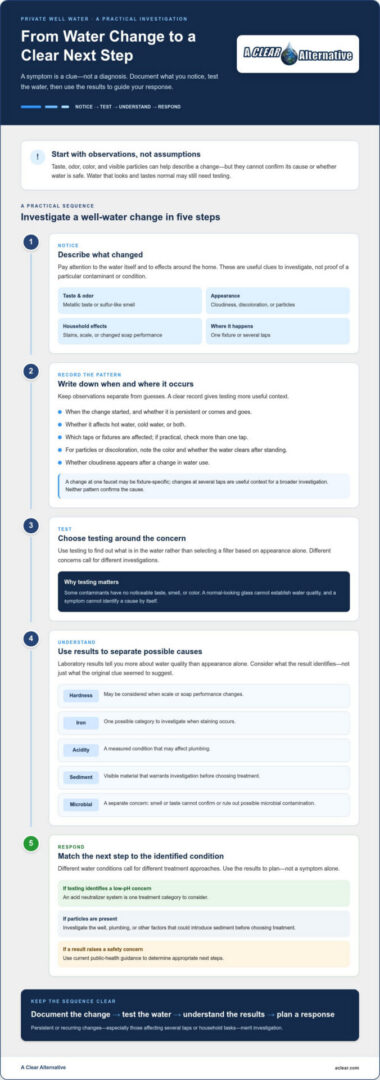
How South Jersey Homeowners Can Investigate Well Water Issues
A clear process can turn an unsettling change into useful information. In South Jersey, start with what you can observe, then choose testing based on the concern rather than guessing from appearance. A Clear Alternative provides comprehensive water testing to help homeowners understand their water quality.
- Document the change. Write down what you’ve noticed, when it began, which taps are affected, and whether it comes and goes. Include recent changes around the home, such as plumbing or appliance work.
- Select relevant testing. Describe the concern, whether it involves taste, odor, staining, cloudiness, or household performance. Don’t assume that one general test covers every possible concern.
- Review the results. Look at what was tested, the findings, and any recommendations for follow-up. Compare results with current authoritative guidance that applies to private wells in New Jersey.
- Plan treatment from the findings. Choose a response based on the conditions identified and your household’s needs. Don’t buy a device simply because a symptom seems to match its label.
What information should you gather before testing?
Make a short record before arranging a test. Describe the issue in plain language and note when it started, whether it affects one or several taps, and whether you notice it in hot water, cold water, or both. Include recent changes around the home that could provide useful context. This helps focus the investigation, but it doesn’t replace laboratory analysis or establish a cause.
Local details can make the process more practical. Homeowners in Tabernacle, Shamong, and Medford Lakes can use the same observation-first approach: record the pattern, then determine which tests fit the question. Testing needs can differ from one well and concern to another, so avoid choosing a test solely because water looks cloudy or has an unusual odor.
What should you do after receiving test results?
Start by checking exactly what the laboratory measured. A result only answers questions about the parameters included in the analysis. If a finding is unclear, or doesn’t address the original concern, use current authoritative guidance to understand whether additional testing or follow-up is appropriate. Keep a copy of the results to inform any treatment decision.
Then match the response to the identified water conditions. A system intended to address acidity, for example, isn’t automatically the right choice for sediment or a possible microbial concern. Treatment categories serve different purposes, and household needs matter too. The goal is a measured plan, not a one-device solution based on guesswork.
If you’re ready to move from observations to answers, explore A Clear Alternative’s water testing and treatment services. A clear sequence, document, test, review, and plan, makes well water issues easier to investigate with confidence.
Choosing a Response to Well Water Issues: Testing, Treatment, and Local Support
Once you have test results, use them as the starting point for a treatment decision. The right approach depends on the conditions identified, where treatment is needed in the home, and your household’s water-use needs. A system chosen to address one result may not address another, so don’t assume that a single device can solve every concern.
Which treatment categories address different well water concerns?
Different treatment categories serve different purposes. The results help show which, if any, are relevant to your well. For broader system planning, consider how whole-house treatment fits your water conditions and household needs.
- Acid neutralizers are used for acidity-related concerns identified through appropriate testing.
- Water softeners address hardness when results and household needs support that choice.
- Iron and sulfur filtration systems are designed for specific iron- or sulfur-related water conditions.
- Reverse osmosis systems treat water at a drinking-water point for certain dissolved substances, depending on the system and water conditions.
- Ultraviolet (UV) sterilizers are a treatment option for microbial concerns when the water and system conditions are appropriate.
- Carbon filtration systems can address certain taste and odor concerns, depending on what testing identifies.
These categories aren’t interchangeable. A softener, for example, shouldn’t be treated as a universal filter, and an odor concern doesn’t automatically call for carbon filtration. Treatment selection should account for the test findings and the intended use of the treated water.
How can local help make the next step clearer?
Clear results make it easier to compare treatment options. A Clear Alternative is a family-owned water treatment and purification business that has served the region since 1991. Its comprehensive water testing can help inform a residential treatment plan based on identified water conditions, rather than a guess based on one symptom.
Think about how your household will use treated water, too. You may be considering treatment for the whole home, drinking water, or a specific concern. Those priorities help shape a practical plan. A broader whole-house approach also involves considering how treatment fits into the home’s water use, rather than focusing on a device in isolation.
For homeowners in Tabernacle, Shamong, and Medford Lakes, the next step can be straightforward: use testing to understand the water, then explore options that fit the results. Contact A Clear Alternative about well-water testing and treatment to plan a practical path forward. You don’t need to diagnose the cause yourself. Start with the evidence and choose the response from there.
Make Your Next Water Decision with Confidence
Your next step can be simple: keep a record of your water results and any changes at home. That gives you a useful reference point if conditions shift, household needs change, or you need to revisit a treatment decision. It also helps focus future questions on what has actually changed, rather than starting from scratch.
Well water issues can feel difficult to sort out when the cause isn’t visible. You don’t have to guess your way through it. A thoughtful plan starts with reliable information and leaves room to tailor the response to your home.
If you’re ready to take the next step, explore A Clear Alternative’s well water testing and treatment options. Testing and treatment support can help turn uncertainty into a practical path forward for your home’s water.
Frequently Asked Questions
Can well water look clear and still be unsafe to drink?
Yes. Some contaminants, including bacteria, nitrate, or arsenic, may not change water’s appearance, taste, or smell. A clear glass isn’t a safety test. If you’re unsure about your water, choose laboratory testing that includes the contaminants relevant to your well and household. A test only provides information about the substances or conditions it measures, so the test panel matters.
Why does my well water suddenly smell or taste different?
A sudden change can have several possible explanations, including a shift in water conditions, plumbing, or a water heater. Compare hot and cold water, and check whether the change happens at one fixture or several. An odor only in hot water may make the water heater worth investigating, but it doesn’t establish the cause. If the change persists or returns, document it and use testing to guide follow-up.
Can heavy rain affect well water quality?
It can, particularly if runoff or floodwater reaches a poorly protected well or enters through damaged components. Not every well will be affected after rain. If water changes after flooding near the well, treat the timing as useful information, not proof of contamination. Record what happened and consult current local public-health guidance about testing and water use. Testing can help determine whether conditions changed.
Does boiling well water remove every contaminant?
No. Boiling can inactivate many disease-causing microorganisms when public-health instructions are followed, but it doesn’t remove chemicals, metals, or minerals. As water evaporates, some dissolved substances may become more concentrated. Boiling isn’t a substitute for testing or a universal treatment method. If you’re concerned about a specific contaminant, use test results and appropriate public-health guidance to decide how to make the water suitable for its intended use.
How often should private well water be tested in New Jersey?
For routine monitoring, the EPA and CDC recommend annual testing for total coliform bacteria, nitrates, total dissolved solids, and pH. New Jersey’s Private Well Testing Act also sets testing requirements for certain property sales and rentals, which are separate from annual recommendations. If you’re buying, selling, or renting a home with a well, check current state guidance for the applicable requirements and testing parameters.
Will a whole-house filter fix every well water issue?
No. A whole-house system only addresses the conditions it’s designed for, and different treatment types serve different purposes. A softener isn’t a universal solution for microbial concerns, and a UV unit doesn’t address mineral hardness. Start with relevant test results, then choose treatment to match the identified conditions and your household’s needs. A single device shouldn’t be assumed to resolve every water concern.
What should I do if my well water issue appears only at one faucet?
First, compare that faucet with another and note whether the problem occurs with hot water, cold water, or both. A clogged aerator, fixture, or nearby plumbing could affect just one tap, so a single-faucet symptom doesn’t automatically point to the well. If it continues, record the pattern and arrange appropriate follow-up. Homeowners in Tabernacle, Shamong, and Medford Lakes can use this information to help focus a water-quality investigation.