
Water Treatment for Hydroponics: How to Choose the Right Approach
What if water that looks clear is still complicating your hydroponic grow? Choosing water treatment for hydroponics starts with the water source, whether it comes from a tap or a well. You may already check pH or EC, but neither reading tells the whole story. Hardness, alkalinity, and dissolved minerals can also affect nutrient preparation, and the wrong treatment can introduce a different imbalance.
You don’t have to guess or adjust your nutrient solution based on one number. Test the source water first, then match treatment to the results and your system’s needs. This guide explains which measurements matter, why pH and TDS alone can be misleading, and how options such as carbon filtration, softening, acid neutralization, and reverse osmosis differ.
You’ll learn what to test before making changes and how to treat source water separately from managing the nutrient solution. A Clear Alternative provides water testing and treatment services for customers in Tabernacle, Shamong, Medford Lakes, and the wider region.
Key Takeaways
- Start water treatment for hydroponics with source-water test results, not assumptions about tap or well water.
- Use pH and EC as useful clues, but don’t treat either reading as a complete picture of water quality or nutrient balance.
- Compare reverse osmosis, carbon filtration, and sediment filtration by the specific issue each can address and its limitations.
- Test water before adding nutrients, then select a treatment approach and retest to understand its effect.
- Comprehensive water testing can help clarify source-water needs before considering options such as softening or acid neutralization.
Why water treatment for hydroponics starts with your source water
Water treatment for hydroponics means managing source-water characteristics before adding nutrients, and the right approach depends on measured conditions. The goal isn’t to make every water source identical. It’s to understand what’s already present and whether those characteristics could affect how you prepare and monitor the nutrient solution.
Source water may contain dissolved minerals or other substances that contribute to its overall profile. When you add nutrients, those existing components combine with the fertilizer salts. This can influence the final mix and make readings harder to interpret: a meter may register dissolved ions without showing which came from the source water and which came from nutrients. Testing the starting water gives you a baseline for deciding whether treatment is needed.
Source-water conditioning and routine pH adjustment address different things. Treatment changes characteristics of the incoming water. Adjusting pH after mixing nutrients is part of managing the prepared solution. Changing one doesn’t automatically resolve the other.
Is tap or well water automatically suitable for hydroponics?
There’s no universal answer. Tap water varies by location, and private wells draw from local groundwater with its own characteristics. Municipal and well supplies raise different testing questions, so don’t assume either is automatically suitable or unsuitable. Test the water you’ll actually use. Results from another grower or a different source may not describe yours.
Source water versus hydroponic nutrient solution
Source water is the starting input, sampled before fertilizer is added. Nutrient mixing changes the solution’s readings, so assess the source separately, then monitor the prepared solution as part of your growing routine. Hydroponics relies on water-based mineral nutrients rather than soil, but filtration alone doesn’t provide a complete nutrient formula. Treating incoming water and formulating plant nutrition are separate steps.
Keep the sequence simple: learn what’s in the source water, then decide whether treatment is appropriate for your setup. A water test can help distinguish a source-water concern from a nutrient-mixing or pH-management issue. This helps prevent unnecessary adjustments based on a reading that combines several factors.
Which water parameters matter before treating hydroponic water?
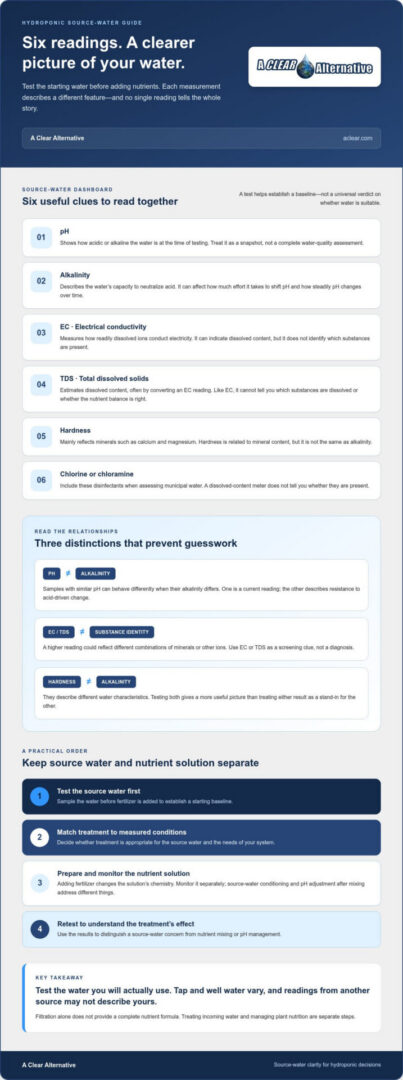
A useful water test involves more than a single pH or TDS number. Each measurement describes a different feature of the source water. Together, the results can help you decide whether treatment is needed before preparing a nutrient solution. For water treatment for hydroponics, the goal is to understand what the readings reveal and what they leave unknown.
How pH and alkalinity affect water management
pH indicates how acidic or alkaline water is at the time of testing. It’s a snapshot, not a full assessment of water quality. Alkalinity is different: it describes water’s capacity to neutralize acid, so it can affect how much effort is needed to shift pH and how steadily pH changes over time. Two water samples with similar pH readings can behave differently if their alkalinity differs.
Keep the source-water reading separate from the reading of a mixed nutrient solution. Fertilizers change the solution’s chemistry, so follow guidance for your crop and system rather than treating one pH target as universal. Penn State Extension’s nutrient solution guidance explains how existing minerals in source water can affect fertilizer recipes.
What EC, TDS, hardness, and chlorine readings can tell you
Electrical conductivity (EC) measures how readily dissolved ions conduct electricity. Total dissolved solids (TDS) meters estimate dissolved content, often by converting an EC reading. Neither measurement identifies the substances present or shows whether the water has the right nutrient balance.
TDS or EC alone can indicate dissolved content, but neither can identify which substances are dissolved in the water. A higher reading could reflect different combinations of minerals or other ions, so use it as a screening clue, not a diagnosis.
Hardness mainly reflects minerals such as calcium and magnesium. It’s related to the mineral content of water, but it isn’t the same as alkalinity and doesn’t determine overall suitability on its own. Testing both gives you a more useful picture than treating either result as a stand-in for the other.
For municipal water, include chlorine or chloramine in the source-water assessment. These disinfectants are separate from pH, EC, and hardness, and a dissolved-content meter won’t tell you whether they’re present. Comprehensive testing can help connect individual results to a treatment decision. If you need a clearer picture of your starting water, explore comprehensive water testing from A Clear Alternative.
Hydroponic water treatment options compared by the problem they address
Choose treatment by matching a test finding to the issue a method is designed to address. No single filter handles every water concern, and a treatment that helps with one reading may leave other characteristics unchanged. Use the table as a starting point, then consider your system’s needs and retest the treated water.
| Treatment type | Issue it may address | Test result prompting consideration | Limitations |
|---|---|---|---|
| Reverse osmosis (RO) | Broad reduction of dissolved substances | Testing shows dissolved constituents that you want to reduce before preparing nutrients | Results depend on system design and incoming water conditions. RO doesn’t guarantee removal of every substance or provide a complete nutrient solution. |
| Carbon filtration | Certain tastes, odors, or treatment chemicals, depending on the filter media and setup | Testing or source information indicates a concern that the selected carbon media is designed to address | Not a general dissolved-mineral reduction method. Performance varies by media and setup, so verify the relevant water concern after treatment. |
| Sediment filtration | Suspended particles, such as visible sediment | Water testing or observation indicates particles that may need to be filtered | Doesn’t remove dissolved minerals or address every chemical or water-quality issue. |
When reverse osmosis or carbon filtration may be considered
Consider RO when test results point to a need for broader dissolved-substance reduction. It changes the starting water profile, so nutrient preparation may need to account for the treated water. Carbon filtration is more targeted: the media and system determine which tastes, odors, or treatment chemicals it can reduce. Neither option replaces follow-up testing. “Filtered” doesn’t automatically mean suitable for every grow.
Why softening, sediment filtration, and pH adjustment aren’t interchangeable
A sediment filter captures suspended particles, not minerals dissolved in water. A conventional ion-exchange softener reduces hardness by exchanging calcium and magnesium for other ions, often sodium. That changes mineral composition; it doesn’t simply remove all dissolved material, so softened water isn’t automatically the right choice for a nutrient reservoir.
Acid neutralization is another distinct process. It addresses acidic water, while adjusting pH in a prepared nutrient solution is part of grow management. Don’t treat them as interchangeable fixes. For water treatment for hydroponics, select equipment and any blending approach only after reviewing source-water results and intended use. Then test again to see what changed.
How to assess and prepare source water for a hydroponic system
A simple testing sequence helps turn water readings into practical decisions. Test the source before adding nutrients, so the results describe incoming water rather than a mixture of source minerals and fertilizer. Use the findings to guide treatment instead of relying on a general product claim.
- Identify the source. Record whether the water comes from a private well, municipal supply, or another source. This context helps frame what to test and gives you a reference if the source changes.
- Collect a representative sample. Follow the sampling and handling instructions for the test you’re using. For well-water sampling, A Clear Alternative’s guide, “Well Water Testing in Tabernacle, Shamong, and Medford Lakes,” offers additional context.
- Measure the basics. Check relevant readings such as pH and EC with meters that are maintained and used according to their instructions. Record the results and date so you can compare later tests.
- Interpret what the results show. Basic meters provide useful clues, but they don’t identify every dissolved substance. Consider laboratory analysis if you need to determine specific minerals or contaminants.
- Select treatment and retest. Match the method to the measured issue and your system’s intended use. Test the treated water before preparing nutrient solution to see how treatment changed the starting profile.
A practical source-water testing checklist
Keep a clear record of the sample source, collection date, and test method. Take readings before adding nutrients, and follow meter instructions for calibration and use. If EC or TDS suggests dissolved content but doesn’t reveal what’s in the water, a more detailed laboratory analysis can help identify specific constituents. A Clear Alternative offers comprehensive water testing to clarify source-water conditions.
Choose treatment, then verify the treated water
Use test results to select treatment that addresses the issue they reveal. For example, suspended particles call for a different response than dissolved minerals. After treatment, retest and record the results before mixing nutrients. This shows what changed and gives you a reliable baseline for the next step.
For water treatment for hydroponics, keep source-water assessment separate from nutrient formulation. A Clear Alternative’s water testing can help you understand the incoming water before considering treatment options. Arrange comprehensive water testing for a clearer starting point for your hydroponic system.
How A Clear Alternative can help with hydroponic source-water questions
Choosing treatment is easier when you know what’s in your source water and how you plan to use it. A Clear Alternative provides comprehensive water testing to clarify the starting point before you consider equipment. Results can help distinguish a concern that may call for filtration from one that requires a different approach. They don’t replace decisions about nutrient formulation, which remains a separate part of managing your grow.
A test-led approach from a local water-treatment company
A Clear Alternative is a family-owned water-treatment company that has provided water treatment and purification services since 1991. The company serves customers in Tabernacle, Shamong, and Medford Lakes, as well as across New Jersey, Pennsylvania, New York, and Delaware.
Depending on the analysis and intended use, relevant options may include reverse osmosis, carbon filtration, water softening, or acid neutralization. Each addresses different water characteristics. For example, an RO system may be considered when testing points to a need to reduce dissolved substances, while carbon filtration may be relevant for certain tastes, odors, or treatment chemicals, depending on the media and setup. Softening changes mineral composition, and acid neutralization addresses acidic water. None is automatically the right choice for every hydroponic system.
Match treatment to the findings instead of choosing a system because it sounds broadly suitable. Household water treatment and hydroponic source-water preparation may have different goals. The analysis, system design, and intended use of the treated water should all inform the decision.
Plan the next step with your water results
Keep your source-water test results together with the test date, treatment history, and any follow-up readings. If you change a filter, adjust the treatment setup, or switch water sources, that record helps you compare results and understand what changed. Use it to consider which options address the measured issue and whether treated water should be tested again before use.
For water treatment for hydroponics, a clear source-water picture is a practical first step, not a nutrient recipe. If you’re growing in Tabernacle, Shamong, Medford Lakes, or the wider service region, A Clear Alternative provides water testing and treatment to help you understand your source water and consider an approach suited to your results and intended use.
Start with a clearer picture of your water
The right water treatment for hydroponics begins with the source, not a guess based on one meter reading. Test water before adding nutrients, then use the results to decide whether treatment is needed. Remember that pH and EC describe different properties, and neither alone identifies every dissolved substance. Treatment options address different concerns, so match the approach to your test results and growing needs.
A Clear Alternative is a family-owned water-treatment business serving customers since 1991. Comprehensive water testing can help you understand your source water before considering options such as reverse osmosis, carbon filtration, softening, or acid neutralization. The goal is a better-informed starting point for your hydroponic setup, not a substitute for managing the nutrient solution.
Explore water testing and treatment support to take the next step with your source-water results in hand. A thoughtful approach can make water decisions simpler and help you grow with greater confidence.
Frequently Asked Questions
Do I need to treat tap water for hydroponics?
Not always. Tap water can be suitable for a hydroponic system, but its quality varies by location. Test it before use for dissolved minerals, hardness, alkalinity, and disinfectants such as chlorine or chloramine. These characteristics can affect nutrient preparation or system management. Water treatment for hydroponics should follow test results, not the assumption that all municipal water needs the same filter or is automatically ready to use.
Can I use well water in a hydroponic system?
Yes, well water can be used if test results and your growing system indicate it’s appropriate. Private wells can vary and may contain dissolved minerals or other constituents that a basic pH or EC meter won’t identify. Test source water before adding nutrients, and consider laboratory analysis when specific minerals or contaminants need identification. For growers in Tabernacle, Shamong, and Medford Lakes, A Clear Alternative offers comprehensive water testing to clarify source-water conditions.
Is reverse osmosis water good for hydroponics?
Reverse osmosis (RO) water can be useful when test results show a need to reduce dissolved substances in source water. But it isn’t automatically the best choice for every system, and RO doesn’t guarantee removal of every substance. Because the treatment changes the water’s mineral profile, use crop and system guidance when preparing nutrients. Test the treated water, then monitor the nutrient solution separately after mixing.
Does a water softener make water suitable for hydroponics?
Not automatically. A conventional ion-exchange water softener reduces hardness by exchanging calcium and magnesium for other ions, often sodium. This changes the water’s mineral composition rather than simply removing all dissolved substances. Whether softened water suits a hydroponic system depends on the source-water results and intended use. Test the water and consider the treatment’s effect before using it to prepare a nutrient solution.
What pH should water be for hydroponics?
Many hydroponic crops do well with a nutrient-solution pH around 5.5 to 6.5, but the appropriate range depends on the crop and system. Don’t treat this as a universal target for untreated source water. Adding nutrients changes the solution, so measure the prepared mix separately and follow crop-specific guidance. Source-water pH is only one reading and doesn’t describe all the water characteristics that may affect management.
Does EC or TDS tell me whether hydroponic water is safe to use?
No. EC measures how readily dissolved ions conduct electricity, while TDS meters estimate dissolved content. Neither reading identifies the substances present or confirms that water is suitable for a particular crop or system. Use these measurements as clues, not a full water-quality assessment. If you need to know which minerals or other constituents are present, consider a more detailed water analysis before choosing treatment.