
Reverse Osmosis Membrane Cleaning: A Safe, Step-by-Step Guide
What if a slow reverse osmosis faucet isn’t a sign that the membrane needs cleaning at all? Reverse osmosis membrane cleaning can help when fouling is the problem, but low flow may also come from clogged prefilters, pressure issues, or another system component. Starting with the wrong fix can waste time or damage the membrane.
When water flow drops or quality seems different, check the system’s symptoms and performance before choosing between maintenance, cleaning, and replacement. A membrane may recover from some types of fouling, while others call for a different solution.
This guide explains how to spot likely membrane fouling, rule out common system issues, and choose an approach that follows the membrane manufacturer’s instructions. You’ll also learn why cleaners and procedures aren’t interchangeable, when replacement or professional maintenance makes more sense, and how pretreatment and routine care can help reduce repeat problems.
Key Takeaways
- Low output, changing TDS readings, or altered taste can signal a system problem, but they don’t prove the membrane is fouled.
- Effective reverse osmosis membrane cleaning depends on identifying the deposit and following the membrane manufacturer’s guidance.
- Compare approved cleaning, replacement, and system diagnosis to choose the option that fits the membrane’s condition.
- Before cleaning, identify the membrane, consult the system manual, and use only approved supplies and clean-water handling practices.
- Compare post-cleaning performance with your baseline, and investigate the full system and feed water if symptoms persist.
Reverse Osmosis Membrane Cleaning: When Symptoms Point to Fouling
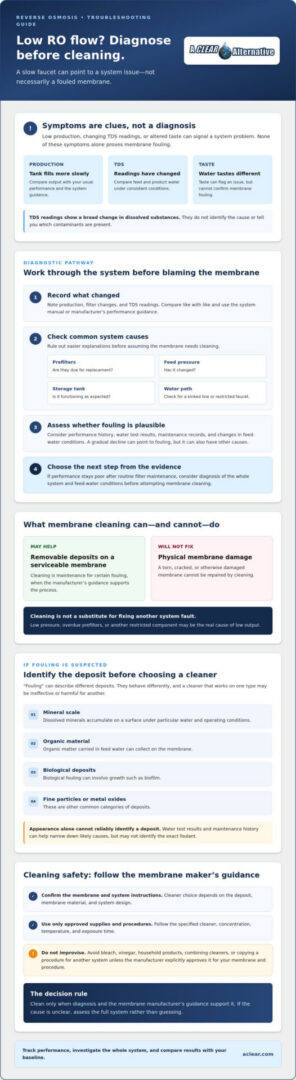
A drop in water production or a new taste can make the membrane seem like the obvious culprit. But in a home RO system, the same symptoms can come from several parts of the setup. Reverse osmosis (RO) uses pressure to move water through a selective membrane, so changes in feed water or system pressure can affect output without proving the membrane is fouled.
Membrane fouling is a buildup of deposits that may be removable with an approved cleaning process; membrane damage is physical harm that cleaning cannot repair. Reverse osmosis membrane cleaning is maintenance, not a way to restore a torn, cracked, or otherwise damaged membrane.
What signs suggest an RO membrane may need attention?
Start with production. If the system fills its storage tank more slowly or delivers less water than usual, record the change and compare it with the system manual or manufacturer’s performance guidance. A gradual decline can point to fouling, but it can also reflect overdue filters, low feed pressure, or another restriction.
A change in total dissolved solids (TDS) readings is another clue, not a diagnosis. If you have a TDS meter, take readings of both feed water and RO product water under consistent conditions. Record the date and results, then compare them with earlier readings and the manufacturer’s guidance. TDS readings show a broad change in dissolved substances; they don’t identify the cause or tell you which contaminants are present. An altered taste can also signal a system issue, but taste alone can’t confirm membrane fouling.
Could another RO system problem explain the symptoms?
Yes. Check the easier explanations before assuming the membrane needs cleaning. See whether the prefilters are due for replacement and whether feed pressure has changed. A storage tank that isn’t functioning as expected, a kinked line, or a restricted faucet can also affect the water you get at the tap.
Keep a simple record of filter changes, production, and TDS readings. Compare like with like, and avoid drawing conclusions from one measurement or symptom. If performance stays poor after routine filter maintenance, the whole system and feed-water conditions may need diagnosis. That helps distinguish a potentially cleanable deposit from a different fault or damage that cleaning won’t fix.
What Fouls an RO Membrane, and Why Cleaner Choice Matters
A membrane can collect deposits carried in feed water, but “fouling” isn’t one single substance. Common categories include mineral scale, organic material, biological deposits such as biofilm, and fine particles or metal oxides. Each behaves differently, so a cleaner that works on one type may be ineffective or harmful for another.
There’s no universal membrane cleaner: the right chemistry depends on the deposit, membrane material, and system design, while the wrong choice can damage the membrane or other components. That’s why reverse osmosis membrane cleaning should start with diagnosis and the membrane maker’s instructions, not trial and error.
How mineral scale and organic deposits differ
Mineral scale forms when dissolved minerals in feed water accumulate on a surface under particular water and operating conditions. Organic deposits come from organic matter in the water, while biological fouling involves growth such as biofilm. These categories can overlap, and appearance alone can’t reliably identify what’s on a membrane.
Water test results, filter and maintenance records, and changes in feed-water conditions can help narrow down likely causes. They don’t automatically identify the exact deposit, but they offer better clues than guessing from low flow or visible residue. If the evidence is unclear, assessing the whole system can help avoid an unnecessary or unsuitable cleaning attempt.
Why household cleaners are not a safe shortcut
Skip bleach, vinegar, and other household products unless the membrane manufacturer explicitly approves them for your specific membrane and cleaning procedure. A product that seems mild or familiar may still be incompatible with the membrane material, seals, tubing, or other system parts. Damage may reduce performance or make the membrane unusable.
Follow the manufacturer’s instructions for the cleaner, concentration, temperature, and exposure time. Don’t combine products or improvise a cleaning sequence. These details vary by membrane and foulant, so a recipe intended for another system isn’t a safe substitute for your own manual.
If fouling keeps returning, cleaning may not address the underlying feed-water issue. Reviewing water quality alongside system maintenance can help identify what’s driving the deposits. Water testing and RO system maintenance can help you decide what to investigate next.
Clean, Replace, or Get Help? Compare the Practical Options
A slow RO system isn’t automatically a dirty membrane. Cleaning may help when confirmed fouling is removable and the membrane is still serviceable. It won’t repair physical damage, and it may not solve a problem caused by low pressure, overdue prefilters, or another system component.
Choose cleaning only when diagnosis and the membrane manufacturer’s guidance support it. Use the comparison below to narrow the next step, then check your system’s manual and performance history.
| Option | When it may fit | Purpose and risks | Evidence to consider |
|---|---|---|---|
| Manufacturer-approved cleaning | Fouling is considered likely, the membrane is otherwise serviceable, and its manufacturer allows cleaning. | Targets certain deposits. An unsuitable cleaner or procedure may damage the membrane or system components; cleaning may not restore performance. | Recorded production and TDS trends, maintenance history, water conditions, and instructions for the specific membrane. |
| Membrane replacement | The membrane is physically damaged, has a history of incompatible treatment, or continues to perform poorly after appropriate checks. | Replaces the membrane rather than attempting to remove deposits. Confirm the replacement is suitable for the system and follow installation guidance. | Inspection findings, persistent performance problems, and the membrane maker’s recommendations. |
| System diagnosis or service | The cause is uncertain, symptoms remain after routine checks, or several system factors may be involved. | Helps identify whether the issue lies with the membrane, pretreatment, pressure, tank, flow path, or feed water before choosing a fix. | System readings, filter history, operating conditions, and, when useful, water testing. |
When cleaning may be considered
Consider cleaning only when evidence points to a cleanable deposit and the membrane is still in suitable condition. Before removing or treating a residential membrane, identify its model and review the manufacturer’s procedure, including approved supplies and handling instructions. Don’t assume a method used on another system applies to yours.
Industrial clean-in-place procedures are designed for larger systems and dedicated equipment. They aren’t a simple household version of membrane maintenance. Base residential decisions on the home system’s own instructions.
When replacement or diagnosis makes more sense
A damaged membrane can’t be restored by cleaning. Persistent poor performance, a record of incompatible chemicals, or symptoms that remain after prefilter and system checks may point toward replacement or further diagnosis. If the cause is unclear, checking the whole RO system and feed water can help prevent treating the wrong component.
Cleaning doesn’t guarantee recovery. Compare performance before and after any approved procedure, then use the manufacturer’s guidance to decide whether the membrane is still doing its job.
How to Approach Residential RO Membrane Cleaning Safely
There isn’t one safe chemical-cleaning recipe for every home RO system. The membrane, housing, plumbing, and cleaning instructions can differ. Use this checklist to decide whether you’re prepared to proceed, not as a replacement for your system manual.
- Confirm cleaning is appropriate. Review your performance records and rule out basic issues such as overdue prefilters or an obvious flow restriction. If the cause is uncertain, pause rather than treating the membrane by guesswork.
- Read the system manual first. Find the shutdown, depressurization, membrane removal, sanitization, flushing, and restart instructions. These steps vary by system, so don’t assume a procedure from another model applies.
- Identify the membrane. Record its model and read the membrane maker’s cleaning and handling guidance before disconnecting anything. Check that cleaning is permitted for that membrane and that the selected supplies are specifically approved.
- Record a baseline. Note water production and TDS readings using the system’s recommended measurement procedure. Record the readings and date so you have a useful comparison after the system is returned to service.
- Prepare a clean work area. Follow the system maker’s instructions for clean-water handling, protective equipment, and sanitation. Keep tools and surfaces clean, and avoid touching membrane surfaces or connections unnecessarily.
- Follow the exact approved method. Use only the cleaner and procedure specified for your membrane and system. Don’t estimate a dose, substitute a household product, or borrow another system’s contact time, temperature, or pressure settings.
- Rinse and restart as directed. Complete the required rinsing and any sanitization steps in the order described by the manufacturer. Return the system to service only according to its instructions, then compare its readings and output with your baseline.
Residential membrane maintenance isn’t the same as industrial clean-in-place (CIP) cleaning. CIP procedures use system-specific equipment and controls; they aren’t a shortcut for a household unit. If the manual doesn’t clearly cover removal and cleaning, or you’re unsure how to handle the membrane safely, stop before opening the system. Proper reverse osmosis membrane cleaning depends on matching the process to the actual equipment.
If you’d like the system and its water conditions assessed together, explore water treatment and maintenance services.
After Cleaning: Check RO Performance and Prevent Repeat Fouling
Cleaning isn’t complete when the membrane goes back in place. Check whether performance changed, then look for conditions that could cause the issue to return. A stronger result isn’t guaranteed, and persistent symptoms may point to a different part of the RO system or to the feed water.
How to verify whether cleaning helped
Follow the manufacturer’s flushing and stabilization instructions before taking readings. Then recheck production and TDS using the same method and, as much as possible, the same conditions as your pre-cleaning measurements. Compare the results with your baseline and the membrane maker’s performance guidance, not with a general target that may not fit your system.
Record whether the original concern has improved, stayed the same, or returned. For example, note whether the system still produces water slowly or whether TDS readings remain different from previous measurements. If readings are inconsistent, repeat them according to the equipment maker’s instructions rather than changing the cleaning process or adding more chemicals.
If flow or water quality remains poor, or symptoms return, don’t assume another cleaning is the answer. Check the full RO system, including pretreatment, pressure, tank, and flow path, and consider whether feed-water conditions have changed.
Preventive maintenance for local home RO systems
Keep prefilters on the replacement schedule specified for your system. They help protect downstream components, including the membrane, from material in the feed water. If the membrane fouls repeatedly, review pretreatment and water quality rather than simply cleaning more often.
For a broader view of how treatment choices fit together, read this whole-house water filtration guide. The well water testing guide also offers helpful context when you’re investigating feed-water quality.
Homeowners in Tabernacle, Shamong, and Medford Lakes can use water testing and regular system maintenance to investigate recurring RO performance concerns. A Clear Alternative provides water testing and maintenance for residential water treatment systems. Schedule water treatment maintenance to discuss your system’s needs and plan a sensible next step.
Make Your Next RO System Check Count
Good membrane care starts with diagnosis, not a quick chemical fix. Reduced output or changing TDS readings can point to fouling, but they can also reflect overdue prefilters, pressure changes, or another system issue. Use the manufacturer’s guidance to decide whether reverse osmosis membrane cleaning is appropriate, and compare performance before and after any approved procedure.
If symptoms persist or keep returning, look beyond the membrane. Feed-water quality and the rest of the RO system can influence performance, so water testing and routine maintenance can help guide a sensible next step.
A Clear Alternative is a family-owned water treatment business serving customers since 1991, with residential reverse osmosis systems, water testing, and recurring maintenance services. Schedule water treatment maintenance with A Clear Alternative to get a clearer picture of your system’s needs. With the right information and a careful plan, you can move forward with confidence.
Frequently Asked Questions
How do you clean a reverse osmosis membrane?
Start by identifying the membrane and checking the system manufacturer’s cleaning instructions. First, diagnose the performance problem: overdue prefilters or low feed pressure can mimic membrane fouling. If cleaning is approved, use only compatible supplies and follow the specified shutdown, depressurization, handling, rinsing, sanitation, and restart steps. Details vary by system. Don’t apply a generic chemical recipe to an unknown membrane or improvise its cleaning procedure.
Can you clean an RO membrane with vinegar or bleach?
Don’t use vinegar or bleach unless the membrane and system manufacturers explicitly approve that chemical for the specific model and procedure. Membrane materials, seals, tubing, and other components may react differently to cleaners. An incompatible product could damage equipment or affect water quality. Check the manual before using any chemical. If the approved instructions are unclear, pause and have the system assessed instead of experimenting with household products.
How do I know if my reverse osmosis membrane needs cleaning?
Reduced water production, changing TDS readings, or altered taste can indicate an RO system issue, but none proves the membrane is fouled. Check prefilter condition, feed pressure, and other components first. Compare readings with your system’s normal baseline and the manufacturer’s guidance, using the recommended measurement method. If symptoms persist, diagnosis can help distinguish cleanable deposits from membrane wear, physical damage, or another fault. Keep a record of readings and filter changes.
Can cleaning restore a reverse osmosis membrane?
Cleaning may improve performance if a removable deposit is the cause and the membrane maker’s approved process applies. It can’t repair physical damage, reverse every kind of fouling, or correct problems elsewhere in the system, such as pressure or pretreatment issues. Results depend on the membrane’s condition, the deposit, and the procedure used. Compare performance before and after with consistent measurements, but don’t assume cleaning will make an older membrane perform like new.
How often should an RO membrane be cleaned?
There’s no single cleaning interval that suits every residential RO system. Cleaning needs depend on feed-water quality, pretreatment, operating conditions, membrane design, and manufacturer guidance. Rather than cleaning by calendar alone, follow the system’s prefilter replacement schedule and monitor performance against its normal baseline. If the membrane repeatedly needs attention, investigate the underlying water or system condition. Repeating cleaning without identifying the cause may not prevent the problem from returning.
What should I do if my RO system still has low flow after cleaning?
First, confirm that you followed the manufacturer’s flushing and restart instructions, including any recommended stabilization period. Then check prefilters, feed pressure, storage-tank function, tubing, and other system components. Compare current output with your baseline using the same measurement method. If low flow continues, a system diagnosis can help determine whether the membrane is damaged, unsuitable for cleaning, or not the source of the problem.
Is reverse osmosis membrane cleaning safe to do at home?
It can be appropriate only when your residential system’s manufacturer provides a clear, approved procedure you can follow safely. Membrane identification, cleaner compatibility, protective measures, handling, flushing, and sanitation all matter. Don’t improvise steps or use a procedure intended for a different system. Homeowners in Tabernacle, Shamong, and Medford Lakes can use water testing and system maintenance to investigate persistent concerns and choose a safer next step.