
What is Hard Water Scale? The Homeowner’s Guide to Limescale and Its Hidden Costs
What if your home was quietly charging you a “tax” that you never agreed to pay? That stubborn, chalky crust on your designer faucets isn’t just a cleaning headache; it’s a sign of a deeper problem. You’re probably wondering exactly what is hard water scale and why it seems to reappear the moment you put the scrub brush away. This mineral buildup is a silent intruder that coats the inside of your pipes and appliances, acting like a thermal blanket on your water heater. It forces your systems to work harder. That means you’re paying more for less efficiency every single month.
We understand how exhausting it is to deal with cloudy glassware, stiff laundry, and the constant fear of a tankless heater breakdown. It feels like your home is working against you rather than for you. You deserve a space where everything just works. In this guide, we’ll break down the real science behind limescale and show you how to protect your expensive appliances. You’ll learn the vital difference between just cleaning up the mess and preventing it entirely. It’s time to move toward invisible home maintenance and the effortless lifestyle you’ve worked so hard for.
Key Takeaways
- Learn exactly what is hard water scale and how these minerals transform from dissolved particles into the solid crust that damages your plumbing.
- Understand why South Jersey’s unique soil makes your water a “universal solvent” that’s naturally prone to heavy mineral buildup.
- Uncover the hidden costs of scaling, from decreased water pressure to the “insulation effect” that silently spikes your energy bills.
- Move beyond temporary fixes like vinegar and discover why systemic prevention is the only way to protect modern fixtures.
- Explore advanced solutions like ion exchange and acid neutralizers to achieve effortless, invisible home maintenance.
Defining Hard Water Scale: More Than Just a Cosmetic Nuisance
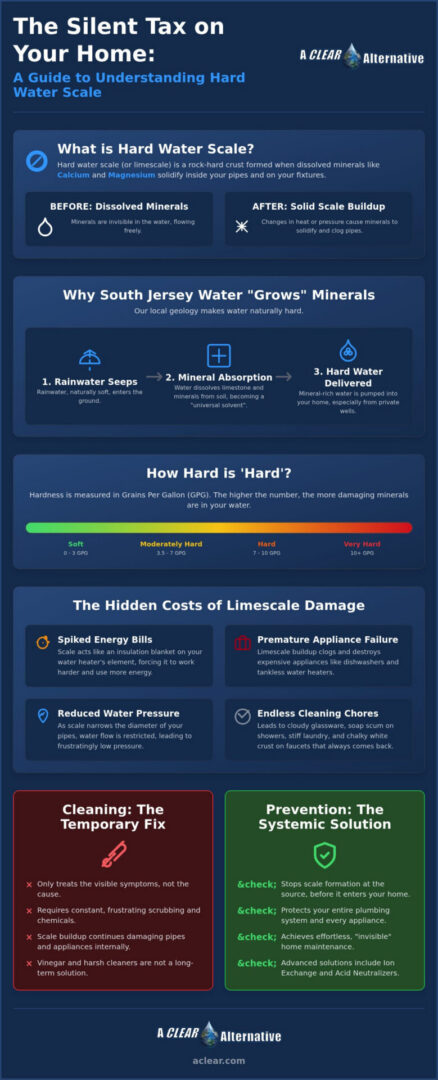
Understanding what is hard water scale starts with looking beneath the surface of your water. Most homeowners see the white crust on their showerhead and think it’s just another cleaning chore. In reality, it’s a chemical transformation happening inside your home. Hard water scale, or limescale, is the precipitated form of dissolved calcium and magnesium carbonate. When your water is hard, it carries these minerals in an invisible, dissolved state. They’re like ghosts in your plumbing until a change in temperature or pressure triggers them to become solid.
This process is tied to Total Dissolved Solids (TDS). You can think of TDS as the total concentration of mineral hitchhikers in your water. The higher the TDS, the more fuel there is for scaling. Identifying what is hard water scale also means distinguishing it from soap scum. Soap scum is a sticky residue that forms when minerals react with your soaps and shampoos. Mineral scale is different. It’s a rock-hard substance that builds up independently of any cleaning products you use. It’s a structural issue, not just a hygiene one.
What Does Hard Water Scale Look Like?
You’ve likely seen the evidence in your kitchen or bathroom. It typically appears as a stubborn, white, chalky crust that clings to faucets and showerheads. On your glassware, it shows up as cloudy spotting that won’t wash away, even after a heavy cycle. If you notice greenish-blue stains, your water likely has a pH imbalance alongside its hardness. This is a common challenge for those of us in South Jersey. Our local well water often has a unique mineral makeup that requires a professional eye to diagnose correctly. These stains aren’t just ugly; they’re a warning sign from your plumbing.
The Chemistry of Scale Formation
How does a liquid turn into a rock? The Science of Scaling explains that evaporation is a major factor. As water dries on a surface, it leaves mineral crystals behind. These crystals bond together to create a hard layer. Heat is another powerful catalyst. This “kettle effect” is why your dishwasher and water heater are usually the first victims of buildup. Higher pH levels also make the process more aggressive. When your water is more alkaline, minerals attach to your pipes and heating elements with surprising speed. It’s a relentless process that doesn’t stop until you change the water chemistry itself.
The Science of Scaling: Why South Jersey Water ‘Grows’ Minerals
Water is often called the universal solvent. This means that as it moves through the environment, it dissolves a little bit of everything it touches. In our corner of South Jersey, specifically around Tabernacle, Shamong, and Medford Lakes, the water travels through layers of limestone and mineral-rich soil. This journey turns soft rainwater into hard water. If you’ve ever looked at a crusty faucet and wondered what is hard water scale, you’re looking at the physical evidence of that geological journey. Those minerals that were once invisible and dissolved have simply decided to become solid again inside your home.
Homeowners with private wells face an even greater challenge than those on city lines. Municipal water often comes from surface sources, but wells pull from deep underground aquifers. This water has spent decades in direct contact with mineral deposits, absorbing high concentrations of calcium and magnesium along the way. Grains per gallon (GPG) is the standard unit of measurement used to define the weight of these dissolved minerals within a single gallon of water.
Groundwater and Mineral Seepage
New Jersey’s aquifers act like giant underground sponges. As water seeps into these reservoirs, it picks up the unique chemical signature of our local earth. By the time that water reaches your pressure tank, it’s often saturated with minerals. You might notice your water quality shifts after a heavy rain or during a particularly dry season. This happens because fluctuating water tables change how much mineral content is pulled into your system. Understanding what hard water is helps you realize that your well isn’t just a pipe in the ground; it’s a direct link to the complex geology of the Pine Barrens.
The Hardness Scale: How Hard is ‘Hard’?
Water hardness exists on a spectrum. While 1 GPG is considered soft, anything between 3.5 and 7 GPG is classified as moderately hard. Once your water tests above 10 GPG, you’ve entered the “very hard” category. Don’t be fooled by a “moderate” rating. Even mid-level hardness can cause what is hard water scale to build up in your pipes over just a few years. It’s a slow, cumulative process that eventually restricts flow and kills efficiency. To protect your home’s infrastructure, getting professional well water testing is the only way to know exactly what you’re up against.
Knowing your specific mineral count is the first step toward reclaiming your home’s efficiency. If your results show high hardness, installing a high-efficiency water softener can stop the scaling process before it reaches your expensive appliances.
The Hidden Costs of Limescale: How It Destroys Your Home
Most homeowners view the chalky buildup on their showerheads as a simple cleaning nuisance. In reality, it’s a silent financial drain. When you consider what is hard water scale, you have to look past the surface. This mineral layer acts as a powerful insulator. It wraps itself around heating elements and lines the interior of your pipes, forcing your home systems to work significantly harder to achieve the same results. This extra effort doesn’t just raise your bills; it aggressively shortens the lifespan of every water-using appliance in your house.
Your dishwasher, washing machine, and even your morning coffee maker are all at risk. These machines rely on delicate valves and heating coils that weren’t designed to operate under a layer of rock. Beyond the mechanical damage, scale affects your daily comfort. The same minerals that clog your pipes also react with your soaps and shampoos. Instead of a clean rinse, they leave a filmy residue on your skin and hair. This often results in that “stiff” feeling in your laundry and a dullness in your hair that no expensive conditioner can fix.
Energy Bills and Your Water Heater
Your water heater is usually the first victim of scaling. As the U.S. Geological Survey defines water hardness, the minerals precipitate out much faster when water is heated. Industry research suggests that just 1/4 inch of scale buildup can increase your water heating energy costs by up to 40%. The heating element has to burn hotter and longer just to get through the mineral “blanket” before it even reaches the water. This is particularly dangerous for modern tankless water heaters. Their narrow heat exchangers can clog completely in a matter of months, leading to costly repairs or total system failure.
Plumbing and Structural Damage
Inside your walls, a process called calcification is likely shrinking your pipe diameter. As the mineral layers grow, your water pressure drops. This isn’t just about a weak shower; it’s about the structural integrity of your plumbing. Scale buildup often leads to pinhole leaks as the minerals create turbulence and localized corrosion. It also ruins the seals in your fixtures. If you have a toilet that won’t stop running, a mineral-coated flapper valve is a common culprit. Investing in whole house water filtration systems provides a holistic shield. It stops what is hard water scale from entering your plumbing in the first place, preserving your home’s value and your peace of mind.
Cleaning vs. Prevention: Why Vinegar Isn’t a Long-Term Solution
Many homeowners spend their weekends armed with spray bottles and scrub brushes. They’ve been told that vinegar is the ultimate natural solution for what is hard water scale. While a quick soak might clear a faucet aerator, it’s a losing battle. You’re treating the symptom while the cause remains active in every drop of water entering your home. Reactive cleaning is a never-ending cycle. The moment you finish scrubbing, the minerals begin to settle again. You’re essentially working a part-time job just to keep your fixtures looking halfway decent.
There’s also a hidden risk to modern aesthetics. Today’s high-end fixtures often feature delicate finishes like matte black, brushed gold, or oil-rubbed bronze. These surfaces don’t play well with acidic cleaners. Over time, the very substances you use to dissolve scale can etch the metal or strip the protective coating. You end up trading a white crust for permanent finish damage. Prevention is the only way to keep your design-forward home looking pristine without the risk of chemical erosion. It’s about moving from a state of constant repair to a state of effortless beauty.
The Limits of Natural Cleaners
Vinegar is a weak acid. It works for light surface spots, but it’s powerless against the thick calcification inside your plumbing. If you’ve looked at what is hard water scale in an old pipe, you know it’s a solid, rock-like mass. Pouring vinegar down the drain won’t touch it. If your home uses a septic system, you have to be careful. Dumping large amounts of harsh chemical descalers or even excessive vinegar can disrupt the delicate bacterial balance in your tank. Physical scrubbing isn’t much better. Aggressive pads can easily scratch expensive natural stone or porcelain tile. This leaves permanent scars on your bathroom’s surfaces that no amount of cleaning can fix.
The Value of ‘Set and Forget’ Systems
Imagine a home where your glass shower doors stay clear without a squeegee. A professional water softener removes the calcium and magnesium before they ever reach your faucets. It’s the difference between constant labor and invisible maintenance. You reclaim your weekends and protect your investment simultaneously. To make this lifestyle even easier, a water softener salt delivery service ensures your system never runs dry. You don’t have to haul heavy bags or remember to check the brine tank. Everything just works in the background.
Transitioning to a systemic solution is a modern lifestyle choice. It moves you away from the scrubbing cycle and into a world where your water simply works for you. If you’re tired of the constant battle against buildup, it’s time to stop cleaning and start preventing. Schedule a professional water test today to see exactly how much time and money you could be saving.
Systemic Solutions: Eliminating Scale with Advanced Treatment
Stopping the cycle of mineral buildup requires more than just a surface level fix. Ion exchange is the gold standard for homeowners who want a permanent answer to what is hard water scale and how to stop it. This technology doesn’t just mask the minerals; it physically removes calcium and magnesium ions from your water supply. By the time the water reaches your designer faucets or high-end appliances, it’s completely soft. This transition protects your home’s infrastructure and creates a maintenance-free lifestyle where water just works.
In our local area, hardness often travels with another silent partner: low pH. For many homes in Tabernacle and Shamong, a softener alone isn’t enough. This is where acid neutralizer systems become essential. These systems balance your water’s chemistry, preventing the blue-green staining and copper pipe erosion that often accompany hardness. When you understand what is hard water scale at a chemical level, you realize that generic “big box” store units often lack the capacity or the specific filtration media needed for South Jersey’s unique well conditions. A professional installation ensures your system is sized correctly for your family’s peak water usage.
Water Softeners vs. Conditioners
It’s important to distinguish between true softening and “conditioning.” Many retail products claim to condition water by sequestering minerals. This means the minerals are still present but supposedly kept in a state where they won’t stick. For the high-hardness well water found in Medford Lakes, this is rarely sufficient. Salt-based softening remains the most effective method because it’s the only way to guarantee mineral removal. Modern systems are incredibly efficient. They use sophisticated sensors to regenerate only when necessary, which saves both salt and water compared to older, timer-based models.
The Importance of Professional Testing
You can’t treat what you haven’t measured. Every well in South Jersey has its own unique mineral profile, and a “one size fits all” approach leads to system failure. A Clear Alternative analyzes your specific water chemistry to build a custom solution tailored to your home. We look at hardness levels, pH balance, and iron content to ensure your equipment performs perfectly from day one. This expert approach turns home maintenance into an invisible background process. Schedule your professional water test today and stop the scale for good. Our team provides ongoing support and expert guidance to ensure your water remains a source of comfort, not a source of chores.
Reclaim Your Home and Your Time
You now understand exactly what is hard water scale and how it acts as a silent tax on your time and your budget. It’s a structural threat that drains your energy efficiency and ages your appliances prematurely. By shifting from reactive scrubbing to a systemic, custom-built solution, you’re choosing a lifestyle of invisible maintenance. This isn’t just about plumbing; it’s about the confidence that comes with a home that works exactly as intended. You deserve to enjoy your space without the constant battle against mineral buildup.
A Clear Alternative has been family-owned and operated since 1991. We specialize in engineering systems specifically for the unique mineral challenges of South Jersey and the Tri-State area. Our custom-built solutions address everything from hardness to pH balance, ensuring your home’s infrastructure remains protected for decades. With 24/7 emergency support, we’re always here to ensure your water quality never disrupts your peace of mind. It’s time to stop the cycle of cleaning and start living with water that simply works.
Protect your home from hard water: Contact A Clear Alternative today!
Frequently Asked Questions
Is hard water scale dangerous to drink?
Hard water scale isn’t considered a health hazard. The calcium and magnesium minerals that create it are actually essential nutrients for the human body. However, while it won’t hurt you, it can make your water taste metallic or unpleasantly chalky. In Tabernacle and Shamong, many homeowners find that high mineral content affects the flavor of their cooking and coffee. Professional water testing is the best way to ensure your water is both safe and delicious.
Can hard water scale cause low water pressure?
Yes, scale buildup is a leading cause of declining water pressure in older homes. As mineral layers grow inside your pipes, a process called calcification effectively shrinks the diameter of your plumbing. This restricts the flow to your showerheads and faucets over time. If you’ve noticed a gradual drop in pressure across your Medford Lakes home, it’s likely that what is hard water scale has turned your pipes into narrow passages that can’t deliver volume.
How do I know if I have hard water scale or just soap residue?
You can distinguish between the two by their texture and how they react to cleaners. Soap residue, or scum, feels waxy or sticky and usually wipes away with a bit of effort. Real mineral scale is rock-hard and has a chalky, crystalline appearance. If you apply a small amount of white vinegar to the spot and it starts to fizz or dissolve, you’re definitely dealing with what is hard water scale rather than soap.
Will a water softener remove existing scale from my pipes?
A water softener is primarily a preventative tool, but it can help over the long term. Once you install a system, the soft water stops new scale from forming immediately. Over months of use, soft water can gradually dissolve some existing mineral deposits as it flows through your plumbing. However, it isn’t a quick fix for heavy blockage. Stopping the growth now is the most effective way to preserve your remaining pipe life in South Jersey.
Why is my scale green or blue instead of white?
Green or blue staining is a major red flag that your water is acidic. While pure limescale is white, low pH water eats away at your copper plumbing. This corrosion releases copper into the water, which then leaves those telltale colorful stains on your tubs and sinks. In Medford Lakes and Shamong, this often happens alongside hardness. You’ll likely need one of our custom acid neutralizers to balance the pH and stop your pipes from leaking.
How often should I have my water treatment system serviced?
We recommend a professional service visit at least once a year. During this checkup, we verify your system’s settings, test the water quality, and ensure the valves are functioning efficiently. Regular maintenance prevents unexpected breakdowns and keeps your salt or media usage optimized. For homes in the Tri-State area with high iron or sediment, more frequent filter changes might be necessary. Staying proactive ensures your home maintenance stays truly effortless and your appliances protected.
Does boiling water remove hard water scale?
Boiling water actually accelerates scale formation rather than removing it. When you heat hard water, the minerals precipitate out of the liquid and become solid much faster. This is why you see a white crust inside your tea kettle or pots. While boiling can kill certain bacteria, it leaves the calcium and magnesium behind in a more concentrated form. To truly remove these minerals from your home’s supply, you need a physical removal process like ion exchange.
What is the difference between hard water and acidic water?
Hardness refers to the concentration of dissolved minerals like calcium, while acidity refers to the pH level of your water. They’re two different chemical problems, though they often appear together in South Jersey wells. Hard water creates rock-like buildup, while acidic water acts like a solvent that corrodes metal pipes. Treating one doesn’t automatically fix the other. We use professional water analysis to determine if you need a softener, an acid neutralizer, or a combination of both.