
Signs of Acidic Water in Tabernacle, Shamong, & Medford Lakes: 2026 Homeowner’s Checklist
On a Tuesday morning in Medford Lakes, you might notice a faint, blue-green ring around your designer sink that refuses to disappear. It’s more than just a cleaning nuisance; it’s a distress signal from your pipes. You’re likely seeing the first signs of acidic water, a hidden issue that’s currently corroding plumbing in homes across Shamong and Tabernacle. In our region, where Pinelands soil can push groundwater pH levels below 4.5, these subtle stains are often the only warning you’ll get before a major pipe failure occurs.
You’ve built a life centered on comfort and style, and your home’s infrastructure should support that confidence. We believe that protecting your plumbing shouldn’t be a chore, but a seamless part of your modern lifestyle. This 2026 checklist empowers you to spot the symptoms of low-pH water before they compromise your family’s health or your property’s value. We’ll break down the science behind our local South Jersey water and introduce a sophisticated, tech-forward solution that brings total clarity and peace of mind back to your taps.
Key Takeaways
- Uncover why the South Jersey ‘Pinelands Effect’ makes your well water naturally corrosive and how to stay ahead of potential damage.
- Master our 7-point checklist to identify the common signs of acidic water, from blue-green stains on fixtures to silent pinhole leaks.
- Protect your investment by learning how corrosive water can cut your water heater’s lifespan by more than half and cause hidden mold issues.
- Get a clear, two-step roadmap for professional-grade testing to ensure your Tabernacle or Shamong home remains a safe, worry-free haven.
- Explore how modern, custom-sized neutralization systems provide a seamless and natural fix for low-pH water issues.
Understanding Low pH Well Water in South Jersey
Living in South Jersey means enjoying the unique beauty of the pines and the lakes, but it also means managing a very specific type of water chemistry. Acidic water is simply liquid with a pH level below 7.0. To understand what pH means, you have to look at the concentration of hydrogen ions in your supply. In Tabernacle and Shamong, this isn’t just a science experiment; it’s your daily reality. When water falls below that neutral 7.0 mark, it becomes “hungry.” It actively looks to dissolve minerals and metals it touches, which is why it’s labeled as corrosive.
Local experts call this the Pinelands Effect. Our sandy soil is naturally low in minerals like calcium and magnesium. These minerals usually act as a buffer to keep water stable. Without them, the decaying organic matter from the forest floor filters into the aquifer, driving the pH down. By 2026, home health standards suggest a target pH between 6.5 and 8.5. Staying within this range ensures your plumbing stays intact and your water remains healthy for your family. In towns like Shamong and Tabernacle, our water is famously “soft.” While that sounds great for your laundry, it’s actually a double-edged sword. Soft water in this region lacks the dissolved minerals that naturally balance pH, leaving the water aggressive and ready to damage your home.
The Science of pH and Your Well
pH stands for “potential hydrogen.” It’s a scale that tells us how acidic or alkaline your water is. In Medford Lakes, it’s common to see well tests returning results between 5.5 and 6.5. That’s significantly more acidic than pure, distilled water. Seasonal shifts play a major role too. Heavy rainfall in New Jersey, especially during spring thaws or autumn storms, can flush more organic acids into the groundwater. This causes your acidity levels to spike unexpectedly, making regular testing a vital part of your 2026 home maintenance routine.
Why Acidity is a ‘Silent’ Threat
You can’t see, smell, or taste low pH. It’s a ghost in your pipes. Unlike sulfur or iron, which announce themselves with pungent odors or orange stains, the initial signs of acidic water are often invisible to the naked eye. The damage is cumulative and expensive. Over several years, that slight acidity eats away at copper and galvanized steel pipes from the inside out. You might eventually notice pinhole leaks in your basement or blue-green staining on your white porcelain fixtures. Installing acid neutralizers is the most effective way to stabilize your water. It’s a modern lifestyle choice that protects your home’s infrastructure and gives you total confidence in every tap. Recognizing the early signs of acidic water before a pipe bursts is the best way to avoid a mid-winter plumbing emergency.
The 7-Point Checklist: Signs of Acidic Water in Your Home
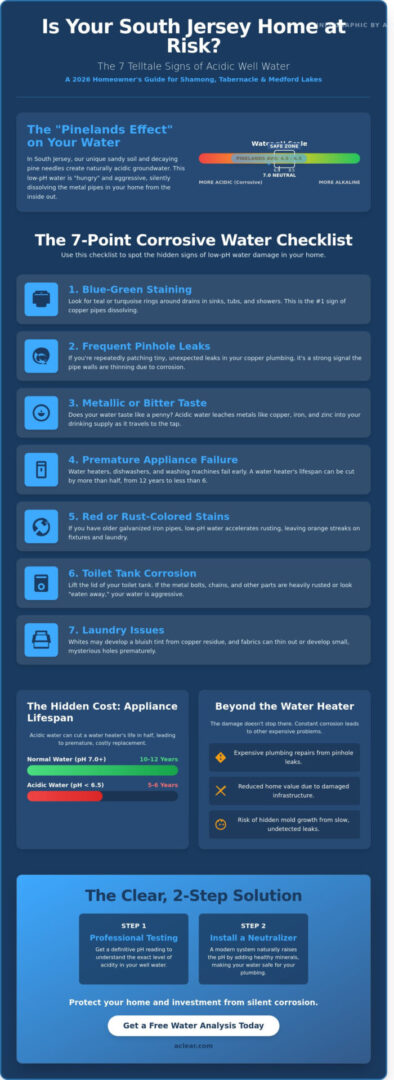
Your home often reveals its secrets through your fixtures and appliances. In South Jersey communities like Medford Lakes and Shamong, where private wells are standard, the signs of acidic water are frequently hidden in plain sight until a major repair is needed. Low pH water is aggressive; it doesn’t just sit in your pipes, it actively dissolves them from the inside out. Use this 2026 checklist to audit your home’s water health today.
- Blue-green staining: Look for teal or turquoise rings around the drains of your sinks, tubs, and showerheads. This is the primary indicator of copper pipe corrosion.
- Frequent pinhole leaks: If you’ve had to patch copper plumbing lines more than once in the last 24 months, your water’s acidity is likely thinning the pipe walls.
- Metallic or bitter taste: Your morning coffee shouldn’t taste like a penny. Acidic water picks up metals as it travels to your tap.
- Premature appliance failure: A standard water heater should last 10 to 12 years. If yours failed after just 5 or 6, acidity is the prime suspect.
- Red or rust-colored stains: If your home still uses older iron piping, low pH water will cause rapid oxidation, leaving orange streaks on your laundry and toilets.
- Toilet tank corrosion: Lift the lid of your toilet tank. If the metal flapper chains or bolts are covered in a heavy crust or look eaten away, your water is too acidic.
- Laundry issues: You might notice your white towels getting a strange blue tint or your favorite cotton shirts developing small holes and thinning fabric prematurely.
Identifying Blue-Green Stains
Those stubborn teal marks in your basin aren’t just an aesthetic nuisance. They’re actually liquefied bits of your own plumbing. When water pH drops below 7.0, it becomes solvent-like. To tell the difference between simple soap scum and acid damage, try the “swipe test.” Rub the stain with your finger. Soap scum feels slick and waxy. Acid-driven copper stains feel gritty or won’t budge at all without a chemical cleaner. If you’re seeing these marks, check out our guide on fixing blue-green stains in sinks to protect your plumbing infrastructure.
The Flavor Profile of Acidic Water
Low pH levels allow the water to leach metals from plumbing systems, which creates a sharp, metallic bite in every glass. This isn’t just about taste. This chemical reaction means you’re likely consuming trace amounts of copper or lead that have migrated from the pipes into your drinking water. You might also notice that the water feels “hard” or “sticky” on your skin and hair, leaving your hair feeling brittle or straw-like after a shower. If your water feels aggressive rather than refreshing, a professional water analysis can confirm your pH levels in minutes.
The Hidden Costs of Corrosive Water Damage
Don’t let a low pH level quietly drain your bank account. In Tabernacle and Shamong, homeowners often overlook the financial toll of corrosive water until a major repair hits. A standard electric water heater should last about 12 years. When your water is acidic, that lifespan often drops to just 5 years. You’re effectively doubling your long-term appliance costs while dealing with the stress of unexpected failures. This isn’t just a maintenance issue; it’s a direct hit to your home’s equity and your monthly budget.
Plumbing Erosion and Pinhole Leaks
Copper pipes are vulnerable to a chemical process called pitting. This happens when low pH water reacts with the metal, creating tiny, localized craters inside the pipe walls. ‘Acidic water acts as a slow-moving solvent, gradually thinning the walls of your plumbing until a breach occurs.’ Even if you’ve upgraded to PEX piping for your main lines, your brass fittings, shut-off valves, and high-end faucets remain at risk. In Medford Lakes, these pinhole leaks often hide behind drywall for months. By the time you see a damp spot, you’re likely facing a $3,000 mold remediation bill on top of the plumbing repair. Recognizing the signs of acidic water early prevents these structural disasters before they start.
Appliance Longevity and Efficiency
Modern high-efficiency appliances rely on delicate internal components that don’t play well with corrosion. Low pH water aggressively attacks the copper heating elements in your dishwasher and washing machine. This corrosion creates a layer of metallic debris that forces the heating elements to work harder, spiking your energy bills by up to 15 percent. It’s a common mistake to confuse this with hard water. While hard water leaves white crusty deposits, acidic water leaves blue-green stains and literally eats the metal away. Investing in a whole house water filtration system is a proactive lifestyle choice that protects your home’s infrastructure and ensures your appliances reach their full potential.
Beyond the house, you have to consider your family’s health. Corrosive water leaches heavy metals directly from your plumbing and into your glass. Long-term exposure to elevated copper levels can cause gastrointestinal distress, while lead exposure remains a serious concern for households with older soldering. Monitoring for the primary signs of acidic water is the first step toward a healthier, more confident home environment. It’s about more than just pipes; it’s about the quality of life you build inside your walls.
Testing Your Well Water in Tabernacle & Shamong
Testing your water shouldn’t feel like a science experiment. It’s a simple, proactive step toward a healthier home and total peace of mind. In South Jersey, the unique geology of the Pine Barrens often results in naturally low pH levels. If you’ve noticed the common signs of acidic water, such as blue-green staining on your fixtures or a metallic aftertaste, it’s time to move beyond guesswork.
Follow this streamlined 5-step process to get clear, actionable answers about your home’s health:
- Step 1: Perform a visual inspection of your faucets, showerheads, and toilet tanks for corrosion or staining.
- Step 2: Obtain a professional-grade water test kit or contact a local expert for a certified analysis.
- Step 3: Collect a first-draw sample, which is water that has sat in your pipes overnight for at least six hours.
- Step 4: Analyze the pH, Total Alkalinity, and Total Dissolved Solids (TDS) levels.
- Step 5: Consult with a South Jersey specialist to interpret the results and build a custom solution.
DIY Strips vs. Professional Laboratory Testing
Paper test strips are fine for a quick pool check, but they lack the precision required for your drinking water. Digital pH meters provide the accuracy well owners need to make informed decisions. Comprehensive well water testing is the only way to confirm if lead or copper is leaching into your supply. The NJ DEP Private Well Testing Act (PWTA) sets strict safety standards, and your results should be measured against these benchmarks to ensure your family’s safety.
Interpreting Your pH Results
A pH reading of 7.0 is neutral, but most well water in Shamong and Tabernacle falls below this mark. If your test returns a 5.5, your water is ten times more acidic than a 6.5 reading. This level of acidity is aggressive and will rapidly degrade copper pipes in homes built before the 1986 lead solder ban. You also need to monitor Total Alkalinity. This acts as a buffer, preventing your pH from swinging wildly. When alkalinity is below 30 ppm, your water is chemically unstable. If your pH is consistently below 6.5, you need immediate professional intervention to stop the damage before a pinhole leak occurs.
Professional Neutralization: The Permanent Fix
Living with the signs of acidic water doesn’t have to be a permanent reality for your home. While blue-green stains and pinhole leaks are frustrating, the solution is grounded in reliable chemistry. Professional grade acid neutralizers use a sacrificial media process to balance your pH levels. We typically utilize a blend of Calcite, a natural crushed marble, and Magnesium Oxide. As your acidic water passes through these minerals, they slowly dissolve into the stream. This raises the pH to a neutral 7.0 or higher, effectively stopping the corrosion of your copper pipes and fixtures before it starts.
Precision sizing is the most critical factor for homeowners in Tabernacle and Shamong. A system that’s too small won’t have enough contact time to neutralize the water during high-flow periods, such as when you’re running the dishwasher and the shower simultaneously. We calculate your specific flow rates, often ranging from 7 to 12 gallons per minute in local well systems, to ensure your neutralizer provides consistent protection. It’s about more than just “fixing” the water; it’s about engineering a system that fits your household’s specific rhythm.
How Acid Neutralizers Work
Modern neutralization systems are designed for your convenience. These automatic units feature digital control valves that manage backwashing cycles. This process flushes out trapped sediment and prevents the media from packing down. You’ll notice an immediate difference in your daily life. Your water will lose that sharp metallic tang, and your laundry will stay bright without the interference of dissolved copper. It’s a “set it and forget it” upgrade that protects your plumbing infrastructure and improves your overall water quality.
- Natural Balance: Calcite and Magnesium Oxide minerals dissolve only as much as needed to reach neutrality.
- Better Taste: Removing acidity eliminates the bitter, metallic flavor often found in South Jersey well water.
- System Longevity: Automatic backwashing keeps the media active and prevents flow restriction.
Choosing a Local Partner for Water Health
A Clear Alternative has served the Tri-State area since 1991. We’re a family-owned business that understands the unique geological makeup of Medford Lakes and the surrounding Pine Barrens. We don’t just sell equipment; we provide 24/7 emergency support because we know water issues don’t follow a 9-to-5 schedule. Maintenance is straightforward. We’ll help you stay on top of media refills, which typically occur every 6 to 12 months depending on your water usage and initial acidity levels.
Your home is your biggest investment. Don’t let low pH levels eat away at your pipes from the inside out. We’re here to provide the expertise and local knowledge required to keep your water safe and clear. Schedule your professional water analysis with A Clear Alternative today and take the first step toward a worry-free home.
Secure Your South Jersey Home Against Corrosive Damage
Your home’s plumbing system shouldn’t be a source of constant worry. Living in the South Jersey Pinelands means your well draws from unique soil chemistry that often leads to low pH levels. If you’ve noticed blue-green stains in your sinks or frequent pinhole leaks, you’re seeing the clear signs of acidic water that can destroy copper pipes and expensive appliances. These issues won’t disappear on their own; the long-term costs of total pipe replacement far outweigh the simple fix of a professional neutralization system.
A Clear Alternative has been family-owned since 1991, providing specialized expertise for Tabernacle, Shamong, and Medford Lakes residents. We understand the specific challenges of local well water and offer 24/7 emergency support to keep your household running smoothly. You don’t have to guess about your water quality or wait for a major leak to take action. Professional testing gives you the data you need to protect your investment and your peace of mind. It’s time to enjoy the clear, balanced water your family deserves.
Protect your home from acidic water—contact A Clear Alternative for expert testing today!
Frequently Asked Questions
Is it safe to drink acidic well water?
It’s generally safe to drink water with a low pH, but the real danger comes from what that water pulls out of your plumbing. Acidic water leaches heavy metals like lead and copper from your pipes. According to the EPA, water below a 6.5 pH level can cause health issues over long periods. You deserve water that supports your health and lifestyle without hidden risks.
Can acidic water cause pinhole leaks in my pipes?
Yes, acidic water is a leading cause of pinhole leaks because it eats away at copper piping from the inside out. This corrosion thins the pipe walls until tiny holes appear. You’ll often see these leaks in Tabernacle homes built before 1986 when copper was the standard. Fixing the water chemistry protects your home’s infrastructure and prevents expensive emergency repairs.
Why does my water leave blue-green stains in the sink?
Blue-green stains are clear signs of acidic water reacting with your copper plumbing. When water with a pH below 7.0 sits in your pipes, it dissolves the metal and leaves colorful deposits on your fixtures. These stains aren’t just an aesthetic problem; they indicate your pipes are literally dissolving. Modern filtration restores your fixtures to their original, pristine condition and protects your home’s beauty.
Does a water softener fix acidic water?
A standard water softener won’t fix acidic water because it’s designed to remove hardness minerals like calcium, not raise pH levels. You need a dedicated acid neutralizer, typically using calcite or magnesium oxide, to balance the water. Think of it as a specialized tool for a specific job. Combining both systems ensures your water is both soft and pH-balanced for a premium home experience.
How much does an acid neutralizer system cost to maintain?
Maintaining an acid neutralizer involves replenishing the neutralizing media once or twice per year depending on your water usage. Most homeowners in Shamong schedule a professional service call every 6 to 12 months to ensure the system operates at peak efficiency. Regular maintenance prevents the pH from dropping back into the corrosive range. It’s a simple, proactive step to keep your water crystal clear and safe.
How often should I test the pH of my well water in South Jersey?
You should test your well water pH at least once every 12 months to track changes in the local aquifer. This helps you identify the signs of acidic water before they cause permanent damage to your home. The New Jersey Private Well Testing Act requires testing during real estate transfers, but annual checks are the gold standard for ongoing safety and peace of mind.
Can acidic water damage my skin and hair?
Acidic water often leaves your skin feeling dry and your hair looking brittle or dull. Low pH water strips away natural oils, which can lead to irritation or even worsen conditions like eczema. Switching to balanced water feels like a luxury spa treatment every time you shower. It’s a simple lifestyle upgrade that boosts your confidence and simplifies your daily beauty routine without extra products.
What is the ideal pH level for home well water?
The ideal pH level for your home’s well water is between 6.5 and 8.5, according to EPA National Secondary Drinking Water Regulations. Staying within this range prevents the common signs of corrosion like metallic tastes or pipe damage. Achieving this balance gives you peace of mind and protects your home’s value. It’s the foundation of a modern, healthy household in Medford Lakes.